A product recommendation quiz asks every shopper the same fixed questions and maps the answers to a result. An AI product finder asks follow-up questions in a conversation and recommends from your live catalog. Quizzes win on short catalogs and email capture. AI finders win when shoppers describe needs in their own words or your catalog runs to hundreds of variants.
We compared these six tools: Zipchat, Octane AI, RevenueHunt, Jebbit (now BlueConic Experiences), Typeform, and Rep AI. Prices and ratings come from each vendor’s Shopify App Store listing or pricing page as of November 2026.
What is a product recommendation quiz, and when does it work well?
A product recommendation quiz is a short, fixed set of questions with set answer buttons. Each answer path leads to a results page with one or a few products. You build the logic once, and every shopper walks the same tree. A skincare quiz is the classic example.
Quizzes work best in three situations:
- The decision rests on a few known attributes. Skin type, hair goal, coffee roast, dog size, or health goals for supplements. Five questions cover it.
- The catalog is small and stable. Ten to fifty hero products means a results page per outcome is easy to maintain.
- You want email or SMS sign-ups. A quiz can ask for an email before it shows results, and every answer becomes a profile property for segmentation.
That third point is where quizzes beat almost everything else. A shopper who tells you “dry skin, sensitive, fragrance-free” has handed you zero-party data you can use in every email that follows.
Personalized recommendations that fit also build loyalty. The product doesn’t come back as a return, and the shopper comes back for the next order.
The weakness is the fixed path. A shopper whose real answer is “combination skin, but only in winter” has no button to press. And once the quiz ends, it can’t answer “is this safe with retinol?”
What is an AI product finder, and how is a conversation different from a fixed quiz?
An AI product finder is an assistant that asks questions in plain language, reads free-text answers, and recommends from your catalog. Some stores call it a product finder quiz, but there’s no fixed path.
It decides what to ask next based on what the shopper has already said. When the shopper names a product, it skips the questions and answers.
The demand for this is bigger than most stores assume. Zipchat Labs analyzed 4.2 million shopper conversations from November 2025 to October 2026. Among typed pre-purchase conversations, 35.4% started with no product in mind (Zipchat Labs Study 001, November 2026).
Most of those shoppers still gave a constraint, like a budget, a skin type, or a car model. That covered 24.8% of typed pre-purchase conversations. Those shoppers are ready for a recommendation if someone asks them one good question.
| Product recommendation quiz | AI product finder |
|---|
| Question path | Fixed tree you build in advance | Chosen per shopper, based on earlier answers |
| Shopper input | Buttons and images | Free text, buttons or a photo |
| Follow-up questions after the result | Not possible | Answered in the same conversation |
| Product data | Mapped to outcomes by hand or by tags | Read from the live catalog |
| Out-of-stock items | Shown unless you update the logic | Skipped or swapped, depending on setup |
| Email capture | Built in, before or after results | Possible, but not the main job |
| Where it lives | A quiz page or pop-up | Chat, search bar and product pages |
| Upkeep | Rebuild paths when the catalog changes | Keep product data complete |
Neither format is smarter by default. Both improve product discovery, for different shoppers.
A quiz is a decision tree you control. An AI finder is a conversation you instruct. The right pick depends on your catalog, which we cover after the tool list.
Best product quiz apps and AI product finders for Shopify compared
| Tool | Type | Starting price | Shopify App Store rating | Best for |
|---|
| Zipchat | AI product finder in chat, search and product pages | $64/month | 4.9 | Large or variant-heavy catalogs and shoppers with no product in mind |
| Octane AI | Quiz builder with AI features | $43/month | 4.7 | Beauty and wellness brands that run on Klaviyo |
| RevenueHunt | Quiz builder | Free up to 100 responses a month, then $31/month | 4.9 | Budget-conscious stores and multi-language quizzes |
| Jebbit (BlueConic Experiences) | Enterprise quiz and product finder platform | Quote only | Not listed | Enterprise brands feeding a customer data platform |
| Typeform with Shopify | General form and quiz builder | $28month | Not listed | Simple quizzes that live outside the store |
| Rep AI | AI sales and support chat | $29/month | 4.6 | Stores that want an AI sales chat priced by traffic |
The second column matters most. Three tools are quiz builders, one is a general form tool, and two are AI assistants that recommend in conversation.
These are the six tools merchants name most often when they ask Zipchat about guiding shoppers to the right product. We scored each one on five questions:
- Catalog connection. Does it read live Shopify product and stock data, or do you map products by hand?
- Shopper input. Buttons only, or free text and photos too?
- Follow-ups. Can the shopper ask a question after the recommendation?
- Data capture. Does it collect emails and sync answers to your email tool?
- Pricing model. Flat plan, responses, sessions, or AI replies?
We didn’t score visual design. Every quiz builder here can match your brand with enough CSS.
1. Zipchat: best AI product finder for large and variant-heavy catalogs
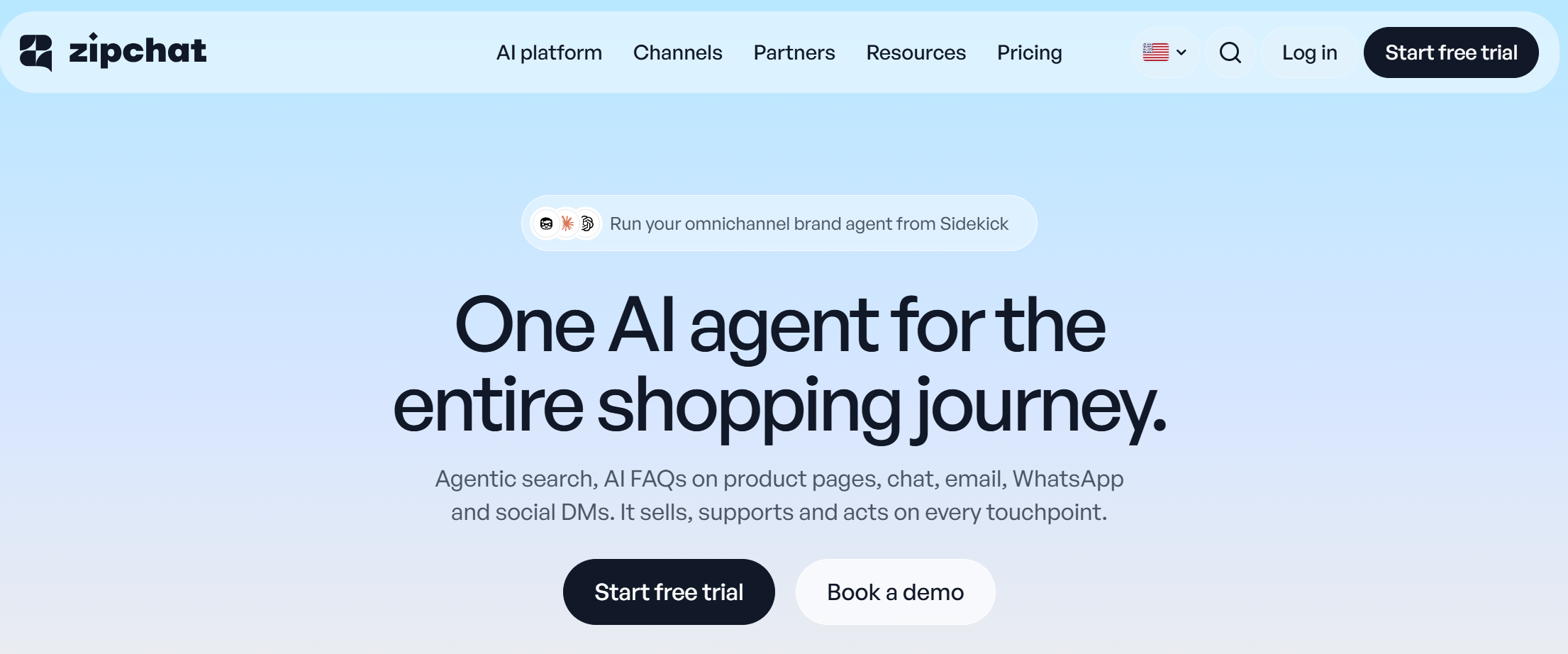
Zipchat is an AI agent that recommends products in chat, in the search bar, and in questions on product pages. It doesn’t follow a fixed question path. It asks follow-up questions to understand what the shopper needs, then recommends from your live catalog.
Here’s what that looks like with a shopper who doesn’t know the product name (illustrative, not a real customer):
Shopper: need something for my kid’s room, it gets cold at night
AI agent: Happy to help. Are you after bedding, like a duvet or blanket, or a heater?
Shopper: blanket, she’s 6
AI agent: Then two fit. The merino kids’ blanket is the warmest and machine washable. The cotton waffle blanket is lighter if she runs hot under a duvet. Both come in single size.
How it works on Shopify
- Live catalog data. Recommendations come from your product data, so new products are included once the catalog syncs.
- Out-of-stock handling. You choose whether the agent ignores out-of-stock products or detects stock status from a keyphrase, so shoppers get an alternative instead of a dead end.
- Variant narrowing. The agent asks about size, color, or compatibility before it recommends.
- Three entry points. The same agent recommends in website chat, in Zipchat AI Search, and in AI product questions on product pages.
- Photo matching. A shopper can send a photo, and the agent recommends matching products from your catalog.
Twitter Bike USA, which sells high-end e-mountain bikes, estimates its AI recommends the right product more than 90% of the time (Twitter Bike USA success story).
AI chat can lift conversion for some stores, especially when the assistant can act. In the Zipchat Labs study, pre-purchase conversations with a custom skill action, like a stock or fitment lookup, converted at 1.39 times the store average (Zipchat Labs Study 001).
Pricing. Plans start at $64/month for 750 AI replies, with a 7-day free trial and a 30-day money-back guarantee (Zipchat pricing, assessed November 27, 2026).
Pros
- Handles free-text needs, follow-up questions, and support questions in one conversation.
- No question tree to rebuild when the catalog changes.
- Built-in A/B test that splits visitors 50/50 and compares revenue.
Cons
- No branded quiz results page. If the page itself is part of your brand, a quiz builder does that better.
- Email capture isn’t the main job.
- Plans are sized by AI replies, so long discovery conversations use more of the monthly allowance.
Best for: stores with hundreds of products or many variants, and shoppers who type what they need instead of a product name. See how it works on our AI product discovery page.
2. Octane AI: best Shopify product quiz app for beauty and Klaviyo stores
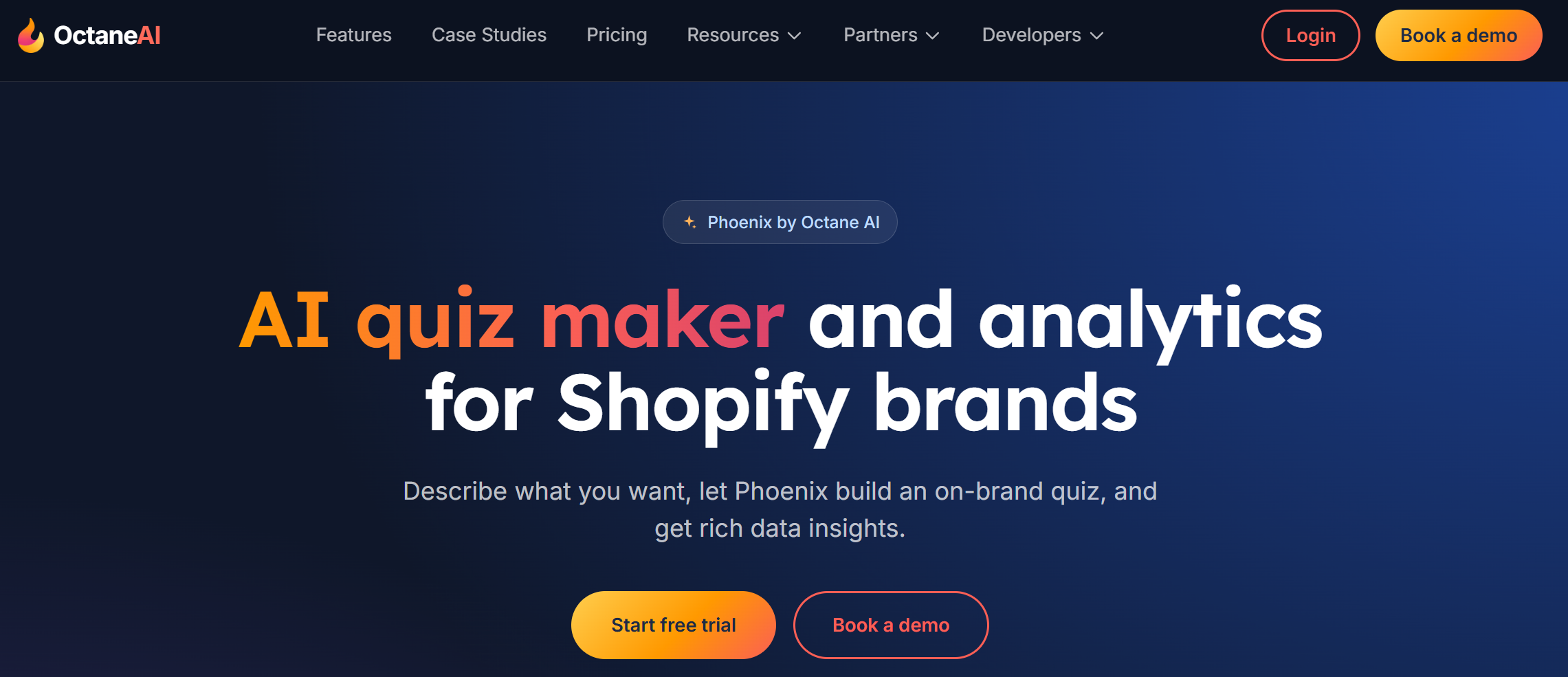
Octane AI is a dedicated quiz builder for Shopify and one of the longest-running, listed since 2018. Its AI builder, Phoenix, builds a quiz from a description of what you want and your Shopify catalog. It then checks the logic for dead ends.
Key features
- AI quiz builder that writes questions, logic, and a results page explaining each pick.
- Flags dead ends and out-of-stock products before shoppers hit them.
- Image Analysis: shoppers answer with a photo, and AI picks products.
- Answers sync to Klaviyo, Attentive, and Postscript as zero-party data.
Pricing. Basic is $43/month with 400 credits and two quizzes. Plus is $170/month with 2,200 credits, unlimited quizzes, and A/B testing. Enterprise starts at $425/month. One credit equals one quiz start, and AI features use extra credits. There is no free tier, and every plan has a 14-day trial.
Pros
- Deep Klaviyo and SMS sync for personalized follow-up flows.
- Analytics show revenue and conversion for each answer.
Cons
- Basic allows only two quizzes, and A/B testing starts on Plus.
- Credits count quiz starts, so high traffic to a quiz pop-up raises the bill.
Best for: beauty, skincare, and wellness brands that run their retention on Klaviyo.
3. RevenueHunt: best value Shopify product quiz app
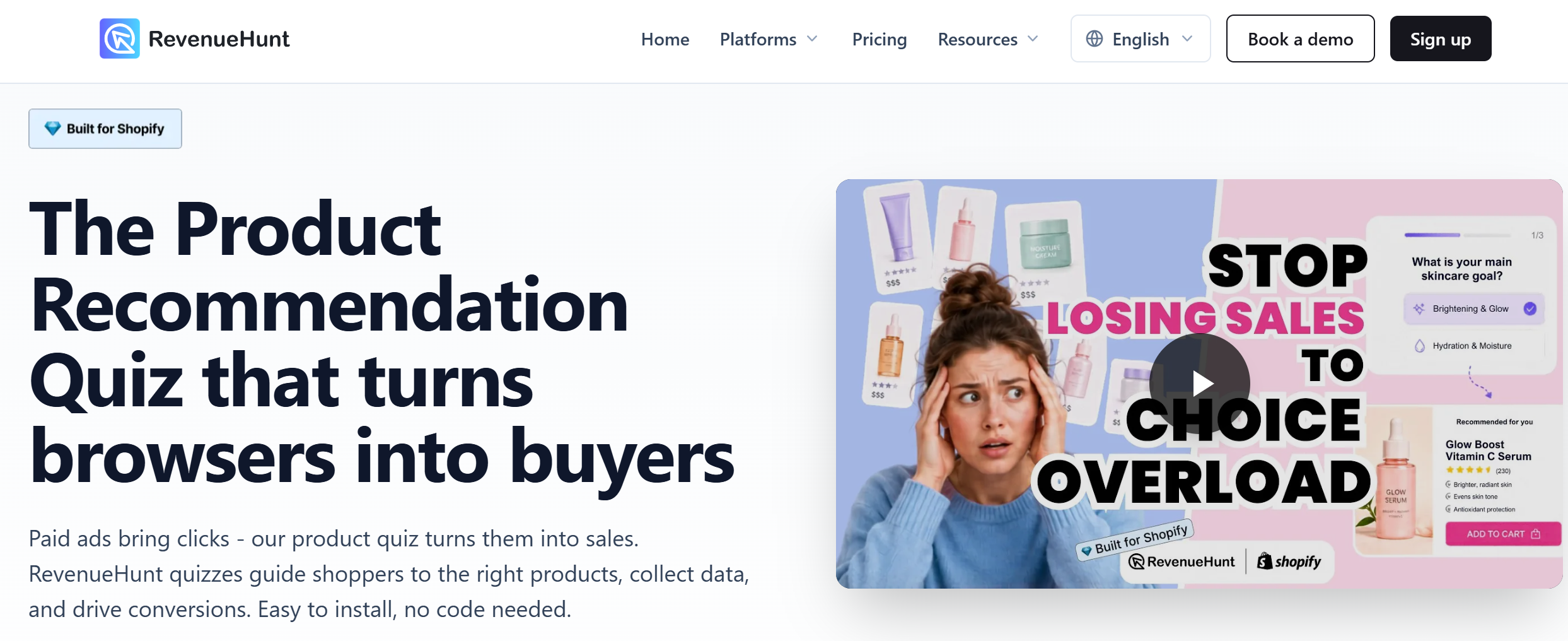
RevenueHunt is a quiz builder with the most reviews in this list and a free plan that’s usable for small stores. It has been on the Shopify App Store since 2019 and supports Shopify Markets.
Key features
- Unlimited quizzes on every plan, with conditional logic.
- Quiz Copilot, an AI assistant that helps build quizzes.
- Shopify Markets support, with quizzes in 12 languages.
- Sync to Klaviyo, Omnisend, Zapier, and webhooks on paid plans.
Pricing. Free covers up to 100 quiz responses a month. Basic is $31/month for 500 responses, Pro is $79/month for 1,000, and Premium is $159/month for 2,500. Paid plans have a 15-day trial.
Pros
- The cheapest way to test a quiz on real traffic.
- 4.9 on the Shopify App Store from 468 reviews, with support praised often.
Cons
- Email and Klaviyo sync need a paid plan.
- Pricing scales by responses, so a popular quiz moves you up a tier.
Best for: stores testing their first quiz, and brands selling in several languages.
4. Jebbit (BlueConic Experiences): best for enterprise first-party data
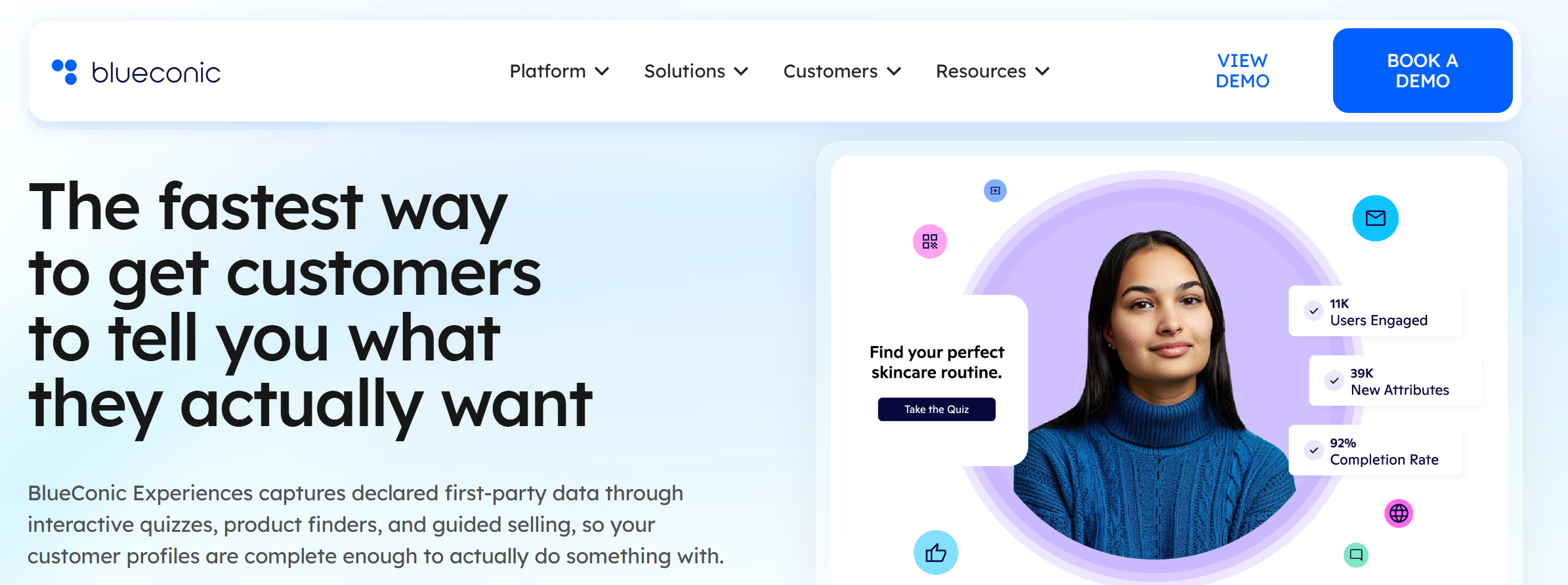
Jebbit is now BlueConic Experiences, part of the BlueConic customer data platform. It builds quizzes, product finders, and preference flows for large retail and consumer brands.
Key features
- Quizzes, product finders, and guided selling flows.
- An AI Builder Agent that drafts an experience from a plain-language request.
- Answers sync to customer profiles in real time, then to ESPs, CRMs, and ad platforms.
- Runs across web, email, paid media, and in-app.
Pricing. Quote only. BlueConic shows no public pricing, and requests go through a demo.
Pros
- Built for teams that want quiz answers in a central customer profile.
- BlueConic reports a 62% conversion lift for Free People’s Denim Finder (vendor case study).
Cons
- Sized and priced for enterprise, not for a typical Shopify store.
- Moving inside BlueConic makes it a bigger buying decision than a quiz app.
Best for: enterprise brands that already run, or plan to run, a customer data platform.
Typeform is a general form builder with strong quiz design. It isn’t built for Shopify. Its Shopify integration page lists Zapier connections that turn responses into Shopify orders or product listings.
Key features
- Unlimited Typeforms with conditional logic and AI-assisted form creation.
- Picture choices and video questions.
- Webhooks and integrations, including Klaviyo through Typeform’s connectors.
- Drop-off rates and conversion tracking on Business.
Pricing. Basic is $28/month for 100 responses. Plus is $56/month for 1,000 responses, and Business is $91/month for 10,000, all billed yearly.
Pros
- Polished, flexible design for any question type.
- Useful beyond product finding, for surveys and feedback.
Cons
- No live catalog sync, so you link results to products by hand and update them yourself.
- Out-of-stock products stay in results until someone edits the form.
Best for: a quiz that runs in ads, emails, or landing pages, where the catalog link is simple.
6. Rep AI: best AI sales chat priced by traffic
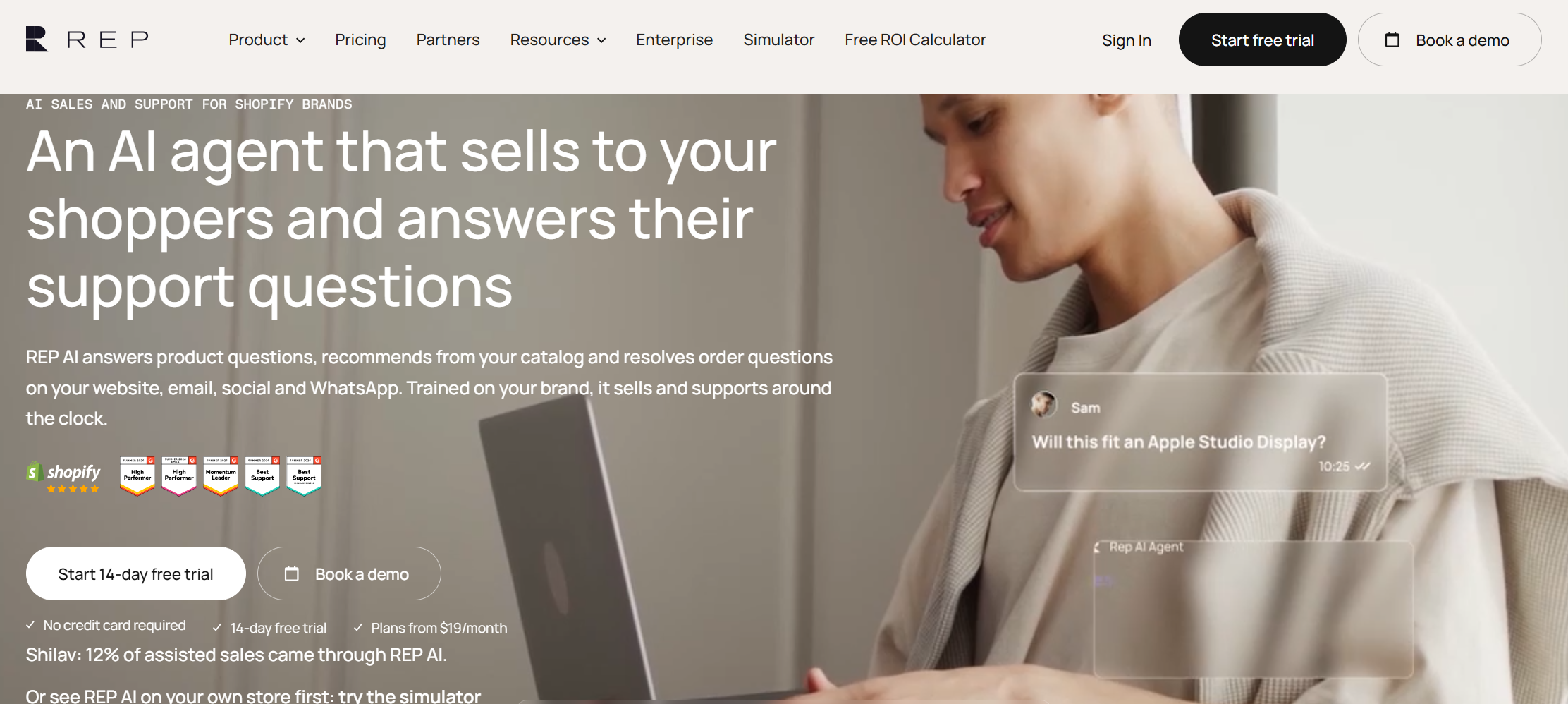
Rep AI is an AI sales and support agent for Shopify. Like Zipchat, it recommends from the live catalog in conversation rather than through a fixed quiz.
Key features
- Starts a chat when a shopper hesitates, based on behavior.
- Recommends from the live catalog, upsells, and edits the cart in chat.
- Tap-to-ask questions on product pages.
- Support for order status, returns, and cancellations, with a helpdesk inbox.
Pricing. Sales is $29/month, Support is $15/month, and Concierge, which combines both, is $37/month. Each covers up to 3,000 sessions a month, with a 14-day trial.
Pros
- Session pricing is easy to predict for low-traffic stores.
- Sales and support in one agent on the Concierge plan.
Cons
- Priced by sessions, so busy stores pay for every visit, not only conversations.
- The Shopify App Store listing shows English as the listed language.
Best for: Shopify stores that want an AI sales chat and price by traffic. We compare the two on our Rep AI alternative page.
Which one fits your catalog: a few hero products or hundreds of variants?
Catalog shape decides this more than any feature list. A quiz has to map every answer path to a product. That’s easy with ten products and painful with ten thousand.
An AI product finder searches the whole catalog for each question instead, so a bigger catalog doesn’t mean more paths to maintain.
| If your store… | Pick | Why |
|---|
| Sells fewer than 30 products, decided by 3 to 5 attributes | Quiz | Every path fits on one page, and results stay accurate |
| Needs email sign-ups more than an instant sale | Quiz | Answers become profile properties for segmentation |
| Has hundreds of products or many sizes and colors | AI product finder | No tree to rebuild, and it reads live variant data |
| Gets questions like “will this fit my car?” | AI product finder | Fit and compatibility need follow-up questions |
| Sells out often or rotates stock weekly | AI product finder | Out-of-stock products are skipped or swapped |
| Has both a hero range and a deep catalog | Both | Quiz on the hero range, AI finder everywhere else |
The 30-product line is a starting point, not a rule. A store with 200 products in one simple category can still run a good quiz. Count the answer paths, not the SKUs.
Here’s a quick test. Write down every outcome your quiz would need. If the list is longer than 15 results pages, or changes every month, the upkeep will outgrow the benefit.
Can you use a product quiz and an AI product finder together?
Yes, and many stores should. The two tools catch different shoppers at different moments. A quiz pulls in shoppers who want to be guided step by step. An AI finder catches the ones who’d rather type a sentence.
| Place on the site | Best tool | What it does there |
|---|
| Homepage hero or collection banner | Quiz | ”Find your routine” entry for browsers |
| Email and paid ads | Quiz | Lead capture before the shopper reaches the store |
| Search bar | AI product finder | Turns “gift for a 6-year-old who likes science” into a shortlist |
| Product pages | AI product finder | Answers “is this the right size for me?” next to the buy button |
| Chat, any page | AI product finder | Picks up shoppers who opened chat with no product in mind |
Quiz answer buttons are easy to tap on a phone, which makes a quiz a good landing spot for ad traffic. Test every quiz on a phone before launch.
Search deserves extra attention. In the Zipchat Labs study, 68.4% of typed AI search queries carried no product, and the median query was two words (Zipchat Labs Study 001). AI product search turns those two words into a shortlist instead of a list of keyword matches.
There’s one rule for running both. Keep them consistent. If the quiz says “dry skin” leads to Serum A, the AI finder should give the same answer for the same need.
How to build a product finder for your store
Pick the format after you’ve done the groundwork, not before. These steps work for a quiz, an AI finder, or both.
- List the questions shoppers ask. Pull 30 pre-sale questions from your inbox and chat logs. Mark the ones that start with “which” or “what should I get”.
- Find the deciding attributes. For each category, write the three to five attributes that decide the choice, like skin type, size, or compatibility.
- Fill the product data. Make sure every product has those attributes in its title, description, tags, or metafields. Missing data breaks quizzes and AI finders alike.
- Choose the format per category. Use the table above. Small, stable ranges get a quiz. Deep or fast-changing ranges get an AI finder.
- Write the questions in order. Ask your best salesperson which two or three questions they’d ask first. Use the same order in the quiz or in the AI agent’s instructions.
- Test with real questions. Run your 30 inbox questions through it. Check that each answer recommends what your team would.
- Measure with a split. Compare conversion and return rate between pages with and without the finder for four weeks.
The same study adds a reason to keep the conversation going. Shoppers who sent five or more messages bought in 12.6% of conversations, against 6.6% for a single message (Zipchat Labs Study 001). For the wider picture of how quizzes fit with search and chat, see our guide to product discovery patterns.
When neither a quiz nor an AI product finder will help
Some stores don’t need a product finder at all. Adding one there costs money and slows shoppers down.
- Low-price, low-risk products. Nobody wants three questions before buying socks. Clear filters and a fast checkout do more.
- Repeat buyers reordering a known item. They know the product. Put reorder links in email instead.
- Thin product data. If descriptions are two lines long, a quiz maps to guesses and an AI finder recommends from guesses. Fix the data first.
- Choices that need a professional. Prescription eyewear or medical devices need a qualified person, not a quiz result.
If behavior-based picks like “customers also bought” are what you’re after, that’s a different tool. Our roundup of AI product recommendation apps for Shopify covers those.
Where product finders are heading in 2026
The line between quiz and chat is fading. Octane AI and RevenueHunt now ship AI builders and photo answers. Rep AI and Zipchat recommend in chat, search, and product pages. Each side is borrowing from the other.
Business leaders expect AI to drive this. In Twilio Segment’s 2024 State of Personalization report, 89% of decision-makers said AI-driven personalization will be critical to their success over the next three years (Twilio, June 2024).
The bigger change is where the conversation starts. More shoppers ask general AI assistants for advice before they reach a store. By the time they land, they ask narrow questions: does this fit, which size, is it in stock?
A fixed quiz path rarely covers those, which is why AI product recommendations built on live catalog data are spreading to every entry point.
Frequently asked questions
What is a product recommendation quiz?
A product recommendation quiz is a short set of fixed questions that leads shoppers to a matching product. Each answer path maps to a results page. Quizzes suit small catalogs defined by a few attributes, like skin type, and they double as an email capture tool for later marketing.
Do product quizzes increase conversion?
They can, when the choice is hard and the catalog fits the quiz. Vendors report large lifts, such as BlueConic’s 62% for Free People’s Denim Finder. Those are vendor case studies, so test your own quiz against a control group of product pages for four weeks.
What is an AI product finder?
An AI product finder is an assistant that recommends products through a conversation. It asks follow-up questions, reads free-text answers, and recommends from your live catalog. Unlike a quiz, it handles questions after the recommendation, such as sizing, compatibility, or stock, in the same conversation.
What is the best product quiz app for Shopify?
RevenueHunt is the best value, with a free plan and a 4.9 rating from 468 reviews. Octane AI is the strongest choice for Klaviyo-driven beauty and wellness brands. Enterprise brands with a customer data platform should look at BlueConic Experiences, formerly Jebbit.
Can AI recommend products without a quiz?
Yes. An AI product finder asks one or two questions in chat or search, then recommends from your catalog. It skips the questions when the shopper names a product. Zipchat, for example, recommends in chat, AI search, and product-page questions without a fixed question path.
How do I build a product finder for my store?
Start with the questions shoppers ask before buying. List the three to five attributes that decide each category, and fill them in on every product. Use a quiz for small, stable ranges and an AI finder for deep catalogs. Then test with real questions and measure.
Our pick for helping shoppers choose
If you sell a short range decided by a few attributes and want email sign-ups, start with a quiz. RevenueHunt is the cheapest way to test one, and Octane AI is the strongest for Klaviyo brands. If your catalog is deep, variant-heavy, or always changing, or your shoppers type what they need, an AI product finder fits better.
Zipchat asks the follow-up questions, recommends from your live catalog, and runs in chat, search, and product pages. See how it works on our AI product discovery page, or start a 7-day free trial and test it on one category first.


 Website chat Turns browsers into buyers on every page.
 WhatsApp Sell on the app your customers read.
 Instagram Answers every DM in seconds.
 Messenger Turns Facebook ad questions into sales.
 Email Answers every email in the same thread.