
The short version
AI product recommendation apps surface personalized products to Shopify shoppers using behavior, purchase, and attribute data. Per a Barilliance study, they drive 12% to 31% of ecommerce revenue in recommendation-engaged sessions. As a conservative, store-wide anchor, McKinsey puts the revenue lift from personalization at 5% to 15%, higher for the leaders.
This guide compares eight apps (Maestra, Zipchat, LimeSpot, Rebuy, Wiser, Glood, AiTrillion, Nosto), with Maestra ranking highest for mid-market and enterprise omnichannel use cases.
Top AI Product Recommendation Apps for Shopify Stores
| | | | |
|---|
| App | Rating / reviews | Best for | Core strength | Starting price |
| Maestra | Not on Shopify App Store | Shopify merchants who want recommendations with omnichannel communications, on-site personalization, loyalty and referral programs in one platform | 14 AI-driven recommendation algorithms, personalization across all channels powered by a real-time CDP, a dedicated forward deployed marketer | From $2,990/mo, all-inclusive pricing |
| Zipchat | 4.8 / ~152 | Stores that want AI recommendations delivered in a conversation across every channel | Conversational, intent-based recommendations (chat, WhatsApp, Instagram, email) that read the live catalog and can act | $80/mo (7-day trial) |
| LimeSpot | 4.7 / ~500+ | Mid-market stores wanting personalization across full catalog | 12+ recommendation types, multi-channel (email + SMS + ads) | From $50/mo (revenue-based) |
| Rebuy | 4.7 / ~824 | Shopify Plus brands optimizing checkout and post-purchase | Smart Cart, native checkout extensions, post-purchase upsells | From $25/mo per package (only checkout post-purchase) + $0.10/order |
| Wiser | 4.9 / ~531 | Stores with 0 to 100 orders/month or Enterprise volume | ”Frequently Bought Together,” product quizzes, free tier under 100 orders | Free / Enterprise (custom) |
| Glood | 4.7 / ~115 | Stores wanting hybrid AI + manual rule control | 12 recommendation types + visual editor + rule overrides | From $19.99/mo |
| AiTrillion | 4.8 / ~258 | Stores consolidating loyalty, email, recommendations into one tool | All-in-one platform with cross-channel triggers | From $19/mo |
| Nosto | 4.8 / ~60 | Enterprise brands across Shopify, Magento, Adobe Commerce, BigCommerce | 4 AI types (Predictive, Semantic, Visual, Generative) | Custom pricing: revenue-based license + modules� |
1. Maestra: Journey-Wide Personalization Driven by a Real-Time CDP
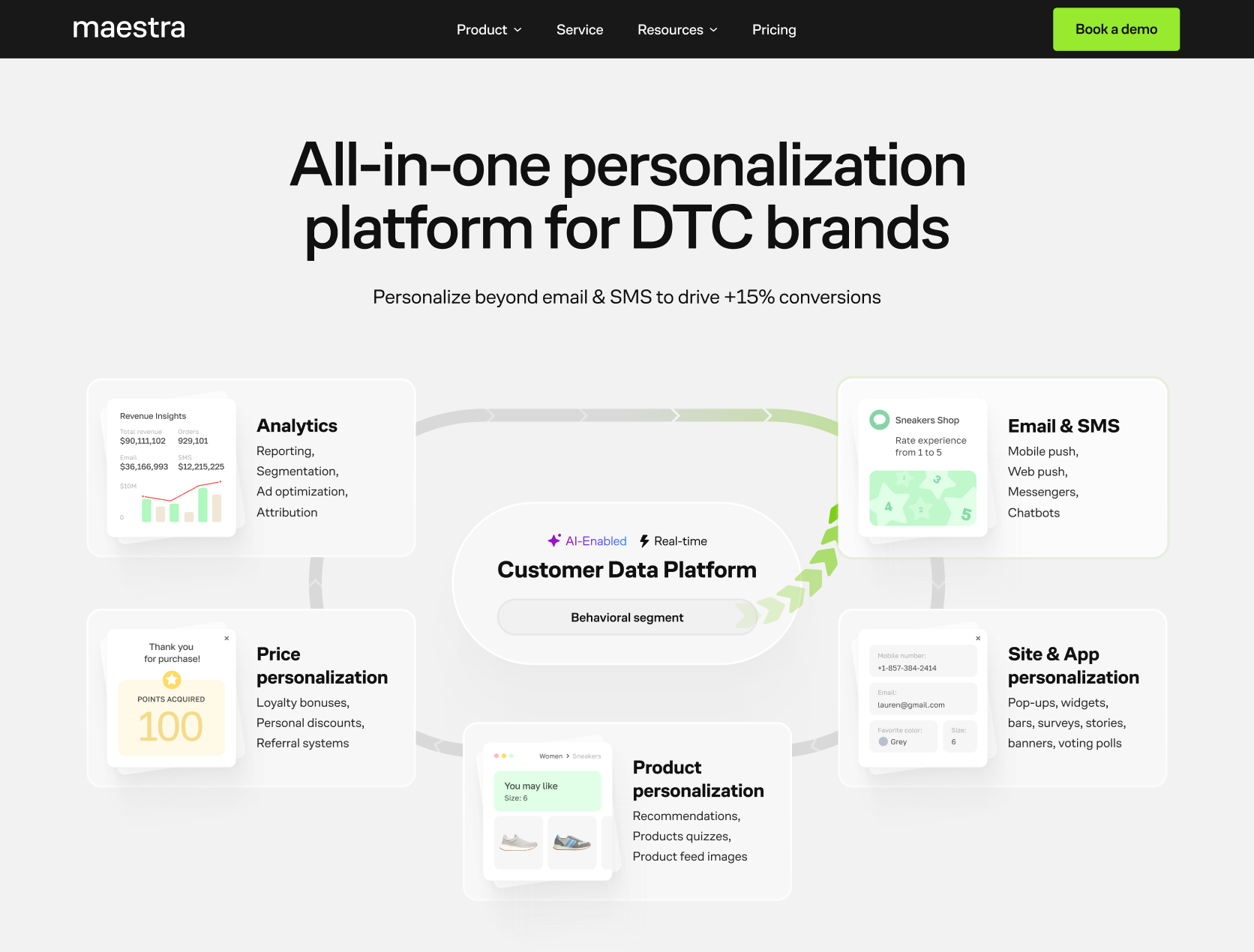
Maestra is an all-in-one personalization platform built around a real-time customer data platform (CDP). Recommendations run on top of unified profiles that update instantly. The same data that powers the recommendation engine also drives email, SMS, popups, loyalty programs, and dynamic ads. Recommendations aren’t a standalone widget; they’re one of ten coordinated products on a single platform.
What Maestra does
14 AI recommendation algorithms, including Bestsellers, Similar Products, Frequently Bought Together, Recently Viewed, Personalized Post-Purchase Picks, and Event-Based Personal Recommendations. Swimwear and athletic apparel brand JOLYN saw 7% of total sales influenced by AI recommendations across product pages, cart, and email.
Business rule overlays. Teams can layer manual logic on top of AI (exclude specific SKUs, prioritize high-margin products, pin seasonal items, or match products by color, style, or price) without losing AI personalization underneath. Tactical gear brand Defense Mechanisms hit 8.9% of sales influenced by recommendations that adapt to both customer behavior and the brand’s merchandising rules.
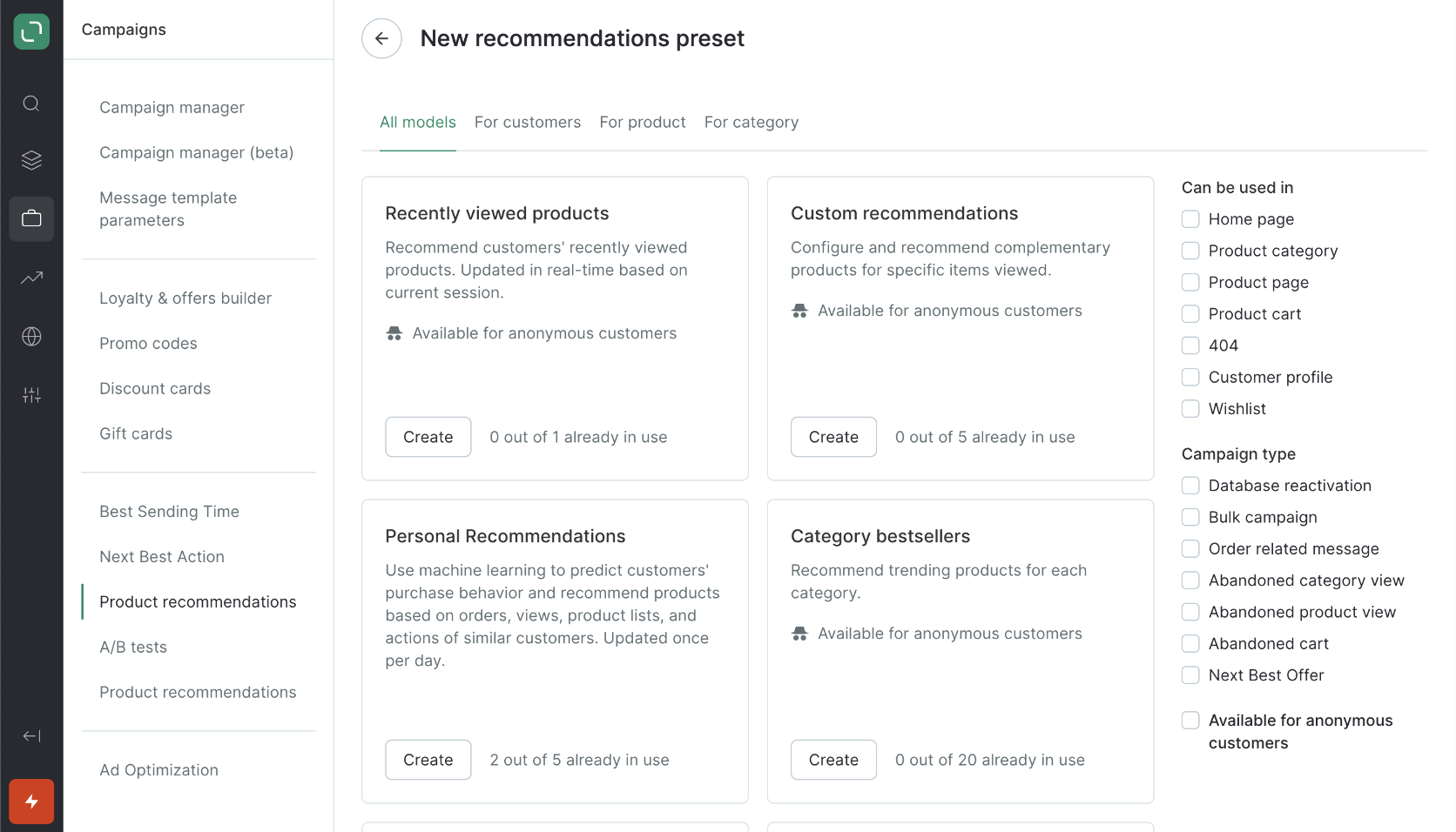
Maestra’s recommendation presets
Real-time CDP. Every recommendation spot reacts to what the customer did moments ago and becomes more relevant with every click. Picks align on color, size, material, and purchase patterns, so when a customer views a green bikini top, the site surfaces matching bottoms in the same size, fabric, and cut. Suggestions are always inventory- and region-aware. Out-of-stock items never get recommended. Sizes and regional availability are respected automatically. No manual rules required.
On-site personalization. Embedded recommendation blocks, product-picking quizzes that guide customers to the right product and capture zero-party data along the way, and product bundles with one-click “Add All” buttons. Creative gift brand Blue Q saw 28.7% higher AOV and 45.3% more items per order from shoppers who engaged with product recommendations. “Often Bought With” bundles drive 40% of recommendation-influenced revenue. Maestra also offers popups, banners, upsell bars, social proof widgets, stories, polls, surveys, games, and more, all with in-session segmentation, frequency control, and prioritization rules so customers don’t get hit with five overlays at once.
Omnichannel messaging. The same recommendation engine feeds dynamic product cards for email, generates personalized picks for MMS, RCS, chatbots, or messengers like WhatsApp, and surfaces relevant items in web and mobile push notifications. The real-time CDP ensures prices and inventory in email recommendation blocks are always current, even after sending. Maestra also supports SMS, paid media, push notifications, and any other channels a brand wants to add.
Loyalty programs and promotions. Tiered points, gamification, a promo code engine, referral programs, gift card management, customizable strategies, and POS processing, all native, not bolted on. Loyalty programs and recommendations can run in the same flow. For example, a customer whose points are about to expire can get an email reminder with personalized recommendations on which products to spend them on, based on what they’ve been browsing or have previously bought.
Built-in A/B testing with incremental revenue impact. Run tests across recommendation algorithms, placements, and creatives (layout, copy, design) to find what converts best. Then run control-group tests to measure the incremental revenue lift recommendations help to generate. The same A/B testing extends to email, SMS, popups, promotions, and rewards.
A forward-deployed marketer for each account: Maestra ships with a customer success specialist included in every subscription. Not a tier, not an add-on. Your forward-deployed marketer responds in a shared Slack or Teams channel, runs weekly Zoom strategy sessions, and treats your Shopify store as their own: handles the migration and setups, maps the strategy, builds segments, designs flows, and connects recommendations to them, launches campaigns, adjusts recommendation logic, and executes A/B tests.
Best for
Mid-market and enterprise Shopify brands that want recommendations as part of a broader personalization program, not as a standalone widget. Especially strong for brands with complex catalogs (apparel with size/color variants, sporting goods, beauty) where attribute-matching matters.
What to consider
Maestra is out of reach for early-stage stores or brands processing fewer than a few hundred orders per month. The platform is deep (clients typically run dozens of automated flows alongside recommendations), so there’s a ramp-up period even with a forward-deployed marketer. If you only need a recommendation widget without the rest of the stack (email, SMS, loyalty, popups), Maestra is overkill.
Maestra pricing
From $2,990/month for 150,000 active customer profiles. All features are included on every plan. No feature gating between recommendations and other modules. Month-to-month billing, no annual contracts. Migration is fully managed at no additional cost; billing starts only after go-live.
2. Zipchat: AI recommendations delivered in a conversation
Zipchat is different from the on-page widget engines in this list. Instead of rendering a “you may also like” grid on the page, Zipchat recommends products inside an AI conversation. It reads the live product catalog and recommends based on what the shopper actually says, then answers follow-up questions and can complete the action, across website chat, WhatsApp, Instagram, Messenger, and email.
What Zipchat does
Stated-need recommendations. The shopper describes a goal (“a fragrance-free moisturizer for oily skin under $40”) and the AI returns matched products with reasons, using Agentic AI Search over the live catalog.
Attribute-aware matching. Size, color, material, and compatibility are read from the catalog, so suggestions respect fit and variants, and out-of-stock items are excluded automatically.
Cart- and browsing-aware suggestions. Cross-sell and upsell based on what is in the cart and what the shopper viewed.
Proactive recommendations. Proactive engagement triggers on high-intent moments (cart page, product dwell) to recommend before the shopper asks.
On-page question entry. AI product questions put tap-to-answer prompts on the product page that lead into a recommendation.
It acts, not just suggests. Via Agentic Skills it can apply a discount, check stock, or move the shopper toward checkout in the same thread.
Every channel, one engine. The same recommendation logic runs on web chat and WhatsApp, in any language. For a deeper look at conversational selling, see Zipchat’s AI shopping assistant guide.
Best for
Stores that want recommendations that sell through a conversation and across WhatsApp, not only static on-site widgets. Strong for catalogs where shoppers have questions before they buy (beauty, supplements, electronics, apparel), and a fit for teams focused on how to increase average order value through guided discovery.
What to consider
Zipchat is a conversational AI agent, not a page-widget personalization platform. If you specifically want homepage and collection-page recommendation blocks plus email product blocks from a CDP, pair Zipchat with a widget engine like Maestra or LimeSpot; Zipchat owns the conversational and WhatsApp surface.
Zipchat pricing
Plans start at $80/month (Starter), with Pro at $300, a 7-day free trial, and a 30-day money-back guarantee.
3. LimeSpot: Full Catalog Personalization
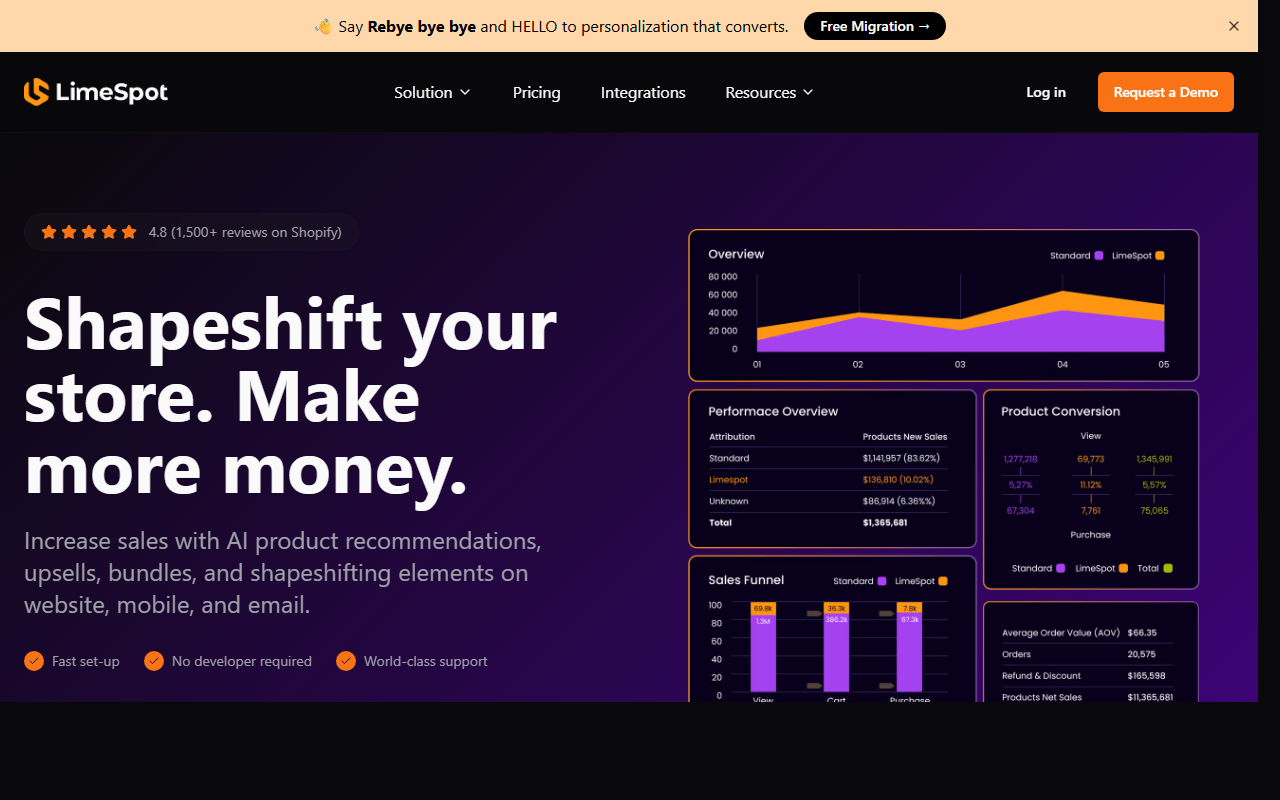
LimeSpot positions itself as a mid-market AI personalization solution for growing Shopify stores. The platform’s strength is breadth: 12+ recommendation types covering homepage, product pages, cart, checkout, post-purchase, and email, all without writing code. It’s a strong middle-market choice for brands that want personalization across the full catalog without committing to a full personalization platform.
What LimeSpot does
12+ recommendation types, including AI-powered bundles, frequently bought together, related products, “complete the look,” recently viewed, and post-purchase upsells.
Cross-store behavior analysis. LimeSpot tracks shopper behavior across its merchant network to identify intent patterns: who’s looking, what they’re after, and what’s likely to convert before they decide.
Multi-channel personalization. Email integrations with Klaviyo, Mailchimp, HubSpot, and SendGrid load personalized product blocks dynamically. Higher-tier plans add SMS personalization. Integrates with Google Shopping for personalized ad experiences.
Audience segmentation. Group customers by affinity, purchase history, or engagement, then upload custom assets per segment: different homepage banners for visitors who recently browsed men’s vs. women’s collections.
Visual editor. Customize widget appearance, placement, and behavior directly in Shopify’s theme editor without touching code.
Best for
Stores with 500+ SKUs that want personalization across the catalog without managing rules manually. Especially strong for fashion, beauty, and lifestyle brands with seasonal collections that benefit from “complete the look” suggestions.
What to consider
Pricing scales by revenue, which can become unpredictable as the store grows. Storefront-only. Recommendations don’t extend to email natively, only through ESP integrations.
LimeSpot pricing
Starts at $50/month for stores with up to $15K in monthly revenue. 15-day free trial.
4. Rebuy: Shopify-Native Checkout Upsell Powerhouse
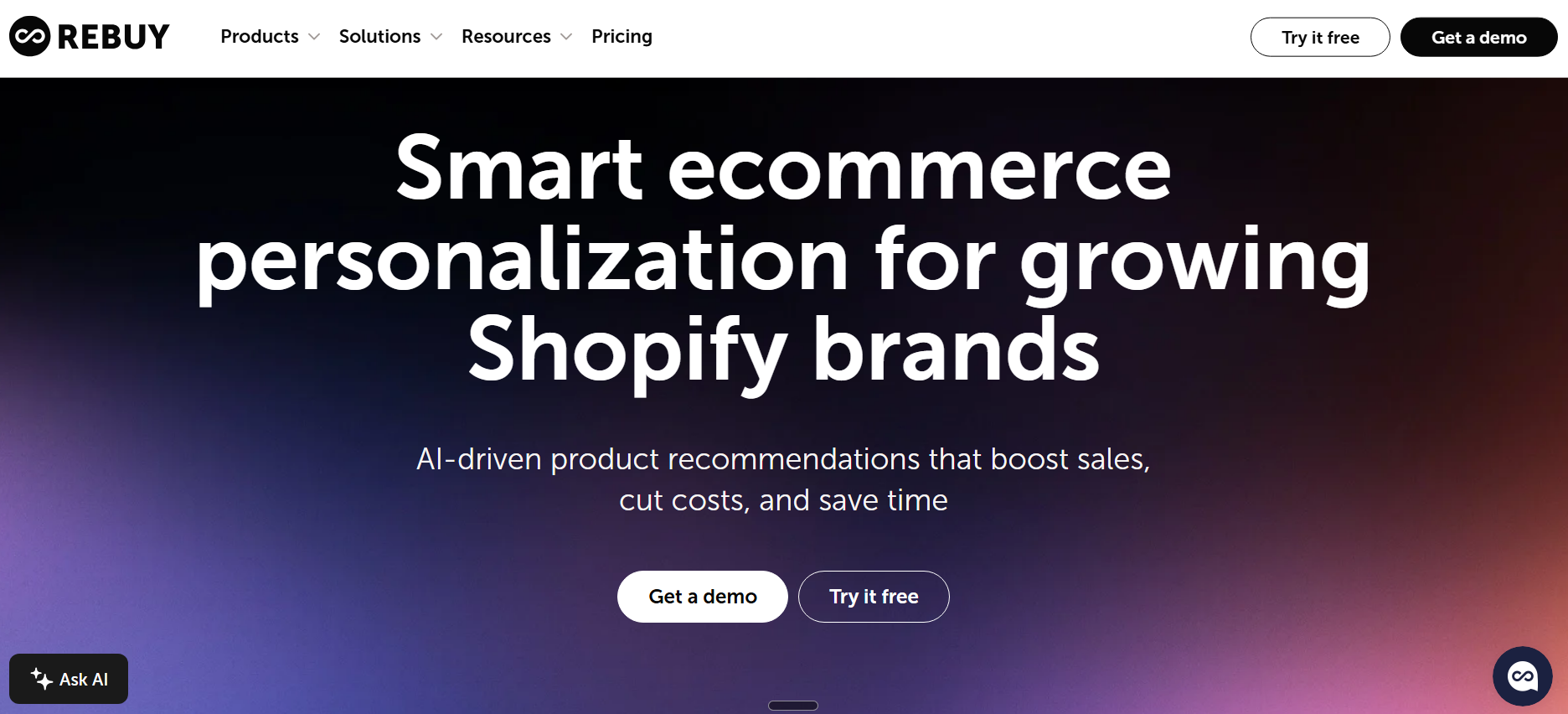
One of the most popular Shopify-native recommendation tools, Rebuy plugs deep into Shopify’s checkout extensions (which are unavailable to multi-platform tools), runs Smart Cart inside Shopify’s cart drawer, and triggers post-purchase offers on Shopify’s order confirmation page. For Shopify Plus brands, no other recommendation tool gets this deep into the platform.
What Rebuy does
Smart Cart. A customizable slide-out cart with AI-powered recommendations, tiered progress bars (up to three bars with four reward tiers each), and Buy More Save More dynamic discounts that apply in real time using Shopify Functions.
Checkout Extensions. For Shopify Plus only: Customize the checkout page itself with content blocks, trust badges, customer reviews, and AI product suggestions.
Post-Purchase Offers. One-click upsells are presented after checkout completion, before the thank-you page. Up to 40 simultaneous flows with multi-step logic. Customers add products without re-entering payment info.
Smart Search and Smart Collections. AI-powered site search with intent recognition; collection pages with advanced merchandising rules.
Rebuy Monetize (free add-on). Earn $0.20 to $0.35 per transaction from third-party brand offers on the thank-you page. Secondary revenue with no cost.
Native integrations with Recharge, Skio, Klaviyo, and 40+ pre-built apps.
Best for
Shopify Plus brands that want checkout-level upsells and deep Shopify integration. Especially powerful for high-AOV stores where post-purchase one-click offers and Smart Cart bundling materially impact total order value.
What to consider
Checkout Extensions are Shopify Plus only. Standard Shopify merchants can’t access this functionality. Package-based pricing means stores wanting the full feature set (cart + checkout + search + flows) end up at $534/month, plus $0.10/order, plus $499/month for support. Some merchants on G2 mention a learning curve when configuring advanced rules.
Rebuy pricing
Starts at $25/month per package (Cart, Checkout, Search, or Flows) + $0.10/order. Pricing scales with monthly order volume. The Platform One plan is $534/month for all packages, a dedicated Customer Success Manager, and beta access. Premium Support +$499/month add-on for priority response. 14-day free trial on packages; 30-day trial on Platform One.
5. Wiser: AI Recommendations for Growing Stores
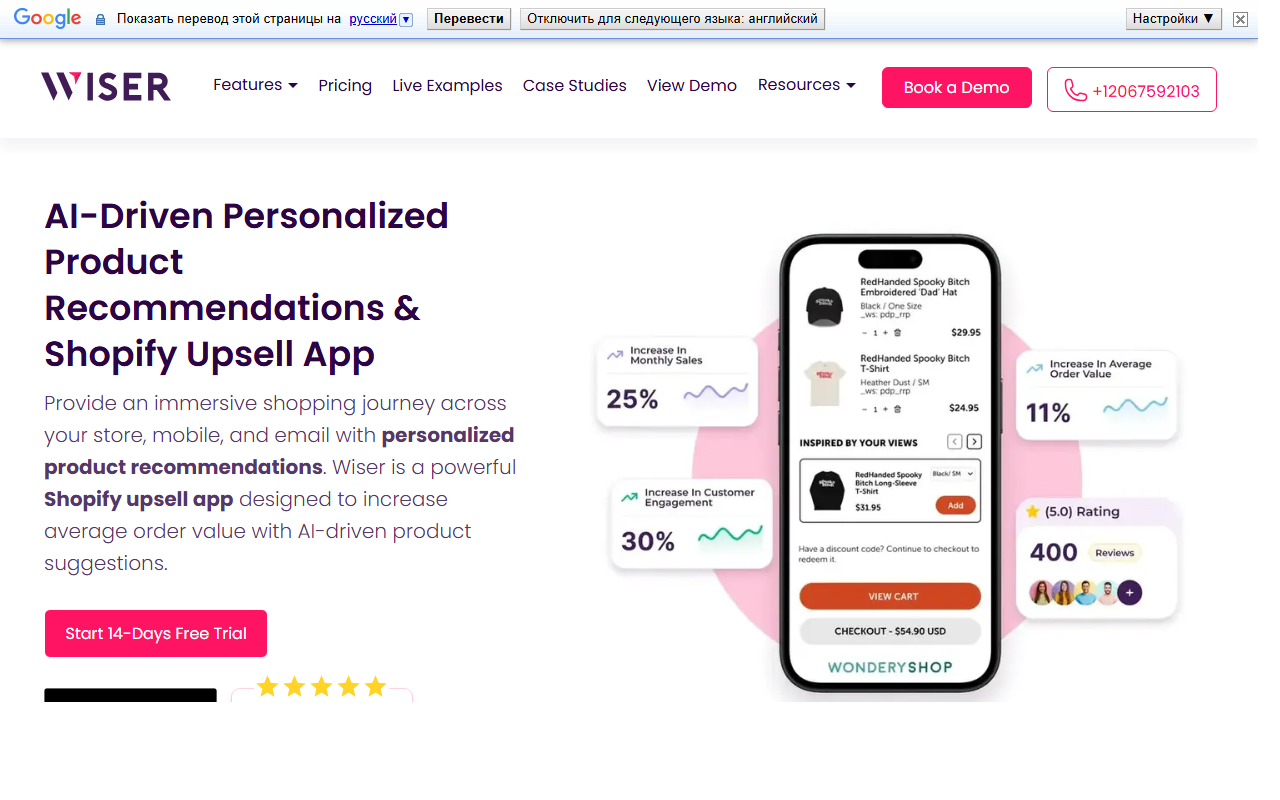
Wiser offers a generous free tier for early-stage stores, plus an Enterprise plan for larger volumes. The free tier (under 100 orders/month) makes it the easiest entry point for new stores experimenting with AI recommendations. It’s one of the most highly rated apps in the category, with consistent praise from merchants for setup speed and support quality.
What Wiser does
“Frequently Bought Together” widget powered by AI and conditional logic. Generates intelligent bundles based on co-purchase patterns.
Multi-page widget deployment. Place recommendations on homepage, product pages, cart, cart drawer, checkout, post-purchase, thank-you page, and order emails.
Product quizzes for guided discovery: customers answer a few questions and receive personalized product picks.
Wiser Pops. Personalized upsell offers in popups triggered by browsing behavior or cart contents.
Email personalization. Send dynamic product recommendations through order notifications, shipping updates, and newsletters.
The analytics dashboard tracks click-through, add-to-cart, and revenue attribution per widget and placement.
Best for
Stores under 100 monthly orders looking for a free AI recommendations tool, or larger stores ready to commit to a custom Enterprise plan. Strong fit for early-stage DTC brands testing personalization tactics before scaling.
What to consider
Free tier caps at 100 monthly orders. Past that, the only path is Enterprise (custom pricing, requires a sales call), with no self-serve middle tier between Free and Enterprise. Some merchants report bugs in specific widget configurations. Earlier billing models charged a percentage of all site sales rather than only sales attributed to Wiser.
Wiser pricing
Free for stores with 0 to 100 orders/month: includes AI-based recommendations, Frequently Bought Together, Related Products, manual recommendations, analytics, and Best Sellers & New Arrivals.
Enterprise (custom pricing, requires a demo) for higher volumes: adds Post-Purchase Upsell, Checkout recommendations, Advanced Search & Filter, Wiser Cart, Thank You, and Cart Drawer upsells, Bundle discounts, dedicated account manager, and API access.
6. Glood: Hybrid AI and Rule-Based Control
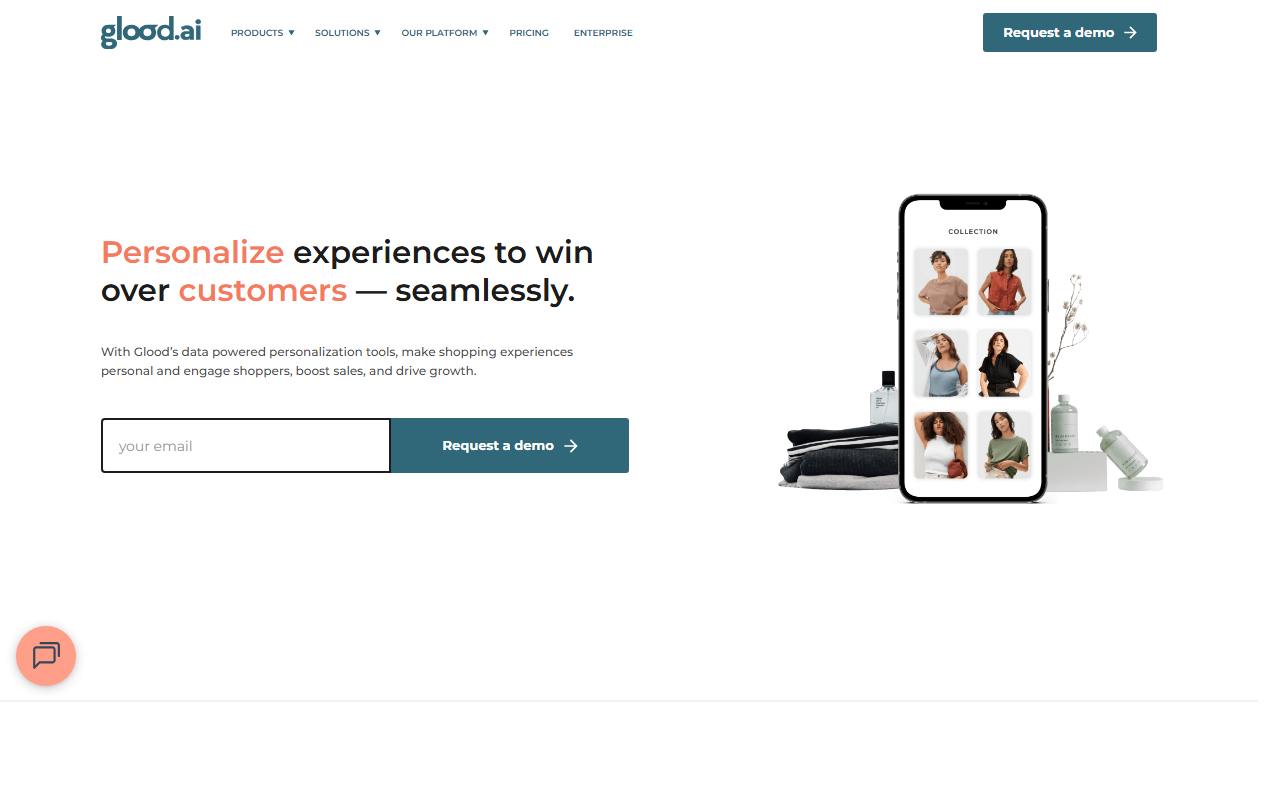
Glood balances AI automation with manual control. Stores can run fully automated machine-learning recommendations, define specific product relationships and display logic manually OR mix both. That hybrid is unusual: most tools are either purely AI or purely rule-based.
What Glood does
12 recommendation types, including Similar Products, Bought Together, Recently Viewed, Trending, and Bestsellers, all deployable without technical setup.
AI personalization that adapts in real time based on visitor behavior patterns.
Rule-based recommendations for merchants who want precise control. Define accessory pairings manually, or build conditional logic based on customer tags or purchase history.
Product bundles with configurable discounts and Mini Cart recommendations to capture last-minute add-ons.
A/B testing on the Plus tier to compare recommendation strategies.
Visual editor for in-theme customization of widget appearance, placement, and behavior.
Best for
Mid-market stores where merchandising teams want to manually pin specific product pairings (clearance items, seasonal collections, branded sets) on top of AI personalization. Useful for brands with strong product knowledge that want to encode it without losing automation underneath.
What to consider
Widget display limits require monitoring: overage charges at $1 per 1,000 displays on Basic, $1 per 2,000 on higher tiers. Feature complexity can overwhelm merchants who want simple plug-and-play. Smaller customer base on Shopify App Store than competitors like LimeSpot or Wiser, which means fewer signals about how the platform performs at scale.
Glood pricing
Free with Recently Launched, Recently Viewed, Trending, Bestseller widgets, and unlimited usage. Basic $19.99/month for 10,000 widget displays + AI personalization. Pro $69.99/month for 100,000 displays + bundles, rule-based recommendations, and custom templates. Plus $299.99/month for 500,000 displays + A/B testing, checkout upsell, and developer API. 14-day free trial on paid plans.
7. AiTrillion: Marketing Automation with Recommendations
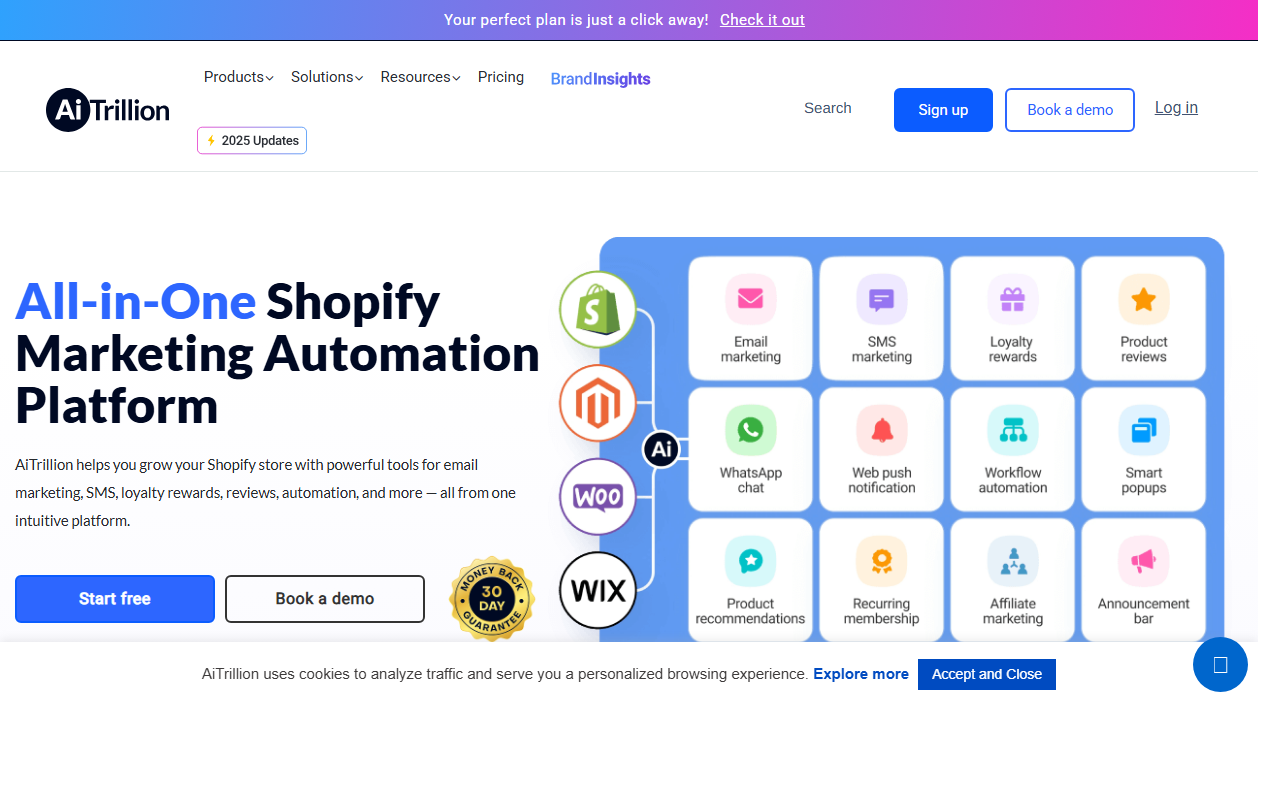
AiTrillion consolidates AI product recommendations with loyalty programs, email marketing, SMS campaigns, product reviews, memberships, and affiliate management. The platform serves 3,000+ Shopify stores, has sent 400M+ automated messages, and powered 100M+ loyalty point redemptions. AiTrillion serves smaller stores, and pricing is based on contact volume.
What AiTrillion does
AI recommendations across email, web push, SMS, and smart pop-ups, triggered by browsing, cart, and purchase behavior.
Workflow automation combining recommendations with loyalty triggers, abandoned cart, and browse abandonment sequences across email, SMS, push, and pop-ups.
Loyalty program built in: points, tiers, referrals, and gamification.
Reviews module with photo and video reviews, plus AI replies and translations on higher tiers.
Affiliate management with custom commission structures.
Pre-built widgets for trending, new, recently viewed, sale, and personal recommendations.
Best for
Smaller Shopify stores (under $5M revenue, under 5,000 active contacts) that want recommendations as part of a broader marketing toolkit (loyalty + email + SMS + reviews) without paying for separate apps. Especially useful for solo founders or lean teams who want one bill instead of seven.
What to consider
Documentation on platform limitations is sparse: merchants report figuring out boundaries through trial and error. Customer support runs 24-hour response times with limited weekend availability, which can slow troubleshooting. Email volume limits per tier can become a constraint as the contact list grows. Reviews highlight responsive support but also note the platform’s breadth makes initial setup more involved than single-purpose tools.
AiTrillion pricing
Free plan with 250 active contacts and 250 emails/month. Contact-based tiers: Starter $19/mo (1k contacts, 1.5k emails), Basic $49/mo (2.5k), Growth $99/mo (5k), Professional $199/mo (15k), Advance $399/mo (40k), Enterprise $699/mo (80k), Enterprise Plus $999/mo (120k). Custom for larger volumes. Order-based plans are also available ($19 to $99/month based on monthly order volume). Annual billing saves ~16%. 14-day free trial on paid tiers.
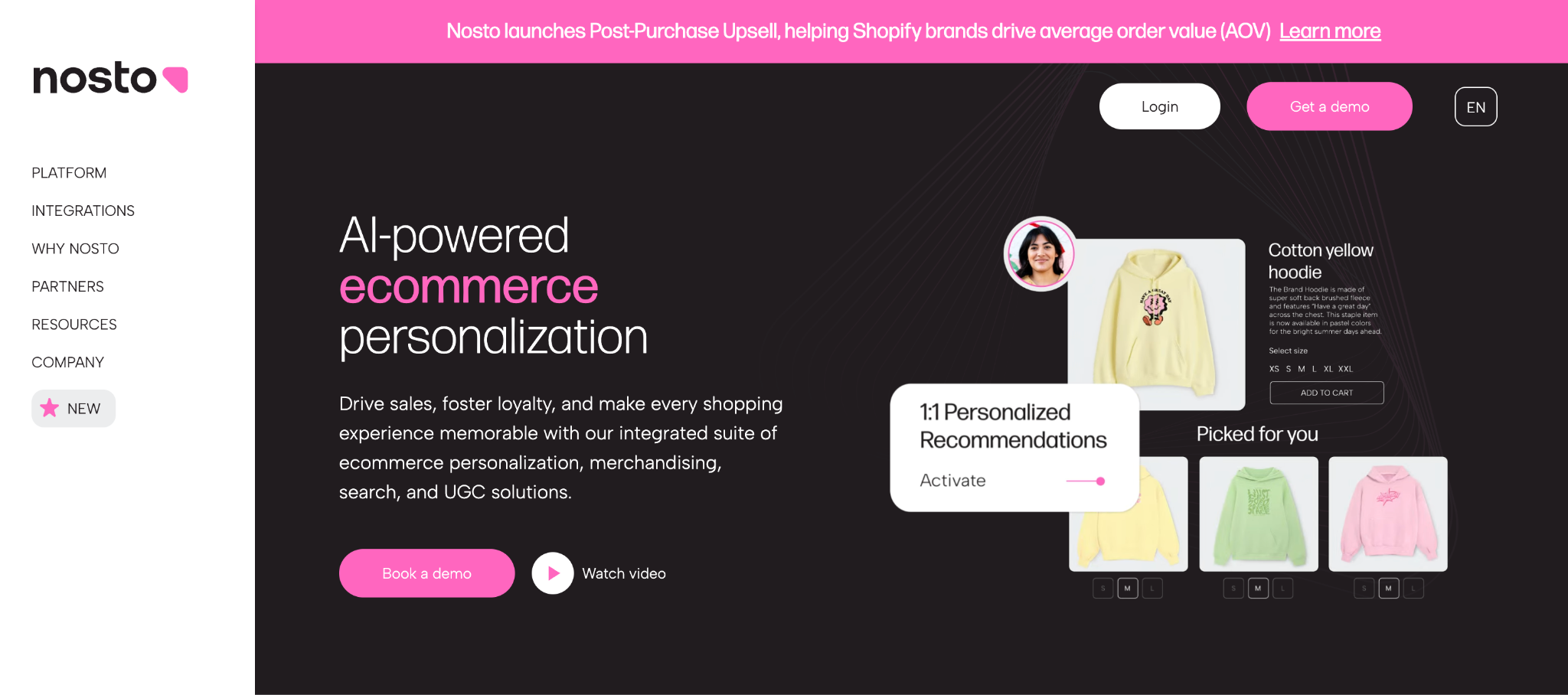
Nosto positions itself as a Commerce Experience Platform rather than a standalone recommendation tool, covering AI-driven recommendations, on-site personalization, search, merchandising, and shoppable UGC.
What Nosto does
Four AI engines: Predictive AI for behavior forecasting, Semantic AI for natural-language search, Visual AI for image recognition and content matching, Generative AI for workflow automation.
AI product recommendations with category merchandising and content personalization tied to visitor segments.
Shoppable UGC from Instagram and TikTok is displayed as shoppable galleries.
AI-driven site search with autocomplete, spelling correction, and intent recognition.
Multi-platform support native to Shopify, Magento, Adobe Commerce, BigCommerce, Salesforce Commerce Cloud, and Shopware.
A/B testing across recommendations, search, and merchandising with commerce KPI measurement.
Best for
Enterprise brands with $3M+ revenue, especially those running on multiple platforms (e.g., DTC on Shopify + B2B on Magento). Strongest fit for fashion, beauty, and lifestyle brands where Visual AI and shoppable UGC genuinely differentiate the shopping experience.
What to consider
Pricing is custom and tied to Gross Merchandise Value plus per-module fees. Costs scale automatically as the store grows, which several G2 reviewers describe as expensive and hard to predict. The attribution model can be hard to verify: merchants pay a percentage of Nosto-attributed revenue, but attribution methodology isn’t fully transparent. Steep learning curve. G2 reviewers consistently note that mastering all four AI engines requires significant time and CSM support.
Nosto pricing
Custom pricing, GMV-based with per-module fees. Typical engagements start around $500/month but can scale to $4,000+/month for larger brands. Implementation and professional services are billed separately. No public rate card.
Shopify’s native Search & Discovery in 2026
Does Shopify have built-in recommendations? Yes. Shopify’s free Search & Discovery app upgraded its model in early 2026 to a sequence-prediction (autoregressive) architecture trained on billions of behavioral events, per Shopify’s engineering team. It now powers Related, Complementary, Trending, and Recently Viewed recommendations.
The limits are real: only four recommendation types, no per-visitor personalization exposed to merchants, no A/B testing, and no checkout, post-purchase, or email placements. There is also a filter ceiling (about 25 attributes and 5,000 products). For stores under ~100 SKUs with low order volume, it covers the basics for free. Above that, the paid apps in this list earn their cost.
Key Takeaways
Recommendations can drive a large share of revenue, but read the numbers carefully. Engaged-session benchmarks attribute up to 31% of ecommerce revenue to recommendations, while McKinsey’s more conservative store-wide anchor puts the personalization lift at 5% to 15%. Either way, picking the right engine is one of the highest-impact decisions for AOV and conversion, and the right tool depends entirely on store size, traffic, channel coverage, and existing stack.
Shopify-only vs. multi-platform. Rebuy is Shopify-native, with checkout extensions only available to Plus. Nosto and Maestra are the meaningful multi-platform choices, both with native Shopify integration. Maestra extends recommendations across email, MMS, RCS, and messaging apps, making it a fit for omnichannel strategies.
Attribute-matching matters. For brands selling apparel, beauty, sports gear, or any catalog with size/color/material variants, the recommendation engine has to understand product attributes, not only co-purchase patterns. Maestra, Nosto (Visual AI), and LimeSpot lead here. Wiser and Glood handle “also bought” patterns well, but are less suited to deep attribute-matching at scale.
Real results come from the full stack, not the widget. Gift brand Blue Q saw 28.7% higher AOV and 45.3% more items per order with Maestra’s recommendations, because the recommendations sit on the same real-time CDP that powers email, pop-ups, and ads. Swimwear brand JOLYN saw 7% of total sales influenced by AI recommendations. Tactical gear brand Defense Mechanisms hit 8.9% of sales influenced by dynamic recommendations. The pattern: when recommendations work, they amplify; when they’re isolated, they convert at category averages.
FAQ
How much revenue can AI product recommendations generate?
Personalized recommendations drive 10% to 30% of ecommerce revenue across most stores that implement them, with top performers exceeding 30% of total revenue.
A Barilliance study found recommendations account for an average of 12% of ecommerce revenue, climbing to 31% at the highest-performing stores.
Click engagement amplifies the lift. A Salesforce-cited study found shoppers who click personalized recommendations are 4.5x more likely to add to cart and 4.5x more likely to convert. In that data, the 7% of visits where shoppers clicked a recommendation drove about 26% of revenue. Read these as recommendation-engaged-session benchmarks, not store-wide averages: the high figures measure sessions where a shopper actually interacted with a recommendation, so a conservative store-wide anchor is McKinsey’s 5% to 15% personalization lift.
Outcomes vary by category and stack depth. Novelty gift brand Blue Q saw 28.7% higher AOV and 45.3% more items per order from recommendation engagement. Athletic apparel brand JOLYN saw 7% of total sales influenced. Tactical gear brand Defense Mechanisms hit 8.9%.
The strongest results come from brands that pair recommendations with the rest of their personalization stack, not from widgets running alone.
Do I need Shopify Plus to access the best recommendation features?
No, for six of the seven apps in this list. Only Rebuy’s native Checkout Extensions require Shopify Plus.
Maestra, LimeSpot, Wiser, Glood, AiTrillion, and Nosto all run on standard Shopify with full AI personalization.
If checkout-page upsells are core to your strategy, Shopify Plus + Rebuy is the strongest combination. Otherwise, standard Shopify gets you 90% of recommendation capability through the other tools.
What’s the difference between AI-powered and rule-based product recommendations?
AI-powered recommendations adapt automatically based on customer behavior. Rule-based recommendations follow manual merchant logic like “if A, then show B.”
AI engines analyze purchase history, browsing patterns, and clickstream data to surface relevant products without manual setup. They improve as data accumulates.
Rule-based recommendations require merchants to define product relationships explicitly. This gives precise control but doesn’t scale across large catalogs.
Maestra and Nosto layer business rules on top of AI, letting merchants override or refine algorithm output without losing automation. Glood supports both modes side by side. AiTrillion, Wiser, and LimeSpot lean more heavily on AI with lighter manual controls.
How long does it take to see results from a recommendation app?
Most engines need 7 to 14 days to collect behavioral data, with measurable revenue lift typically appearing within the first 30 days.
The fastest wins come from cart-page widgets and post-purchase upsells. Those touchpoints have high intent and convert immediately.
Deeper personalization takes longer. Segment-based homepage content and attribute-matched email recommendations need more data and tuning before they outperform the baseline.
Can I use recommendations across email and MMS, not only on-site?
Yes, but each app handles cross-channel differently. Maestra and AiTrillion run recommendations natively across email, SMS, and push. The rest rely on integrations with external email tools.
Maestra runs cross-channel recommendations from a single engine. Product cards appear in email and MMS (image, price, CTA), and rich carousels in RCS, WhatsApp, mobile push, and chatbots.
So when a customer browses without buying, tomorrow’s email reflects what she saw. The follow-up SMS the next day references those same products by name and price, with a deep link to the cart.
AiTrillion also handles cross-channel recommendations natively (email, SMS, push, popups).
LimeSpot and Rebuy integrate with Klaviyo and other ESPs but don’t send emails themselves; you need a separate sending tool. Wiser sends product recommendations through Shopify’s order-related emails (notifications, shipping updates) but doesn’t run independent email campaigns. Nosto integrates via API to feed external email tools.
What should I look for when comparing recommendation apps?
Score every app against five questions: catalog complexity match, channel coverage, real-time vs. batch updates, pricing predictability, and support depth.
Catalog complexity. Does the engine match on product attributes (color, size, material) or only co-purchase patterns? Apparel, beauty, and sports brands need attribute-matching.
Channel coverage. Do recommendations extend to email, SMS, and ads, or only on-site? Single-engine cross-channel beats stitched ESP integrations in consistency.
Real-time vs. batch. Does the recommendation react to what the visitor did 30 seconds ago, or what their session looked like last night? Real-time wins on returning visits within a single browsing window.
Pricing predictability. Is pricing flat, order-based, revenue-based, or commission-based? Model how it scales at 10× your current volume before signing.
Support depth. Does the team handle setup and ongoing optimization, or is it self-serve? Dedicated CSMs or forward-deployed marketers shift the cost-benefit when recommendations require continuous tuning.
A widget shows a product grid based on aggregate behavior (“customers also bought,” “you may also like”). Zipchat recommends inside a conversation: it reads the shopper’s stated need, returns matched products with reasons, answers the follow-up questions, and can act on the recommendation (apply a discount, check stock, move toward checkout), across web chat and WhatsApp. The widget is a placement; Zipchat is a salesperson that happens to recommend.