Most Shopify sellers price a product once, usually with their own store’s math in mind, and then list the same product at the same price on TikTok Shop and eBay. The price looks the same everywhere. The money kept does not.
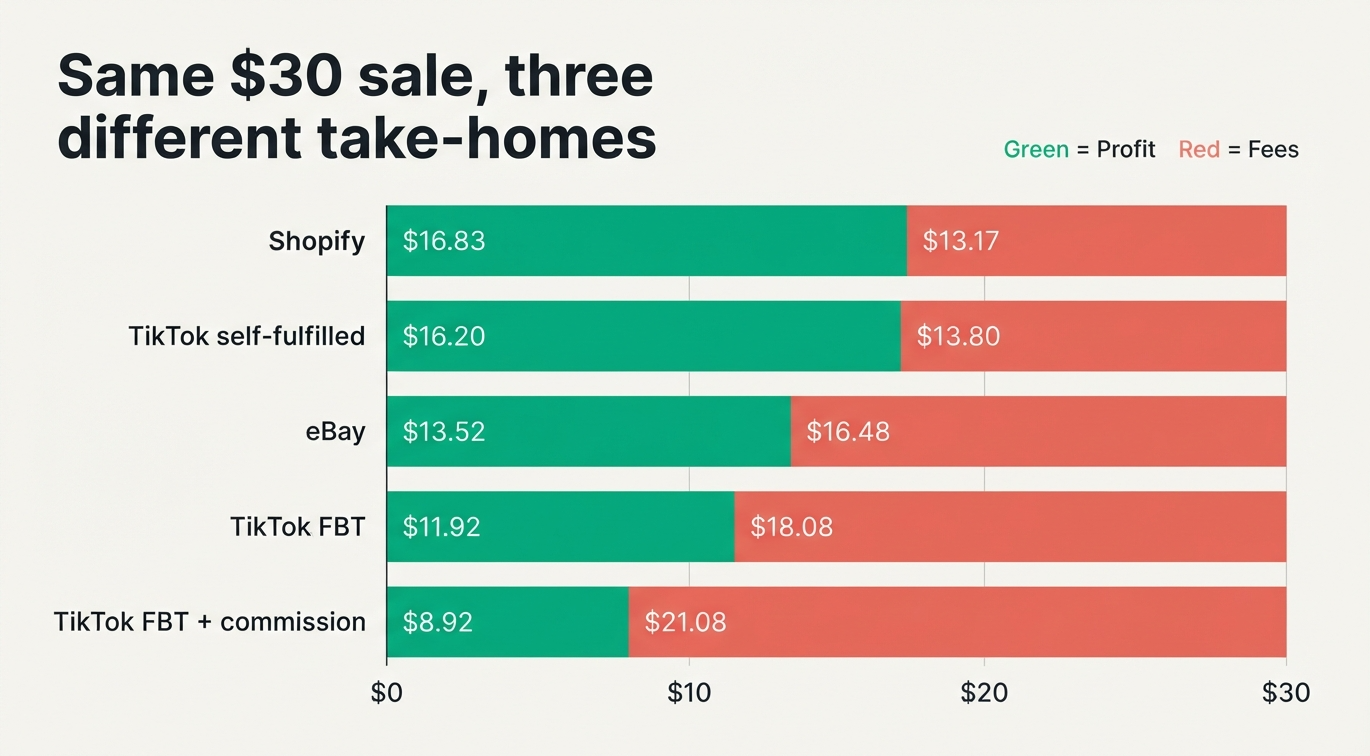
A $30 sale is not a $30 sale. On your own Shopify store, it leaves you about $16.83 before anything else. On TikTok Shop with Fulfilled by TikTok, the same $30 sale leaves you $11.92. Add a 10% creator commission, and it drops to $8.92. That is nearly half your profit gone on the same product, at the same price, for reasons that have nothing to do with your product.
This article works through one $30 sale, line by line, on all three channels. The product cost in every example is $12, an illustrative figure. Substitute your own landed cost and the method still works; the numbers below will move, the gaps between channels will not.
Shipping you pay yourself is not in these numbers, because it varies by product and destination. Monthly plan fees are not in them either. What follows is the per-sale fee math only.
The $30 sale, side by side
| Channel | Fees on a $30 sale | Fees | What is left before product cost | Profit with a $12 product cost |
|---|
| Shopify (own store) | 2.9% ($0.87) + $0.30 | $1.17 | $28.83 | $16.83 |
| TikTok Shop, self-fulfilled | 6% referral ($1.80) | $1.80 | $28.20 | $16.20 |
| TikTok Shop, Fulfilled by TikTok (FBT) | 6% referral ($1.80) + FBT $4.28 | $6.08 | $23.92 | $11.92 |
| TikTok Shop, FBT + 10% creator commission | $1.80 + $4.28 + $3.00 | $9.08 | $20.92 | $8.92 |
| eBay US | 13.6% final value fee ($4.08) + $0.40 per-order fee | $4.48 | $25.52 | $13.52 |
Read the table from the bottom line up. The cheapest channel to sell on keeps $16.83. The most expensive combination keeps $8.92. The difference, $7.91 on a single $30 sale, is nearly half of what the same sale keeps on Shopify. Nobody loses that money to a bad product. They lose it to a price set for one channel and copied to the others.
Shopify: the baseline
On a US Shopify store on the Basic plan, an online card payment through Shopify Payments costs 2.9% + $0.30. On $30, that is $0.87 + $0.30, or $1.17. Keep $28.83, subtract the $12 product cost, and $16.83 remains.
That is the baseline everything else is measured against, and it feels cheap for a reason: it is only the payment processing. It does not include the $39-a-month Basic plan fee, your apps, or your own advertising.
A store doing ten $30 sales a month carries $3.90 of plan fee per sale on top of the $1.17; a store doing a thousand pays almost nothing per sale. The per-sale fee is the smallest part of selling on Shopify. The fixed costs are the real ones, and they shrink as you scale.
Two warnings before you treat 2.9% + $0.30 as the whole story. First, that is the standard US card rate. Premium and international cards cost more. Second, if you use a payment provider other than Shopify Payments, Shopify adds its own fee on top: 2% on Basic.
The $1.17 figure assumes Shopify Payments and a standard domestic card. Check your own rate in your Shopify admin before you rely on any published figure, including this one.
TikTok Shop: referral, fulfillment, and creator commission
TikTok Shop charges a referral fee of 6% on the sale price in most US categories. Some sellers report the rate rising to 8% from August 2026, so confirm yours in the Seller Center. On $30, that is $1.80, and there is no separate transaction fee on top of it in the US.
If you fulfill the order yourself (pick, pack, and ship it), $1.80 is the whole fee bill. Profit: $16.20, only $0.63 less than Shopify. If you haven’t connected your store yet, start with this guide to using Shopify with TikTok.
Fulfilled by TikTok changes the picture. FBT charges per unit, in tiers set by product weight and units per order. This example uses $4.28 for a single-unit order, on top of the $1.80 referral fee. Total fees: $6.08. Profit: $11.92, which is $4.28 less than self-fulfilling, exactly the FBT charge, as it should be.
FBT buys you storage, picking, packing, and faster delivery. Whether it is worth $4.28 a sale depends on what your own time and warehouse cost, but it is never free, and it is never small. At a $30 price point, it eats more than a quarter of your profit.
Then there is creator commission, the cost most sellers forget to budget for because it looks optional. TikTok Shop creators promote your product for a commission you set. There is no fixed rate: you choose it. At a 10% example rate, commission on a $30 sale is $3.00.
On an FBT order that takes total fees to $9.08 and profit to $8.92. The commission bought you a sale you might not have made. It also halved your profit. Both things are true at once, and the only wrong move is not doing the math before you set the rate.
Run your own numbers before you list: try the free TikTok Shop fee and the Zyrro profit calculator. It works through the same referral, FBT, and commission figures for any price you enter.
One more TikTok cost, for completeness: if a buyer returns a $30 FBT order, TikTok charges a refund administration fee of 20% of the referral fee, which is $0.36 on this sale. FBT returns also carry a return handling charge, which third-party fee guides list at about $3 per return order. Small on one order. Real across a hundred.
eBay: the final value fee surprise
eBay US charges a final value fee of 13.6% in most categories, plus a $0.40 per-order fee on orders over $10. On a $30 sale, that is $4.08 + $0.40, or $4.48. Profit: $13.52. That sits between TikTok’s two fulfillment options and is $3.31 below Shopify.
Sellers new to eBay are usually surprised twice. The first surprise is the rate itself: 13.6% is more than double TikTok’s 6% referral fee. The second is what it is charged on: the total amount of the sale, including the shipping the buyer paid and the sales tax collected.
The $4.08 above is calculated on the $30 item price alone; if you charged $5 for shipping, the fee is calculated on $35.
Listing the item, by contrast, is usually free. eBay gives sellers up to 250 zero-insertion-fee listings a month; after that, each listing costs $0.35 in most categories. If you list fewer than 250 items a month and buy no optional upgrades, insertion costs you nothing, and the $13.52 profit above stands.
An eBay Store subscription changes the math. From the Basic tier up, most categories drop to 12.7%, but the subscription itself costs $27.95 a month, so it only pays once your volume justifies it. Do that calculation separately; do not fold a subscription into a per-sale comparison and pretend the fee is free.
A note on tax reporting, because old guides still get it wrong: the 1099-K threshold for 2025 and 2026 is $20,000 and 200 transactions. The $600 figure that still appears in older articles is stale. It does not change what you keep from a $30 sale, but it is the kind of outdated number that quietly destroys trust in an otherwise accurate guide.
The three fees sellers miss
Most profit leaks are not in the headline rates. They are in the three costs below, which never appear in a fee table summary.
1) Refunds cost more than the refund. On TikTok Shop, a returned $30 sale costs you the $0.36 refund administration fee, plus return handling, plus the time to process it. An AI order refund assistant can take the eligibility checks and back-and-forth off your team.
On eBay, a return costs you the sale and the shipping, and in many cases the final value fee is credited back, but the time is not. A channel with a 10% return rate is a channel where one sale in ten earns you nothing and costs you handling. Price for your real return rate, not for zero returns.
2) Fulfillment is a fee, even when you do it yourself. FBT’s $4.28 is visible, so sellers argue about it. Self-fulfillment’s cost is invisible: your time, your packaging, your trips to the post office. So sellers call it free. It is not free.
If self-fulfillment costs you $3 of time and materials per order, the gap between FBT and self-fulfillment is $1.28, not $4.28. Cost it honestly, in dollars per order, before you choose.
3) Promotion that looks optional until it isn’t. Creator commission on TikTok and Promoted Listings on eBay are both optional in the sense that nobody forces you to use them. In practice, a new listing with no promotion often gets no views.
Budget a promotion rate into your price from the start, even 5%, and treat a sale with no promotion spend as a bonus, not the plan.
Break-even price before you list
The most useful number in this article is not the profit on a $30 sale. It is the price below which you lose money on every sale: the break-even price, with the same $12 product cost:
| Channel | Break-even price |
|---|
| Shopify | $12.67 |
| TikTok Shop, self-fulfilled | $12.77 |
| TikTok Shop, FBT | $17.32 |
| TikTok Shop, FBT + 10% creator commission | $19.38 |
| eBay US | $14.35 |
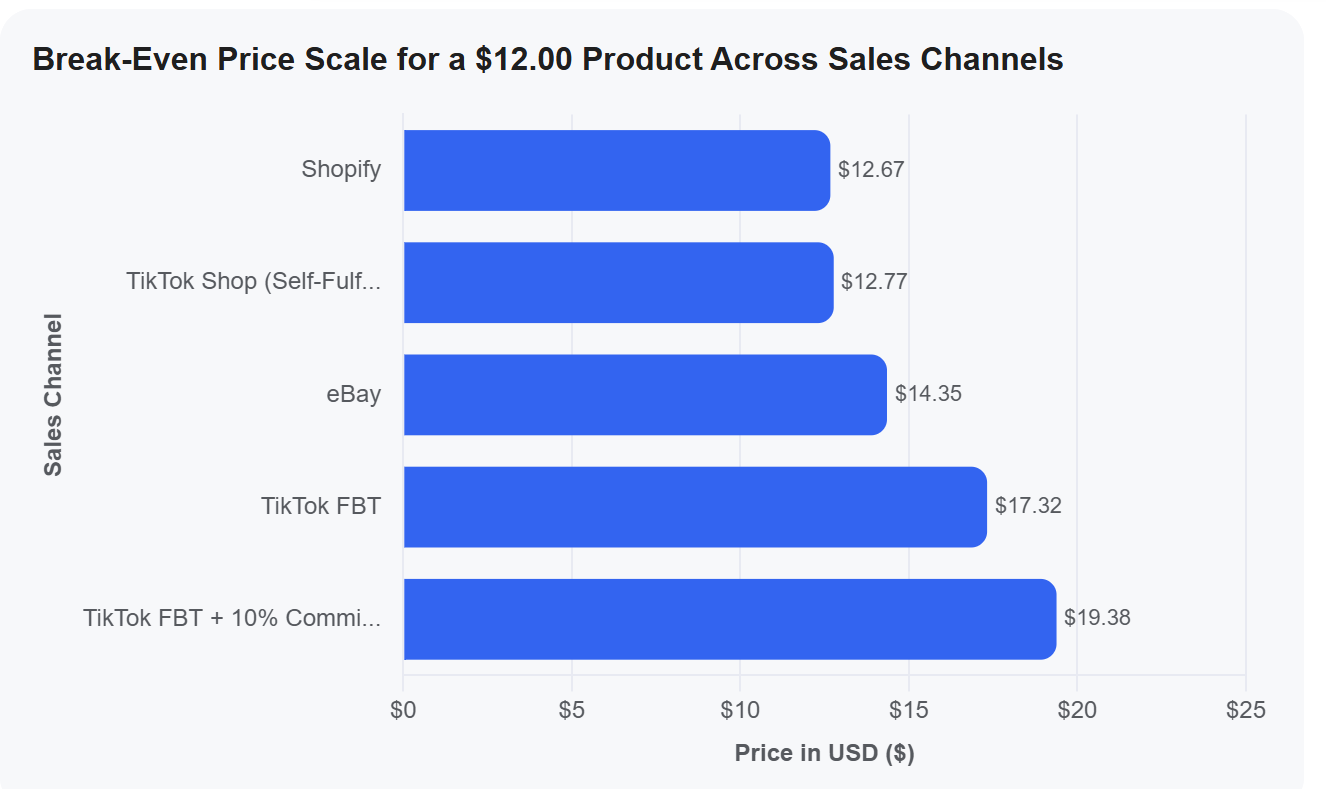
The formula is simple: break-even price = (product cost + any flat per-order fee) ÷ (1 − percentage fee rate). For TikTok FBT: ($12 + $4.28) ÷ (1 − 0.06) = $17.32. Add the 10% commission, and the percentage rate becomes 16%: $16.28 ÷ 0.84 = $19.38.
Read that row carefully. The same product, with the same $12 cost, needs a $17.32 price on TikTok FBT just to break even, against $12.67 on Shopify. That $4.65 gap is the FBT cost showing up in your price. If you list at $15 on TikTok FBT, you lose $2.18 on every sale, and the sales will look like success because orders will keep coming in.
Work out your break-even price for each channel before you list, and write it down next to the listing. If your price is below it, either raise the price, cut the product cost, or do not list on that channel.
The takeaway
Price per channel, not one price everywhere. A $30 price that earns $16.83 on Shopify earns $8.92 on TikTok Shop with FBT and a creator commission. The product never changed. The channels did.
Start with your product cost, add the channel’s percentage fee and its flat fees, add the promotion you will actually spend, and only then set the price. Check the break-even first, the profit second, and the sales volume last, in that order.
And when a fee changes, redo the math the same week. TikTok moved FBT to weight- and unit-based pricing tiers in January 2026; sellers still pricing off an old flat rate may be over- or under-pricing every FBT order without knowing it.
 Website chat Turns browsers into buyers on every page.
 WhatsApp Sell on the app your customers read.
 Instagram Answers every DM in seconds.
 Messenger Turns Facebook ad questions into sales.
 Email Answers every email in the same thread.