In a Zendesk vs Intercom decision, Zendesk wins high-volume, structured, multichannel ticketing. Intercom wins product-led teams that want in-app messaging and Fin AI resolutions. But neither is built for ecommerce. Neither natively reads your product catalog or order status. For a Shopify or WooCommerce store, that gap is the real question.
Most comparisons treat this as a two-horse race. It isn’t. Both tools are general-purpose customer support software designed for B2B and SaaS ticketing first. An ecommerce store has different jobs: answering pre-sale questions, handling “where is my order,” and turning browsers into buyers. This guide compares the two honestly, then shows where an ecommerce-native layer changes the math.
What is the difference between Zendesk and Intercom?
Zendesk is a ticket-first support suite built for structured, high-volume queues across email, chat, voice, and social. Intercom is a messaging-first platform built around in-app chat and its Fin AI agent, popular with SaaS and product-led teams. Zendesk scales operations. Intercom drives conversations.
The split shows up in how they charge, how their AI works, and who they serve. Zendesk sells seats plus outcome-based AI. Intercom sells seats plus $0.99 per Fin resolution. Here’s the head-to-head.
| Factor | Zendesk | Intercom |
|---|
| Starting price | Support Team $19/agent/month; Suite Team $55/agent/month (annual) | Essential $19/seat/month; Advanced $85/seat/month |
| Core model | Ticket-first support suite | Messaging-first customer platform |
| AI and automation | AI Agents billed per resolution (outcome-based) | Fin AI Agent at $0.99 per resolution |
| Best for | High-volume, multichannel ticketing teams | Product-led SaaS wanting in-app messaging + AI |
| Key limitation | Cost climbs with seats and AI overages; steeper setup | Usage-based Fin billing makes spend hard to predict |
| G2 rating | 4.3/5 | 4.5/5 |
All figures accessed August, 2026.
Both tools started from different problems. That origin still shapes how they behave today.
Zendesk
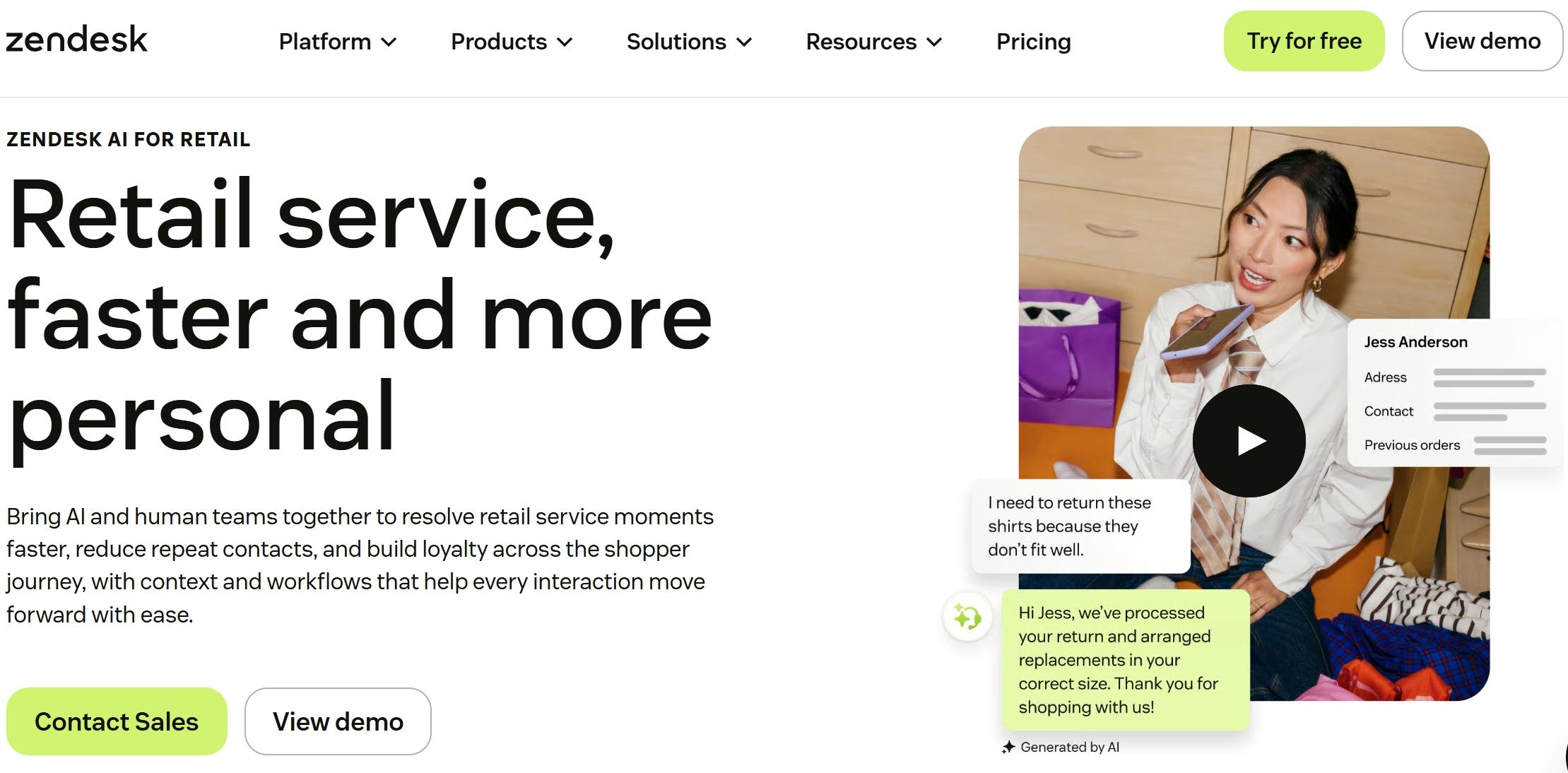
Zendesk is a ticketing suite with deep support heritage. It began as a help desk and grew into an omnichannel platform covering email, live chat, voice, messaging, and a knowledge base. Large support teams pick it because it handles volume and routing at scale.
Zendesk’s AI agent and reporting
Zendesk’s strengths are structure and reporting. Skills-based routing, SLAs, macros, and analytics are mature and battle-tested.
Zendesk provides operational reporting that covers SLA compliance and agent productivity. Zendesk features native Quality Assurance and Workforce Management tools that help support agents stay accountable at scale.
Its AI agent is capable but priced in layers. Zendesk’s Copilot AI add-on costs $50 per agent per month and requires Suite Professional or higher, with automated resolutions billed on top.
Zendesk covers messaging across multiple channels: web, mobile, and social. A chat widget is bundled into every Suite plan, and its connector library is the widest in the category.
Zendesk offers over 1,500 integrations with third-party apps (Zendesk, 2025). Zendesk’s integrations include Salesforce, Jira, and Shopify.
Both Zendesk and Intercom integrate with Zapier for automation, so you can wire either into thousands of apps.
The trade-off is cost and complexity. Full omnichannel features sit in Suite Professional at $115 per agent per month on annual billing.
Setup takes real admin time, and smaller teams often pay for capacity they never use. Zendesk scores 4.3/5 on G2 and 4.5/5 on Capterra, so quality isn’t the issue. Fit and price are.
Intercom
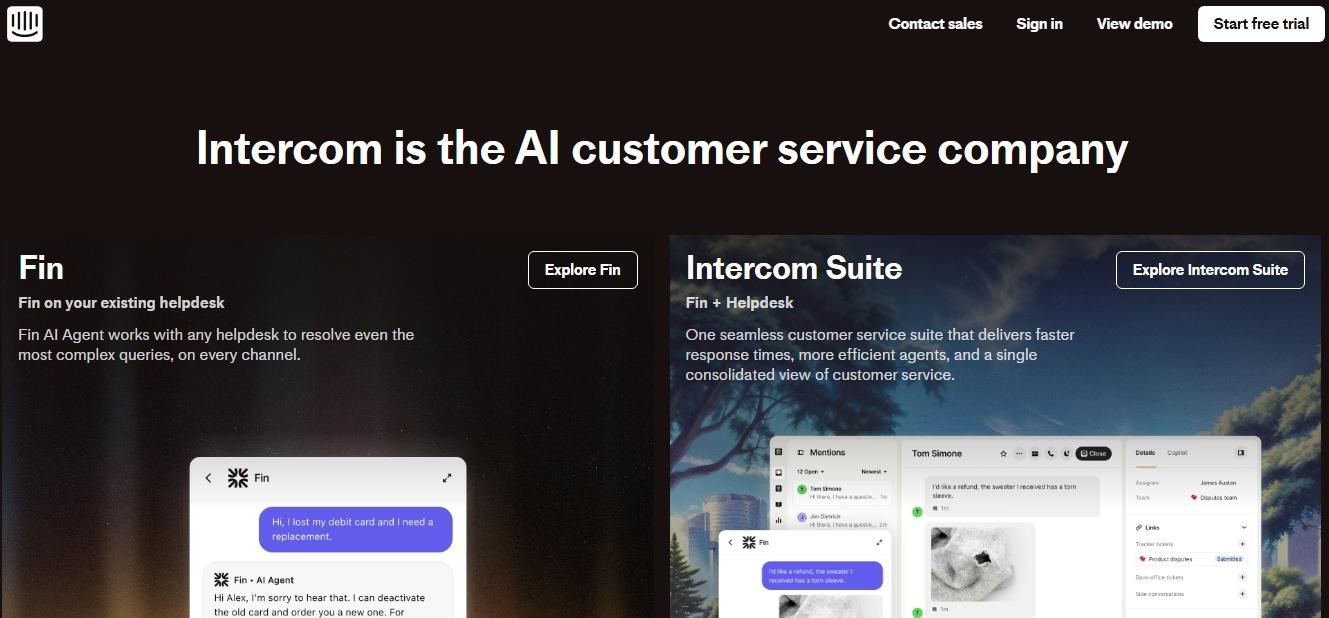
Intercom is a messaging-first platform. It made its name with the in-app chat bubble and now positions itself around Fin, its AI agent. Product-led SaaS companies favor it because support, onboarding, and engagement live in one layer of conversational customer support.
Intercom’s AI capabilities: Fin
Fin is Intercom’s headline AI, and its resolution numbers are strong once tuned. Intercom’s Fin AI resolves up to 86% of customer inquiries after company-specific tuning, and about 51% out of the box (Intercom, 2024).
It also handles harder queries well. Intercom’s Fin AI achieved a 96% answer rate for complex questions that pull from multiple sources, in Intercom’s own head-to-head test. Treat vendor benchmarks as a ceiling, not a guarantee.
Its connector library is smaller than Zendesk’s. Intercom supports around 450 third-party app integrations. Intercom integrates with Salesforce and Slack among others.
The weakness is predictability. Intercom charges per seat plus $0.99 per Fin resolution, so a busy month raises the bill in ways that are hard to forecast.
It rates 4.5/5 on G2 and 4.5/5 on Capterra, and most complaints center on cost, not capability.
Intercom’s entry seat is $19 per seat per month, the same headline price as Zendesk’s email-only Support Team, but it includes chat and Fin AI. Zendesk’s comparable chat-capable tier starts at Suite Team ($55) or Suite Professional ($115). Both stack AI charges on top of seats.
The headline number misleads on either side. Neither price is what you pay once AI resolutions and channels get added. Model your volume, not the starting tier.
| Pricing element | Zendesk | Intercom |
|---|
| Entry plan | Support Team $19/agent/month (email/ticketing, no chat) | Essential $19/seat/month |
| Mid tier | Suite Team $55; Suite Professional $115/agent/month | Advanced $85/seat/month |
| Seat model | Per agent, per month | Per seat, per month |
| AI charges | Per automated resolution, outcome-based (stacks on seats) | $0.99 per Fin resolution (stacks on seats) |
| Enterprise | Suite Enterprise, contact sales | Expert $132/seat/month |
Intercom Essential is shown at its current $19/seat/month new-customer rate (35% off the standard $29). Monthly billing on Zendesk runs roughly 15% to 25% higher than annual.
Run the numbers on a real team. A 10-seat Intercom setup on Essential is $190 a month before Fin. Add 1,000 Fin resolutions, and you’re near $1,180. A 10-agent Zendesk Suite Professional team is $1,150 before AI, then outcome fees land on top. The cheaper tool is whichever matches your volume.
Which has better AI, Zendesk or Intercom?
Intercom’s Fin is the more polished, self-serve AI agent, resolving questions from your help content at $0.99 per resolution. Zendesk’s AI Agents are strong at scale but need a mature knowledge base and historical tickets to perform, and the outcome-based billing is harder to read.
Both answer from the content you give them. Neither understands an ecommerce catalog on its own. That distinction matters more than raw AI capabilities.
| AI factor | Zendesk AI Agents | Intercom Fin |
|---|
| Pricing | Per automated resolution (rate not published) | $0.99 per resolution |
| Answer sourcing | Help Center, past tickets, connected knowledge | Help content, docs, connected sources |
| Setup effort | Higher; wants a mature Help Center first | Lower; usable quickly on existing docs |
| Cold start | Improves as ticket history grows | Works early on published content |
Fin wins on speed to value. You can point it at a help center and see resolutions within days. Zendesk’s AI rewards scale and history, which suits large operations more than new stores. Neither, though, can tell a shopper whether a jacket runs small or where a specific order is right now without extra integration work.
Which is better for an ecommerce store?
For ecommerce, it’s close, and both fall short. Zendesk fits stores with large, structured support queues. Intercom fits stores that live inside an app or want AI-led self-serve. Neither is ecommerce-native, so both need integrations to read your catalog, orders, and storefront.
This is the axis most comparisons skip. A helpdesk built for SaaS ticketing treats an order like a ticket, not like a live commerce object. That works, but only after setup.
Catalog knowledge is the first gap. Neither Zendesk nor Intercom crawls your product pages by default, so pre-sale questions about size, materials, or compatibility depend on manually maintained content. Order status is the second gap. “Where is my order?” needs a Shopify, WooCommerce, or Magento connector, plus mapping, before the AI can answer.
Storefront conversion is the third. Both tools are built to resolve tickets, not to recommend a product and move a hesitant shopper toward checkout. You can bolt commerce workflows onto either through apps and APIs. You’re building ecommerce behavior onto a general foundation, not getting it out of the box.
How do their support and setup compare?
Intercom is faster to launch and friendlier for small to medium businesses. Zendesk takes more setup but rewards it with deeper admin control, routing, and reporting. Both offer solid support, weighted toward higher tiers.
Onboarding effort is the clearest split. Intercom’s Messenger and Fin get running on existing docs quickly. Zendesk’s suite wants configuration: routing rules, SLAs, macros, and a Help Center before its automation shines.
Admin complexity follows the same line. Zendesk gives more levers, which helps large teams and overwhelms small ones. Intercom hides more of the machinery, which suits lean teams and frustrates admins who want fine control. Support quality is good on both, though the fastest response tiers and dedicated help usually sit behind higher plans.
Choose Zendesk for high-volume, structured, multichannel ticketing where routing and reporting matter. Choose Intercom for product-led or in-app businesses that want AI-led self-serve and modern messaging. For an ecommerce store, ask a different question first.
Here’s the decision framework.
- If you run a large support operation across email, voice, chat, and social, and you need SLAs and skills-based routing, choose Zendesk.
- If you’re a SaaS or app-first business that wants in-app messaging and fast AI resolutions, choose Intercom.
- If you’re a lean team and want the lowest entry seat, Intercom’s $19 seat beats Zendesk’s chat-capable Suite Team at $55.
- If you’re an ecommerce store whose top tickets are pre-sale questions and “where is my order,” neither is built for that job. Keep reading.
That last case covers most Shopify, WooCommerce, and Magento stores. It’s why the category, not the brand, is the real decision.
Where Zipchat fits for ecommerce
Zipchat is the ecommerce-native option that sits where Zendesk and Intercom weren’t designed to. It auto-crawls your store and catalog to build its own knowledge base, then answers pre-sale and post-sale questions across website chat, WhatsApp, Instagram, Facebook Messenger, and email. Instead of adapting a SaaS helpdesk, you start with commerce behavior.
The difference is what the AI understands on day one. Zipchat reads your product pages, so it can handle size, fit, materials, and compatibility questions without you writing help articles for each SKU. It tracks orders through Shopify or a custom order-lookup API, so WISMO gets answered in chat. On Shopify, it can generate single-use discount codes to recover a hesitant cart. See how it handles automated WISMO answers and WhatsApp support.
Pricing works differently too. Zipchat plans are reply-based, from $49 a month, with AI replies included and no per-resolution fee stacked on top. That removes the usage-billing surprise that shapes both Zendesk and Intercom.
It doesn’t replace a full enterprise ticketing system, and it isn’t trying to. Zipchat integrates with and escalates to Zendesk, Intercom, Gorgias, Freshdesk, and Salesforce, so it can sit in front of your helpdesk as the ecommerce AI layer and hand off complex cases to human agents. If you’re weighing it head to head, see Zipchat vs Zendesk and Zipchat vs Intercom, or see Zipchat pricing.
Skip both when you’re a small or mid-size store whose support is mostly repetitive pre-sale and WISMO questions, your budget is tight, and you don’t need full enterprise ticketing. In that case, a general helpdesk is overhead you’ll pay for and underuse.
Use these thresholds to self-diagnose.
| Condition | Threshold | What it signals |
|---|
| Repetitive pre-sale + WISMO tickets | >60% of volume | An ecommerce AI layer deflects more than a general helpdesk |
| Support headcount | 1 to 5 agents | Per-seat suites cost more than they return |
| Monthly AI resolution spend | Hard to predict | Per-resolution billing risks runaway cost |
| Need for SLAs and routing | Low | Enterprise ticketing features go unused |
If three or more rows describe you, a full Zendesk or Intercom deployment is the wrong category. An ecommerce-native tool, alone or in front of a lighter helpdesk, fits better. For a broader view, compare options in our customer service software comparison.
FAQ
Neither is ecommerce-native. Zendesk suits stores with large, structured support queues; Intercom suits app-first stores wanting AI self-serve. Both need integrations to read your catalog and orders, so an ecommerce-built tool often fits a store better.
Intercom’s entry seat ($19/month) matches Zendesk’s email-only Support Team ($19) on price but includes chat and Fin AI, while Zendesk’s chat-capable Suite Team starts at $55/month. Total cost depends on AI usage: Intercom adds $0.99 per Fin resolution, Zendesk adds outcome-based fees.
Intercom’s Fin is more polished and faster to launch, resolving from help content at $0.99 each. Zendesk’s AI Agents perform well at scale but want a mature knowledge base first. Neither understands an ecommerce catalog without added integration.
Only through integrations. Both need a Shopify connector and setup before the AI can answer “where is my order.” Ecommerce-native tools track orders through native Shopify or a custom API without rebuilding the workflow.
Is there a better ecommerce alternative to Zendesk and Intercom?
For stores, an ecommerce-native AI tool that crawls your catalog and answers pre-sale and WISMO questions across channels often fits better. Compare the head-to-heads at Zipchat vs Zendesk and Zipchat vs Intercom.