TL;DR
A Klaviyo alternative is an ecommerce marketing tool that reaches customers by email, SMS, WhatsApp, or chat without Klaviyo’s price climb as your list grows. We ranked 8 options on channel reach and cost at scale. Best like-for-like email and SMS swap: Omnisend. Best for adding a channel customers reply on: Zipchat, with AI chat and WhatsApp campaigns.
Most stores don’t leave Klaviyo because the emails stop working. They leave when the bill climbs past what broadcast email returns, or when they want a channel customers reply on. Klaviyo is free up to 250 active profiles, then the Email plan costs $20 a month at 500 active profiles, about $720 at 50,000, and about $2,300 at 250,000, with SMS credits billed on top (TinyCommand pricing analysis, 2026).
Stores are also adding channels that invite a reply. Klaviyo itself now sells WhatsApp marketing as a built-in channel, launched in 2025, with AI agent features on the way (Klaviyo), which tells you where the category is moving. This list scores each Klaviyo alternative on two axes most roundups skip: cost at scale, and whether the channel gets a reply.
A note on the ranking: this is not a list of drop-in Klaviyo replacements only. Tools 2 to 8 replace Klaviyo’s email and SMS job. Zipchat sits first because it answers a different question, “which channel do I add so customers reply?”, and it has no email-marketing flow builder. If you need a straight swap, start at #2.
How we picked these Klaviyo alternatives
We scored each tool on five things an ecommerce marketer cares about, not a generic email shopper. Channel reach came first: email, SMS, WhatsApp, and on-site chat. Then pricing at scale, because the whole reason to switch is to stop paying more as your list grows. Next came ecommerce fit for Shopify, WooCommerce, and Magento, automation depth, and setup time.
Ratings come from G2 and Shopify in September 2026. Prices are the lowest published rate as of September 2026. Zipchat, Omnisend, Brevo, Sender, and ActiveCampaign are shown at annual billing; Klaviyo, Mailchimp, and Drip bill monthly. Where a tool is strong, we say so. Where it’s weak, we say that too, including for Zipchat.
Klaviyo alternatives compared at a glance
| Tool | Best for | Starting price | Channels (email / SMS / WhatsApp / chat) | G2 rating |
|---|
| 1. Zipchat | Adding a channel customers reply on: AI chat plus WhatsApp campaigns | $64/month, 750 AI replies | AI email support / WhatsApp / Chat (no email marketing, no broadcast SMS) | 4.8/5 |
| 2. Omnisend | Best like-for-like email and SMS swap | Free, then $11.20/month | Email / SMS (Pro) | 4.6/5 |
| 3. Mailchimp | Broad email marketing beyond ecommerce | $13/month (Essentials) | Email / SMS (limited) | 4.4/5 |
| 4. Brevo | Email, SMS, and WhatsApp on one bill | Free, then $8.08/month | Email / SMS / WhatsApp (Pro) / Chat | 4.5/5 |
| 5. Drip | Ecommerce email automation with unlimited sends | $39/month (2,500 contacts) | Email / SMS (add-on) | 4.4/5 |
| 6. ActiveCampaign | Deep automation and CRM workflows | $15/month (annual, 1k contacts) | Email / SMS (add-on) | 4.4/5 |
| 7. Sender | Budget email plus SMS with a real free tier | Free, then $6.30/month | Email / SMS | 4.7/5 |
| 8. Attentive | SMS-led reach at scale | Custom quote (enterprise) | SMS / Email | 4.5/5 |
Pricing and ratings as of September 2026.
Why Klaviyo gets expensive, and who should switch
Two forces push stores off Klaviyo: a monthly cost that scales with your active profile count, and a channel mix built for broadcast email and SMS rather than two-way conversation.
Klaviyo prices on active profiles, so the bill rises as your audience grows even if your send volume holds steady. Since February 2025, every contact you could email counts as an active profile, whether you email them or not. The Email plan runs $20 a month at 500 active profiles and about $720 at 50,000, and dormant contacts count toward that total. Omnisend’s review study found users reporting bills jumping from $39 to $200 after the change. SMS credits are billed on top.
Pricing and support are the two most common complaints in a 300-review study across G2, Trustpilot, and Capterra. Then there’s the channel question. Klaviyo is strong at broadcast email and SMS, and it earns its 4.6 out of 5 on G2. But a broadcast reaches an inbox, not a conversation.
WhatsApp and chat are built for replies, and a reply is where a cart gets recovered, or a product question gets answered before checkout. Stores that want that motion outgrow a broadcast-only stack.
Klaviyo still sends good email. The pressure comes from the cost curve, and from stores that scale hard or want customers to talk back.
The 8 best Klaviyo alternatives
1. Zipchat, best for conversational AI chat plus WhatsApp campaigns
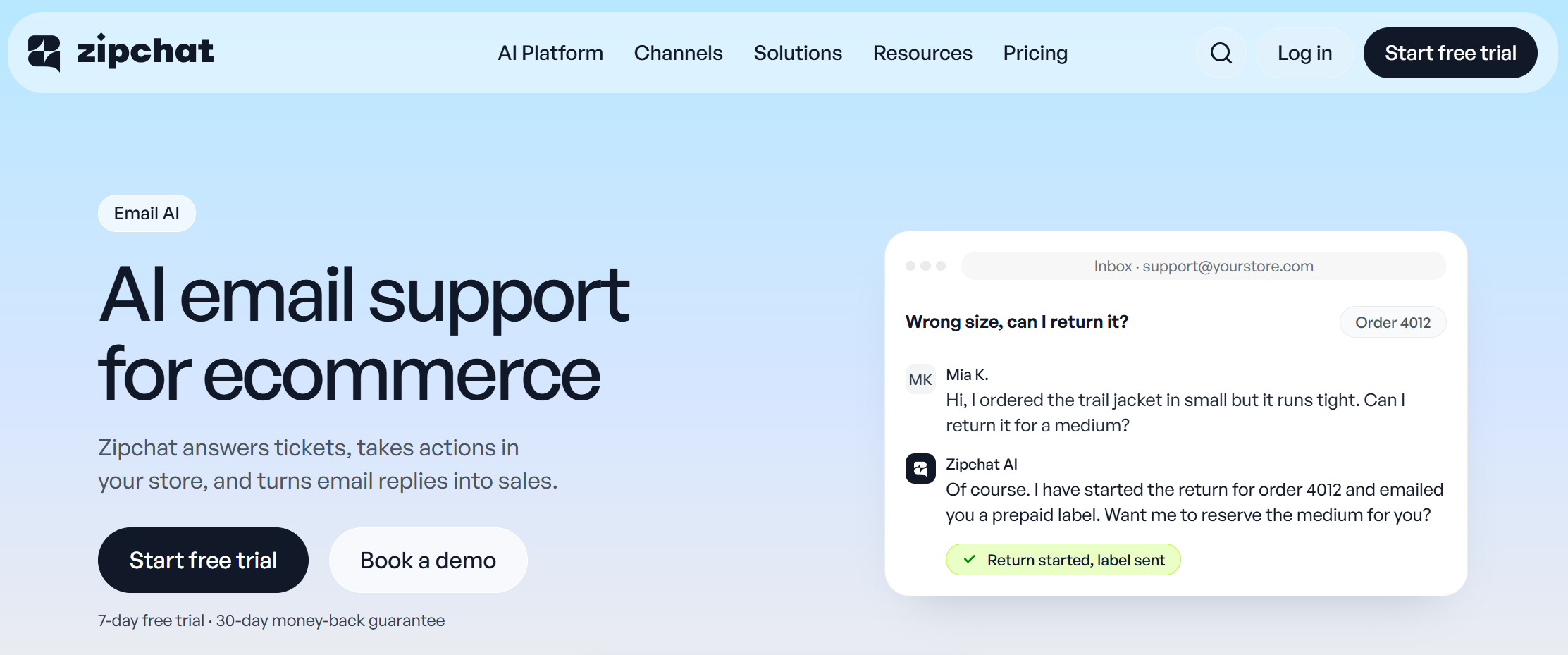
Zipchat is an AI customer-engagement platform for ecommerce that answers shoppers and sells across chat, WhatsApp, and email. It reads your catalog, policies, and pages, then handles pre-sale questions, product recommendations, and order tracking in 95+ languages. Broadcast tools send a message and wait. Zipchat’s AI answers the reply and can close the sale in the same thread.
Add Zipchat alongside your email tool when you want shoppers to answer back: AI website chat catches the shopper mid-browse, and WhatsApp campaigns reach the phone customers keep checking, then let them respond to the AI or a human agent.
Proof it converts: Ring Automotive saw 12% of its Zipchat conversations turn into sales, with a higher average order value than the site average (Ring Automotive success story). Shelly reports 8-12x monthly ROI from better conversion and fewer drop-offs (Shelly success story).
Key features:
- AI website chat that recommends products and answers pre-purchase questions.
- One-off WhatsApp campaigns to segments (cart recovery, launches, upsells), with automated. triggers coming soon. Analytics cover delivery, read, reply, purchase, and revenue.
- One-time Shopify discount code generation inside the chat.
- WhatsApp, Instagram, Messenger, and AI email support in one inbox.
- Built for Shopify certified, plus WooCommerce, Magento, and Wix.
Pricing: Starter is $64/month (750 AI replies), Pro $240/month (3,000), Scale $480/month (6,000), and Scale Plus $960/month (14,000), each with a 7-day free trial and a 30-day money-back guarantee.
Rating: 4.8/5 on G2 and 4.8/5 on the Shopify App Store.
Pros:
- Real two-way conversation, answered by AI that knows your catalog.
- WhatsApp campaigns with revenue attribution.
- 1-click Shopify install, with the AI trained automatically from a crawl of your site and catalog.
Cons:
- It’s a conversational engagement tool, not a full email-automation flow builder.
- WhatsApp campaigns are one-off sends today. Automated triggers such as abandoned-cart flows are still coming soon.
- Pricing is tiered by AI replies, so a busy month can push you into a reply pack or the next plan.
Best for: Shopify, WooCommerce, and Magento stores that want a channel customers reply on, not another broadcast. For the deeper playbook, see WhatsApp marketing for ecommerce.
2. Omnisend, best for email plus SMS built for ecommerce
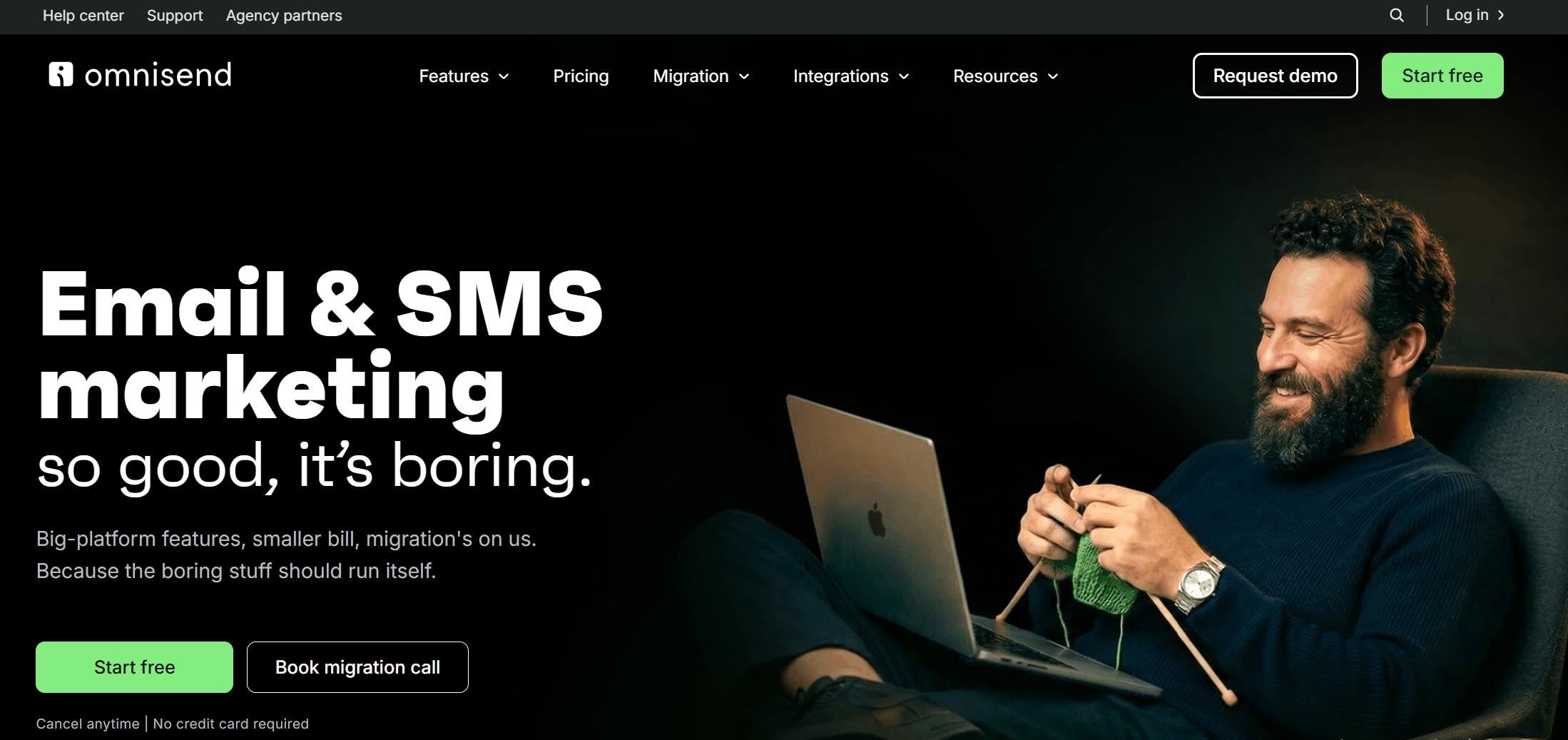
Omnisend is an ecommerce-focused email and SMS platform, and the closest like-for-like swap for Klaviyo’s core job. It carries pre-built automations for welcome, cart, and post-purchase flows, and a clean Shopify integration that most reviewers call out.
Key features:
- Email, SMS, and web push notifications in one workflow builder.
- Pre-built ecommerce automations and segmentation.
- Product picker that pulls catalog items into campaigns.
- A/B testing and reporting tuned for revenue.
Pricing: Free tier (500 emails), Standard from $11.20/month, Pro from $41.30/month; SMS pricing starts at $0.007 per SMS.
Rating: 4.6/5 on G2.
Pros:
- Strong ecommerce fit.
- Easy setup.
- SMS and email in one flow.
Cons:
- No WhatsApp or on-site chat.
- SMS now needs the Pro tier for accounts opened on or after May 4, 2026.
Best for: Shopify and WooCommerce stores that want Klaviyo’s email-plus-SMS motion at a gentler price.
3. Mailchimp, best for broad email marketing beyond ecommerce
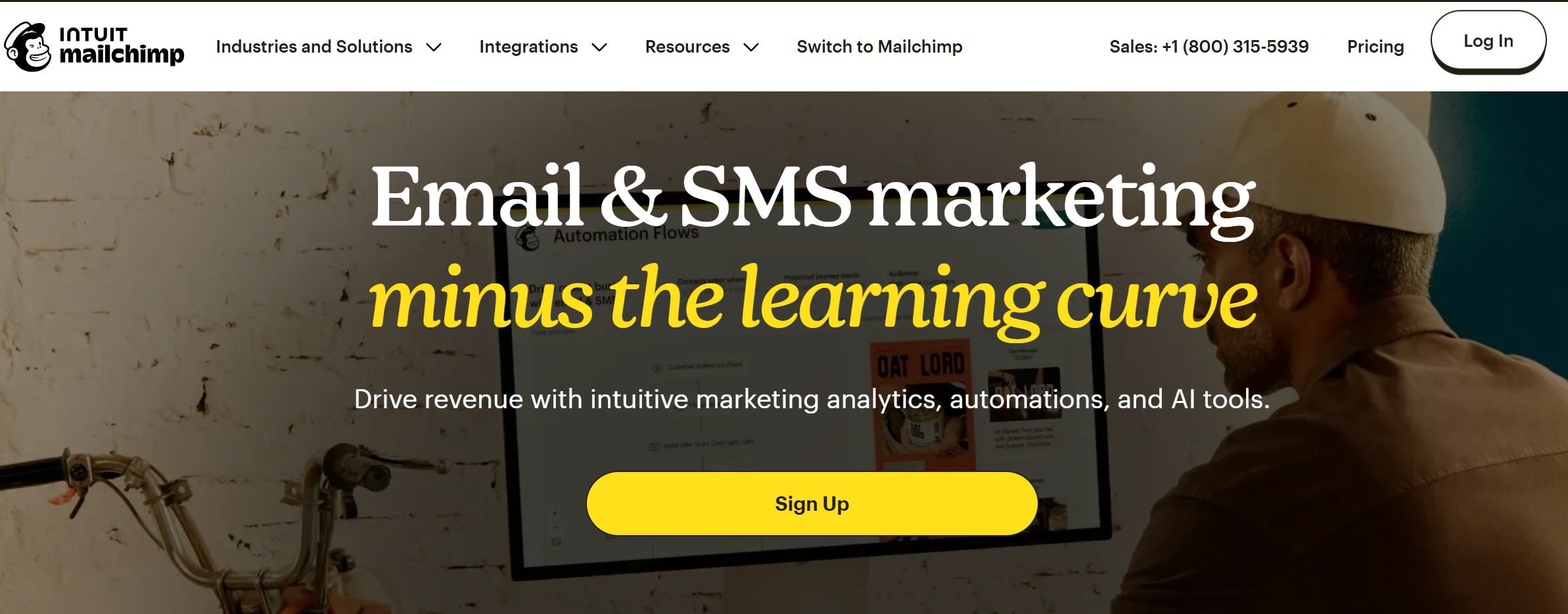
Mailchimp is an all-in-one marketing platform suitable for smaller stores, covering email and social media marketing from one account. It’s the general-purpose tool most teams have touched, with a huge template library and a low learning curve.
It’s less ecommerce-specialized than the others here, so deep store automations need more setup, but it’s approachable and widely integrated.
Key features:
- Drag-and-drop email builder with a large template gallery.
- Audience management and basic segmentation.
- Multi-step automations on the Standard tier.
- SMS marketing as a paid add-on in supported regions.
Pricing: Essentials from $13/month, Standard from $20/month, and Premium from $350/month.
Rating: 4.4/5 on G2.
Pros:
- Familiar interface.
- Wide integrations.
- Gentle entry price.
Cons:
- Pricing at scale and charges for unsubscribed contacts draw the most complaints.
- SMS is limited by region.
- Ecommerce depth trails the specialists.
Best for: smaller stores and mixed B2C/B2B senders who want simple email over deep ecommerce automation.
4. Brevo, best for email, SMS, and WhatsApp on one bill
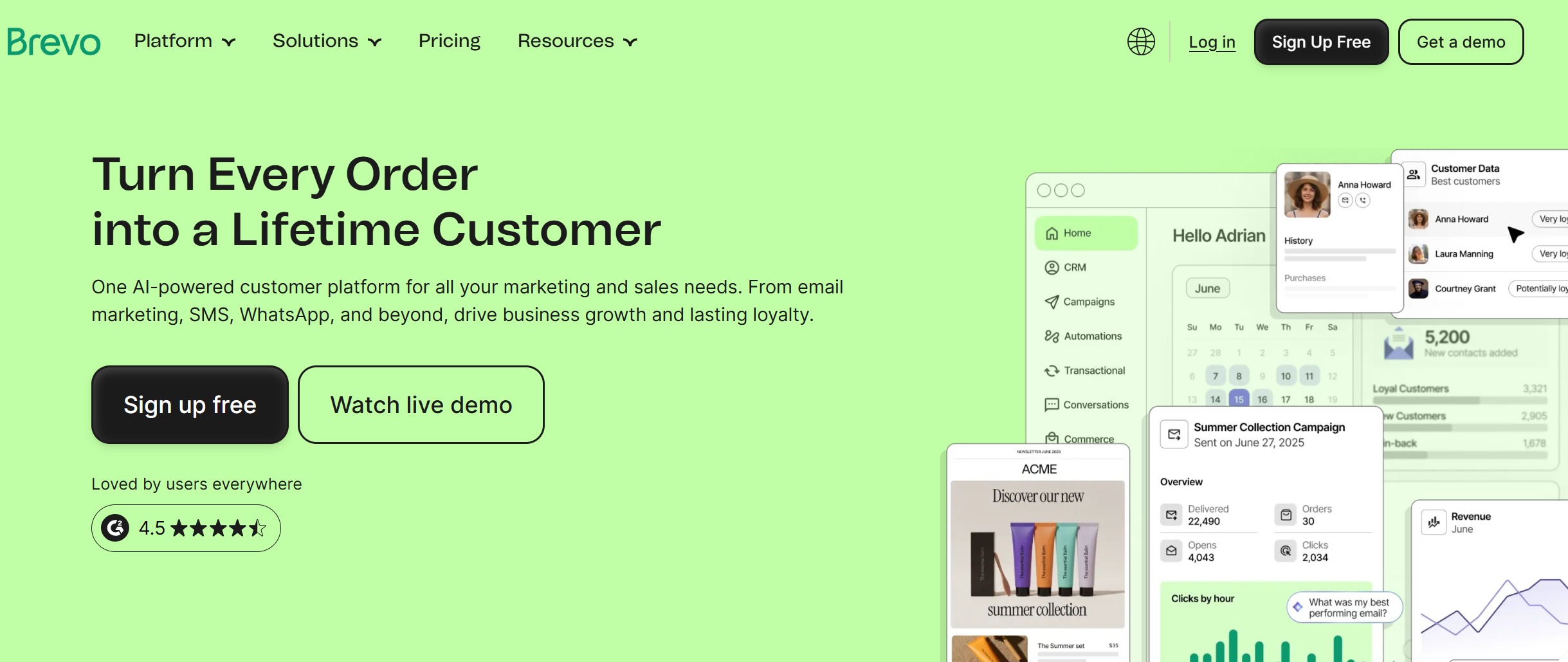
Brevo (formerly Sendinblue) is a marketing platform that bundles email, SMS, WhatsApp campaigns, and a live chat widget. It’s the broadest traditional channel mix on this list, which makes it a value pick for a store that wants more than email without stitching tools together.
Key features:
- Email and SMS campaigns with automation.
- WhatsApp campaigns on the Professional plan.
- Built-in live chat and a shared inbox.
- CRM and contact management included.
Pricing: Free tier, Starter from $8.08/month, Standard from $16.17/month, and Professional from $449.08/month. WhatsApp campaigns start on Professional.
Rating: 4.5/5 on G2.
Pros:
- Email, SMS, WhatsApp, and chat under one roof.
- Low entry price.
- CRM included.
- Offers customer support for all users, including free plan subscribers.
Cons:
- WhatsApp is gated to the pricier Professional plan.
- Tight contact caps on cheaper tiers push you up faster than expected.
Best for: stores that want the widest channel spread on a single platform and can grow into the Professional tier for WhatsApp.
5. Drip, best for ecommerce email automation with unlimited sends
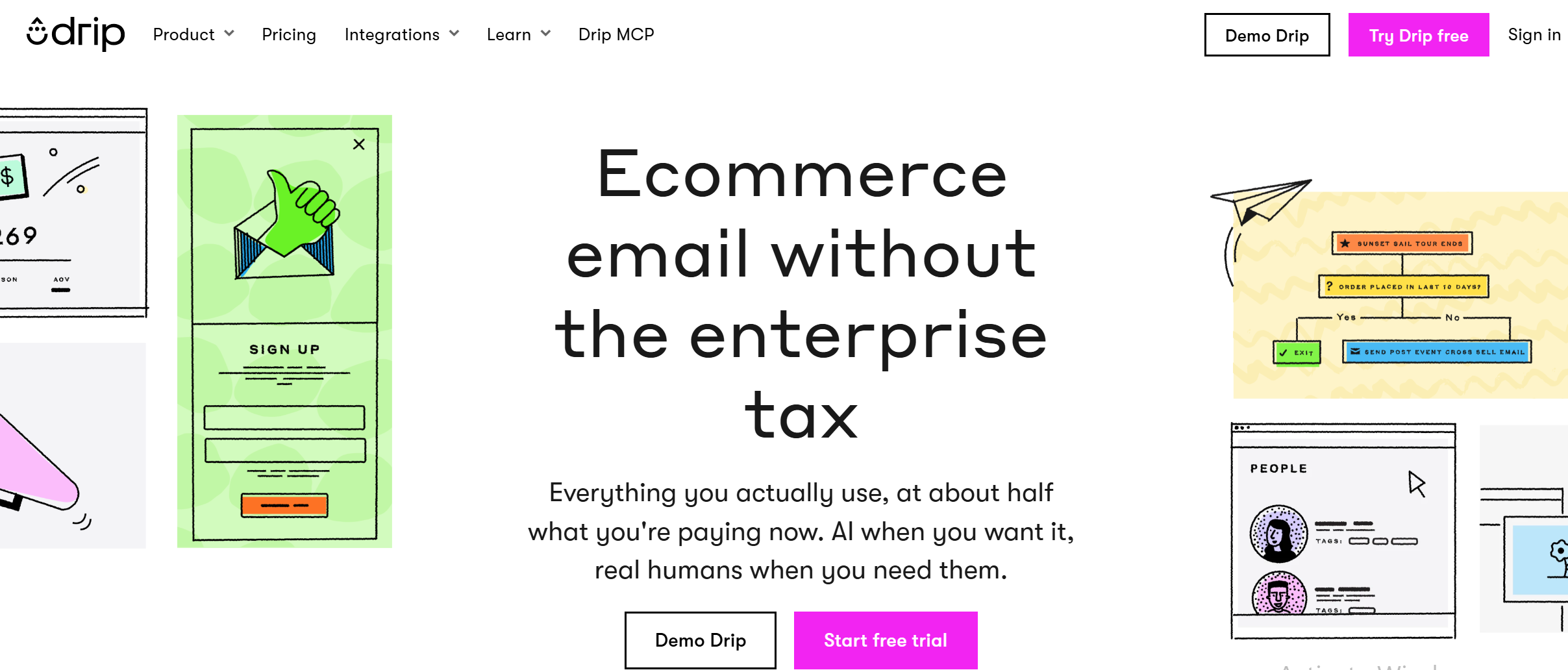
Drip is an ecommerce email automation tool that syncs purchase, catalog, and browsing data to drive personalized flows. Its email pricing is one subscriber-based slider with no feature gates on email automation, so there’s no “pay more for flows” tier.
Key features:
- Subscriber-based pricing with unlimited email sends.
- Deep ecommerce automations and segmentation.
- Catalog and browsing-behavior personalization.
- Pre-built flows for cart, welcome, and win-back.
Pricing: from $39/month for 2,500 contacts, scaling with list size. SMS is a separate add-on.
Rating: 4.4/5 on G2.
Pros:
- No feature gates on email automation.
- Strong ecommerce automation.
- Unlimited sends.
Cons:
- Higher entry price than Omnisend or Sender.
- No WhatsApp or chat.
- SMS costs extra and has no public price.
Best for: DTC stores that live in email automation and want no feature gates as they scale.
Running broadcast email and want a channel that answers back? A conversational layer can recover carts over WhatsApp and reply to shoppers in real time, then hand off to a human when the question gets complex. Start a 7-day free trial and see how many chats turn into orders.
6. ActiveCampaign, best for deep automation and CRM workflows
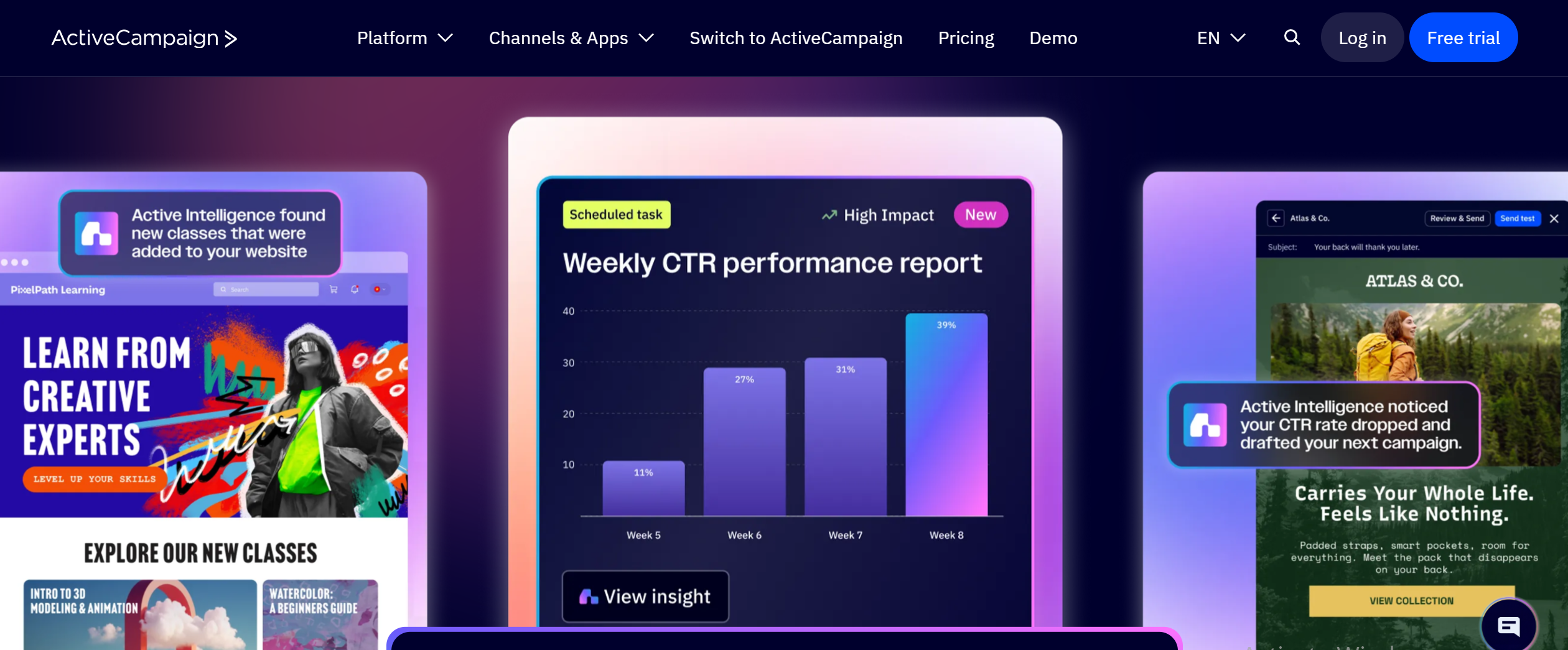
ActiveCampaign is the automation-heavy pick, built for teams that want conditional logic, CRM, and attribution over simple broadcasts. It handles ecommerce, but it leans toward marketers who want to engineer detailed journeys.
Key features:
- Advanced automation with conditional branching.
- Built-in CRM and sales pipelines.
- Segmentation, A/B testing, and attribution.
- SMS as an add-on.
Pricing: Starter from $15/month, Plus from $49/month, Pro from $79/month, Enterprise from $145/month at 1,000 contacts on annual billing. Costs rise with contact count.
Rating: 4.4/5 on G2.
Pros:
- Deep automation.
- CRM included.
- Mature attribution.
Cons:
- A steeper learning curve.
- SMS costs extra.
- No WhatsApp or storefront chat.
Best for: marketers who want to build complex automations and manage contacts as a CRM, not only send campaigns.
7. Sender, best for budget email plus SMS with a real free tier
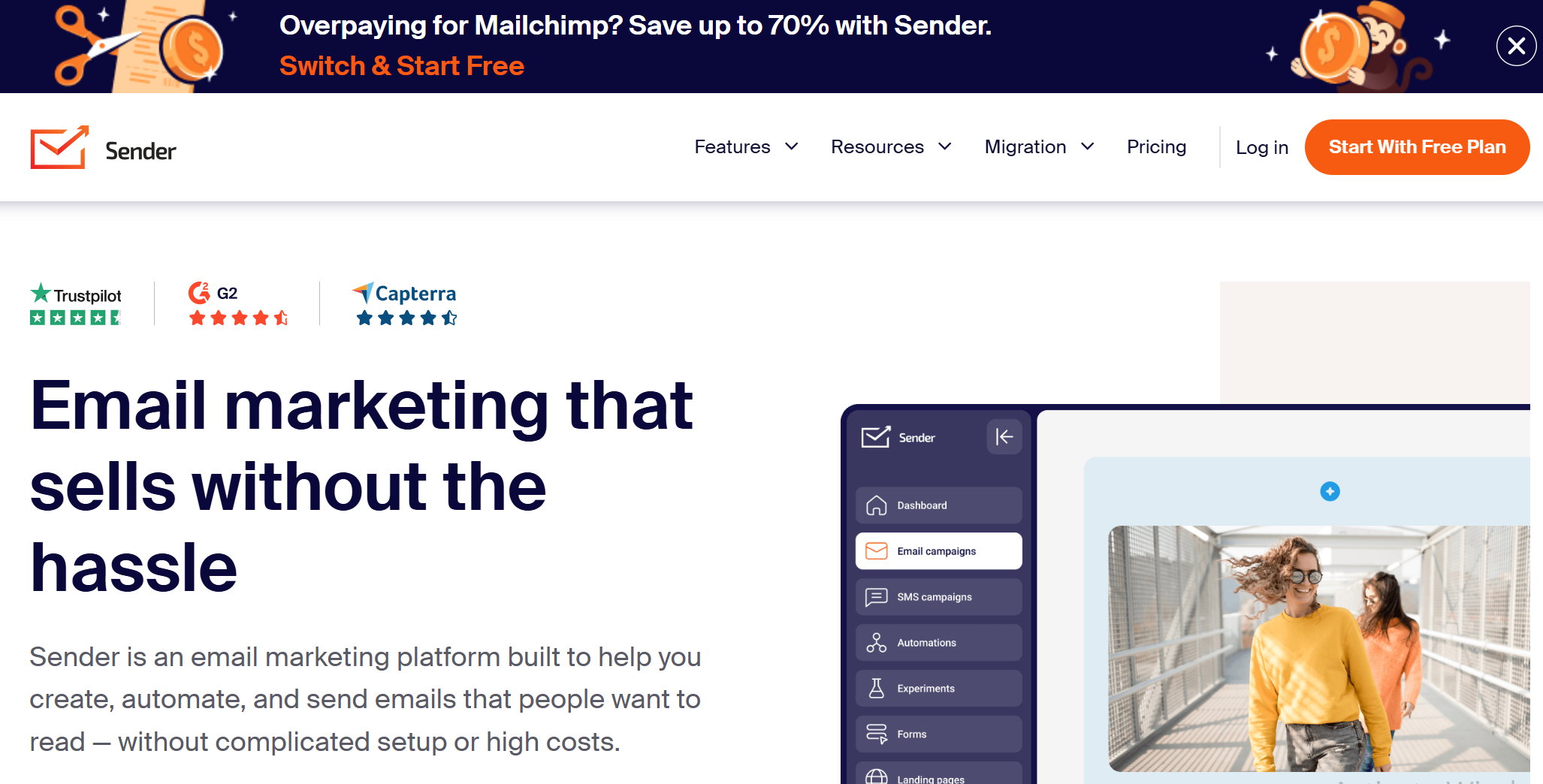
Sender is the budget email marketing platform, with a free tier generous enough to run a small store’s whole program. It covers email and SMS with automation, a drag-and-drop editor, and forms, without the price climb of the bigger names.
Key features:
- Free Forever plan for 2,500 subscribers and 15,000 emails a month.
- Email automation and drag-and-drop editor.
- SMS with pay-as-you-go credits.
- Sign-up forms and a landing page builder.
Pricing: Free Forever (2,500 subscribers, 15,000 emails), Standard from $6.30/month, and Professional from $10.50/month.
Rating: 4.7/5 on G2.
Pros:
- One of the most generous free tiers.
- Low paid prices.
- Easy to use.
Cons:
- Lighter ecommerce depth than Omnisend or Drip.
- No WhatsApp or chat, and fewer advanced automations.
Best for: small and early-stage stores that want email plus SMS without a monthly commitment.
8. Attentive, best for SMS-led reach at scale
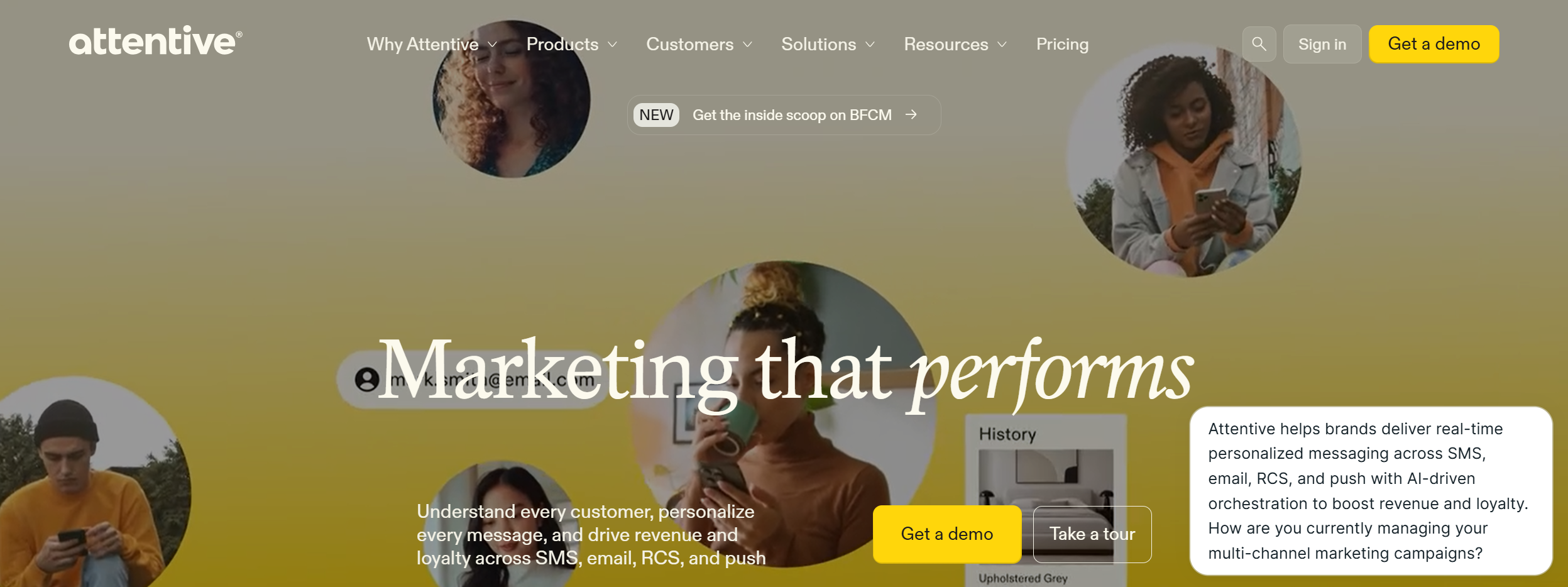
Attentive is the SMS-first platform for brands that treat text as a primary revenue channel, with email bundled in. Attentive’s reach and deliverability are strong, but this is an enterprise buy.
Key features:
- SMS marketing with advanced subscriber growth tools.
- Email on the combined Text plus Email plan.
- Identity and audience tools for large lists.
- Compliance tooling for high-volume sending.
Pricing: custom quote only, tied to a monthly message commitment plus email contact volume.
Rating: 4.5/5 on G2.
Pros:
- Best-in-class SMS reach.
- Strong list-growth tools.
- High-touch support.
Cons:
- No public pricing.
- Enterprise-level cost, so it’s a poor fit if your reason for leaving Klaviyo is price.
- No on-site chat or WhatsApp.
Best for: larger ecommerce brands making SMS a core revenue channel and budgeting for enterprise pricing.
How much do Klaviyo alternatives cost?
Entry prices range from free (Omnisend, Brevo, Sender) to $64 a month (Zipchat) to enterprise quotes (Attentive). The number that matters is cost at scale, because contact-based tools get more expensive as your list grows, while reply-based tiers track conversation volume instead of list size.
Here’s a starting-price view, all as of September 2026.
| Tool | Free tier | Entry paid price | Pricing model |
|---|
| Klaviyo (baseline) | Up to 250 active profiles | $20/month | Active profiles + SMS credits |
| Zipchat | 7-day trial | $64/month | Tiered by AI replies; Meta WhatsApp fees extra |
| Omnisend | Yes | $11.20/month | Contact-based, SMS on Pro |
| Mailchimp | Limited | $13/month | Contact-based |
| Brevo | Yes | $8.08/month | Send-volume based, WhatsApp on Pro |
| Drip | 14-day trial | $39/month (2,500 contacts) | Subscriber-based, unlimited sends |
| ActiveCampaign | 14-day trial | $15/month | Contact-based tiers |
| Sender | Yes (2,500 subs) | $6.30/month | Subscriber-based, SMS credits |
| Attentive | No | Custom quote | Message commitment + contacts |
Two costs sit outside every plan price above. SMS credits bill per message on every SMS tool. WhatsApp marketing messages also carry a Meta fee per delivered message, whichever tool sends them: about $0.025 per US marketing message, and more in markets such as Germany, since Meta moved to per-message pricing on July 1, 2025 (Meta WhatsApp pricing).
The trap with contact-based pricing is that it charges you for the size of your list, not the revenue it returns. A dormant subscriber costs the same as a buyer. Use this to compare tools on what each channel earns per dollar:
Effective cost per outcome = Monthly tool cost / conversions from that channel

Broadcast email:  reaches the inbox, converts on open-then-click
Two-way channel:  reaches the phone, converts on the reply

Same spend, higher reply rate on WhatsApp or chat = lower cost per recovered cart
The direction matters more than the exact figure. A tool priced on list size climbs whether or not the list converts. A reply-based plan climbs with conversations, which is closer to where revenue happens. Model your own list size and reply rates before you commit.
Is there a Klaviyo alternative with WhatsApp?
Yes. Zipchat and Brevo both run WhatsApp campaigns. Zipchat pairs WhatsApp with AI chat and treats it as a two-way channel, while Brevo offers WhatsApp campaigns on its Professional plan alongside email and SMS. Since Klaviyo also has WhatsApp now, the question is less “who has WhatsApp” and more “who answers the reply.”
WhatsApp matters because the message lands in an app customers already use to talk, and it invites a reply. You don’t have to take that on faith: Zipchat’s campaign dashboard reports read rate and reply rate per send, so you can test it on your own list. That reply is where a hesitant shopper asks the question that unblocks a purchase, or a cart abandoner comes back.
The two tools take different routes. Zipchat’s WhatsApp campaigns connect to its AI, so when a customer replies, the AI answers with product knowledge and can recover the cart or recommend an item in the same thread. Campaigns are one-off sends to segments today, with automated triggers coming soon.
Brevo runs WhatsApp as a campaign channel next to email and SMS, which suits a broadcast-first team. If two-way conversation is the goal, the AI-backed route resolves the reply instead of routing it to a busy inbox.
Don’t pick on email templates alone. Every tool here sends a decent campaign, so the real differences show up in channel reach, automation capabilities, pricing at scale, and whether customers reply. Match the tool to your main constraint.
| If your situation is… | Then prioritize… | Best fit here |
|---|
| You want a channel customers reply on | Two-way chat and WhatsApp, not broadcast | Zipchat |
| You want Klaviyo’s email plus SMS for less | Ecommerce email and SMS in one flow | Omnisend |
| You want WhatsApp, SMS, and email on one bill | The widest single-platform channel mix | Brevo |
| You live in complex automations | Deep branching logic and CRM | ActiveCampaign, Drip |
| You’re on a tight budget | A generous free tier | Sender |
| SMS is your core revenue channel | Enterprise SMS reach | Attentive |
Can a Klaviyo alternative recover abandoned carts?
Yes, and the channel changes what happens after the send. Every tool here can send a cart-recovery email or SMS. A WhatsApp or chat follow-up adds something email can’t: the shopper can reply with the question that stopped them, and get an answer on the spot.
Email cart recovery works on a delay: send, wait, hope for an open. A two-way channel shortens that loop. When a shopper replies to a WhatsApp campaign with “is this back in stock?”, an AI that knows your catalog answers on the spot and can recover the cart in-thread, rather than dropping the thread into a queue.
With Zipchat, those campaigns go out as one-off sends to a segment today; automated abandoned-cart triggers are coming soon. That’s the difference between measuring sends and measuring conversations.
Where ecommerce marketing is heading in 2026 and beyond
The channel mix is widening past email. Klaviyo has added WhatsApp to email and SMS, and Brevo gates WhatsApp to its top plan, so the leaders are betting on conversation. The edge goes to the tool that answers the reply a campaign triggers, in the customer’s language, while intent is high.
When Klaviyo is still the right choice
Keep Klaviyo when your program is built on deep email-flow automation, large existing flows and integrations, and an email-first channel mix. Above a certain reliance on that depth, rebuilding costs more than the savings.
Klaviyo has years of ecommerce-specific flow logic, predictive analytics, and a large integration library. A team that runs granular segmentation, leans on its data science features, and has already wired dozens of flows gets real value from that maturity. If your revenue comes mostly from email and SMS broadcasts, and your list growth is steady rather than explosive, the price curve may be worth it.
The threshold is roughly this: if email automation is the core of your revenue and you’ve invested heavily in Klaviyo flows and integrations, stay. If your bill is climbing faster than email returns, or you want a channel customers reply on, a conversational or lower-cost alternative resolves more for a cost you can forecast.
Switching channels doesn’t mean an all-or-nothing move. A store can keep a dedicated email sender for broadcast flows while Zipchat handles WhatsApp campaigns and on-site chat, so the two-way channel answers shoppers and recovers carts when they reply, without ripping out the email stack.
FAQ
What is the best Klaviyo alternative for ecommerce?
It depends on your channel needs. Omnisend is the closest like-for-like email-plus-SMS swap at a lower price. Zipchat is best for adding AI chat and WhatsApp campaigns that customers reply to.
Is there a cheaper alternative to Klaviyo?
Yes. Brevo starts at $8.08/month, Sender at $6.30/month, Mailchimp at $13/month, and Omnisend at $11.20/month, versus Klaviyo’s $20/month for 500 active profiles with SMS billed separately.
Is there a Klaviyo alternative with WhatsApp?
Yes. Zipchat runs one-off WhatsApp campaigns whose replies are answered by AI in real time (automated triggers coming soon), and Brevo offers WhatsApp campaigns on its Professional plan.
Which Klaviyo alternative is best for Shopify?
Zipchat is Built for Shopify certified with in-chat discount codes and order tracking. Omnisend and Drip also have strong native Shopify integrations.
Does Klaviyo do WhatsApp marketing?
Yes. Klaviyo now lists WhatsApp marketing as a channel alongside email and SMS. If you want an AI that answers WhatsApp replies with product knowledge and recovers the cart in the same thread, Zipchat is built around that job.
Can a Klaviyo alternative recover abandoned carts?
Yes, through email, SMS, or WhatsApp follow-ups. WhatsApp and chat let the shopper reply with the question that stopped them, so a conversational tool can resolve the objection that an email sequence can only guess at.
Match the tool to your main constraint: channel reach, pricing at scale, automation depth, or budget. Use the decision table above to shortlist by need.
Verdict
If you want to replace Klaviyo’s email and SMS program for less, choose Omnisend. If you want to add a channel customers reply on, choose Zipchat: it pairs AI chat with WhatsApp campaigns whose replies get answered and turned into orders, on tiered plans with a set reply allowance. Keep a dedicated email sender alongside it if your revenue depends on multi-step email flows.
If your Klaviyo bill is climbing faster than your email returns, start a 7-day free trial and see how many conversations turn into orders.