
TL;DR
Zipchat is the best Algolia alternative for most Shopify, WooCommerce, and Magento stores without an engineering team. Algolia is an API-first search engine built for developers. Doofinder is a plug-and-play, search-only tool for SMBs. Zipchat is an AI engagement platform whose Agentic Search sits inside chat, WhatsApp, and email. Pick Doofinder for search alone. Pick Zipchat for search plus support.
Most buyers start this comparison assuming search is a product you buy on its own. It doesn’t have to be. Algolia and Doofinder are both standalone search tools with no chat layer, no WhatsApp, and no way to answer the question after the shopper finds the product. Zipchat runs search on the same AI brain that runs support, so discovery and conversation share one knowledge base and one dashboard.
Algolia vs Doofinder vs Zipchat: quick pick by need
Here’s the short version before the details. Match your main constraint to the tool, then read the section that fits.
| If your priority is… | Best pick | Why |
|---|
| Search plus chat, WhatsApp, and email in one tool | Zipchat | Agentic Search shares the brain that runs support; no second tool to buy |
| Fast, no-code search on a small store | Doofinder | Plug-and-play install on Shopify, WooCommerce, Magento; search-only |
| Custom search infrastructure at massive scale | Algolia | API-first control and sub-50ms speed, if you have developers |
| Setup without a developer | Zipchat or Doofinder | Both install no-code; Algolia needs engineering time |
| Turning vague queries into the right product | Zipchat | Agentic search reads intent, not just keywords |
Algolia vs Doofinder vs Zipchat at a glance
Zipchat wins for stores that want search and customer engagement from one platform. Doofinder wins for a store that only wants search. Algolia wins for enterprise teams building custom search with developers.
Key features side by side
The table below is the full head-to-head.
| Feature | Algolia | Doofinder | Zipchat |
|---|
| Search type | Keyword + AI/vector (developer-configured) | Keyword + semantic (preset) | Agentic search (intent-driven) |
| Setup | Developer / API integration | No-code app install | No-code, live in under an hour |
| Primary audience | Enterprise, dev teams | SMB stores | SMB to mid-market stores |
| Platforms | Shopify, WooCommerce, Magento (via API/plugins) | Shopify, WooCommerce, Magento, PrestaShop | Shopify (native), WooCommerce, Magento, Wix |
| Chat layer | No | No | Yes (AI chat agent) |
| WhatsApp / Instagram / Messenger | No | No | Yes |
| Email support automation | No | No | Yes |
| Analytics | Deep search analytics | Search + conversion analytics | Search, chat, conversion, revenue attribution |
| Starting price | Free tier, then usage-based (Grow) | $49/month (Basic) | $49/month (Starter) |
| G2 rating | 4.5/5 | 4.7/5 | 4.8/5 |
| Best for | Enterprise custom search | Search-only SMB stores | Search + chat + WhatsApp from one platform |
Pricing and ratings verified September 2026.
Algolia overview
Algolia is a hosted search-and-discovery API that developers embed into a site or app. It’s the fastest and most configurable option here, and the most technical. You index your catalog through its API, then build the search UI yourself with its InstantSearch libraries, which return instant search results as the shopper types.
Who it’s for:
Enterprise teams and product-led companies with engineers. Strengths are real. Sub-50ms query speed, typo tolerance, granular relevance rules, and vector search you can tune to the token. Tuned well, it keeps every relevant search result near the top. At scale, few tools match its control.
The weaknesses are equally clear for a store without a dev team. Setup is an engineering project, not an app install. It rewards technical expertise most small teams don’t have on staff. Pricing is usage-based and climbs with search requests and records, so a busy catalog gets expensive fast. G2 reviewers rate it 4.5 out of 5 across 447 reviews, and the recurring theme is that the power justifies the cost only if you can staff the integration.
Algolia solves search brilliantly. It does not touch support, chat, or messaging. Weigh that before you commit a sprint to it.
Doofinder overview
Doofinder is a plug-and-play site search tool aimed at small and mid-size stores. It installs as an app or a snippet, learns your catalog, and gives you an AI-assisted search box.
Its key features include autocomplete, filters, and product recommendations, and no developer is required. Doofinder supports text, image, and voice search. Doofinder offers multi-language and multi-currency support.
Who it’s for:
SMB merchants who want better search than their platform’s default, fast, and without code. Strengths are the quick install, native connectors for Shopify, WooCommerce, Magento, and PrestaShop, and a clean merchandising layer. It’s a genuine upgrade over stock Shopify search.
The limitation is scope. Doofinder does one thing. It searches. There’s no chat agent, no WhatsApp, no Instagram, no email support. When a shopper finds a product and then asks, “Does this ship to Canada?”, Doofinder can’t answer. That conversation goes to a support tool you buy separately. Doofinder scores 4.7 out of 5 on G2 and 4.8 out of 5 on Capterra, so users like it for what it is.
It’s a strong search-only product. The question is whether search-only is what you need.
Zipchat overview
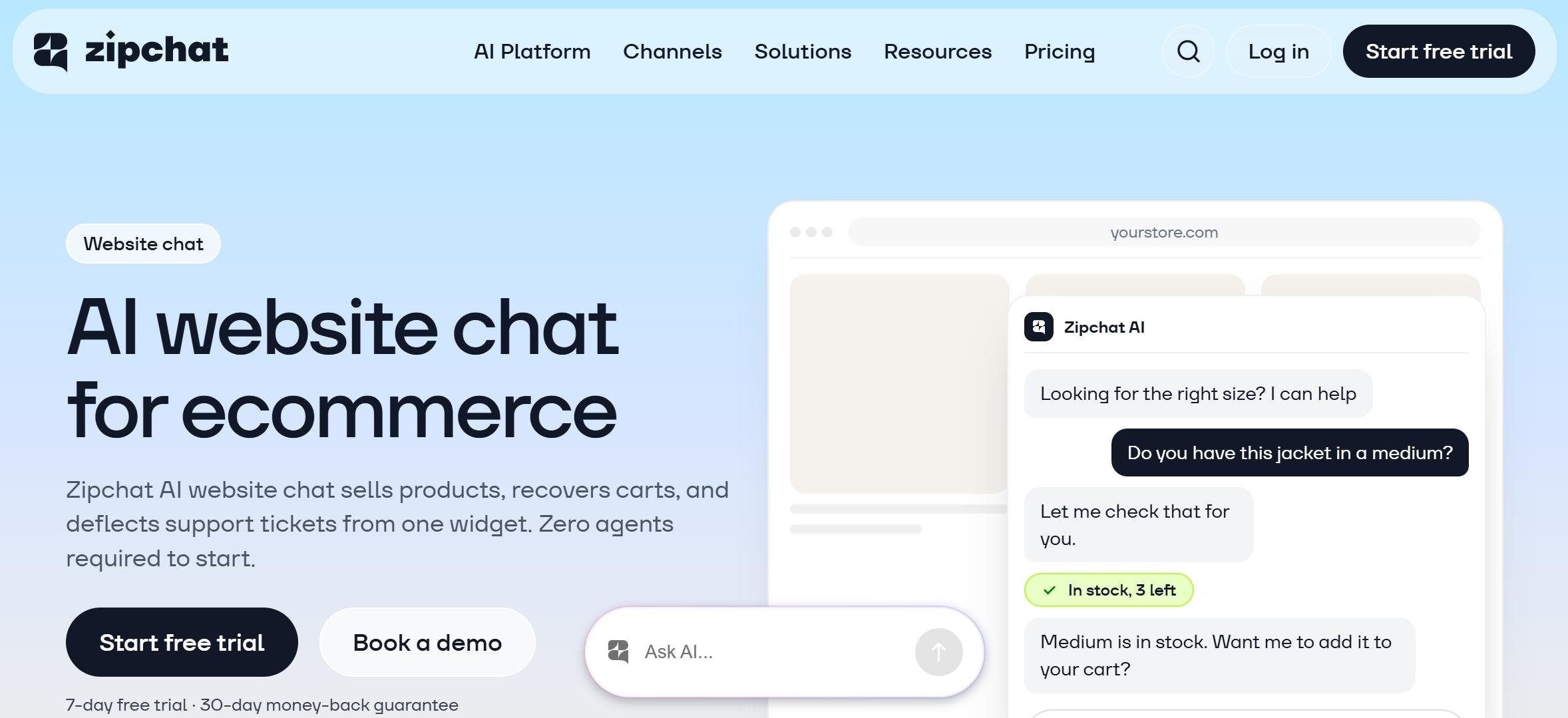
Zipchat is an AI customer-engagement platform for ecommerce. Search is one capability inside it, not the whole product. Its Agentic Search runs on the same AI that powers the chat agent, so the system that finds products is the system that answers questions about them. This is AI driven search that shares one knowledge base with support instead of running beside it.
Here’s what that changes:
Zipchat crawls your catalog, policies, and pages once, into one knowledge base. That base powers search, website chat, WhatsApp, Instagram, Messenger, and email. Setup is no-code and goes live in under an hour. It’s Built for Shopify certified, and works on WooCommerce, Magento, and Wix. See the Shopify AI search integration for the native install.
Be honest about the trade-off, because objectivity is the point. Zipchat is not a dedicated search-infrastructure product. If you need token-level relevance tuning, a custom ranking pipeline, or search at Algolia’s raw scale and speed, a specialist tool wins on that axis. Zipchat’s edge isn’t beating Algolia at search infrastructure. It’s giving a store good agentic search plus the entire engagement layer that neither competitor offers, with no second subscription. Zipchat holds a 4.8 out of 5 on G2.
Feature-by-feature comparison
Search intelligence: keyword vs semantic vs agentic
Algolia is keyword-first with configurable AI and vector search layered on top by your developers. Doofinder blends keyword matching with preset semantic search, so a query like “warm jacket” can surface coats without an exact term match. Both are search engines that return a list of search results and stop.
Zipchat’s Agentic Search goes one step further. It reads intent. A shopper who types “something for a beach wedding in July” gets interpreted, not just matched, then routed to products and, if they ask, an answer in the same thread. Keyword search fails on vague input. Agentic search treats the vague input as the real query.
Setup and developer effort
Algolia is a build. The integration process means API integration, index configuration, and a custom front end, which adds up to engineering hours and a timeline. Doofinder is a no-code app install with a setup wizard. Zipchat is also no-code and typically live in under an hour, because it crawls your site automatically and needs no help center or catalog schema work first.
For a store without engineers, this line alone rules Algolia out and puts Doofinder and Zipchat neck and neck on ease.
All three cover the big three platforms, but the path differs. Algolia connects through its API and community or third-party plugins, so coverage depends on integration work. Doofinder ships native apps for Shopify, WooCommerce, Magento, and PrestaShop.
Doofinder runs its visual site search natively on each of those platforms, with no code to write. Zipchat is Built for Shopify certified with a one-click install, plus script-based setup for WooCommerce, Magento, and Wix.
On Shopify specifically, Zipchat adds order tracking and in-chat discount codes that a search-only tool has no way to offer.
Product recommendations and merchandising
Recommendations separate a search box from a discovery engine. Doofinder pairs AI-guided product recommendations with visual search, so shoppers can browse by image, not just text. Algolia hands recommendation logic to your developers to build and rank.
Zipchat ties every suggestion to the agent that answers the follow-up question, so a recommendation can arrive with a reason. Doofinder’s merchandising rules let you pin, boost, or bury products in the results, which helps with catalog browsing but still stops at the search box.
Multichannel and chat layer
This is the clean dividing line. Algolia and Doofinder have no chat layer and no messaging channels. Zipchat runs website chat, WhatsApp, Instagram, Messenger, and email from the same agent and knowledge base. A shopper can search on the site, then continue on WhatsApp, and the AI keeps the context.
If your buyers ask questions, not just search, this is the feature that decides it.
Analytics
Algolia gives deep search analytics: query volume, click position, no-result rates. Doofinder reports search and conversion metrics. Zipchat reports across the whole journey, search queries, chat volume, chat-to-sale conversion, average order value, and revenue attributed to conversations.
That view turns raw analytics into conversion optimization you can act on. You see not only what shoppers searched, but what they bought after the AI helped.
Pricing comparison
Zipchat starts at $49/month flat. Doofinder starts at $49/month. Algolia is free to start, then usage-based, which gets unpredictable as traffic grows.
| Plan detail | Algolia | Doofinder | Zipchat |
|---|
| Free tier | Yes (10k requests, 100k records) | Free trial only | No free plan |
| Starting paid price | Usage-based (Grow): ~$0.50 per 1,000 requests + $0.40 per 1,000 records | $49/month (Basic, up to 10k requests) | $49/month (Starter) |
| Mid tier | Grow Plus (adds AI features) | $149/month (Pro), $349/month (Advanced) | $129/month (Growth), $249/month (Pro) |
| Billing model | Usage-based (requests + records) | Flat monthly by request tier | Flat monthly by AI reply tier |
| Free trial | Free tier, no time limit | 30-day free trial | 7-day free trial |
| Money-back guarantee | No | No (annual is non-refundable) | 30-day money-back |
| Enterprise path | Premium / Elevate (custom, Elevate ~$50k/yr) | Enterprise (custom) | Scale $499/month, Enterprise on request |
Algolia usage-based Grow and Grow Plus pricing and free tier; Doofinder Basic, Pro, and Advanced plans with 10% annual discount; Zipchat plan tiers, 7-day trial, and 30-day money-back.
Doofinder’s Basic tier is $49/month, while Algolia’s free tier is genuinely useful for a small catalog, but the usage-based model means a traffic spike or a large catalog can turn a $0 bill into a four-figure one without a plan change. A flat reply-based plan like Zipchat’s holds its price whether the AI handles 50 searches or 5,000. To size your own tiers, compare Zipchat pricing.
What agentic search is and why it matters
Agentic search is search that understands what a shopper wants from a vague query, then acts on it, instead of matching keywords to a catalog. It’s the strategic difference between these three tools, so it’s worth being precise.
Keyword search matches strings. Type “blue shoes” and it finds products tagged blue and shoes. Semantic search adds meaning, so “warm jacket” can find a coat. Both still hand back a list and stop. Agentic search reads intent from messy, human input like “a gift for my dad who fishes” and reasons toward the answer, then continues the conversation if the shopper has a follow-up.
Why does that matter for a store? Because real shoppers type badly. They describe a use case, not a SKU. Keyword search returns “no results” on exactly the queries with the highest buying intent, and every no-result is a lost sale a search log rarely flags.
The second half is the part Algolia and Doofinder structurally can’t copy. Zipchat’s Agentic Search shares the same AI brain that runs the chat agent, WhatsApp, and email. Discovery and support are one system, trained on one knowledge base. A shopper searches, the AI interprets, recommends, and then answers the shipping question, all in one flow. Standalone search hands the shopper a list and a dead end. See how the Agentic Search engine connects discovery to conversation.
Who each solution is best for
Algolia fits enterprise dev teams. Doofinder fits SMBs that want search only. Zipchat fits stores that want search, chat, and WhatsApp from one platform.
| Store profile | Best fit | Reason |
|---|
| Enterprise with engineers and custom search needs | Algolia | API control, tunable relevance, raw scale and speed |
| Small store wanting a quick search upgrade only | Doofinder | No-code install, native connectors, search-focused |
| Store that also handles support and messaging | Zipchat | Search plus chat, WhatsApp, Instagram, and email in one tool |
| Store with no developer and a tight budget | Zipchat | Flat $49/month, one subscription instead of search plus a chat tool |
| High-intent shoppers who ask questions | Zipchat | Agentic search interprets vague queries and answers follow-ups |
The pattern is simple. If search is the only gap, a specialist fills it. If the shopper’s journey includes questions, and it almost always does, an engagement platform covers more of it for less. For the Doofinder-style buyer weighing that trade-off, the Agentic Search page shows what search plus conversation looks like in practice.
Zipchat isn’t the answer for every store, and pretending otherwise would fail the honesty test that makes this comparison useful. There are three clear cases where a dedicated search tool wins.
First, huge catalogs that need dedicated search infrastructure. If you’re indexing millions of SKUs and need custom ranking pipelines, faceting at scale, and sub-50ms speed as a hard requirement, Algolia’s specialist engine is built for exactly that. A general engagement platform isn’t.
Second, teams already invested in a chat stack. If you run Intercom, a mature help center, and a support org you’re not replacing, bolting a focused search tool onto that stack can be the cleaner move than adopting a new engagement layer.
Third, API-level control requirements. If your search needs to power a custom app, a headless front end, or logic your developers must own end to end, an API-first tool gives control an app-based platform intentionally abstracts away.
Outside those cases, the standalone-search assumption usually costs a store a second subscription and a split knowledge base for no real gain.
Verdict
If you’re an enterprise with a dev team and search is a build you’re staffing, choose Algolia. Its speed, control, and scale are worth the engineering cost at that level, and nothing here matches its raw search infrastructure.
If you run a small store, want a fast no-code search upgrade, and only need search, choose Doofinder. It installs in minutes, it’s a real improvement over default platform search, and its ratings back it up.
If you want search that understands intent plus chat, WhatsApp, Instagram, and email from one platform, one knowledge base, and one flat plan, choose Zipchat. For most Shopify, WooCommerce, and Magento stores without an engineering team, that’s the better economics and the fuller answer to how shoppers shop.
Search doesn’t have to be a separate product from engagement. Start a 7-day free trial and see how many searches turn into conversations, and conversations into orders.
FAQ
What is the best Algolia alternative for ecommerce?
It depends on fit. Doofinder is the best Algolia alternative for search-only SMB stores. Zipchat is the best pick for stores that want search plus chat, WhatsApp, and email from one platform.
What is the difference between Algolia and Doofinder?
Algolia is an API-first search engine built for developers, with deep control and usage-based pricing. Doofinder is plug-and-play and no-code, but search-only, aimed at small and mid-size stores.
Is Doofinder a good alternative to Algolia?
Yes, for non-technical SMB stores that want fast, no-code search. Note that Doofinder has no chat layer, WhatsApp, or email, so it covers search but not customer conversations.
Do I need a developer to set up ecommerce search?
For Algolia, yes; it requires API integration and a custom front end. For Doofinder and Zipchat, no; both install no-code, and Zipchat is typically live in under an hour.
What is agentic search?
Agentic search understands shopper intent from vague queries and acts on it, rather than matching keywords. It interprets input like “a gift for my dad who fishes” and reasons toward the right product.
Does Zipchat replace Algolia and Doofinder?
For most SMB stores, yes. Zipchat covers agentic search and adds chat, WhatsApp, Instagram, and email that neither competitor offers. Very large catalogs needing custom search infrastructure may still prefer Algolia.
Which AI search works with Shopify, WooCommerce, and Magento?
All three support those platforms. The difference is setup effort: Algolia needs developers, while Doofinder and Zipchat install no-code, and Zipchat is Built for Shopify certified.er alternative”.