By goal
By industry
View all industriesBy capability
Integrations
All integrationsZipchat reads every comment on your Facebook and Instagram posts, reels and ads, then hides spam, scams and abuse before other shoppers see them.
Try Zipchat in action
Start your free trial or book a demo, no credit card required.
Start free trial Book a demoLearn agentic commerce
Earn certification and merch rewards. No credit card needed.
Start nowZipchat's AI reads each comment under your Facebook and Instagram content and decides what to do with it: hide it, answer it, or leave it alone. It runs on organic posts, boosted posts and unpublished dark post ads, without keyword lists to maintain.
Yes. Zipchat connects to your Facebook Page and Instagram account, reads every incoming comment, and takes an action on it within seconds. Unlike a keyword blocklist, which only catches the words you thought of in advance, the agent reads the comment in context and decides whether it is a real customer, a scam account, a competitor, or abuse.
The distinction matters more than it sounds. A blocklist that hides the word "refund" also hides the customer who is asking a fair question about one. Zipchat separates the two, because it understands what the comment is asking for and it has your order data behind it.
Why this is a revenue problem, not a hygiene problem. A Harvard Business School working paper ran two field experiments on live Facebook and Instagram ad campaigns. When automated moderation was switched on, return on ad spend rose from 0.459 to 0.678 and cost per purchase fell from $666.56 to $454.34. In a controlled follow-up with 2,485 participants, hiding harmful comments raised stated purchase intent from 36.9 to 47.2, a significant effect. Replying to comments, tested on its own in the same experiment, did not produce a significant effect.
That result is worth sitting with. The people affected by your comment section are mostly not the people writing in it. They are the shoppers reading it before they decide. Peer-reviewed work in the Journal of Marketing Research found a single visible negative review on the first page cut purchase probability by 41.8%. A comment section under a paid ad works the same way, and you are paying to put it in front of people.
Does moderation cost you reach? No. The same Harvard experiment measured impressions and reach across both arms and found no meaningful difference. Delivery was unaffected. What changed was whether the traffic converted.

Zipchat handles the public layer and then continues the conversation privately through comment to DM automation, or hands it to a person with human chat takeover. For the full picture of what the agent does with a comment, see the AI social media manager overview.
A supplement brand launches a Meta campaign on a Friday afternoon at $2,000 a day. Within an hour the ad has ninety comments. Eleven of them are scam accounts posting "message this number for 70% off", using a display name close enough to the brand's own that a shopper skimming the thread would not catch it. Four more are competitors dropping their own link.
Nobody on the team is looking. It is Friday evening, the campaign runs through the weekend, and the ad keeps serving. Every impression the brand pays for on Saturday shows that comment section underneath the creative.
With Zipchat connected, each of those fifteen comments is hidden within seconds of being posted. The scam accounts see their own comments still sitting there, so they do not know to try again from a different handle. Meanwhile a real comment in the same thread, "is this safe with blood pressure meds?", gets a public reply pointing to the ingredient page and a private message opening a proper conversation.
Why moderation pays for itself here: the ad spend is the same either way. The only variable is what the next shopper reads before deciding.
A customer comments under a product reel: "third week waiting, no tracking, this is a joke." It is a real complaint from a real customer, and hiding it would be the wrong call. Deleting it would be worse, because deletion is conspicuous and this person is already angry.
Zipchat is set with a rule the brand wrote in one sentence: never discuss a delivery problem in public, always move it to DM. So the agent posts a short public reply, "That is not good enough, we have sent you a message to sort it out", and opens a direct message. In the DM it looks up the order, finds the carrier exception, and either resolves it or escalates to a person with the full thread and the order attached.
The public thread now shows a brand that answered in seconds. The problem gets handled where it belongs. And the next shopper scrolling that reel sees a company that responds, not a company with an unanswered complaint sitting at the top of its comments.
Why hiding was the wrong tool: moderation is not about silencing criticism. It is about removing what has no business being there, and routing what does.
No. A Harvard Business School field experiment ran the same ad campaigns with and without automated moderation and measured impressions and reach across both. The difference was not meaningful. Delivery is not affected by what you hide. What changed in that experiment was conversion: return on ad spend rose from 0.459 to 0.678.
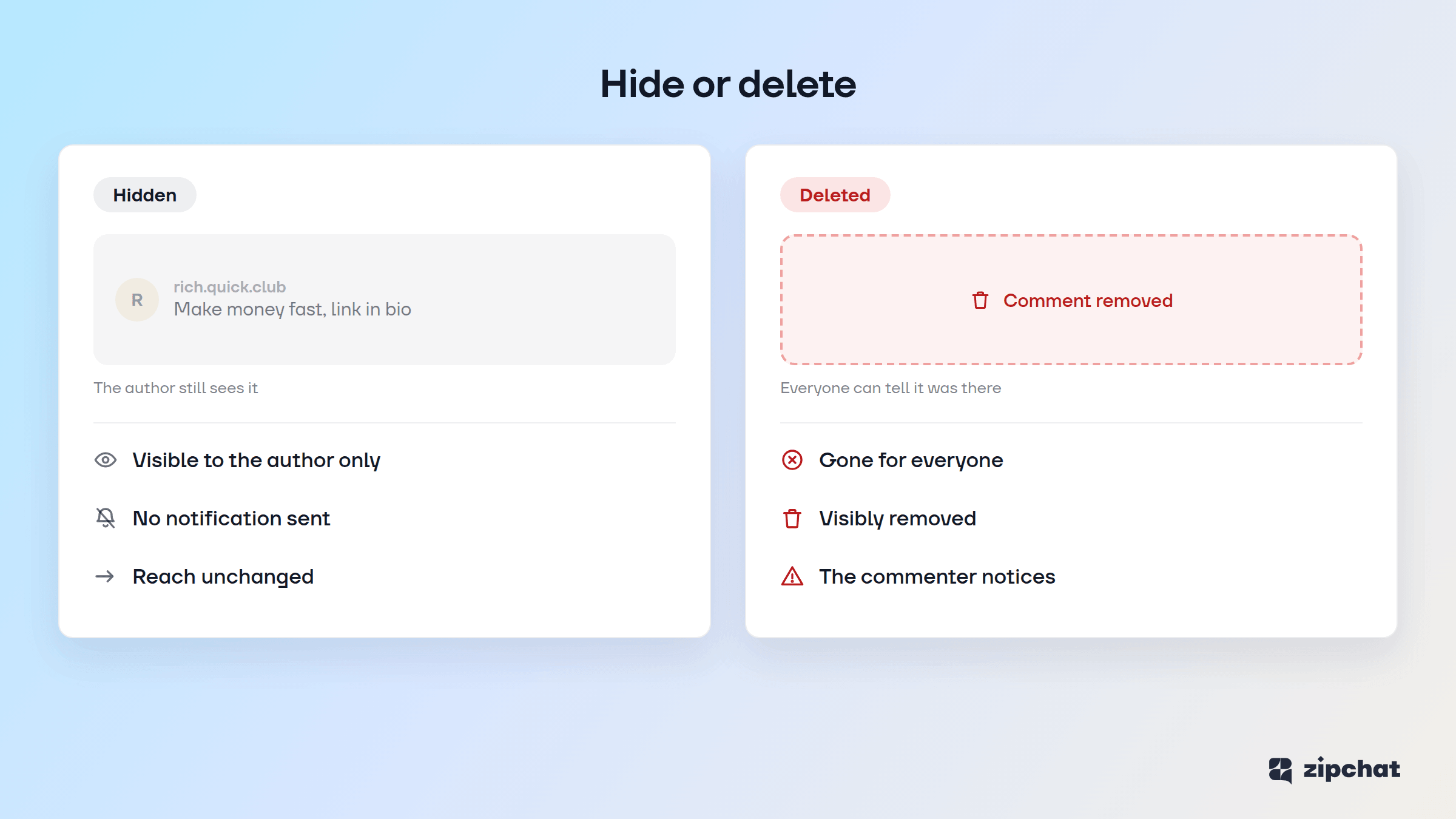
No. On both Facebook and Instagram, a hidden comment stays visible to the person who wrote it and to nobody else, and neither platform sends a notification. This is why hiding is usually the better tool than deleting. A deleted comment vanishes conspicuously, which tends to provoke the kind of commenter you least want to provoke.
Yes, on both platforms, including boosted posts and unpublished dark post ads. There is no separate configuration. Ad comments are where most brands need this most, because the brand is paying to distribute the creative that the comment section sits under.
It reads the comment rather than matching it against a word list. A keyword filter set to catch "refund" will hide a legitimate question about your returns policy. Zipchat separates a customer with a problem from an account attacking you, then applies the rule you set for each. Real complaints get answered, publicly or privately, based on your instructions.
They go to a person. Anything the agent cannot resolve with confidence is escalated with the full comment thread attached, so whoever picks it up has the context without going to find it. You can also set categories that always escalate regardless of confidence, which most brands do for anything legal or medical.
Comment moderation is the part of social media management that nobody enjoys and everybody postpones. It is also the part that a Harvard field experiment measured a return on ad spend improvement from. Both of those things are true at once, which is why it is worth automating first.
When someone comments on your Facebook or Instagram post, Zipchat opens a direct message and keeps talking, with your catalog, your stock levels and your order data behind every reply.
Seamlessly transfer conversations from AI to human agents when needed, with live chat takeover or ticketing system integration.
Instantly resolve "where is my order" inquiries by automatically pulling live order status, tracking numbers, and courier details from Shopify.
Let the AI Agent recommend products through natural conversation, understanding complex requirements and asking qualifying questions to match shoppers with perfect items.