By goal
By industry
View all industriesBy capability
Integrations
All integrationsWhen someone comments on your Facebook or Instagram post, Zipchat opens a direct message and keeps talking, with your catalog, your stock levels and your order data behind every reply.
Try Zipchat in action
Start your free trial or book a demo, no credit card required.
Start free trial Book a demoLearn agentic commerce
Earn certification and merch rewards. No credit card needed.
Start nowZipchat turns a comment into a private conversation. It posts a short public reply so the commenter knows to check their messages, opens the DM, and then continues as a real conversation rather than a one-shot link drop.
Yes. When a comment arrives on your Facebook Page or Instagram account, Zipchat can send that person a direct message and post a short public note in the thread so they know to look. This is the mechanic most people know from keyword campaigns: comment a word, get a message.
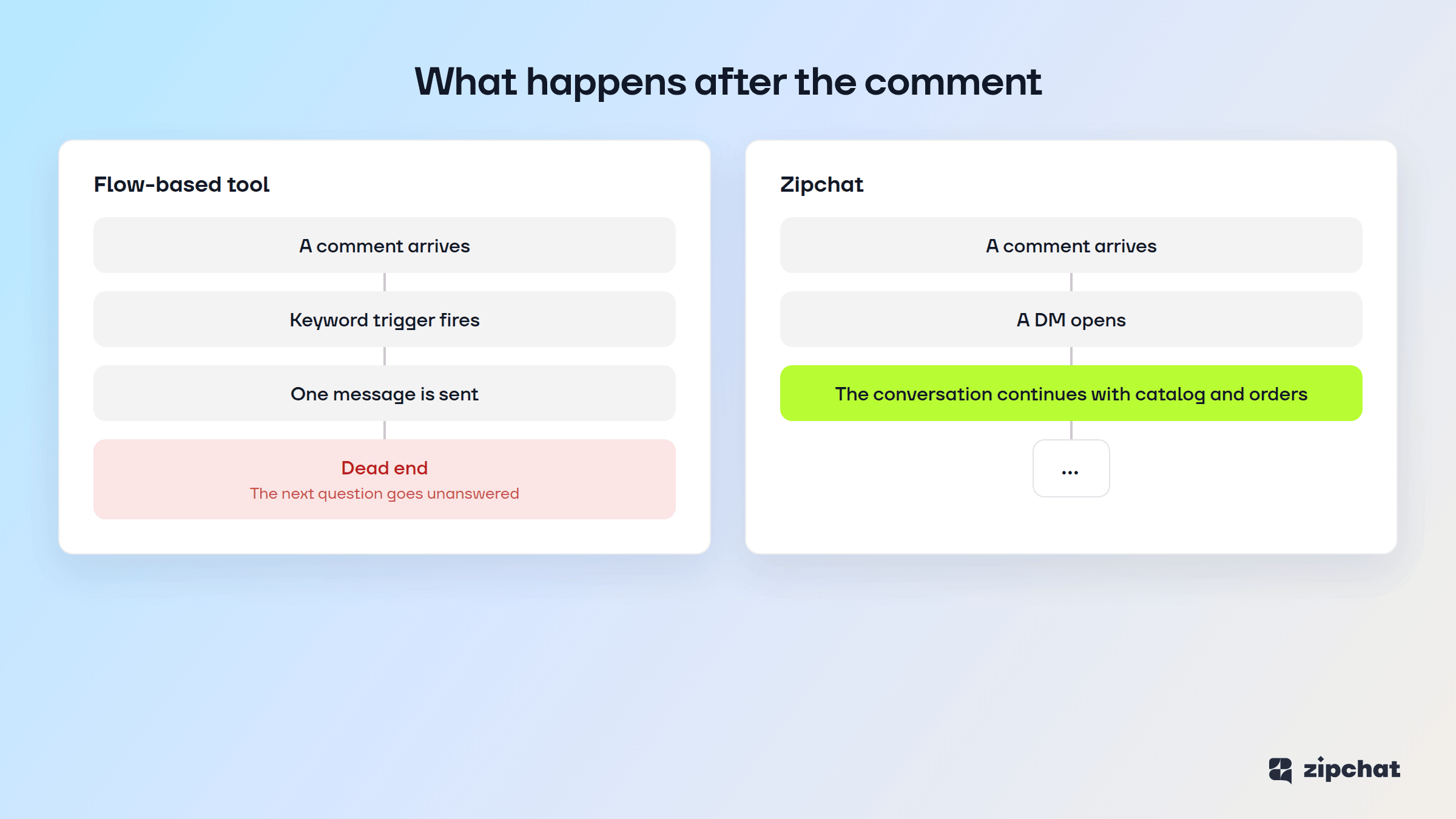
What happens next is where this stops being the same feature. In a flow-based tool, the DM is the end of the sequence. The person receives whatever was loaded into the flow, and if they reply with a question the flow did not anticipate, the conversation stops.
In Zipchat, the DM is where the conversation starts. The agent that receives the reply is the same agent that runs your Instagram DMs and Messenger. It can read your live catalog, check whether the size is actually in stock, look up an order, generate a discount code, or take an action in your store through Agentic Skills. Someone who comments "link?" under a reel can be in a conversation about which of two products fits them better ninety seconds later, and buying.
Why the public reply matters. Zipchat posts a short acknowledgment in the thread alongside the DM, for two reasons. The commenter gets a signal to check a message they were not expecting. And everyone else reading the thread sees a brand that answered, which is the part that affects the shoppers who never comment at all.
On speed. The median time from comment to reply across the first 33 brands in early access was 13 seconds. That number matters because of where the person is standing when it lands. They are still in the app, still on the post, still in the state of mind that made them comment. An hour later they have moved on, and a reply two days later is talking to nobody. Research on sales lead response found contacting someone within five minutes rather than thirty improved the odds of qualifying them by 21 times. That study is about phone calls, not comments, so treat it as a parallel rather than proof. The mechanism is the same one: attention decays fast, and the reply is worth the most while it is still fresh.

For the full picture of what the agent does with a comment, see the AI social media manager overview.
A skincare brand posts a reel about its routine and adds a line to the caption: comment ROUTINE and we will send you the full guide. The reel does better than expected. Four hundred people comment the word overnight.
Every one of them gets a direct message with the guide, and a short public reply in the thread. That part is not new. Any comment automation tool does this.
Then eleven of them reply to the DM. "Which of these works for oily skin?" "Is the serum safe while pregnant?" "Do you ship to Ireland?" "I have the cleanser already, what do I add next?"
In a flow-based tool those eleven replies sit unanswered until someone opens the inbox, because the flow ended when the guide was sent. In Zipchat the same agent answers each one from the product catalog and the shipping rules, recommends the right next product for the routine the person already owns, and checks stock before recommending anything. The pregnancy question gets escalated to a person, because the brand set that rule.
Why the difference compounds: the giveaway was never the point. The eleven conversations were the point, and they only exist if something can answer them at 2am.
A shopper comments under a Facebook ad: "i ordered on the 3rd and it still says processing, whats going on."
This is a real customer with a real problem, and it is sitting in public under an ad the brand is actively paying to distribute. Every shopper who reads that thread before buying sees an unanswered order complaint.
Zipchat posts a public reply within seconds, "Sorry about that, we have messaged you to check on it", and opens a DM. In the message it asks for the order number or matches the customer directly, pulls the live order status, finds that the order shipped two days ago with a tracking update the carrier had not pushed, and sends the tracking link.
The thread under the ad now reads as a brand that answers. The customer has an answer instead of a ticket. Nobody on the team touched it.
Why this is the same feature as the giveaway: both are a comment becoming a conversation. The only difference is who started it and why.
ManyChat runs a flow you build in advance, triggered by a keyword you predicted. When the person replies with something the flow did not anticipate, the conversation stops. Zipchat reads the comment, decides what it means, and then keeps talking with your live catalog and order history behind it. There is no flow to build and no keyword to guess.
Both. A keyword trigger handles the campaign case, where you ask people to comment a specific word. Outside of that, the agent decides per comment whether the answer belongs in the thread, in a private message, or in both. A sizing question usually gets answered publicly so everyone reading benefits. An order problem moves to private.
Yes, and they are Meta's, not ours. The platforms allow one automated private reply per comment, and it has to be sent within seven days of the comment being posted. There is also an hourly ceiling per account. Zipchat stays inside these limits automatically, so you do not have to think about them.
The conversation continues with the same agent that handles all your other channels. It can recommend products from your live catalog, check stock, look up an order, generate a discount code, or take an action in your store. If it needs a person, it escalates with the full thread and order history attached.
Yes, on both Facebook and Instagram, including boosted posts and unpublished dark post ads. Comments under paid creative are usually the highest-intent comments a brand receives, because the person just clicked through an ad for the product they are asking about.
A comment is the shortest distance between someone noticing your product and someone asking about it. Most of that distance gets lost waiting for a reply. Closing it in seconds, with an agent that can actually answer, is what turns a comment section into a channel.
Zipchat reads every comment on your Facebook and Instagram posts, reels and ads, then hides spam, scams and abuse before other shoppers see them.
Let the AI Agent recommend products through natural conversation, understanding complex requirements and asking qualifying questions to match shoppers with perfect items.
Instantly resolve "where is my order" inquiries by automatically pulling live order status, tracking numbers, and courier details from Shopify.
Create unique, single-use Shopify discount codes on demand during conversations based on your rules for negotiation and discount triggers.