
Zendesk has 100,000+ customers. Most review sites score it 4.3-4.4/5 on G2 and Capterra. Those ratings hide a pricing and architecture story that ecommerce buyers need to understand before signing.
The short version
Zendesk is a ticket-based helpdesk built for airlines, banks, and 100+ agent enterprises. It wins on voice, ITSM, and integration depth. It breaks down on pricing ($3,300/mo for 10 agents after add-ons), AI cold-start (1,000 tickets required), and missing ecommerce capabilities. This review covers where it fits, where it fails, and what replaces it.
Zendesk at a glance
| Zendesk | Zipchat |
|---|
| Best for | 100+ agent enterprises, ITSM, voice support | Ecommerce stores wanting AI that sells and answers from live data |
| Pricing | $55-$115+/agent/mo + add-ons ($50-$110/agent) + AR overages | $80-$1,200/mo (usage-based, by replies) |
| AI model | Ticket triage + deflection (needs 1,000+ tickets) | Agentic: AI runs conversations from day one |
| Ecommerce capabilities | No cart recovery, no product recommendations | Cart recovery, AI product questions, proactive sales |
| Setup time | 4-8 weeks | Under 30 minutes |
| Cold-start requirement | 1,000+ resolved tickets | None |
| G2 rating | 4.3/5 (~7,524 reviews) | 4.8/5 |
| TrustPilot rating | 1.8/5 (~717 reviews) | Not used |
| Capterra rating | 4.4/5 (~4,080 reviews) | 4.8/5 |
| Free trial | 14-day trial | 7-day trial, full access |
What is Zendesk?
Zendesk is a cloud-based customer service platform founded in Copenhagen in 2007. A consortium led by Hellman & Friedman and Permira took it private in November 2022 for $10.2 billion.
The platform serves 100,000+ companies across 160 countries. Its largest verticals include ecommerce/retail (~46,000 customers). Its flagship product, the Resolution Platform (launched March 2025), integrates AI agents, a knowledge graph, and workflow automation. The AI runs on GPT-5 and claims training from 18 billion customer service interactions.
Here is the part that review sites skip. Zendesk was designed for a specific type of company: airlines routing luggage complaints across three continents, banks handling fraud disputes under regulatory audit, telecom providers managing 500-agent call centers across time zones.
That DNA shapes everything: the ticket queue architecture, the per-seat pricing, the 4-8 week implementation, the 1,000-ticket AI cold-start requirement. These are not bugs. They are design choices for organizations where support is a cost center staffed by shift workers.
If that describes your operation, Zendesk is the right tool. If you sell products online, keep reading.
What Zendesk gets right
Credit where it belongs. Zendesk does several things no competitor matches at scale.
Integration depth. 1,500+ apps in the Zendesk Marketplace. No other support platform comes close. If your stack depends on niche tools, Zendesk connects to them.
Voice and IVR. Zendesk Talk and Voice AI Agents handle phone support natively. For teams where voice is 40%+ of volume, this is non-negotiable.
Enterprise SLA workflows. Shift-based workforce management, QA scoring, SLA routing across departments. For 100+ agent teams running customer service, IT, and HR from one platform, the orchestration layer is mature.
Industry recognition. Gartner Magic Quadrant Leader. Two decades of enterprise deployments. Regulatory audit history that newer platforms cannot replicate. For how it stacks up against the rest of the field, see our customer service software comparison.
In March 2026, Zendesk completed the acquisition of Forethought, an agentic AI startup. As of June 4, 2026, Forethought became a purchasable add-on powering “Action Flows for AI Agents,” so Zendesk bots can act on external systems via API, with 40 prebuilt connectors and 100+ planned by end of 2026.
In May 2026, Zendesk also unified its AI agent tiers (advanced agentic features now included across Suite and Support plans), deprecated “AI agents - Essential” (sunset December 31, 2026), and added a lightweight Zendesk Quality Score to Professional and above.
Zendesk is moving toward agentic actions through Forethought. That is real. The open question is whether an agentic layer on a 2007 ticket-queue foundation matches a platform that was agentic from day one, and whether the per-agent-plus-add-on-plus-per-resolution cost model still makes sense.
Where Zendesk breaks down
The $55 starting price is a fiction
Zendesk advertises $55/agent/month for Suite Team. Here is what a 10-agent team pays on Suite Professional with the features Zendesk markets in its AI campaigns:
| Component | Monthly cost |
|---|
| Suite Professional (10 x $115) | $1,150 |
| Advanced AI (10 x $50) | $500 |
| Quality Assurance (10 x $35) | $350 |
| Workforce Management (10 x $25) | $250 |
| Automated Resolution overages (~700 x $1.50) | $1,050 |
| Total | $3,300/mo |
Source: Zendesk pricing page, accessed June 2026.
The Automated Resolution overage is the line item that catches teams off guard. As of January 2026, overage charges are billed automatically with no manual grace period. The billing model became more nuanced in May 2026: Zendesk now distinguishes “contained” resolutions (no human involved, not billed) from “verified” resolutions (confirmed outcome, billed), and intelligent-triage auto-replies no longer count as resolutions. The dashboard AR% reads higher than what is actually billed. The honest point stands: AI cost is still usage-based, and peak-season spikes (Black Friday, product launches) remain hard to forecast.
Architecture: AI bolted onto a 2007 ticket queue
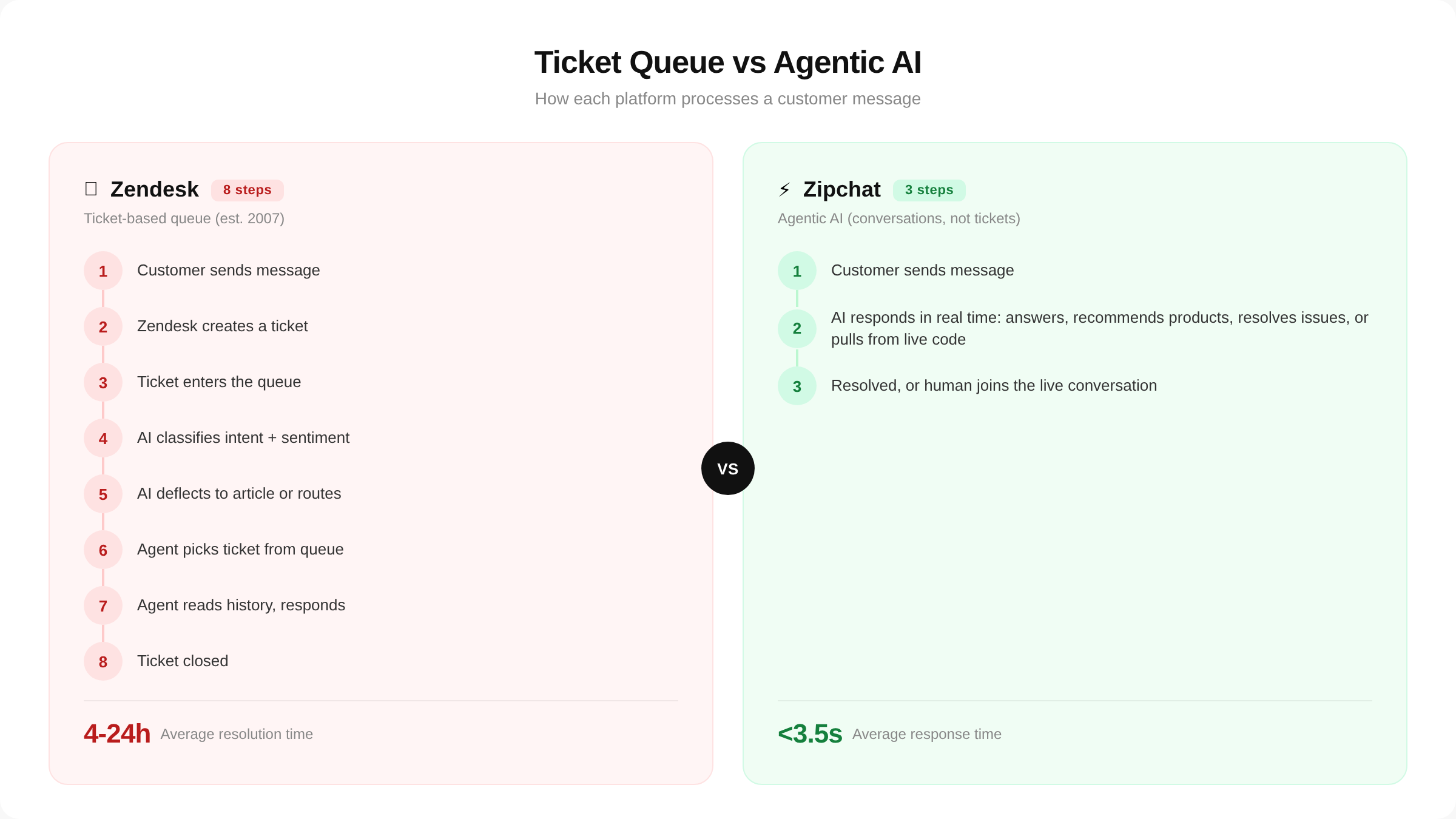
Zendesk’s core model has not changed. A customer sends a message. Zendesk creates a ticket. The ticket enters a queue. AI classifies it by intent, sentiment, and language. Then it either deflects to a help article or routes to a human.
This works when your goal is managing a queue. It fails when your goal is selling products in real time.
For ecommerce: shoppers do not file support tickets before buying. They ask questions while browsing. A ticket system turns a buying moment into a waiting moment.
AI cold-start: 1,000 tickets before anything happens
Zendesk’s AI needs 1,000+ resolved tickets before it can classify intent or suggest responses. New teams pay full price for AI that sits idle for months. I have heard this story from dozens of ecommerce store owners. They signed up expecting AI-powered support. They discovered the 1,000-ticket gate and paid $115/agent/month while the AI did nothing.
Ecommerce: no revenue capabilities
Zendesk has no native product recommendations, no cart recovery, no proactive sales messaging, and no revenue attribution. Its Shopify integration is a sidebar that pulls order data into the ticket view. Agents switch between tools to process a single refund.
For a platform serving 46,000+ ecommerce customers, the absence of revenue-generating features is the gap that matters most. Ecommerce support is not a cost center. It is a sales channel.
The support quality paradox
A customer support company scoring ~1.8/5 on Trustpilot. Important context: Trustpilot reviews skew toward end customers (people whose companies use Zendesk), not the buyers who chose the platform. G2 reviewers (buyers) rate it 4.3/5. The Trustpilot gap is still worth noting: it signals the downstream support experience that your own customers may face when your team relies on Zendesk’s tooling. G2 reviewers consistently flag slow response times and difficulty reaching human agents. The irony is visible to every team evaluating Zendesk for their own support operation.
Who Zendesk still fits
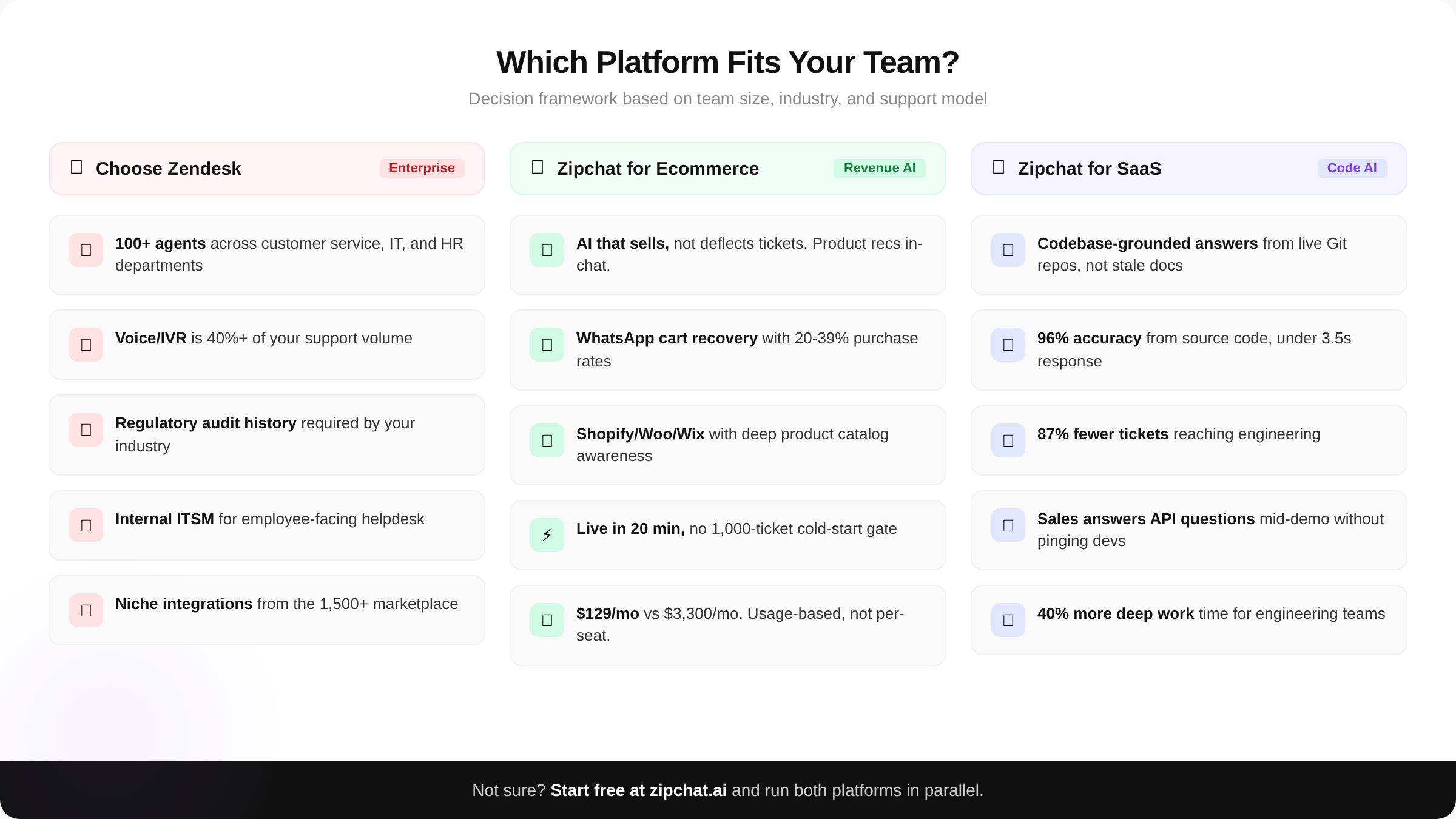
Zendesk is the right choice under specific conditions. This is not a softened recommendation. These are the use cases where its architecture, integrations, and maturity outperform newer alternatives.
| Condition | Why Zendesk wins |
|---|
| 100+ agents across multiple departments | Workforce management, QA scoring, and SLA routing built for scale |
| Voice/IVR is 40%+ of support volume | Zendesk Talk and Voice AI Agents are native and mature |
| Industry requires legacy vendor audit history | Two decades of enterprise compliance certifications |
| Internal IT helpdesk (ITSM) | Employee-facing service across IT, HR, and facilities |
| Deep dependency on niche integrations | 1,500+ marketplace apps with established connectors |
If none of those conditions apply, Zendesk’s architecture becomes overhead, not advantage.
Zipchat + Zendesk: keep Zendesk, add the AI front line
Not every team wants to leave Zendesk, and they do not have to. The strongest setup for many operations is Zipchat in front of Zendesk.
Zipchat runs as the AI front line across website chat, WhatsApp, Instagram, Messenger, and email. It resolves the high-volume conversations on its own, from day one, with no 1,000-ticket cold start. When a case genuinely needs a human, Zipchat escalates it straight into Zendesk with the full context attached, so your agents open a ticket that is already understood, not a blank queue.
This is where it gets powerful. With Agentic Skills, Zipchat does not just answer before Zendesk: it acts. It tracks orders and creates discount codes on Shopify, and with a custom skill for any tool with an API it starts returns and exchanges and reads live data. The result is that only the complex, high-value cases reach a Zendesk agent, already contextualized. You keep Zendesk for what it is good at (voice, ITSM, enterprise SLA workflows) and put an AI agent that sells and resolves in front of it. See the Zendesk integration.
The math still favors leading with AI: Zipchat Pro at $300/month gives a 10-person team more front-line AI capability than Zendesk’s add-on stack, and it deflects the volume before it ever becomes a billable Zendesk resolution.
What ecommerce teams use instead
The pattern repeats across the ecommerce stores I talk to. They signed up for Zendesk expecting AI support. They discovered the AI needs 1,000 tickets and the pricing hits $3,300/month. They started looking for something that was built for how ecommerce works.
Zipchat was built for ecommerce from day one. The AI connects to your Shopify, WooCommerce, Magento or any other CMS (even custom) store, reads the product catalog, and starts handling conversations immediately. No cold-start period. No training data required.
Four capabilities Zendesk does not offer:
Proactive engagement to customers sitting on your product pages or browsing pages clearly showing intent.
AI product questions and recommendations in-conversation. The AI handles AI product questions directly on product pages and reads browsing behavior to suggest products mid-chat. Top-performing stores achieve 25-37% conversion rates from AI conversations. The industry average ecommerce conversion rate is 2-3%, a 10-15x multiple. (For store setup patterns, see the AI shopping assistant guide.)
WhatsApp AI cart recovery. Abandoned cart campaigns via WhatsApp deliver 20-39% purchase rates across Zipchat’s customer base. The industry average for email cart recovery is 3-5%. IntegroPet recovers 25%+ of its abandoned carts through WhatsApp AI only.
Revenue attribution. Every AI-driven purchase is tracked and attributed. Zendesk tracks ticket deflection. Zipchat tracks revenue generated.
Ecommerce feature comparison:
| Feature | Zipchat | Zendesk |
|---|
| Product recommendations | Native, in-conversation | Not available |
| Cart recovery (WhatsApp) | 20-39% purchase rate | Not available |
| Proactive sales triggers | Behavior-based, automated | Not available |
| Shopify integration | Full catalog, orders, checkout | Sidebar app, order lookup only |
| Revenue attribution | Native conversion tracking | No sales tracking |
Zendesk pricing vs Zipchat: the real numbers
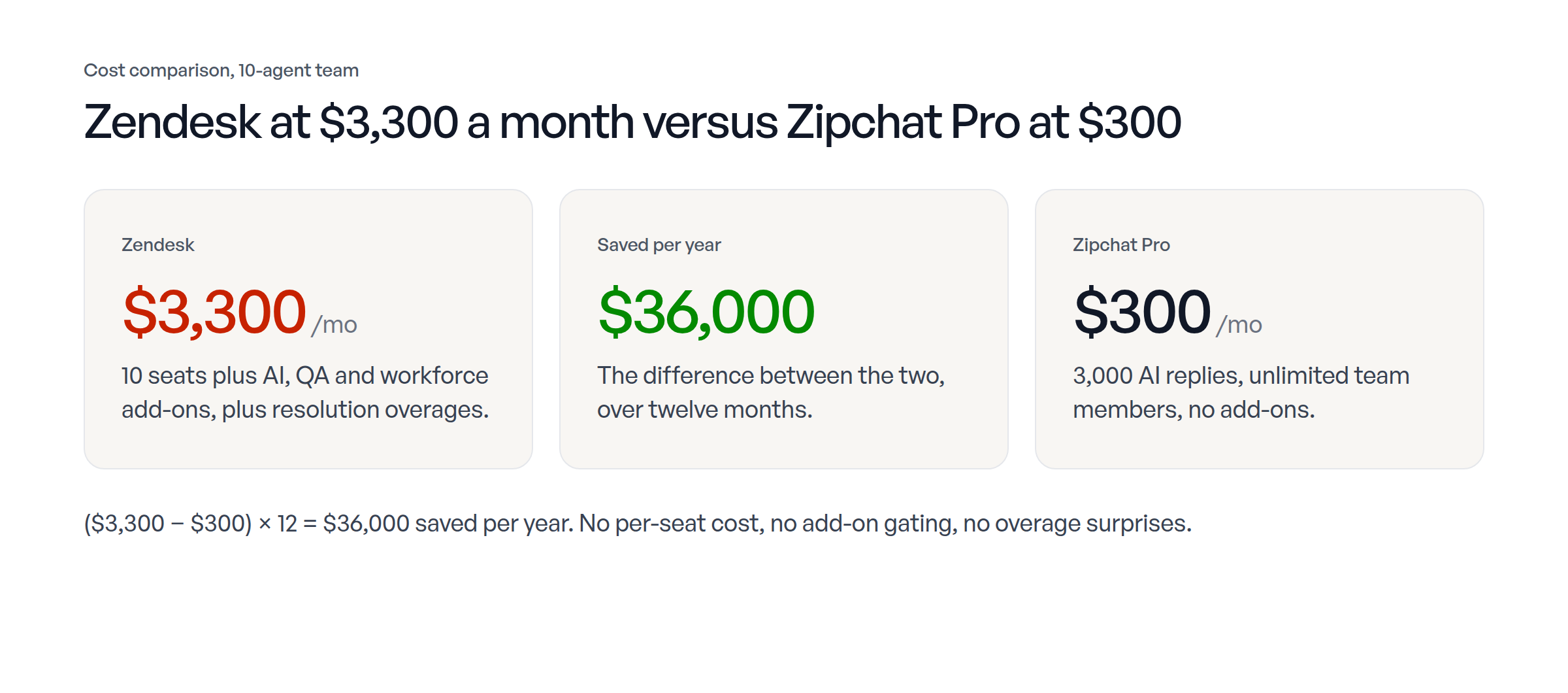
Zendesk total cost for a 10-agent team: $3,300/mo (see breakdown above).
Zipchat pricing:
| Plan | Price/mo | AI Replies | Includes |
|---|
| Starter | $80 | 750 | Conversion tracking, all channels, 1 AI agent |
| Pro | $300 | 3,000 | WhatsApp AI, cart recovery, unlimited team members, 3 AI agents |
| Scale | $600 | 6,000 | Proactive sales AI, order status, 300K knowledge pages, 5 AI agents |
| Scale Plus | $1,200 | 14,000 | 10 AI agents, unlimited knowledge pages |
Every plan includes a 7-day free trial and a 30-day money-back guarantee.
See full pricing.
Annual savings formula:
(Zendesk monthly cost - Zipchat monthly cost) x 12 = annual savings
($3,300 - $300) x 12 = $36,000/year
Zipchat Pro at $300/month gives a 10-person team more AI capability than Zendesk at $3,300/month. No per-seat cost. No add-on gating. No overage surprises.
For ecommerce teams, add the revenue Zipchat generates through cart recovery and product recommendations. Zendesk generates $0 in direct sales revenue.
Setup: 8 weeks vs under 30 minutes
Zendesk’s average implementation takes 4-8 weeks. It requires admin training, workflow configuration, and 1,000+ historical tickets before the AI activates. 73% of companies report 4+ week Zendesk deployments.
Zipchat goes live in under 30 minutes. Start your free trial.
For ecommerce: install the Shopify/WooCommerce/Everything integration. The AI reads your product catalog and starts responding.
You can run both platforms in parallel during transition. No data migration required for Zipchat to go live.
Verdict
For ecommerce: Zipchat wins. Zendesk has no cart recovery, no product recommendations, and no proactive sales. Its per-agent pricing charges for a cost center model in an industry where AI should generate revenue.
For 100+ support agent enterprises needing voice/IVR and regulatory audit history: Zendesk wins. Two decades of maturity in those areas.
Already on Zendesk and not ready to migrate: Put Zipchat in front as the AI front line and use Agentic Skills to make Zendesk more powerful. Zipchat handles the high-volume front-line conversations across all channels, escalates to Zendesk with full context, and acts on external systems before a ticket is ever created. See the Zipchat + Zendesk section above.
The question is structural. Do you want a ticket management system with AI bolted on, or an AI-first platform that makes tickets unnecessary? If the second, see the full Zendesk alternative comparison.
Where AI support is heading in 2027+
The ticket queue model is dying. Two shifts are accelerating the transition.
Agentic AI replaces triage. The current Zendesk model (AI classifies, human resolves) is giving way to systems where AI resolves and humans supervise, a shift covered in depth in our guide to agentic commerce in 2026. Zendesk’s Forethought acquisition and June 2026 add-on launch signal they recognize this shift. The open question is whether an agentic layer on a 2007 ticket-queue foundation matches a platform that was agentic from day one, and whether the per-agent-plus-add-on-plus-per-resolution cost model still makes sense once Forethought is included in the total.
Usage-based pricing replaces per-seat. When AI handles 80%+ of conversations, charging per human seat becomes indefensible. The market is moving toward per-resolution or per-conversation billing. Teams that lock into per-seat contracts today will pay for a pricing model that the industry is abandoning.
Frequently asked questions
Is Zendesk good for ecommerce?
Zendesk handles support tickets for ecommerce but lacks revenue-generating features. It has no product recommendations, no cart recovery, and no proactive sales. Ecommerce-specific platforms like Zipchat generate measurable revenue from AI conversations while handling support.
Is Zendesk worth the price?
Zendesk’s advertised $55/agent/month becomes $3,300/month for a 10-agent team after required add-ons and AI overages. For 100+ agent enterprises with voice and ITSM needs, the investment pays off. For smaller ecommerce teams, usage-based alternatives deliver more AI capability at a fraction of the cost.
What are the main problems with Zendesk?
The most reported issues are hidden pricing (add-ons and AR overages), a 1,000-ticket AI cold-start requirement, and 4-8 week implementation timelines. Zendesk’s own support quality scores ~1.8/5 on Trustpilot (end-customer sentiment) versus 4.3/5 on G2 (buyer sentiment). The ticket queue architecture also limits real-time selling.
Can Zipchat replace Zendesk for ecommerce?
Yes. Zipchat handles AI-powered support, AI product questions, and WhatsApp cart recovery (20-39% purchase rate). Ecommerce brands on Zipchat see 10-15x higher conversion rates than the industry average. Zendesk does not offer any of these features.
Can Zipchat and Zendesk work together?
Yes. Zipchat handles AI-powered conversations across your chat widget, email, WhatsApp, Instagram, and Messenger. When a conversation needs a human agent, Zipchat escalates it directly into Zendesk with full context attached. Teams that want AI resolution on the front line and Zendesk for complex cases can run both without forcing an either-or migration. See Zipchat + Zendesk: keep Zendesk, add the AI front line for how it works end to end, including Agentic Skills and the Zendesk integration.
How long does it take to switch from Zendesk to Zipchat?
Under 30 minutes. Sign up, connect your store, and the AI goes live in under 30 minutes. No 1,000-ticket training period required. You can run both platforms in parallel during transition.
For ecommerce teams under 50 employees, Zipchat offers AI sales, support, and cart recovery starting from $64/month, billed annually, with no per-seat fees and a 7-day free trial. It goes live in under 30 minutes with zero cold-start requirements.
Sources
Third-party sources:
Zipchat internal data (2026):
- Zipchat Impact Report - anonymized customer metrics (conversion rates, cart recovery rates, AI-attributed purchases): 25-37% AI-conversation conversion, 20-39% WhatsApp cart-recovery purchase rate
- Zipchat pricing page - accessed June 2026