
Tidio has 300,000+ businesses on its platform and scores 4.6/5 on G2 (~1,879 reviews), 4.7/5 on Capterra (~590 reviews), and 4.8/5 on the Shopify App Store (~1,239 reviews). Those ratings hide a pricing add-on maze, an architectural split, and a WhatsApp story that ecommerce merchants need to understand before signing.
The short version
Tidio is a live chat platform built for micro-businesses that added AI (Lyro) as a second product module in 2023. It wins on setup speed, Shopify FAQ automation, and affordable entry pricing for small teams. Since November 2025 Lyro can take actions (order status, booking, lead qualification, refunds) and since April 2026 it powers a Shopping Assistant with cart-aware product recommendations and add-to-cart from chat. Real improvements - but they sit on top of a two-brain architecture where Flows and Lyro still run as separate logic systems. The full AI-enabled cost is also higher than the base plan suggests: Lyro AI and Flows are separate add-ons on Free, Starter, and Growth plans. Growth starts at $49/mo for 250 billable conversations; add Lyro (from $32.50/mo) and Flows (from ~$24.17/mo) and the real cost approaches $105+ before you reach the 10-seat hard cap that forces a jump to Plus at $749/mo. This review covers the full story.
Tidio at a glance
| Tidio | Zipchat |
|---|
| Best for | Shopify stores (3-10 agents), repetitive FAQ automation | Ecommerce stores wanting AI that sells + supports |
| Pricing | Growth from $49/mo + Lyro add-on + Flows add-on; Plus $749+/mo at 11+ agents | $80-$1,200/mo; no seat ceiling; no add-on maze |
| AI model | Claude-based + in-house models; Flows + Lyro still run on separate logic tracks | AI-native agent; single AI across all channels from day one |
| Ecommerce capabilities | FAQ deflection, Lyro Actions, Shopping Assistant (Shopify only) | Cart recovery, proactive sales, upsells, revenue attribution |
| WhatsApp AI | Inbound support within 24-hour window only; no native outbound cart recovery | Native: cart recovery, campaigns, upsells built in |
| Setup time | 30-60 min; 1-2 weeks to optimize AI | Minutes; catalog-grounded from first conversation |
| Cold-start requirement | 1-2 weeks of manual knowledge base work | None |
| G2 rating | 4.6/5 | 4.8/5 |
| Capterra rating | 4.7/5 | 4.8/5 |
| Free trial | Free plan (50 conversations, exhausted in 3-7 days) | 7-day trial, full access |
What is Tidio?
Tidio was founded in 2013 in Szczecin, Poland, by Tytus Gołas and Marcin Wiktor. The company raised $25M in a Series B in May 2022 (PeakSpan Capital) and remains private with 180+ employees and an estimated ~$48M ARR (third-party estimate). It serves 300,000+ businesses across ecommerce, healthcare, IT services, and automotive, with ~$26.8M in total funding.
The founding story matters more than most review sites acknowledge. Tidio started as a digital advertising agency tool for micro-businesses that needed a cheap, quick-deploy live chat widget. No developer required. Up in minutes. That was the product-market fit in 2013, and it still is in 2026.
When AI became a market requirement in 2023, Tidio launched Lyro: an AI agent built on Claude (with dynamic routing between Anthropic and Vertex models) that learns from the store’s uploaded knowledge base. What they did not do was rebuild the platform. Lyro runs as a separate product module alongside the original rule-based automation engine (Flows). The two systems operate on different logic tracks.
If you run a Shopify store with 3-10 support agents and your primary goal is deflecting repetitive FAQ traffic on a budget, Tidio was built for you. If you want AI that actively generates revenue, keep reading.
What Tidio gets right
Credit where it belongs.
Setup speed. Consistently the top-cited strength across G2, Capterra, and the Shopify App Store. Non-technical teams go live in 30-60 minutes. Multiple reviewers report going from signup to live chat in under one hour. At this price point, no competitor matches the onboarding simplicity.
Lyro AI has grown beyond FAQ deflection. For stores with structured, repetitive FAQ content, Lyro performs well. Resolution rates average 64-67% (peak ~89-90% in optimized deployments; the greater-than-50% guarantee applies to Premium plans). In November 2025, Tidio shipped Lyro Actions: Lyro can now check order status, book calls via Calendly, qualify leads, create HubSpot or Klaviyo contacts, handle refunds, and update Mailchimp subscriptions - via prebuilt templates. In April 2026 they added a Lyro Shopping Assistant for Shopify: product cards, follow-up questions, out-of-stock awareness, cart-aware recommendations, and add-to-cart from chat. These are real product advances worth acknowledging.
Shopify integration depth. Native catalog sync, real-time inventory checking, order lookup by order number or email, and customer purchase history surfaced in chat. Agents and Lyro see full Shopify order details without switching tabs. This is among the deepest Shopify integrations in the category.
Multi-channel inbox. Website chat, email, Instagram, Facebook Messenger, and WhatsApp in one dashboard. The consolidated view eliminates channel-switching for lean teams. Lyro supports 45+ languages.
In March 2025, Tidio won AI Company of the Year at the Global Business Tech Awards. That is a real signal.
Where Tidio breaks down
The $49 plan hits a wall fast
Tidio’s pricing has more moving parts than the headline numbers suggest.
Base plans (annual billing; monthly billing runs ~20% higher):
| Plan | Annual price | Conversations | Lyro AI | Seats |
|---|
| Free | $0 | 50/mo | 50 one-time | 10 |
| Starter | $24.17/mo | 100/mo | 50 one-time | 10 |
| Growth | from $49.17/mo | 250-2,000/mo (volume-priced) | Not included | 10 hard cap |
| Plus | from $749/mo | Custom | Custom | Custom |
| Premium | from ~$2,999/mo | Custom | Managed Lyro | Custom |
Source: Tidio pricing page, June 2026.
Lyro AI and Flows are not bundled into Growth. On Free, Starter, and Growth, Lyro AI is a separate add-on: from $32.50/mo (annual) for 50 conversations, scaling to ~$149/mo for 1,000 conversations; self-serve is capped at 1,000 Lyro conversations. Flows is a separate add-on at $24.17/mo. The real AI-enabled cost on a Growth plan is: base ($49) + Lyro ($32.50+) + Flows ($24.17) = $105+/mo before you hit any seat or volume issues. This add-on maze is what makes Tidio’s pricing harder to predict than it first appears.
Growth volume pricing. The Growth base plan is volume-priced by billable conversations: approximately $49/mo at 250 conversations, $129/mo at 500, $179/mo at 1,000, and $349/mo at 2,000. At 2,000 conversations the next self-serve step is Plus at $749/mo. That is a 2-3x jump from the Growth ceiling ($349/mo) to Plus - and a 15x jump from the Growth base price. There is no intermediate tier.
Billable vs Lyro conversations. A billable conversation is one with at least one human-agent reply (Lyro and Flows replies do not count as agent replies). A Lyro conversation is one with at least one Lyro reply. Note the 15-minute inactivity window: if a visitor goes quiet for 15 minutes and returns, Lyro opens a new thread that consumes another Lyro quota allocation. Stores with interrupted shopping sessions exhaust Lyro quota faster than monthly conversation counts suggest.
The 10-seat hard cap. Growth has a hard cap of 10 seats. The most common trigger forcing stores onto Plus is not conversation volume - it is needing an 11th agent seat. There is no self-serve path to add a single seat on Growth.
Auto-upgrade. Tidio notifies users when approaching the conversation limit and auto-upgrades monthly non-Plus plans when the limit is hit (this does not apply on Shopify-integrated projects). Users report the warning is not always a proactive email [notification method TO VERIFY]. If auto-upgrade is disabled, conversations stop entirely at 100% quota.
The December 2024 billing incident. Tidio doubled bills for many existing customers with no email notification. Multiple Capterra reviewers documented bills going from $32 to $64 and from $25 to $120 in a single cycle. The Trustpilot review corpus documents a recurring pattern: prices reportedly increased ~27% in 2023, ~32% in 2024, and ~112% in 2025 for some customer segments. One reviewer tracked a four-year trajectory: $150 (2021), $190 (2022), $250 (2023), $500 (2024), with no advance notice at any stage.
Zipchat uses flat per-reply pricing with no Lyro or Flows add-ons, no seat cap, and a unit cost that drops as volume grows. A growing store never hits a 15x cliff.
The two-brain problem
This is the most important architectural limitation in the product.
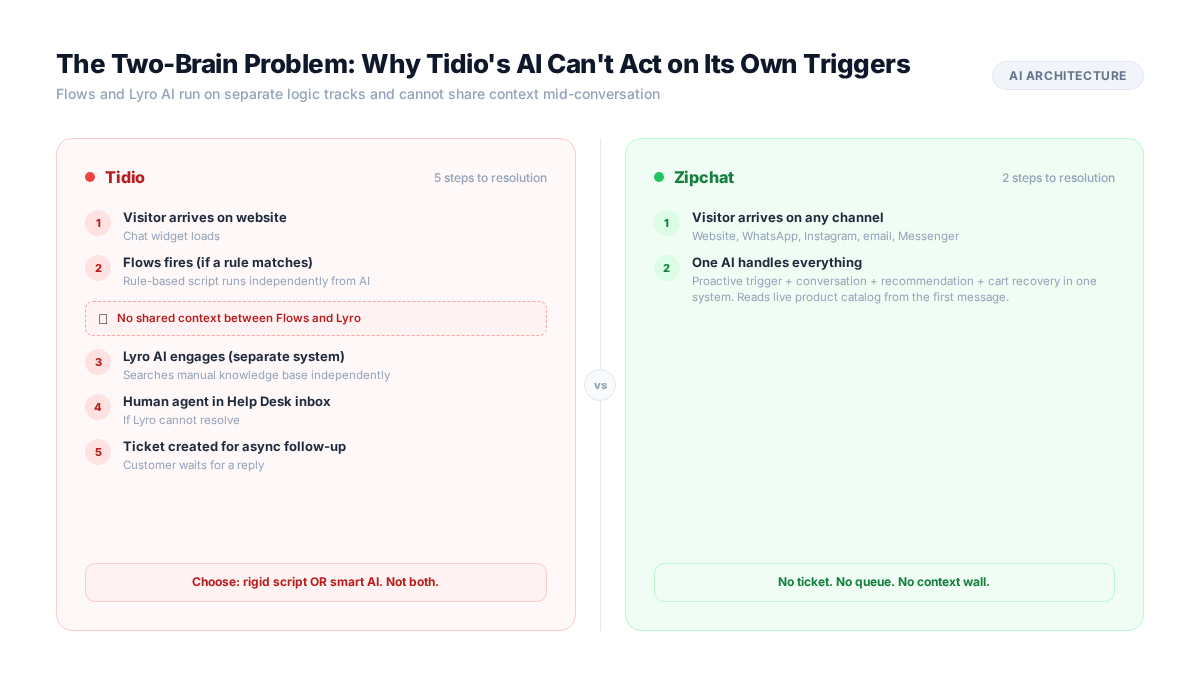
Tidio has two separate logic systems: Flows (rule-based, created in the live chat era) and Lyro AI (launched 2023). A conversation that enters a Flow cannot escalate to Lyro mid-flow with full context, and a trigger from Lyro cannot feed back into a Flow. The processing order is Flows first, then Lyro, then live agents - but the systems do not share logic. Third-party analysts describe it as “a wall between Flows and Lyro that stops you from creating truly smart, flexible automations and forces you to choose between a simple-but-rigid bot and a smarter-but-separate AI.”
This is confirmed as of June 2026: Lyro cannot run inside a Flow, and no architectural unification has been announced. Even the November 2025 Lyro Actions and April 2026 Shopping Assistant are add-on capabilities built beside this two-brain structure, not a resolution of it.
For ecommerce teams, this creates a concrete ceiling. Imagine a proactive trigger: a shopper has been on a product page for 90 seconds, has items in their cart, and has not checked out. You want the AI to initiate a conversation, surface a relevant product question, and dynamically recommend a complementary item based on their cart. That requires a trigger (Flows) that seamlessly hands to an AI with full context (Lyro) that reads live catalog data. Tidio cannot do this cleanly. The merchant must choose between a scripted flow with no AI intelligence or an AI response with no proactive trigger.
Zipchat runs a single AI brain across all channels. The proactive trigger, the conversation, the recommendation, and the cart recovery all happen inside the same system, with Agentic Skills taking the action inline and Agentic AI Search grounding every answer in live catalog data. No module boundary. No context loss between trigger and response.
The growth-to-Plus cliff
Tidio’s self-serve tiers have no middle ground. Growth tops out at 2,000 volume-priced conversations and a hard 10-seat cap. The next self-serve step is Plus at $749/mo.
At 2,000 billable conversations, the Growth base alone costs ~$349/mo. Add Lyro and Flows add-ons and the real total is closer to $490+/mo. The jump to Plus at $749/mo is 2-3x even at the Growth ceiling, and 15x from the Growth entry price. There is no way to add a single agent seat, increase conversation limits incrementally, or access custom features without committing to Plus.
Zipchat scales from $80 to $1,200/mo across four plans with no seat ceiling and no hidden add-ons. The unit cost per reply drops as volume grows.
The WhatsApp gap
Tidio’s marketing includes WhatsApp as a supported channel. The reality is more constrained.
Lyro runs on WhatsApp only as inbound support within the 24-hour messaging window. Flows on WhatsApp are rule-based only. There is no native WhatsApp outbound cart recovery or proactive WhatsApp campaign via Lyro. Tidio’s cart recovery capability runs through the web chat widget, not WhatsApp outbound.
Multiple Capterra reviewers, particularly from Latin America, report that Lyro AI on WhatsApp is unreliable without complex, poorly documented configuration. Colombian fitness brand PuroEstadoFisico documented ongoing WhatsApp integration failures in a Shopify App Store review (June 2025), citing missed messages and broken AI responses - a recurring theme in that review cluster.
WhatsApp is not a checkbox. Third-party 2026 benchmarks put WhatsApp cart recovery at 25-60% purchase rates versus email at 5-15%. That is a 4-8x gap. Zipchat’s WhatsApp AI recovers abandoned carts at 13-40% purchase rates across brands, built in from the Growth plan. For a store doing meaningful cart volume, Tidio cannot serve as the WhatsApp cart recovery or outbound AI revenue layer.
The support company with support problems
Tidio’s comparison pages against Intercom and Gorgias explicitly claim it provides better customer support quality than its competitors.
Its Trustpilot score is 4.0-4.1/5 across approximately 220 reviews. The AI-generated summary on Trustpilot specifically calls out account suspensions without warning and unresponsiveness from the support team as recurring themes. A scheduled support call was cancelled without explanation or reschedule, according to one Capterra reviewer (Paulo S., CEO, retail, June 2025). A Partner Program member reported multiple follow-up attempts with no response from Tidio’s team (Calvin J., Capterra, November 2025).
On Shopify specifically, Tidio has approximately 29,077 installs, down ~11.2% year-over-year (Store Leads, May 2026). Across all ecommerce platforms, Tidio is present on ~90,334 stores, up ~12.2% YoY. Shopify share is declining while other platforms grow.
The 0.6-0.7-point gap between Trustpilot (4.0-4.1) and G2/Capterra (4.6-4.7) reflects where dissatisfied customers go when in-app support fails them. A platform that positions its core value as “better support” while scoring modestly on the public review channel where support failures are most visible has a credibility problem that product updates cannot fix.
Who Tidio still fits
| Condition | Why Tidio works |
|---|
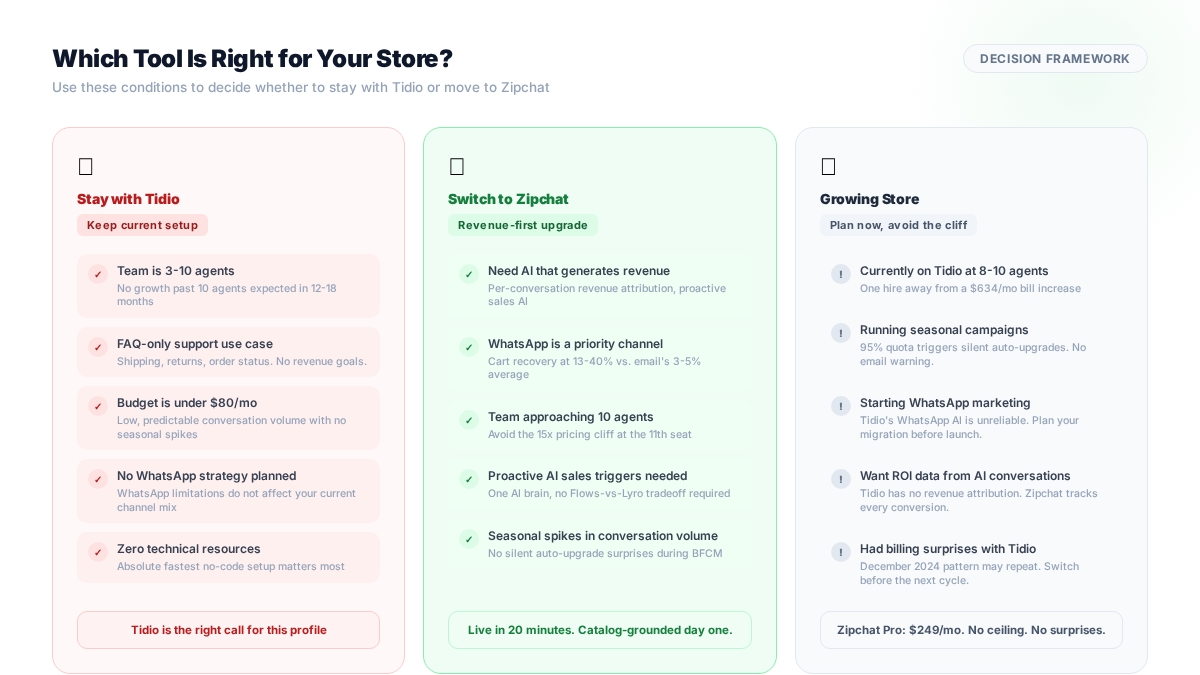
| Small team with no growth plans for 12-18 months | No risk of hitting the seat ceiling |
| Primary use case is FAQ deflection (shipping, WISMO), mostly escalated to human | Lyro performs well on structured, repetitive questions |
| Budget is under $80/mo and volume is predictable | Strong value-to-cost ratio at this price point |
| Seasonal spikes are minimal or predictable | No auto-upgrade risk at quota limits |
| No need for strong AI, just basic FAQ answering | Simple knowledge base built on FAQs |
| No WhatsApp marketing strategy planned | WhatsApp limitations are irrelevant |
If none of those conditions apply, Tidio’s architecture becomes overhead. Not advantage.
What ecommerce teams use instead
Shopify merchants outgrowing Tidio are not looking for another support tool. They are looking for an AI that generates revenue.
Zipchat was built in the AI era, for ecommerce, from the ground up. The AI is the platform, not a module. It runs conversations across website, WhatsApp, Instagram, email, and Messenger from a single logic system. There is no Flows-equivalent sitting beside the AI. There is no manual knowledge base to maintain. The AI trains from the product catalog on day one and uses Agentic AI Search to retrieve answers from any connected source in real time.
WhatsApp cart recovery. Zipchat recovers abandoned carts on WhatsApp at 13-40% purchase rates. Industry email average is 3-5%. For a store with 200 abandoned carts per month at a $60 average order value, a 20% recovery rate is $2,400/mo in recovered revenue. That is not support cost avoidance. That is new revenue.
Proactive Agentic Skills. A shopper browses a product page for 90 seconds without adding to cart. Zipchat initiates a conversation, handles AI product questions from the live catalog, and recommends complementary items. All from a single AI. No separate Flows system. No choice between a script and an AI.
Revenue attribution. Every conversation that produces a sale is tracked. Merchants see which AI interactions closed purchases, what the conversion rate per channel is, and what revenue the AI generated per month. Documented case studies show Zipchat stores reaching 37.8% conversion rates (health supplements, 7,400 conversations) vs the 2-3% ecommerce average.
Multi-platform reach. Lyro’s Shopping Assistant is Shopify-only. Zipchat connects Shopify, WooCommerce, and Wix with full AI support on all three. See the full AI shopping assistant guide for capability details.
Ecommerce comparison: Zipchat vs Tidio
| Feature | Tidio | Zipchat |
|---|
| WhatsApp cart recovery | Not available natively; user-reported reliability issues | Native; 13-40% purchase rate |
| WhatsApp marketing campaigns | Not available | Built in from $64/mo, billed annually (Starter) |
| Proactive sales AI | Flows only (separate from Lyro AI) | AI-native; no scripting needed |
| Revenue attribution per conversation | No | Yes |
| Upsells and cross-sells on WhatsApp | Not available | Built in from $64/mo, billed annually (Starter) |
| AI knowledge source | Manual KB (URL scraping + uploads) | Live product catalog from day one + additional sources |
| Seat ceiling | 10 agents on self-serve plans | No seat ceiling |
| Shopping assistant platform reach | Shopify only (Lyro Shopping Assistant) | Shopify, WooCommerce, Wix |
| Automate support | Lyro + Flows (two separate systems) | Single AI, all channels |
Pricing comparison: the real numbers
Tidio real cost for an AI-enabled Growth store (annual billing):
| Component | Monthly cost |
|---|
| Growth base (250 conversations) | $49.17 |
| Lyro AI add-on (50 conversations) | $32.50 |
| Flows add-on | ~$24.17 |
| Minimum AI-enabled total | ~$105/mo |
Growth base price scales with volume: ~$129/mo at 500 conversations, ~$179/mo at 1,000, ~$349/mo at 2,000. The only self-serve step beyond 2,000 conversations or 10 seats is Plus at $749/mo - a 2-3x jump from the Growth ceiling, and 15x from the Growth base.
Zipchat pricing:
| Plan | Price/mo | Replies/month | Features |
|---|
| Starter | $80 | 750 | All included |
| Pro | $300 | 3,000 | All included |
| Scale | $600 | 6,000 | All included |
| Scale Plus | $1,200 | 14,000 | All included |
No add-on maze. No seat ceiling. See full Zipchat pricing.
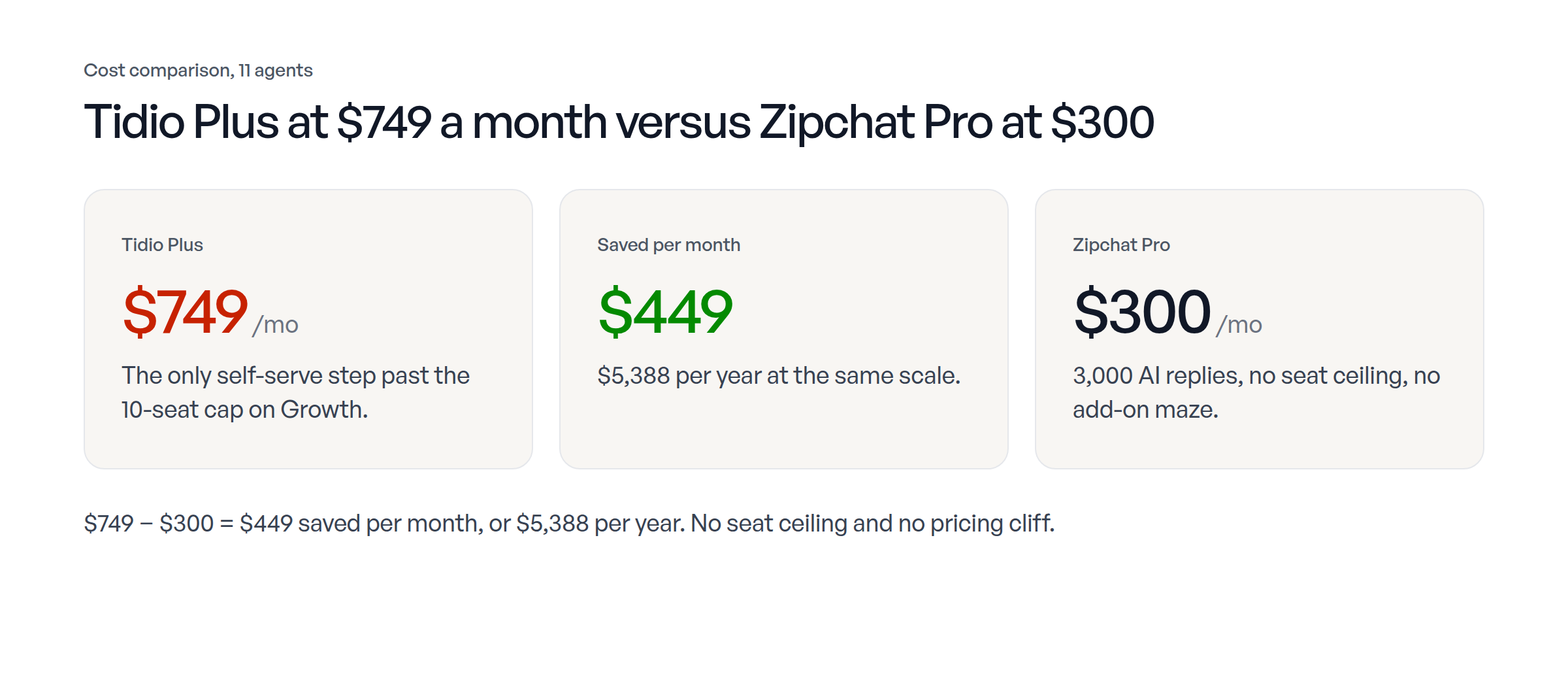
Annual savings at the 11-agent growth stage:
Tidio Plus ($749/mo) - Zipchat Pro ($300/mo) = $449/mo saved
$449 x 12 = $5,388/year with Zipchat
Setup comparison
Tidio advertises 10-minute setup. In practice, the live chat widget goes live in 30-60 minutes. Lyro AI goes live on day one from scraped website content but requires 1-2 weeks of manual knowledge base optimization to reach reliable answer quality. A 10-agent team’s full implementation (chatbot flows, team training, integration setup) takes 10-20 hours per independent analysis.
Zipchat connects to your Shopify store, indexes the product catalog, and goes live in under 30 minutes. The first conversation is as good as the 1,000th. No manual knowledge base population. No optimization period.
Start your free trial with Zipchat
Verdict
For ecommerce stores that need AI to generate revenue: Zipchat wins. Tidio manages support conversations. Zipchat turns them into revenue with WhatsApp cart recovery, proactive Agentic Skills, and revenue attribution per conversation.
For stores hitting Tidio’s growth ceiling: Zipchat wins. The Growth-to-Plus cliff (10-seat hard cap, no self-serve middle tier, $749/mo Plus) makes Tidio a growth blocker, not a growth tool.
For Shopify stores with low and predictable FAQ volume, no WhatsApp strategy, and no growth plans: Tidio wins. At $49/mo for Growth base, the value is real and the setup speed is unmatched.
The question is structural. Do you want a tool that manages support conversations, or a tool that turns customer conversations into revenue?
For the full feature comparison and alternatives, see the Tidio alternative comparison. To weigh Tidio against the rest of the category, see our customer service software comparison.
Where AI support is heading in 2027+
Support and revenue merge into one function. The division between “customer support AI” and “sales AI” is a legacy of how helpdesks were built in 2010. AI-native platforms treat every conversation as a revenue opportunity: answer the question, recommend a product, recover the cart, upsell on the next message, the shift our agentic commerce 2026 guide tracks end to end. Tools built as support deflection systems will either add revenue layers (as Tidio is doing with Lyro Actions and the Shopping Assistant) or cede the category to platforms where revenue generation was the original architecture.
Conversation-based pricing replaces seat-based pricing. The per-seat model served enterprise helpdesk economics. Usage-based pricing (per reply or per conversation) better reflects AI economics, where the cost of a conversation is low and the value of a conversion is high. The market is moving toward outcome pricing: Zendesk charges ~$1.50 per verified AI resolution (May 2026); Intercom charges $0.99 per resolution. Tidio’s volume-based billable conversation model is a step in this direction, but the add-on maze and 10-seat hard cap remain seat-era constraints.
WhatsApp becomes the dominant ecommerce channel. Third-party 2026 benchmarks put WhatsApp cart recovery at 25-60% versus email at 5-15%. As Shopify merchants build WhatsApp audiences, the support platform that cannot deliver reliable AI on WhatsApp becomes a secondary tool, not a primary one. Tidio’s WhatsApp gap is not a feature request. It is a structural positioning problem for the next two years.
Frequently asked questions
Is Tidio good for ecommerce?
Tidio handles Shopify FAQ automation well: shipping questions, return policy, order status. The November 2025 Lyro Actions (order lookup, booking, refunds, CRM contacts) and April 2026 Shopping Assistant (cart-aware product recommendations, add-to-cart from chat) are real advances. The gaps remain: Flows and Lyro still run as two separate systems (confirmed June 2026, no unification announced); the Shopping Assistant is Shopify-only while Zipchat supports WooCommerce and Wix too; there is no WhatsApp outbound cart recovery; there is no revenue attribution per conversation; and Lyro AI is a separate add-on that significantly raises the real cost above the base plan price. For support-only ecommerce with under 10 agents, Tidio works. For stores that want AI to generate measurable revenue, the architecture is not built for it.
Is Tidio worth the price?
Tidio Growth at $49/mo base is genuine value for a small store with low, predictable conversation volume - if you do not need Lyro AI or Flows. The real AI-enabled cost on Growth is $105+/mo (base + Lyro add-on + Flows add-on). The value breaks further as you scale: the 10-seat cap forces a jump to Plus at $749/mo with no intermediate self-serve tier, and the December 2024 billing incident (bills doubled overnight with no email notice) alongside a documented pattern of annual price increases makes the pricing harder to trust at any tier.
What are the main problems with Tidio?
Five documented structural issues: (1) Flows and Lyro AI run on separate logic tracks with no shared context - a two-brain architecture confirmed as of June 2026 with no unification announced; (2) Lyro AI and Flows are not included in Growth base plans but are separate add-ons that push the real AI-enabled cost to $105+/mo; (3) Growth jumps directly to Plus at 15x the base price ($49/mo to $749/mo) with no self-serve middle tier, and the most common trigger is the 10-seat hard cap; (4) WhatsApp AI is limited to inbound support within a 24-hour window with no native outbound cart recovery, and integration reliability is a recurring user complaint; (5) the December 2024 pricing incident doubled bills with no email notification, part of a documented pattern of annual price increases (approximately 27% in 2023, 32% in 2024, 112% in 2025 for some customer segments).
Can Zipchat replace Tidio for ecommerce?
Yes. Zipchat handles AI support automation, proactive product recommendations via Agentic Skills, WhatsApp cart recovery (13-40% purchase rates), and post-purchase upsells from a single platform. See the AI shopping assistant guide for the full capability picture. Ecommerce brands on Zipchat reach up to 37.8% conversion rates in documented cases (industry average 2-3%). The Pro plan ($300/mo) includes WhatsApp marketing and cart recovery, which Tidio does not offer natively.
Can Zipchat and Tidio work together?
There is no documented integration between the two platforms. Migrating from Tidio to Zipchat takes under 30 minutes: connect the Shopify store, and the AI indexes the product catalog immediately. No parallel run period is needed.
How long does it take to switch from Tidio to Zipchat?
Under 30 minutes to connect and go live. No manual knowledge base migration is required. Zipchat trains from the live product catalog on day one. Tidio’s conversation history can be exported, but Zipchat does not require historical data to start performing.
Does Tidio have WhatsApp cart recovery?
Tidio supports WhatsApp as a channel, but Lyro AI on WhatsApp is limited to inbound support within the 24-hour messaging window and Flows on WhatsApp are rule-based only. There is no native WhatsApp outbound cart recovery campaign capability. Multiple users report reliability issues with the WhatsApp AI integration in practice. Zipchat’s WhatsApp AI is a native revenue channel with documented 13-40% cart recovery rates.
What is the best Tidio alternative for growing Shopify stores?
For Shopify stores approaching 10 agents or wanting WhatsApp cart recovery and revenue attribution, Zipchat is the most direct replacement. The Pro plan ($300/mo) covers all AI support, proactive sales, WhatsApp marketing, and cart recovery with no add-on fees and no agent ceiling.
Why is Tidio’s Trustpilot score lower than its G2 and Capterra scores?
Trustpilot is where billing-dispute customers go when in-app support fails them. Tidio scores 4.0-4.1/5 on Trustpilot versus 4.6-4.7 on G2 and Capterra. The AI-generated Trustpilot summary specifically cites account suspensions without warning and unresponsiveness from the support team as recurring themes. The gap reflects where complaints land, not the full customer population.
Sources
Third-party sources
- TechCrunch: Tidio raises $25M Series B (May 2022)
- Tidio pricing page (accessed June 2026)
- eesel.ai: Tidio AI reviews 2025 (accessed April 2026)
- G2: Tidio reviews (checked June 2026; ~1,879 reviews, 4.6/5)
- Capterra: Tidio reviews (checked June 2026; ~590 reviews, 4.7/5)
- Trustpilot: Tidio reviews (checked June 2026; ~220 reviews, 4.0-4.1/5)
- Shopify App Store: Tidio (checked June 2026; ~1,239 reviews, 4.8/5)
- Store Leads: Tidio Shopify installs ~29,077 (-11.2% YoY), all-platform ~90,334 (+12.2% YoY) (May 2026)
- Global Business Tech Awards: AI Company of the Year 2025 (March 2025)
- Capterra: December 2024 billing incident documentation
- Trustpilot hike pattern: ~27% (2023), ~32% (2024), ~112% (2025) reported by multiple reviewers
- WhatsApp cart recovery benchmarks: 25-60% vs email 5-15% (third-party, 2026)
- Zendesk outcome pricing ~$1.50/verified resolution (May 2026); Intercom $0.99/resolution
Zipchat internal data
- Zipchat Impact Report: WhatsApp cart recovery 13-40% purchase rate range (internal, April 2026)
- Zipchat Impact Report: Top conversion rate 37.8% (health supplements, 7,400 conversations), industry average 2-3%
- Zipchat Impact Report: $212K revenue from single WhatsApp campaign (yoga brand, 4,401 messages)
- Zipchat metrics: 4.8/5 G2 (51 reviews), 4.8/5 Capterra (26 reviews), April 2026
This review is written by Luca Borreani, CMO & Co-Founder at Zipchat. We include Tidio’s genuine strengths and recommend it where it fits better than Zipchat.