
The short version: Gorgias started as a Gmail Chrome extension for email templates. It became a helpdesk. It became a Shopify helpdesk. Then it bolted AI on top. That sequence produced a system optimized for routing and resolving tickets, not for generating revenue from them. Its billing model reflects that origin: as AI automation improves, the bill goes up. Gorgias wins for legacy Shopify brands with large human support teams who need deep order management and unlimited seats. Zipchat was built for a different mission. It was built to turn your tickets into revenue.
Gorgias vs. Zipchat: at a glance
| Feature | Gorgias | Zipchat |
|---|
| Best for | Legacy Shopify brands with 5+ human agents managing ticket queues and order actions at scale | Shopify brands that want AI to generate revenue, recover carts, and support customers proactively |
| Pricing (real cost) | $360/mo (Pro, base) → $960/mo (with 50% AI automation) | $80/mo (Starter) → $300/mo (Pro) |
| AI model | Ticket-based helpdesk + AI add-on layer; retrieves from static Help Center articles | AI-native; trains on live product catalog; Agentic AI Search across real data |
| Ecommerce platforms with full AI | Shopify only | Shopify, WooCommerce, and Wix |
| Cart recovery via WhatsApp | Available (AI Agent add-on, Shopify only; 45-minute abandon trigger) | Built in from $64/mo, billed annually (Starter); 13.8 to 39.6% recovery rate |
| Proactive sales triggers | Shopping Assistant (Shopify, add-on; ~2.25x add-to-cart in Gorgias tests) | Proactive AI on website and WhatsApp outreach |
| Setup time | 1 to 7 days (helpdesk); ~1 week to start AI; several weeks for optimal performance | Under 1 hour (AI trains on product catalog immediately) |
| Cold-start requirement | Help Center or AI-Generated Guidance required; no autonomous learning | Zero; trains on catalog on day one |
| Agentic AI Search | No; retrieves from static, manually-maintained Help Center articles | Yes; searches live catalog, real-time inventory, and dynamic product data |
| Shopify App Store | 4.3/5 (~646 reviews) | 4.8/5 (~175 reviews) |
| G2 rating | 4.6/5 (~561 reviews) | 4.8/5 |
| Trustpilot rating | 2.5/5 (~143 reviews) | Not used |
| Capterra rating | 4.6/5 (~134 reviews) | 4.8/5 |
| Free trial | 7-day trial on paid plans | 7-day trial, full access |
What is Gorgias
Gorgias was not built by support strategists. It started as a Gmail Chrome extension for email templates in Paris in 2015. The founders noticed their early users were customer service agents, not marketers, so they pivoted to a helpdesk product. In 2017, Shopify invested in Gorgias, and the product narrowed its focus to Shopify merchants. That sequence is not background. It is architecture.
Today Gorgias serves approximately 16,400 merchants and has raised approximately $101 to $104M (latest: Series C-2, $29M, February 2024) from Shopify, CRV, and Sapphire Ventures. The company was valued at approximately $710M at its Series C in 2022; secondary-market trades in 2024 suggested a valuation near $548M, a likely down-round signal. MRR was reported above $40M in early 2026. The company is led by co-founder and CEO Romain Lapeyre, co-founder and CTO Alex Plugaro, and CFO Kunal Agarwal. Its ICP is Shopify DTC brands, SMB to mid-market, primarily US, Canada, and Australia.
In January 2025 Gorgias rebranded as a “Conversational AI Platform for Ecommerce.” In July 2025 it launched AI Agent 2.0 with proactive triggers, WhatsApp cart recovery, intent-based discounting, and a Shopping Assistant. These additions reflect a real product investment. The helpdesk foundation, however, has not changed. A decade-old ticket-based architecture sits underneath every AI feature Gorgias ships.
If you run a Shopify store with a large human support team handling hundreds of tickets per month and you need agents to cancel orders, issue refunds, and apply discounts without switching tabs, Gorgias was built for your operation. If you need AI that turns those conversations into revenue before customers ask, keep reading.
What Gorgias gets right
Deepest Shopify order management of any helpdesk. Agents can cancel orders, edit shipping addresses, issue refunds, apply discount codes, and create new orders without leaving the ticket view. No other platform matches this action depth inside Shopify. For high-volume support teams, this reduces average handle time measurably.
Per-ticket pricing removes seat costs for large collaborative teams. Every plan includes unlimited agent seats. A brand with 20 people contributing to support (seasonal staff, store managers, marketing) pays zero incremental cost per person. This is a structural advantage over Zendesk, Intercom, and Freshdesk, all of which charge per seat.
Multi-channel unification in one inbox. Email, live chat, Instagram DMs, Facebook Messenger, TikTok ad comments, SMS, voice, and WhatsApp all route to a single view. For DTC brands where customer contact arrives from social channels at unpredictable volume, this matters.
A real 2025 to 2026 AI investment. Gorgias reported 22.7M tickets handled by AI in 2025, with 8M fully automated. Its AI quality score rose from approximately 57% in January 2025 to 85% by November 2025, and the company reports “up to 60%” automation rates on eligible conversations. AI Agent now includes a Shopping Assistant, intent-based discounting, proactive chat triggers (Gorgias reports approximately 2.25x add-to-cart in tests), WhatsApp cart recovery with a 45-minute abandon trigger, Vision (AI reads customer-uploaded images), and support for 80+ languages. AI-Generated Guidance, released July 2025, can seed the knowledge base from historical tickets, reducing manual setup work. These are not superficial additions.
Where Gorgias breaks down
Pricing forensics: the real monthly bill
Gorgias is marketed starting at $10/month (Starter: 50 tickets, 3 fixed seats, monthly billing only, no annual option). The actual plan tiers in June 2026: Starter $10/mo, Basic $60/mo ($50 on annual), Pro $360/mo ($300 on annual, 2,000 tickets included), Advanced $900/mo ($750 on annual, 5,000 tickets included), Enterprise custom. Per-ticket overage runs roughly $0.36 to $0.40 above the included count. AI Agent is a separate add-on billed on top of the base plan, not bundled with any tier.
The real cost for a mid-tier Shopify brand looks different.
Representative scenario: Shopify brand on the Pro plan, 2,000 tickets/month, 50% AI automation (1,000 AI resolutions):
| Component | Monthly cost |
|---|
| Pro plan base (2,000 tickets included, 600 AI resolutions included) | $360 |
| AI Agent overage: 400 resolutions × $1.50 (above the 600 included) | $600 |
| Total | $960/mo |
The advertised Pro base price is $360. The same brand, achieving exactly the AI automation rate Gorgias markets as the goal, pays $960/month. Success doubles the bill.
The AI resolution rate is $1.00/resolution on monthly billing and $0.90/resolution on annual billing; overage on the Support + Shopping Assistant bundle is $1.50/resolution, 67% above the annual rate. Billing mechanics are documented at docs.gorgias.com. There is no published spend ceiling on AI resolutions: a volume spike has no built-in cap.
The line item that catches teams off guard most often is the double-billing structure. When AI Agent fully resolves a conversation with no human handoff, Gorgias charges both a helpdesk ticket fee and an automation fee. If the AI hands off to a human agent, only the ticket fee applies. This is documented by Gorgias itself at docs.gorgias.com and is structural to the pricing model, not a billing error.
Add SMS ($1.50/ticket), and the same brand reaches $1,300 to $1,500/month. At enterprise scale, one brand publicly reported paying $83K/year before switching: $6,900/month. Source: Amit RG, Richpanel CEO, on X (@realamitrg), January 2025.
Architecture: built to route tickets, not turn them into revenue
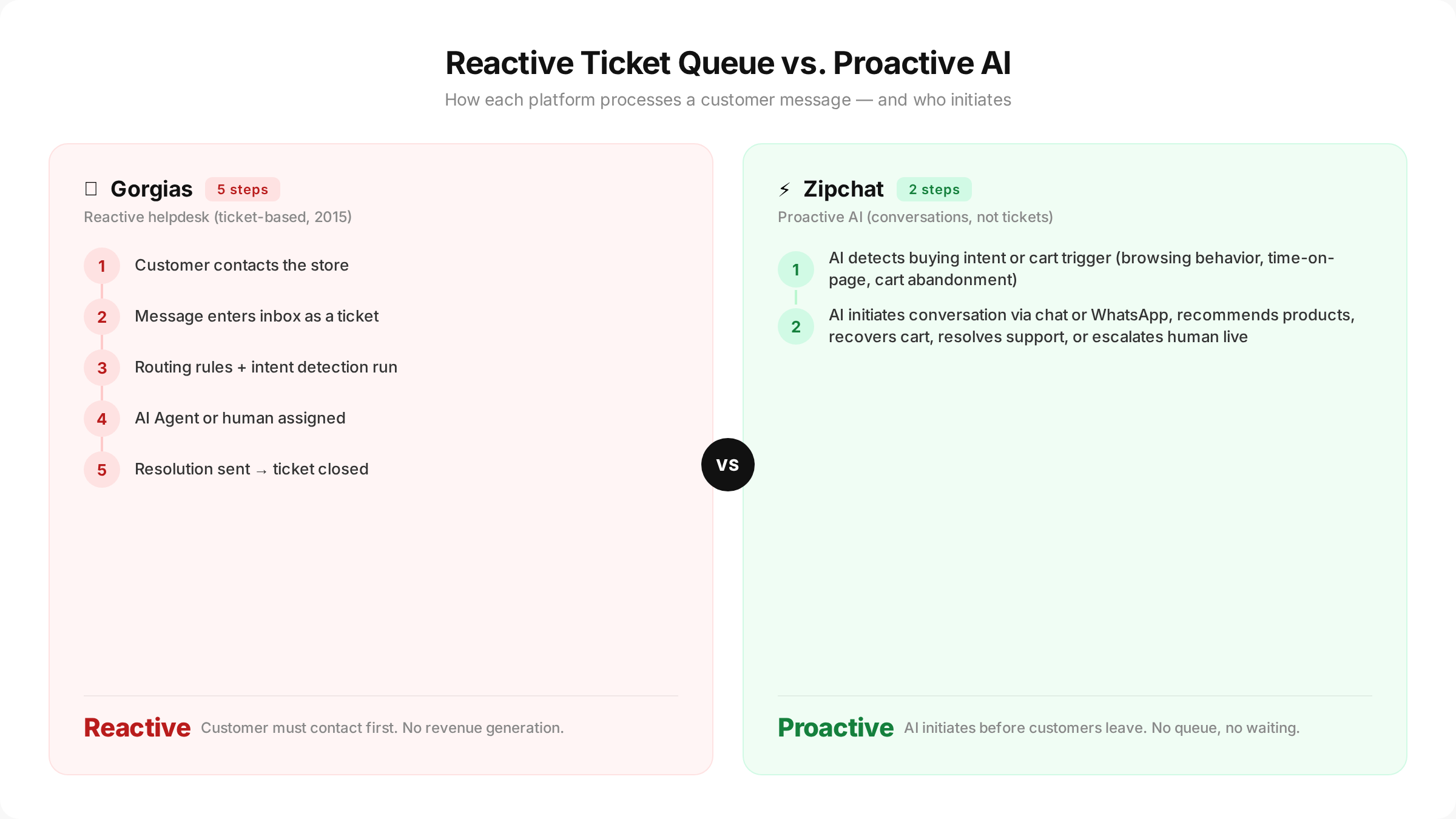
Gorgias is a reactive, pull-based system. A customer contacts the store, a ticket enters the inbox, routing rules and macros categorize it, AI or a human resolves it, the ticket closes. The interaction flow has 3 to 5 handoff steps between a customer message and resolution.
That architecture has a business model logic behind it. Gorgias earns revenue per ticket resolved. When AI automates more of those resolutions, Gorgias charges overages to protect the per-ticket model. The double-billing structure is not a product bug. It is what happens when a ticket-based business model meets an AI automation layer. The constraint is structural and permanent.
The Shopping Assistant and proactive triggers added in 2025 sit on top of this architecture as an added layer. The core product was designed to respond efficiently, not to initiate contact or drive purchase decisions. Cart recovery via WhatsApp, intent-based discounting, and proactive browsing triggers are newer additions to a system that was not built to hold them natively.
Zipchat’s architecture runs in the opposite direction. The AI initiates conversations, recommends products, and sends WhatsApp recovery messages before a customer has signaled distress. That architectural difference is why Zipchat reports WhatsApp cart recovery rates of 13.8 to 39.6% across campaigns. A recovery layer that performs at that rate requires a proactive-first system, not a helpdesk with proactive features added later.
Cold-start: knowledge base still required before AI activates
Gorgias AI Agent requires four things before it can function: an active AI Agent subscription (a separate add-on from the base plan), a connected Shopify store, admin-level permissions, and at least one populated knowledge source (Help Center articles, website content, uploaded documents, or AI-Generated Guidance content).
AI-Generated Guidance, released July 2025, can generate knowledge base content from historical tickets, which is a genuine step forward. Gorgias now markets a roughly 1-week launch for AI. That said, the AI still does not learn autonomously; there is no model training on your store’s data. AI-Generated Guidance produces static articles from past tickets, which still require review and maintenance. Optimal AI performance, covering the full range of customer questions accurately, still takes several weeks of tuning. The gap between “AI is turned on” and “AI handles 60% of conversations well” remains real, even if the floor is lower than it was in 2024.
There is also a hard constraint on customer context: the AI can only access a customer’s last 10 orders, confirmed in Gorgias documentation (April 2026). Brands with high-repeat-purchase rates lose full customer history in AI-handled conversations.
Zipchat trains on the product catalog from the moment it connects to Shopify or WooCommerce. Setup takes under 30 minutes. There is no manual knowledge base step.
Gorgias AI retrieves answers from static, manually-maintained Help Center articles. When a customer asks about a specific product’s ingredients, availability, or compatibility, the AI searches those articles. If the article is outdated or missing, the AI cannot answer accurately.
Zipchat uses Agentic AI Search: the AI searches the live product catalog, real-time inventory data, and dynamic product pages at query time. When a shopper asks whether a specific variant is back in stock, the AI checks the actual catalog and answers with current data. There is no Help Center to maintain. No articles to write. No stale information to correct.
The gap is architectural. Static retrieval from manually-maintained articles is what you build when your foundation is a helpdesk. Real-time search from live product data is what you build when your foundation is ecommerce AI.
The AI Agent, Shopping Assistant, intent-based discounting, and Order Management automation all require an active Shopify store connection. Brands on WooCommerce, BigCommerce, Magento, PrestaShop, or custom platforms can use Gorgias as a helpdesk. They cannot access any AI features.
This is documented in Gorgias’s own compatibility table: AI Agent is supported only on Shopify; it is not supported on BigCommerce, Magento, WooCommerce, or PrestaShop. Order Management is Shopify-only too. As more DTC brands operate on multi-platform stacks or migrate between platforms, this constraint becomes a migration risk.
The support quality paradox
Gorgias holds a 2.5/5 rating on Trustpilot (~143 reviews, June 2026). Its Shopify App Store score is 4.3/5 (~646 reviews), with 9% of reviews at one star, consistently citing poor support response, billing disputes, and account shutdowns without resolution.
From the Shopify App Store: “The customer support at this ‘customer support’ software is comically bad. I have been using this software for almost five years and can not wait to get away from it.”
From G2: “The actual support@gorgias.com is not quick and usually takes a few days or more to respond to me. If I provided that type of service to my clients, they would terminate our relationship.” — Brad B., Customer Engagement Manager.
A company whose product promises exceptional customer experiences, rated 2.5/5 by its own customers on a public platform, has a credibility gap that its category position amplifies.
Who Gorgias still fits
| Condition | Why Gorgias is the right choice |
|---|
| Legacy Shopify brand with tens or hundreds of human support agents | Per-ticket pricing and unlimited seats mean large teams pay no incremental seat cost |
| Complex org structure with supervisors, managers, and QA workflows built around the inbox | Deep macro, rules, and assignment logic built over years; migration cost is high |
| Primary need is reactive helpdesk with Shopify order actions | No competitor matches the Shopify sidebar depth for agent actions (cancel, refund, edit) |
| Shopify Plus or enterprise with multi-brand, multi-store compliance requirements | Multi-brand management, multi-language routing, enterprise contract terms |
| Switching costs make migration unacceptable in the current cycle | Deep workflow investment in macros, rules, and automation configurations |
If none of those conditions apply, the pricing model, the platform constraint, and the reactive foundation create friction that grows proportionally with the store’s ambition.
What Shopify brands use instead
Shopify brands leave Gorgias when their primary problem shifts from “route and resolve support tickets efficiently” to “turn every customer conversation into a revenue opportunity.”
Zipchat was built for the second mission, not as a helpdesk alternative, but as a different system entirely. There is no ticket queue. The AI runs conversations proactively across website chat, WhatsApp, Instagram DMs, and email. When the AI cannot resolve a conversation, a human joins live.
WhatsApp cart recovery that works. Zipchat’s WhatsApp AI sends cart recovery messages with a 13.8 to 39.6% purchase rate across campaigns. The highest-revenue single campaign recovered $212K from 4,401 messages for a yoga brand. Email cart recovery averages 3 to 5% by comparison; third-party WhatsApp benchmarks (2026) show 30 to 40% vs. email’s 8 to 12%. This capability requires a proactive architecture, not a proactive feature bolted onto a helpdesk.
Agentic AI Search, not static retrieval. Zipchat’s AI searches the live product catalog at query time. When a shopper asks about a specific product’s ingredients, size, or back-in-stock status, the AI checks the actual catalog and responds with current data. No Help Center articles to write. No stale information to correct. For Shopify brands with large, frequently-updated catalogs, this is the difference between an AI that answers accurately and one that confidently answers wrong.
Zero cold-start across platforms. Zipchat connects to Shopify, WooCommerce, and Wix. On connection, the AI indexes the product catalog and begins answering customer questions and making product recommendations immediately. For merchants who want AI operating on day one, with no setup overhead, Zipchat is the only option with this architecture.
Pricing that scales with AI success, not against it. Zipchat charges per conversation, not per ticket. There are no AI resolution overages. A brand that automates 80% of conversations pays the same rate per reply as a brand that automates 20%. The model does not punish automation.
Proactive conversion at scale. Zipchat’s proactive sales AI triggers on browsing behavior, cart activity, and time-on-page signals, initiating conversations before customers leave. Top performers in Zipchat’s impact data show 25 to 37% conversion rates from AI-handled conversations, 10 to 15 times the industry average of 2 to 3%.
For a deeper look at how AI shopping assistant capabilities compare across platforms, see the full guide.
Shopify feature comparison
| Capability | Zipchat | Gorgias |
|---|
| Platforms with full AI support | Shopify, WooCommerce, and Wix | Shopify only |
| WhatsApp AI cart recovery | Yes, built in from $64/mo, billed annually (Starter) | Yes, AI Agent add-on (Shopify only; 45-minute abandon trigger) |
| Proactive sales triggers | Yes, AI-initiated | Yes, Shopping Assistant (add-on, Shopify only) |
| Agentic AI Search | Yes; searches live catalog and real-time product data | No; retrieves from static, manually-maintained Help Center articles |
| Cold-start time | Zero; catalog-trained on day one | ~1 week to start; several weeks for optimal performance |
| Historical learning | Continuous (trains on conversations) | AI-Generated Guidance seeds from past tickets; no autonomous learning |
| Pricing model | Per reply, no overages | Per ticket plus AI resolution fees; overages at $1.50/resolution |
| Free trial | 7-day trial, full access | 7-day trial on paid plans |
| Multi-language AI | Yes (any language) | Yes (80+ languages, AI Agent) |
Pricing comparison: the real numbers
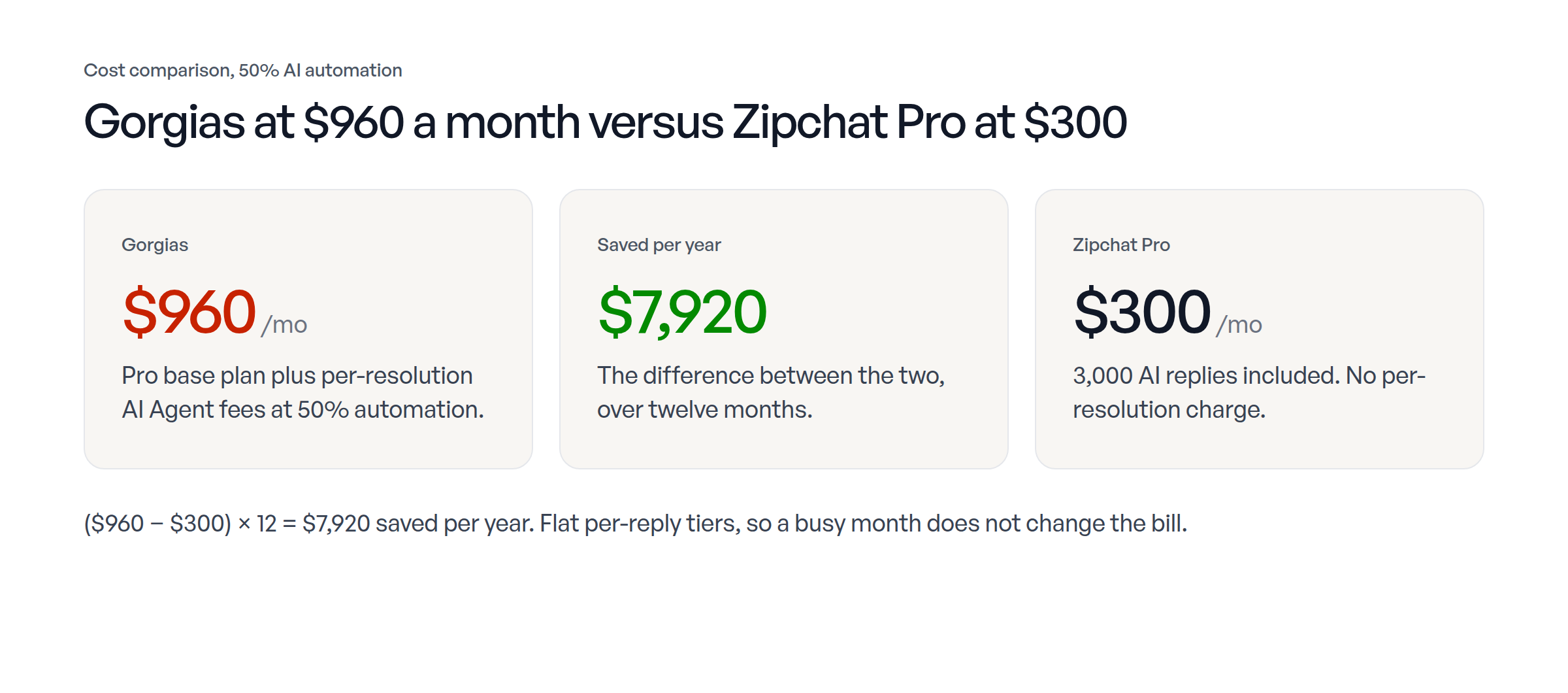
Gorgias Pro plan for a brand with 2,000 tickets/month and 50% AI automation: $960/month. Add SMS and voice: $1,300 to $1,500/month. Enterprise reference: $6,900/month.
Zipchat pricing for the same brand:
| Plan | Price/mo | Replies/month | Includes |
|---|
| Starter | $80 | 750 | WhatsApp AI, cart recovery, proactive sales, multi-language |
| Pro | $300 | 3,000 | All Starter features plus order status, 75,000 training pages, 3 AI agents |
| Scale | $600 | 6,000 | All Pro features plus 300,000 training pages, 5 AI agents |
| Scale Plus | $1,200 | 14,000 | All Scale features plus unlimited training pages, 10 AI agents |
View full Zipchat pricing
Annual savings formula:
(Gorgias Pro with 50% AI) - (Zipchat Pro) × 12 = annual savings
($960 - $300) × 12 = $7,920/year
(Gorgias Advanced + SMS/voice) - (Zipchat Scale) × 12 = annual savings
($1,425 - $600) × 12 = $9,900/year
Setup comparison
Gorgias basic helpdesk: 1 to 7 days. Gorgias AI Agent: Gorgias now markets roughly a 1-week launch, aided by AI-Generated Guidance (July 2025), which can seed the knowledge base from historical tickets. Optimal AI coverage, accurate enough for 60%+ automation, still takes several additional weeks of tuning. AI Agent subscription billing starts from day one regardless of knowledge base readiness. Enterprise deployments include a dedicated implementation team. Lower-tier plans use self-serve documentation only.
Zipchat: connect Shopify, WooCommerce, or Wix. The AI indexes the product catalog and begins operating within one hour. No manual knowledge base. No Help Center articles. Start your free trial and reach full AI capability on day one.
Verdict
For Shopify brands with large legacy support teams: Gorgias wins. If you have tens or hundreds of human agents, deep Shopify order management workflows, and organizational structures built around the ticket inbox, the migration cost and disruption of switching outweigh the gains. Gorgias’ seat pricing model is genuinely better for large teams than any per-seat competitor.
For Shopify brands where AI revenue generation is the primary goal: Zipchat wins. Gorgias’ proactive sales features are add-ons to a reactive helpdesk. Zipchat’s WhatsApp cart recovery, Agentic AI Search, and proactive conversation triggers are the core product. The billing model reinforces this: Zipchat does not charge more when automation succeeds.
For Shopify brands on Gorgias Pro paying $500 to $1,000+/month in overages: Zipchat wins. The annual savings at mid-tier pricing are $8,500 to $11,000+, with AI-native capabilities included at base price rather than charged as overages.
For brands on WooCommerce, BigCommerce, or any non-Shopify platform: Zipchat wins. Gorgias AI does not function outside Shopify. Zipchat runs full AI capabilities on WooCommerce and Wix from day one.
The structural question is not feature-for-feature. Gorgias was built to handle your tickets. Zipchat was built to turn your tickets into revenue. Those are different architectures, and switching later is a migration project.
See the full Gorgias alternative page for a feature-by-feature breakdown and live pricing comparison.
Customer testimonials
“We selected Zipchat as it aligned well with our scale. It makes much more sense than Gorgias.”
— Community discussion, r/EcommerceWebsite, Reddit, November 2025
“We move from Gorgias to Zipchat because at the end of the day their AI is so good we actually make lots of money from customer support and since all queries gets handled fast, it’s even faster and simpler to get customer reviews.”
— Community discussion, r/Shopify, Reddit, February 2026
“In our market (Italy) WhatsApp is a big thing. Zipchat AI cart recovery capabilities have no competitors.”
— Community discussion, r/ShopifyDevs, Reddit, January 2026
Where ecommerce support is heading in 2026 and beyond
AI shifts from reactive deflection to proactive revenue generation. The early AI in support tools (2022 to 2024) was built to deflect tickets: automated responses to WISMO queries, returns, FAQs. The second wave, now arriving, is AI that initiates conversations, qualifies shoppers, and recovers revenue before it leaves the site, the direction our agentic commerce 2026 guide lays out in full. Gorgias added proactive features in 2025. Purpose-built proactive systems were already there. The gap is architectural and takes years to close.
Ticket-based billing becomes a structural liability. Per-ticket pricing was invented when the unit of value was agent time. As AI automation rates approach 50 to 80%, the cost model inverts: the more a tool succeeds, the more it charges. Named pricing anchors show where the market is moving: Zendesk announced outcome-based pricing at approximately $1.50 per verified resolved ticket in May 2026; Intercom’s Fin has charged $0.99 per resolution since 2023. Industry analyses project hybrid pricing across approximately 61% of vendors by end of 2026, a trend we map across vendors in our customer service software comparison. Gorgias is already a hybrid: it charges both a ticket-based plan fee and per-resolution AI fees. The company publicly frames this as “pay per outcome,” but it has not removed the ticket-based component, which is the structural tension. CEO Romain Lapeyre acknowledged pricing criticism on LinkedIn in March 2026 and floated “annual volume commitments with seasonal buffers” as a potential future direction; as of June 2026, that feature has not shipped.
Static knowledge retrieval loses to live search. Help Center articles require ongoing manual maintenance. As product catalogs grow larger and change faster, the maintenance burden of static retrieval compounds. Agentic AI Search, which queries live product data at inference time, removes this burden entirely and answers more accurately. The merchants who experience this difference do not go back.
Frequently asked questions
Is Gorgias good for ecommerce?
Gorgias is the leading Shopify helpdesk for ecommerce. It is the right choice for Shopify brands with large human support teams who need to manage tickets at volume, perform order actions from within the ticket, and scale headcount without per-seat costs. For Shopify brands where proactive AI revenue generation is the primary goal, or for brands on WooCommerce and BigCommerce, it is not the right choice.
Is Gorgias worth the price?
At the base Pro plan ($360/month), Gorgias provides strong value for high-volume Shopify helpdesk operations. At real-world costs ($960/month for a brand with 50% AI automation, or $1,400+/month with SMS and voice), the value calculation changes, particularly because the AI overages causing the cost increase are charged specifically because AI automation is succeeding.
What are the main problems with Gorgias?
Four documented structural problems: (1) AI features work only on Shopify; WooCommerce, BigCommerce, Magento, and PrestaShop users get helpdesk only. (2) No autonomous learning; AI-Generated Guidance can seed from historical tickets but does not train on new data automatically. (3) Double-billing on AI resolutions; when AI Agent fully resolves a conversation, Gorgias charges both a helpdesk ticket fee and an automation fee, documented by Gorgias itself at docs.gorgias.com. (4) A reactive architecture that treats proactive selling and cart recovery as add-ons, not core capabilities.
Can Zipchat replace Gorgias for ecommerce?
Zipchat replaces the AI-automated portion of Gorgias: product recommendations, FAQ resolution, cart recovery, proactive engagement, and multi-channel AI conversations. It does not replace the ticket-routing, agent assignment, and order management workflow for teams that need large human agent teams handling volume at scale. Brands with 5+ dedicated support agents typically evaluate the full migration.
Can Zipchat and Gorgias work together?
Yes. Some brands use Zipchat for proactive AI-driven sales and WhatsApp cart recovery, while keeping Gorgias as the human agent inbox for escalated tickets. The AI handles first contact; Gorgias handles complex resolutions requiring order actions. This is a transitional architecture; most brands eventually consolidate into one system.
How long does it take to switch from Gorgias to Zipchat?
The Zipchat setup (connecting Shopify or WooCommerce and training on the product catalog) takes under 30 minutes. The full migration, including confirming AI coverage rates and turning off Gorgias workflows, typically takes 3 to 5 business days. Gorgias migration tooling for departing customers is self-serve; there is no white-glove offboarding on lower tiers.
Does Gorgias have WhatsApp cart recovery?
Yes, as of AI Agent 2.0 (July 2025), Gorgias includes WhatsApp cart recovery and proactive messaging on Shopify only, with an active AI Agent subscription. The abandon trigger fires at 45 minutes. Zipchat has included WhatsApp AI cart recovery in every plan, from $64/month, billed annually, since before that release, and it works on Shopify, WooCommerce, and Wix.
What is the best Gorgias alternative for WooCommerce?
Zipchat. Gorgias AI does not function on WooCommerce; only the basic helpdesk features work. Zipchat runs full AI capabilities (product recommendations, cart recovery, proactive triggers, multi-language support) on WooCommerce from day one, with zero manual knowledge base setup required.
Does Gorgias have a free plan?
No. Gorgias offers a 7-day free trial on paid plans. The lowest paid plan starts at $10/month (Starter: 50 tickets, 3 fixed seats, monthly billing only). Zipchat plans start from $64/month, billed annually, and include a 7-day free trial with full access plus a 30-day money-back guarantee on your first payment.
Disclosure: This review is written by Luca Borreani, CMO at Zipchat. We include Gorgias’ genuine strengths and recommend it in the use cases where it outperforms Zipchat. We have a commercial interest in Zipchat, and we are transparent about that.