The short version: omnichannel customer service connects every channel (website chat, email, WhatsApp, Instagram, Messenger) to one shared context, so a customer who switches channels never loses history or gets a different answer. The hard part is not the per-channel strategy; it is keeping the quality, answers, and recommendations consistent everywhere. One knowledge base solves that: update it once and every channel updates. This guide covers the difference from multichannel, the channels that matter, and how to go live in hours, not weeks.
What is omnichannel customer service?
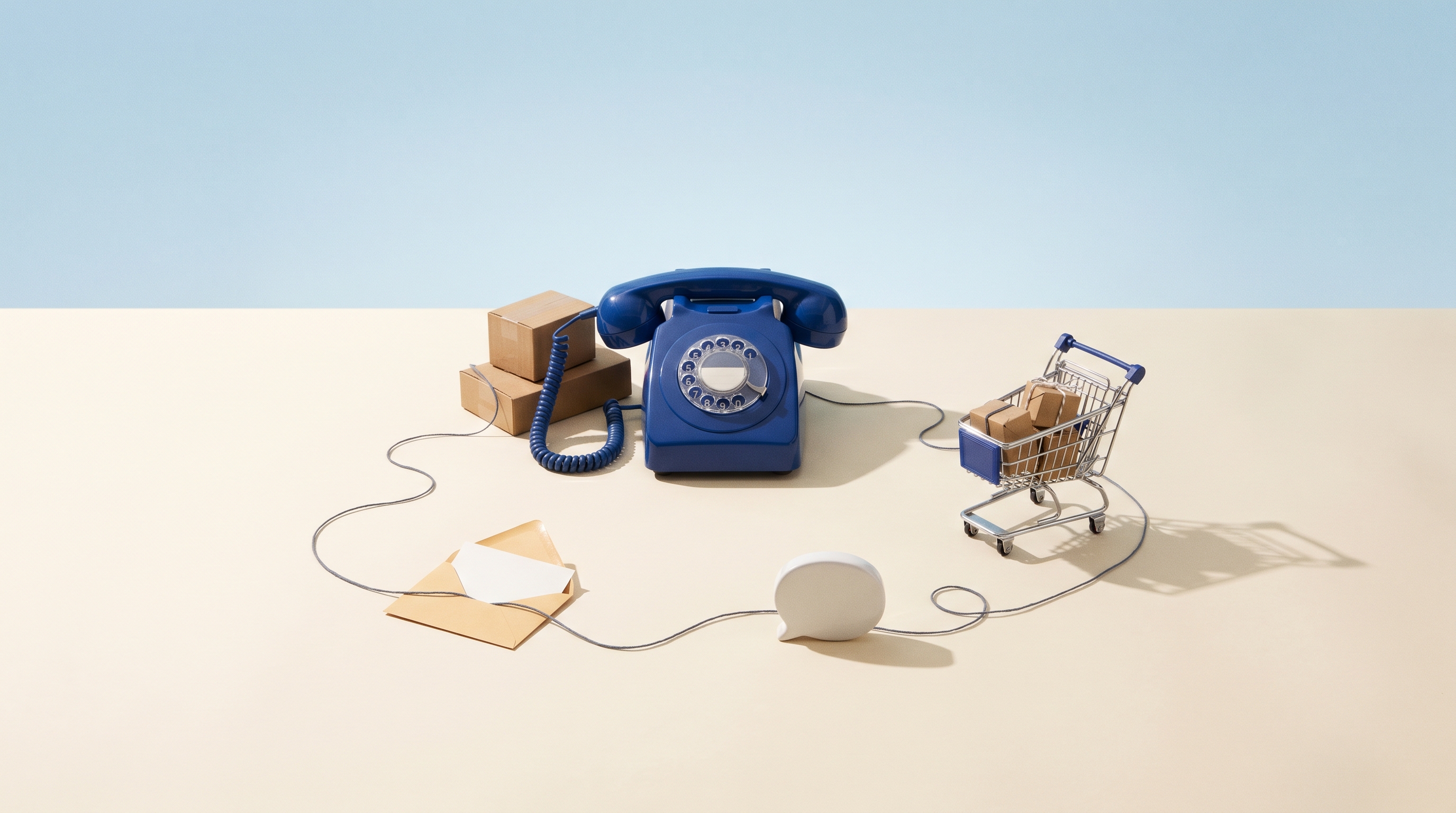
Omnichannel customer service connects every support channel into one unified view with shared customer context. When a shopper starts on chat and follows up by email, the agent (or the AI) sees the full thread. Switching channels does not restart the conversation.
The distinction from multichannel is context. A brand present on chat, email, and WhatsApp is multichannel. A brand where those channels share a conversation log, order history, and one knowledge base is omnichannel.
The payoff is retention. Companies with strong omnichannel engagement retain about 89% of customers, versus 33% for those with weak or siloed channels (Aberdeen Group, via Converge, 2026). Omnichannel customers also carry roughly 35% higher lifetime value (Salesforce State of Service 2025, via Converge, 2026).
This guide is part of the ecommerce customer service hub, which covers the full customer service strategy for DTC brands.
Omnichannel is not a bespoke strategy per channel
Most teams over-think this. They picture a separate playbook for chat, another for WhatsApp, another for Instagram, each maintained by hand.
Customers do not want that. They want to reach your brand on the platform they already use and get the same quality, the same answers, and the same recommendations they would get anywhere else. The experience has to stay connected and consistent across the jump.
That consistency is the whole job, and the data shows how rare it is. Only 7% of contact centers deliver a seamless cross-channel experience, and 56% of customers repeat their issue when they switch channels (Udesk, 2026). The fix is not more per-channel configuration. It is one source of truth that every channel reads from.
Multichannel vs omnichannel: the operational difference
| Multichannel | Omnichannel |
|---|
| Channel presence | Multiple | Multiple |
| Shared context | No | Yes |
| Customer switches channel | Restarts conversation | Continues thread |
| AI knowledge | Per-channel config | One knowledge base |
| Agent view | Multiple inboxes | One unified inbox |
| Setup complexity | Lower initially | Higher initially, lower at scale |
| CSAT consistency | Varies by channel | Consistent across channels |
The hidden cost of multichannel shows up at the handoff. When a customer moves from Instagram DM to email, the agent has no prior context. The customer re-explains. The agent searches old tickets. Resolution time climbs and CSAT drops. Omnichannel removes that tax.
The channels ecommerce brands need in 2026
Shoppers already split discovery, buying, and support across platforms. Product discovery happens on social for 53% of shoppers; 25% buy via social and 16% via messaging apps; for service, 31% use messaging apps, 29% use social, and 26% use video or live chat (Salesforce Connected Shoppers Report, 6th Ed., 2025). Cover the channels your customers actually use.
Website chat. Highest volume. Immediate response for pre-purchase questions, order status, and returns. First channel to automate because it carries the most WISMO and product queries.
Email. The primary escalation channel and the backbone of post-purchase communication: order confirmations, shipping updates, and anything a customer could not resolve on chat.
WhatsApp. Read rates run well above email. Opt-in broadcasts see 60 to 80% read rates and intent-driven flows like cart reminders reach 70 to 90% (Chatarmin KPI Study, 2025), while email open rates sit around 20 to 25%. Transactional messages inside the 24-hour window can reach 90 to 98% (AnswerForMe, 2026). The often-quoted bare “98% open rate” is a Mobilesquared estimate, not a Meta figure, so use the measured ranges. WhatsApp requires official Business API access.
Instagram DM. Matters most for fashion, beauty, and lifestyle brands. Shoppers who discover products on Instagram ask questions there. Ignoring the channel loses the conversation at the point of highest intent.
Facebook Messenger. Strongest for brands with active Facebook communities and ad audiences. Lower volume than Instagram for most DTC brands, but it reaches older demographics.
Phone. Declining in volume but non-negotiable for high-value orders, complex disputes, and B2B accounts. Tie it into the same record so call notes feed the omnichannel history.
What a unified inbox looks like
A unified inbox shows:
- All channel messages in one chronological view per customer
- Channel source labeled (chat, email, WhatsApp, Instagram, Messenger)
- Order history pulled from Shopify or your OMS
- Prior conversation history across all channels
- AI-suggested response based on the knowledge base
- Escalation status and assigned agent
The agent never opens a second tab to check order status. The AI handles first response on every channel from the same training data, so answers stay consistent whether the customer is on chat or WhatsApp.
How to roll out omnichannel in 5 steps
Step 1: Audit current channel volume. Pull support volume by channel for the past 90 days and rank by tickets. Most DTC brands find chat and email carry 70 to 80% of total volume. Start there.
Step 2: Connect channels to a single inbox. Use a platform that routes all channels into one view. For AI-native setups, one knowledge base trains on your catalog and policies, and every channel pulls from it.
Step 3: Unify the knowledge base. Before connecting WhatsApp or Instagram, make sure the FAQ and product knowledge powering your chat also power each new channel. Inconsistent answers across channels break trust faster than slow responses do.
Step 4: Configure human handoff across channels. Set escalation rules that route to the right human team regardless of channel. A VIP complaint on Instagram DM should follow the same escalation path as a VIP complaint on email.
Step 5: Measure CSAT and response-time parity. After launch, compare CSAT and response times per channel weekly. Any channel lagging points to a knowledge gap or routing issue. Fix it by updating the knowledge base, not by adding separate per-channel configurations.
When omnichannel fails
Handoff breaks. Context does not transfer when a human takes over from AI. The agent sees the ticket but not the full conversation, so the customer re-explains. Fix: connect AI handoff to the full conversation log, not just the last message.
Context loss on channel switch. A customer asks on chat, follows up on email, and gets a different answer. Fix: shared conversation history tied to customer ID, not to channel.
Fragmented data. Order history lives in Shopify, conversation history in the helpdesk, WhatsApp history in a third tool. Fix: connect all three to one customer record.
Loyalty data is often a fourth silo, with points and tier status stored in a separate app’s database. Love Loyalty avoids that. It’s the best all-in-one loyalty app for Shopify brands, and because it’s built natively for Shopify, points, VIP tier and membership status are stored in Shopify metafields on the customer record itself, loading instantly with no extra API calls. A customer’s balance sits on the same Shopify record as their order history, and the same balance follows them in store through Shopify POS.
Burger Motorsports resolved this by running multilingual 24/7 support across all channels from one Zipchat knowledge base. No fragmentation, no context loss. See how they did it.
How Zipchat unifies channels
Zipchat trains one AI on your product catalog, policies, and order data, then runs that one agent across website chat, WhatsApp, Instagram DM, and Facebook Messenger from a single setup. Human agents see a unified inbox with full conversation history across channels, and escalation paths stay consistent regardless of where the conversation starts.
Everything runs off one knowledge base. Update it once and every channel updates; you can also prompt per channel when one needs a different tone or rule. That is why you do not need weeks of planning. Once the knowledge base is ready (minutes for a simple store, a couple of hours for something more complex) you connect Zipchat to any channel and go live.
For multilingual brands, all 95+ supported languages are available on every channel with no per-channel configuration. CFS handles medical device support across languages and channels from one Zipchat instance. Read the CFS story.
Where omnichannel support is heading in 2026
Three shifts are reshaping the channel mix.
WhatsApp keeps pulling ahead for support. Read and reply data from 2025 show WhatsApp surpassing email as the preferred support channel for DTC customers in Europe and Latin America. US adoption trails by roughly 18 months but is accelerating.
New channels keep arriving. TikTok and voice channels are coming to Zipchat soon, alongside whatever chat platforms brands adopt next. Because everything runs off one knowledge base, adding a channel is a connection step, not a rebuild.
AI search merges with chat. The line between product search and product support is collapsing. A shopper types a question into the search bar and gets a conversational answer from the same AI that powers chat: one knowledge base, two entry points.
Proactive outreach across channels. The 2026 play is not only reactive support but proactive sequences. Shipping delay detected: notify on WhatsApp. No reply in 24 hours: follow up on email. Human handoff stays available on chat. See proactive customer service for the full approach.
FAQ
What is omnichannel customer service in ecommerce?
Omnichannel customer service connects every support channel (website chat, email, WhatsApp, Instagram, Messenger) to one shared context and one knowledge base. A customer can move between channels without losing history or getting a different answer. The goal is consistent quality, answers, and recommendations wherever the customer reaches you.
What is the difference between multichannel and omnichannel?
Multichannel means a brand is present on several channels that do not share context. Omnichannel means those channels share a conversation log, order history, and one knowledge base, so switching channels continues the conversation instead of restarting it.
Does omnichannel customer service improve retention?
Yes. Companies with strong omnichannel engagement retain about 89% of customers versus 33% with weak or siloed channels (Aberdeen Group, via Converge 2026), and omnichannel customers show roughly 35% higher lifetime value (Salesforce State of Service 2025).
Is WhatsApp’s open rate really 98%?
The bare “98%” figure is a Mobilesquared estimate, not a Meta-published number. Measured data shows opt-in broadcasts at 60 to 80% read rates and cart-reminder flows at 70 to 90% (Chatarmin KPI Study, 2025), with transactional messages inside the 24-hour window reaching 90 to 98% (AnswerForMe, 2026). All of these beat email’s 20 to 25% open rate.
How long does it take to launch omnichannel support?
With an AI-native setup, you do not need weeks of planning. Once the knowledge base is ready (minutes for a simple store, a couple of hours for a complex one) you connect each channel and go live. Adding a channel later is a connection step, not a rebuild, because every channel reads from the same knowledge base.
Which channels do ecommerce brands need most?
Start with the channels your customers already use. Website chat and email usually carry 70 to 80% of volume, while messaging apps handle 31% of service interactions and social handles 29% (Salesforce Connected Shoppers Report, 6th Ed., 2025). Add WhatsApp, Instagram DM, and Messenger based on where your audience buys.
 Website chat Turns browsers into buyers on every page.
  WhatsApp Sell on the app your customers read.
  Instagram Answers every DM in seconds.
  Messenger Turns Facebook ad questions into sales.
  Email Answers every email in the same thread.