The short version: multilingual customer support means answering shoppers in their own language at the same speed and quality as your home market. For brands selling across borders it is a revenue lever, not a nicety, because most shoppers will not buy in a language they do not read. AI handles this from one training pass, covering any language with no per-language setup, while keeping your brand voice consistent. This guide covers why it matters for revenue, how AI does it, the quality comparison with human translation, and how to keep your voice intact across markets.
What is multilingual customer support?
Multilingual customer support is the ability to answer a customer in their preferred language at the same quality and speed as your primary market.
In ecommerce the case is direct: shoppers who get support in their language buy more and return more. CSA Research surveyed 8,709 consumers across 29 countries and found 76% prefer buying products in their native language and 40% will never buy from sites in other languages (CSA Research, “Can’t Read, Won’t Buy,” 2020). The same study found 75% are more likely to repurchase when after-sale support is in their language.
This article is part of the ecommerce customer service hub covering the full support strategy for DTC brands.
Why multilingual support is a revenue issue, not a nicety
Language coverage decides whether cross-border shoppers buy at all. A brand selling across 15+ European countries faces a different official language in nearly every market, plus regional dialects inside many of them.
The buyer base is wider than the map suggests. Every country also has immigrants, expats, and tourists who buy on a recommendation or while abroad, often in a language that is not the local default. A German site that only speaks German still loses the Turkish-speaking resident, the visiting American, and the French tourist who found the brand on a friend’s recommendation.
The preference data is blunt. 65% of consumers prefer content in their own language even when it is poor quality, and Germany ranks highest, with 57% buying only at local-language sites (CSA Research, 2020). Localized sites also outperform on engagement, conversion, and retention, and language remains a top cross-border barrier (Analytics Insight, March 2026).
Messaging makes coverage broader still. 16% of shoppers have bought through a messaging app and 31% use messaging apps for customer service (Salesforce Connected Shoppers Report, 6th ed., 2025). Those channels carry whatever language the buyer speaks, so single-language support quietly caps revenue.
AI-native platforms treat every language as the baseline. Zipchat runs one AI agent across website chat, WhatsApp, Instagram, Messenger, and email in any language on one knowledge base, with no per-language setup or extra cost beyond the subscription.
Human translation vs AI translation
AI now handles the bulk of support translation at near-human quality and flat cost, while human translation stays best for high-stakes, idiomatic, or regulated content.
| Dimension | Human translation | AI translation |
|---|
| Languages supported | Limited by staff availability | 95+ from one setup |
| Setup time | Weeks to hire or contract | Immediate |
| Cost | $0.10 to $0.30 per word | Included in platform |
| Speed | Minutes to hours | Under 3.5 seconds |
| Quality (standard queries) | Native-level | Near-native |
| Quality (complex complaints) | Best-in-class | Good, human review recommended |
| Brand voice consistency | Variable by translator | Consistent once configured |
| Scaling | Linear with headcount | Flat cost with volume |
The quality gap has closed fast. Top-20 language pairs now hit 85 to 92% accuracy in 2026, up from 70 to 80% in 2023, and modern LLMs reach 90 to 95% human-equivalence on general and business support content (IntlPull, June 2026; better-i18n, February 2026). Creative and idiomatic copy sits lower, at 75 to 85%, which is why brand-voice configuration matters.
The economics favor a split. A hybrid setup, AI plus human post-edit on the hardest content, cuts translation cost 40 to 60% versus human-only (IntlPull, June 2026). AI handles standard queries at near-native quality; human review adds value on the complex, emotional, or high-stakes share.
How AI multilingual support works
AI delivers multilingual support by translating its own knowledge at the LLM layer, not by bolting a translation service onto a single-language bot.
Step 1: Train the AI on your brand content. Upload product catalog, FAQ, return policy, product pages, and positioning. The AI learns your brand in your home language.
Step 2: Configure language detection. The AI detects the language of each incoming message automatically. No manual routing.
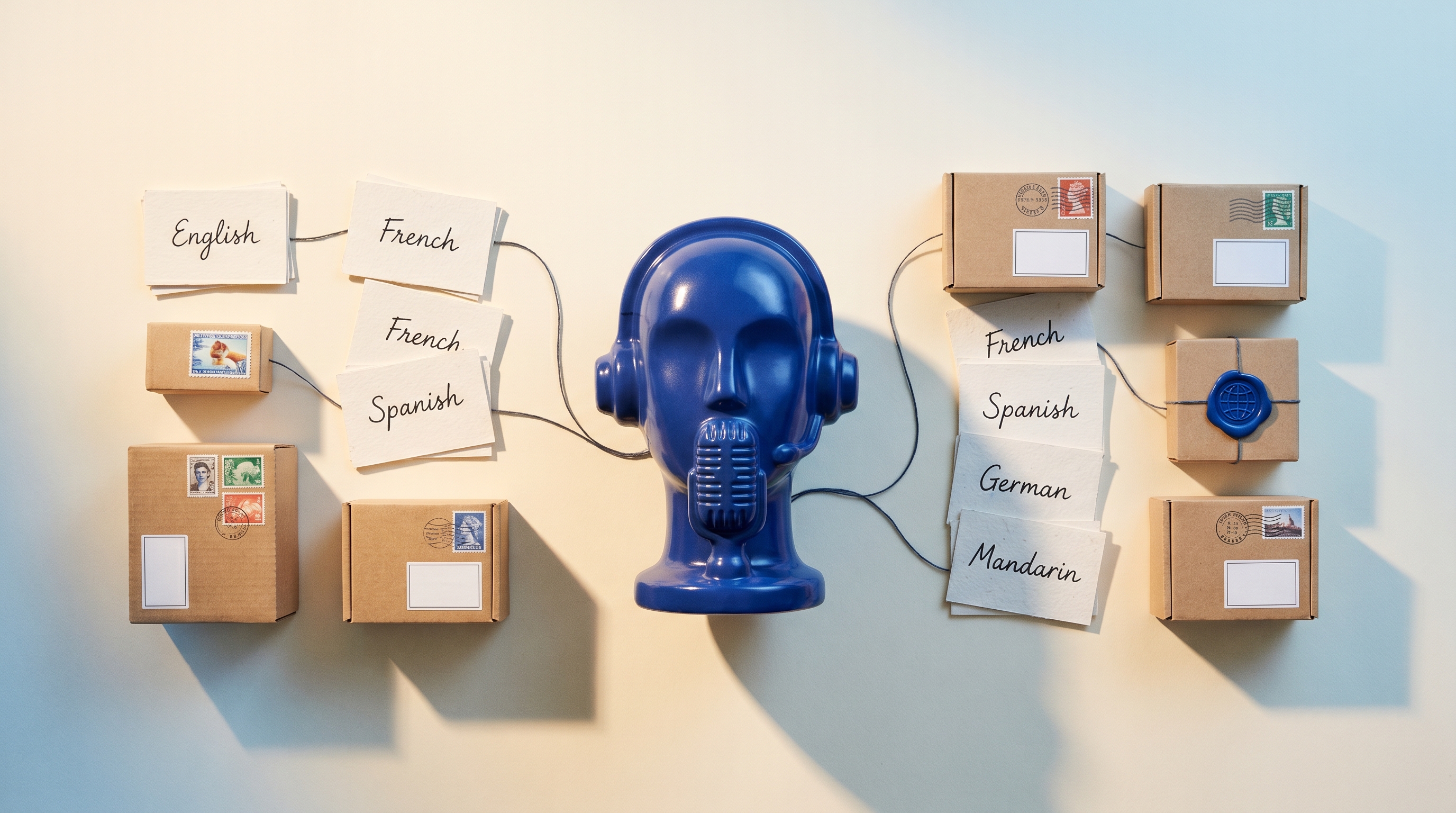
Step 3: The AI answers in the customer’s language. When a French shopper asks about returns, the AI retrieves the policy and generates a French reply directly. Knowledge transfer happens inside the model, not through a separate translation step.
Step 4: Set quality-assurance thresholds. Define which query types route to a human in key languages. A complex complaint in German or Japanese can warrant a native-speaker review before sending.
Step 5: Monitor accuracy by language. Review conversation logs for your top markets weekly. If the AI uses the wrong formal register or mistranslates a product name, update the brand-voice guidelines or prompt.
For the full automation context across channels, see the customer service automation playbook.
Which languages AI covers, and which to prioritize
AI covers any language, and it performs exceptionally across all North American and European languages and perfectly in Chinese, Arabic, Hindi, Russian, and beyond. Prioritization is about where your revenue concentrates, not where the AI is capable.
| Market | Priority languages |
|---|
| US domestic | English, Spanish |
| European | French, German, Spanish, Italian, Dutch, Polish |
| Latin America | Spanish, Portuguese (Brazil) |
| Asia-Pacific | Japanese, Chinese Simplified, Korean |
| Middle East and North Africa | Arabic, Turkish |
| Southeast Asia | Indonesian, Thai, Vietnamese |
For most DTC brands shipping from the US, English plus Spanish covers the home market and adding French and German opens Europe. A brand selling across Europe should map languages to its actual order data, then account for the expats, immigrants, and tourists inside each market who buy in a different language.
Brand voice preservation across languages
AI keeps your voice consistent because it is trained on your own content, knowledge base, product pages, and positioning, then guided further by prompts. Factual accuracy is reliable; voice needs configuration. Three common failure modes to set up against:
Formality register. German shoppers expect formal address (Sie, not du) and Japanese expects high formality. Set formality per language in your brand-voice guidelines.
Idiom translation. English marketing idioms translate literally and poorly. Plain product descriptions translate cleanly; clever taglines do not.
Product names. Product names should stay in their original form. Configure the AI to keep them untranslated across every language.
Vaonis ships telescopes globally and uses Zipchat to answer product questions accurately in 12 languages without a multilingual support team. Read how Vaonis handles global support.
When multilingual AI support needs a human in the loop
AI handles the volume; a human still belongs on the edges. Three cases warrant review or escalation:
Regulatory language. Legal disclaimers, financial terms, and medical-device questions need certified translation in some markets. Do not route regulatory-sensitive content through AI without legal review.
Dialect variation. European Portuguese differs from Brazilian; Castilian Spanish differs from Latin American. Configure the AI for your specific target market, and prompt for the dialect your buyers actually use rather than the generic language.
High-stakes complaints. Emotional or high-value disputes benefit from native-speaker review in your top languages before the reply goes out.
Burger Motorsports serves European and US customers with 24/7 multilingual support across all channels. See how they eliminated language barriers.
Where multilingual AI support is heading in 2026
Voice is the next barrier to fall. The AI layer that already handles any language in chat applies to phone support, removing the last gap, the call from a non-English speaker to an English-only line.
The near-term shift is messaging. WhatsApp is the primary support channel across Latin America, the Middle East, and Southeast Asia, and 31% of shoppers already use messaging apps for service (Salesforce Connected Shoppers Report, 2025). AI that handles multilingual WhatsApp at any language opens those markets without adding headcount. For the channel strategy behind this, see omnichannel customer service for ecommerce.
FAQ
How many languages can AI customer support handle?
AI platforms cover any language from one training pass. Zipchat supports any language across website chat, WhatsApp, Instagram, Messenger, and email on one knowledge base, with no per-language setup. Coverage is exceptional across North American and European languages and accurate in Chinese, Arabic, Hindi, and Russian.
Is AI translation good enough for customer support?
For standard support content, yes. Modern LLMs reach 90 to 95% human-equivalence on general and business support queries, and top language pairs hit 85 to 92% accuracy in 2026 (IntlPull, 2026). Keep human review for legal, medical, and high-stakes complaints.
Does language really affect ecommerce conversion?
Yes. 76% of consumers prefer buying in their native language and 40% will never buy from sites in other languages (CSA Research, 2020). For brands selling across many countries, plus the expats and tourists inside each one, language coverage caps how much revenue you can reach.
How does AI keep brand voice consistent across languages?
The AI is trained on your content, knowledge base, product pages, and positioning, then guided by prompts. You set formality per language, keep product names untranslated, and use plain descriptions that translate cleanly, then refine from weekly conversation logs.
When should a human handle multilingual support instead of AI?
Route regulatory content (legal, financial, medical), dialect-sensitive markets, and high-stakes complaints to human review. AI handles the standard volume at near-native quality; humans add value on the complex and high-risk share.
Which languages should an ecommerce brand prioritize?
Map languages to your actual order data. US brands usually start with English and Spanish, then add French and German for Europe. Then account for immigrants, expats, and tourists inside each market who buy in a different language.
 Website chat Turns browsers into buyers on every page.
  WhatsApp Sell on the app your customers read.
  Instagram Answers every DM in seconds.
  Messenger Turns Facebook ad questions into sales.
  Email Answers every email in the same thread.