
TL;DR
Gorgias vs Zendesk comes down to fit. Gorgias is the Shopify-native helpdesk with order actions inside the ticket and ticket-based pricing, aimed at SMB and mid-market stores. Zendesk is the enterprise, multichannel platform with per-seat pricing, aimed at large support operations. Both charge per AI resolution, so both price against ticket volume rather than reduce it.
The difference between Gorgias and Zendesk is what each was built to do. Gorgias is an ecommerce helpdesk designed around Shopify, so an agent can refund, edit, or cancel an order without leaving the ticket. Zendesk is a general-purpose, enterprise support platform built for scale across many channels and departments, with Shopify added through integration. Gorgias is built around Shopify-native ticketing. Zendesk is built around enterprise breadth. Both are still ticketing tools, and both bill AI resolution as a separate usage-based line.
That last point matters more than most comparisons admit. With either tool, you are choosing how to close tickets faster, not how to create fewer of them. This guide compares the two on price, AI, Shopify fit, and setup, then covers where an AI-first layer changes the math.
Gorgias vs Zendesk at a glance
| Factor | Gorgias | Zendesk |
|---|
| Starting price | $10/month, without AI agent (Starter, 50 tickets) | $19/agent/month (Support Team, ticketing only) |
| Pricing model | Ticket-based, unlimited agents | Per-agent seat |
| Shopify integration | Native read and write; refunds and order edits in the ticket | Via integration; custom API config for deep actions |
| AI and automation | AI Agent add-on, billed per resolved conversation | AI Agents included in plans, small free allotment then per resolution |
| Best for | Shopify SMB and mid-market stores | Large, multichannel, multi-department operations |
| Key limitation | Ticket caps with overage fees; AI billed on top | Seat costs and add-ons stack fast; heavier setup |
| Rating | 4.6/5 rating on G2 | 4.3/5 rating on G2 |
Pricing and ratings as of August 2026.
Gorgias
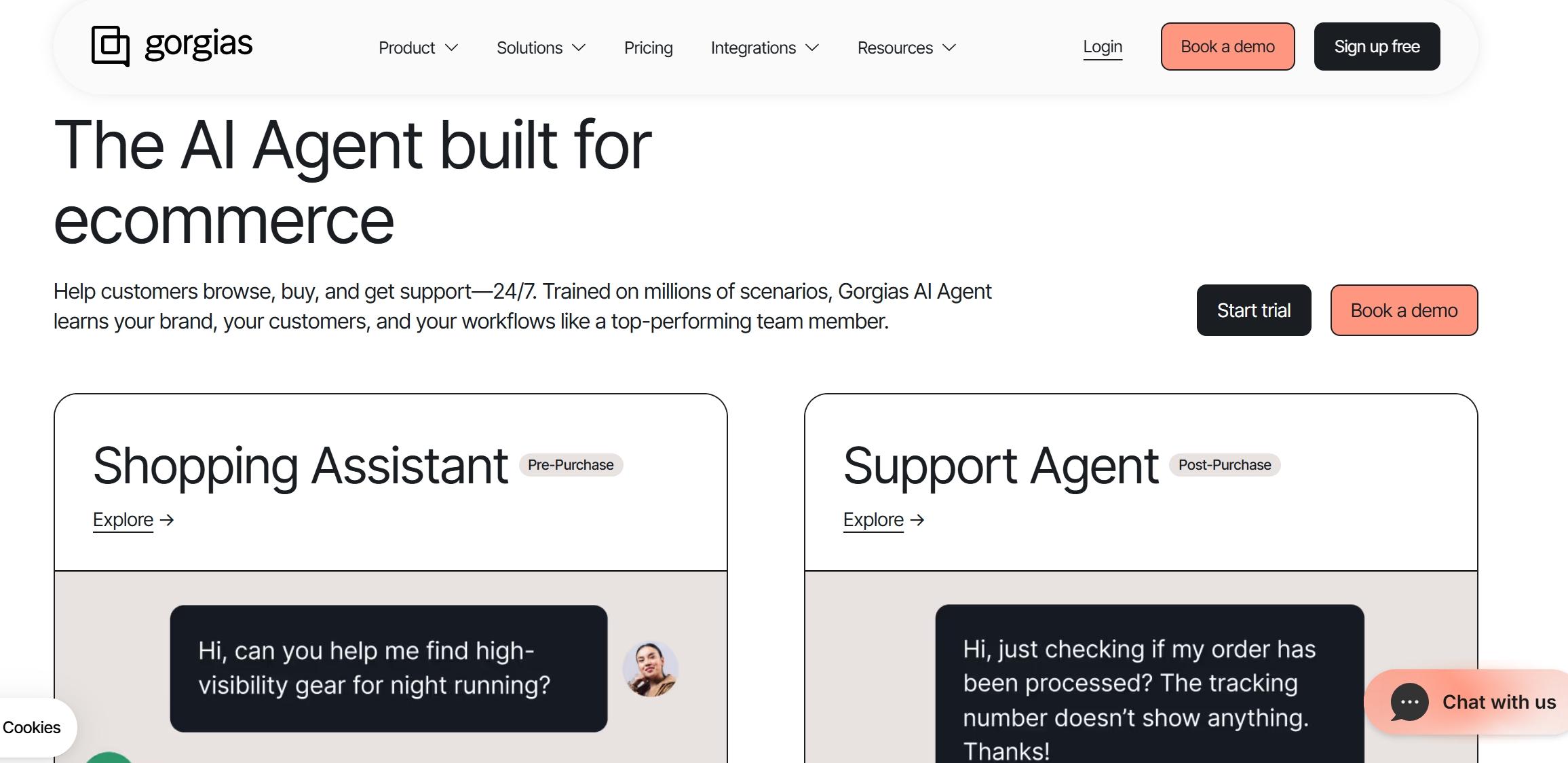
Gorgias is a customer support helpdesk built for ecommerce, with the deepest roots in Shopify. It centralizes email, chat, social, and SMS into one ticket view, then layers Shopify order data directly beside each conversation.
When a shopper emails about an order, the agent sees line items, fulfillment status, tracking, customer lifetime value, and recent order history inline, and can refund or edit the order without switching tabs.
Who it is for:
Shopify and ecommerce stores from SMB up to mid-market that want native order actions and predictable, ticket-based cost.
Strengths:
- Native Shopify read and write.
- Unlimited agents on every plan that answer tickets.
- Supports over 100 ecommerce platforms
- Ecommerce macros and routing rules.
- Fast time-to-value for a store already on Shopify.
Weaknesses:
- Pricing is capped by ticket volume, so overages add up during spikes.
- The AI Agent is a separate line billed per resolved conversation.
- Heavy multichannel or multi-department operations outgrow its ecommerce focus.
Zendesk
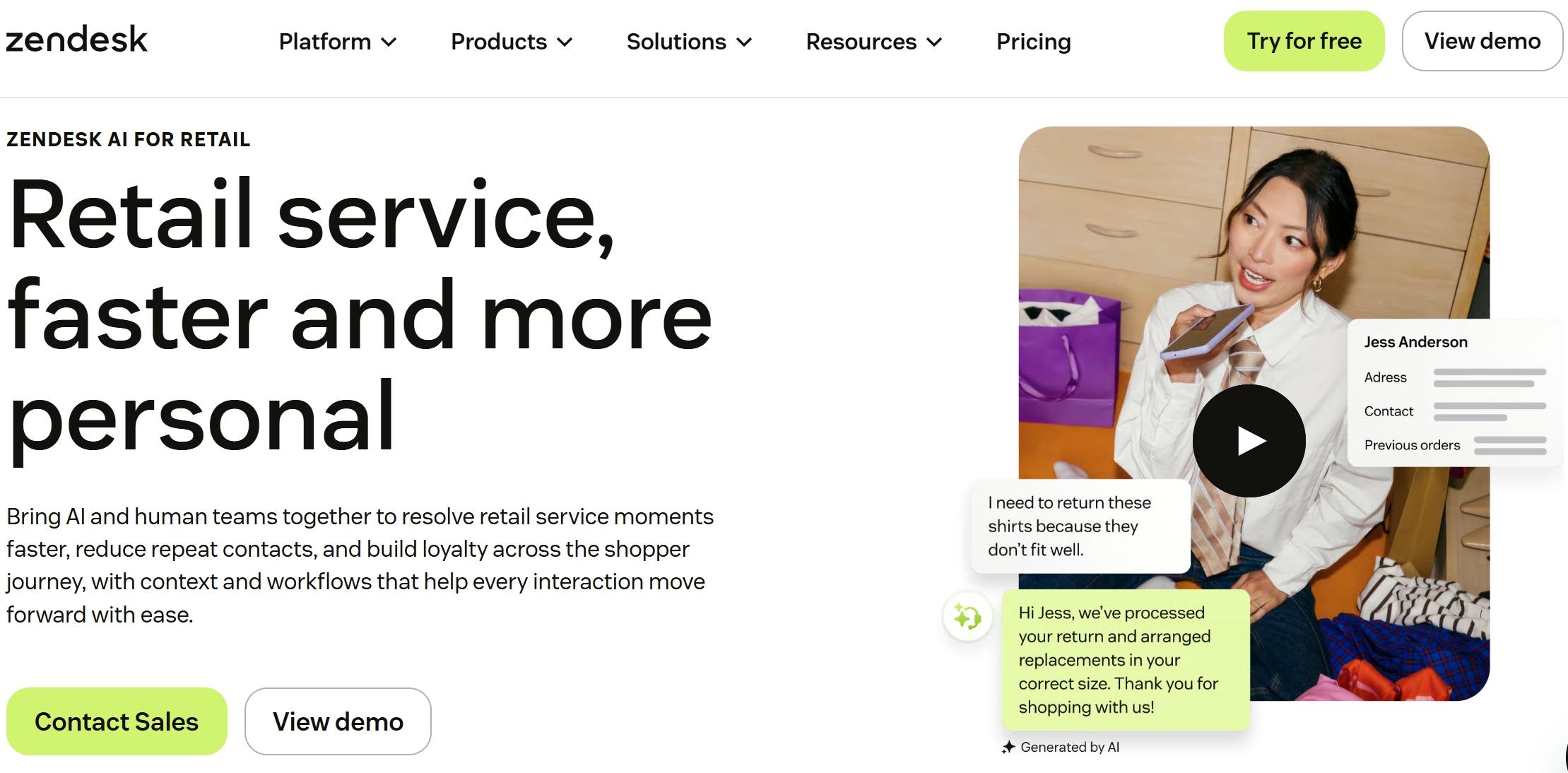
Zendesk is a general-purpose customer service platform built for scale. It runs support across email, chat, voice, messaging, and social, with skills-based routing, SLA enforcement, workforce management, and a marketplace of 1,500+ integrations across various platforms.
It serves companies well beyond ecommerce, including financial services, and multi-brand enterprises.
Who it is for:
Large support organizations with complex routing, strict SLAs, multiple departments, and channels beyond the storefront.
Strengths:
- Enterprise workflow depth.
- Mature reporting.
- Broad channel coverage.
- One of the largest app marketplaces in support software.
Weaknesses:
- Shopify is an add-on, not the core, so deep order actions need API configuration and often lose context.
- Per-seat pricing scales with headcount.
- Useful AI and analytics add-ons stack on top of the base plan.
- Setup is heavier and slower than an ecommerce-native tool.
Is Gorgias or Zendesk cheaper for a Shopify store?
For most Shopify stores, Gorgias is cheaper, because it charges by ticket with unlimited agents, while Zendesk charges per seat and adds AI on top. The gap widens as your team grows, and narrows as your ticket volume spikes.
The two use opposite cost models, so the cheaper option depends on your cost driver. Gorgias prices by ticket volume: your team can be any size, but you pay for the conversations you handle. Zendesk prices by agent seat: your channel count can be modest, but every hire adds a fixed monthly cost.
| Plan tier | Gorgias (ticket-based, annual) | Zendesk (per agent, annual) |
|---|
| Entry | $10/month, 50 tickets (Starter) | $19/agent/month, ticketing only (Support Team) |
| Core | $50/month, 300 tickets (Basic) | $55/agent/month (Suite Team) |
| Growth | $300/month, 2,000 tickets (Pro) | $115/agent/month (Suite Professional) |
| High volume | $750/month, 5,000 tickets (Advanced) | Custom (Suite Enterprise) |
| Ticket overage | $0.36 to $0.40 per extra ticket | Not applicable (billed by seat) |
| AI resolution | $0.90 per resolved conversation (annual) | Small free allotment, then ~$1 to $2 each |
Gorgias helpdesk plans run $10 (Starter, 50 tickets), $60 (Basic, 300), $360 (Pro, 2,000), and $900 (Advanced, 5,000) on monthly billing, with annual billing cutting roughly 16% off the paid tiers.
Extra tickets cost $0.40 on Starter and Basic, dropping to $0.36 on Pro and Advanced. The AI Agent is a separate add-on at $1.00 per automated resolved conversation monthly, or $0.90 on annual.
Zendesk runs $19 per agent for Support Team (ticketing only), $55 for Suite Team, and $115 for Suite Professional on annual billing, with Suite Enterprise on quote. Autonomous AI Agents have been included in every plan since May 2026, but only 5 to 15 automated resolutions per agent per month are free; past that, resolutions bill per outcome, landing around $1 to $2 in 2026 mid-market deals.
Copilot ($50 per agent), Quality Assurance (about $35), and Workforce Management (about $25) are further add-ons, and stacking them onto Suite Professional reaches about $215 per agent per month, roughly 87% over the base plan.
Here is a like-for-like scenario: a Shopify store with 5 agents and 2,000 tickets a month, AI resolving 40% (800 conversations).
| Cost line | Gorgias (ticket + AI) | Zendesk (seat + AI) |
|---|
| Agents / seats | Unlimited (included) | 5 x $115 = $575/month |
| Ticket plan | $300/month (Pro, 2,000 tickets) | Included above |
| AI resolutions | ~800 x $0.90 = ~$720/month | ~750 billable x $1.50 = ~$1,125/month |
| Estimated total | ~$1,020/month | ~$1,700/month |
Use one formula to compare any two tools on the same footing:
Cost per resolved conversation = Total monthly tool cost / conversations resolved

Gorgias:  $1,020 / 2,000 = $0.51 per conversation
Zendesk:  $1,700 / 2,000 = $0.85 per conversation
The takeaway: Gorgias tends to cost less for Shopify stores because agents are unlimited and the base plan is cheaper. Zendesk’s per-seat model grows with headcount, and the AI plus analytics add-ons compound the gap.
Both, though, bill AI resolution as a variable cost that rises with volume. That shared trait is the opening the last section addresses.
Which has better AI and automation?
Zendesk has the broader, more configurable AI across channels and departments. Gorgias has narrower AI that is ecommerce-aware out of the box. Both charge per automated resolution, so cost scales with how much the AI does.
Gorgias AI Agent is trained on your Shopify data and help center, and resolves ecommerce conversations like order status, returns, and product questions. It is purpose-built for storefront support, so it needs less configuration to sound ecommerce-fluent. The trade-off is scope: it is designed for ecommerce tickets, not broad multi-department automation.
Billing is per fully automated resolved conversation, and a resolved ticket can count against both your AI usage and your ticket allowance.
Zendesk AI Agents are broader and more configurable, spanning messaging, email, voice, and internal service, with routing and workflow tools around them. That flexibility fits complex operations, but it comes with heavier setup and a longer path to reliable deflection.
Zendesk includes autonomous AI Agents in every plan as of May 2026, yet the free allotment is only 5 to 15 resolutions per agent per month before per-resolution billing begins.
The structural similarity matters. Both tools automate the resolution of tickets that already exist, and both meter that automation. Neither model reduces the number of pre-sale or WISMO questions arriving in the first place, which is where variable AI cost comes from.
Which is better for Shopify specifically?
On Shopify depth, Gorgias goes deeper. Its native integration reads and writes order data inside the ticket, so agents refund, cancel, and edit orders without leaving the conversation. Zendesk connects to Shopify, but deep actions need custom API work.
This is the clearest split between the two. Gorgias treats Shopify as its home platform. The order panel sits in the ticket sidebar with line items, fulfillment status, tracking, customer lifetime value, and return history, and agents can act on the order in place. For WISMO and returns, that native depth removes tab-switching and shortens handle time.
Zendesk reaches Shopify through its marketplace rather than a native core. Basic order lookup is available, but deeper actions and subscription edits often require custom API configuration and can happen outside the ticket, so the agent loses context. Zendesk offsets this with breadth: 1,500+ integrations and channel coverage that a store running many tools and departments will value.
Gorgias is built for the mostly-Shopify-order-questions case. Zendesk’s breadth is built for the case where Shopify is one of many systems in a large operation. Either way, both handle the tickets after they arrive, not the volume before it.
How is setup and support for each?
Gorgias is faster to set up for a Shopify store because the integration is native and the scope is ecommerce. Zendesk takes longer to configure but offers deeper admin control and enterprise support tiers.
Gorgias connects to Shopify in a few clicks, pulls order data automatically, and gets a store live quickly. Its admin surface is smaller and ecommerce-focused, which suits lean teams. The limit is the ceiling: fewer enterprise controls when your operation grows past ecommerce support.
Zendesk trades speed for depth. Configuring routing, SLAs, business rules, and multi-brand workspaces takes real setup time, often with admin or partner help. In return, you get granular control, mature reporting, and enterprise support options.
For a small Shopify team, that depth is overhead. For a large operation, it is what Zendesk is built to provide.
Verdict: how Gorgias and Zendesk compare for your online store
Both tools answer the same question, “how do we close tickets faster,” in two different shapes. Gorgias is the Shopify-native, ticket-priced option with order actions in the conversation. Zendesk is the enterprise, per-seat option with routing, SLAs, and 1,500+ integrations. Score the choice on cost per resolved conversation, not per agent seat, and each tool’s design target becomes clear.
| If your situation is… | The tool designed for it… | What it still leaves on the table |
|---|
| Shopify store, SMB to mid-market, order-heavy support | Gorgias | Repetitive WISMO and pre-sale volume still bills per ticket and per resolution |
| Large multichannel operation with strict SLAs | Zendesk | Seat and add-on costs climb; storefront depth stays shallow |
| Small team, growing headcount | Gorgias | AI resolution is a separate, rising line on top of the ticket plan |
| Multi-department support beyond ecommerce | Zendesk | Nothing here reduces how many tickets arrive |
Both design targets hold if the goal is to resolve tickets faster. But notice what neither option changes: the volume of repetitive pre-sale and WISMO questions hitting your queue, and the AI resolution fees that scale with that volume. That is the gap the next section addresses.
Where Zipchat fits for Shopify stores
Zipchat is the AI-first third option, and it solves a different problem than either helpdesk. Where Gorgias and Zendesk are built around agents closing tickets, Zipchat is built to resolve questions before they become tickets. It reads your Shopify catalog, policies, and pages automatically, then answers pre-sale and WISMO questions across website chat, WhatsApp, Instagram, Messenger, and email, in 95+ languages.
The strategic point is about volume, not features. Gorgias and Zendesk both price against the tickets you receive, whether by ticket allowance or per resolution. An AI-first layer that deflects repetitive questions upstream shrinks the inbound volume both tools are priced against.
Named outcomes back this up: Tropicfeel automated 85% of customer inquiries, Family Nation automated 80%, and CFS.it reduced its support workload by more than 75%.
Zipchat is Built for Shopify certified, tracks orders in chat, and generates one-time Shopify discount codes to recover a hesitant buyer. It does not replace deep ticket actions like refunds or order edits, and it is honest about that.
Instead, it escalates cleanly to a live agent when a conversation needs a human or a refund. If you keep a ticketing backbone, Zipchat handles the pre-sale and WISMO layer on the storefront and hands the rest off to your support team.
Pricing follows a reply-based model, not per seat or per resolution. Starter is $80/month and Pro is $300/month with 3,000 AI replies included, unlimited team members, a 7-day free trial, and a 30-day money-back guarantee.
AI replies are bundled into the plan, so the resolution cost does not climb with every conversation the AI handles. For a direct head-to-head, see Zipchat vs Gorgias and Zipchat vs Zendesk.
When neither Gorgias nor Zendesk is enough
A ticketing tool alone is the wrong choice when repetitive pre-sale and WISMO questions are the real cost, your budget is tight, or you need multichannel AI rather than a shared inbox. In those cases, deflection upstream beats faster ticket closing.
| Condition | Threshold | Action |
|---|
| Repetitive pre-sale and WISMO questions dominate | More than half of tickets are the same handful of questions | Add an AI deflection layer before the ticketing tool |
| Tight budget, small team | Per-seat or per-resolution fees outrun the value | Use a reply-based plan with AI included |
| Need multichannel AI, not a shared inbox | Customers arrive on WhatsApp, Instagram, and web chat | Choose a tool that answers across channels natively |
A helpdesk resolves tickets efficiently, but it does not lower how many arrive. If your queue is dominated by the same pre-sale and shipping questions, closing them faster still leaves you paying to close them. Deflecting them upstream reduces the volume both Gorgias and Zendesk price against, and recovers pre-sale conversations that a deflection-only helpdesk never measures.
FAQ
Is Gorgias or Zendesk better for Shopify?
On Shopify depth, Gorgias goes deeper. Its native integration reads and writes order data inside the ticket, so agents refund, cancel, and edit orders without leaving the conversation. Zendesk connects to Shopify through its marketplace, but deep actions typically need custom API configuration. For a large multi-department operation, Zendesk’s breadth carries more weight.
Is Gorgias cheaper than Zendesk?
For most Shopify stores, yes. Gorgias charges by ticket with unlimited agents, starting at $10/month, while Zendesk charges per seat from $19/agent/month for ticketing and $55 to $115 for Suite plans. Both add AI resolution as a separate usage-based fee. The gap grows as your team grows.
Which has better AI, Gorgias or Zendesk?
Zendesk’s AI is broader and more configurable across channels and departments. Gorgias’s AI Agent is narrower but ecommerce-aware out of the box, so it needs less setup for a Shopify store. Both bill per automated resolved conversation, so cost scales with automation volume.
Does Gorgias integrate with Shopify better than Zendesk?
Yes. Gorgias offers native read-and-write Shopify integration with order data and actions inside the ticket. Zendesk reaches Shopify through integrations, and deeper actions or subscription edits often need custom API work and can happen outside the ticket.
Is there a more AI-native alternative to Gorgias and Zendesk for Shopify?
Yes. An AI-first tool like Zipchat resolves pre-sale and WISMO questions before they become tickets, across website chat, WhatsApp, Instagram, and email, then escalates to a helpdesk when needed. See Zipchat vs Gorgias and Zipchat vs Zendesk for direct comparisons.
Can Gorgias and Zendesk handle WhatsApp and Instagram for a Shopify store?
Both cover social and messaging channels through their platforms, though setup and depth vary. A multichannel AI tool answers natively across WhatsApp, Instagram, Messenger, and web chat from one knowledge base, which reduces per-channel configuration.
Which is easier to set up for a small Shopify store?
Gorgias. Its Shopify integration connects in a few clicks and pulls order data automatically, so a store can go live quickly. Zendesk offers deeper admin control but takes longer to configure routing, SLAs, and business rules.
Conclusion
Gorgias and Zendesk answer the same question two different ways. For a Shopify store that lives in order tickets, Gorgias is the native, lower-cost, faster-to-launch tool. For a large operation that spans channels and departments, Zendesk’s enterprise depth is what it is built to earn. Score the fit on cost per resolved conversation, not per agent seat, and each tool’s role becomes clear for your size.
Then ask the question neither tool answers: how many of your tickets should exist at all? If most are repeat pre-sale and shipping questions, deflect them upstream first and let a helpdesk handle the rest. Start a 7-day free trial and see how many chats resolve before they ever reach a ticket.