TL;DR
The Shopify trust stack is the set of signals that convince a shopper to buy: customer reviews, real customer photos, transparent shipping and return policies, and AI chat that answers questions on the spot. Reviews prove the product is trustworthy. AI chat proves it’s right for this specific buyer. Run both, and you close doubts that a discount never could.
Traffic is cheap in 2026. Trust is the bottleneck. A shopper who lands on your Shopify store ready to buy still pauses to check one thing before the card comes out: can I trust this business? Reviews answer part of that question. AI chat answers the rest.
Stores that stitch both into one experience convert the doubt that everyone else loses. Products with five reviews are 270% more likely to sell than products with none (Medill Spiegel Research Center, 2025), yet reviews alone can’t answer “will this fit me.”
What the Shopify trust stack is
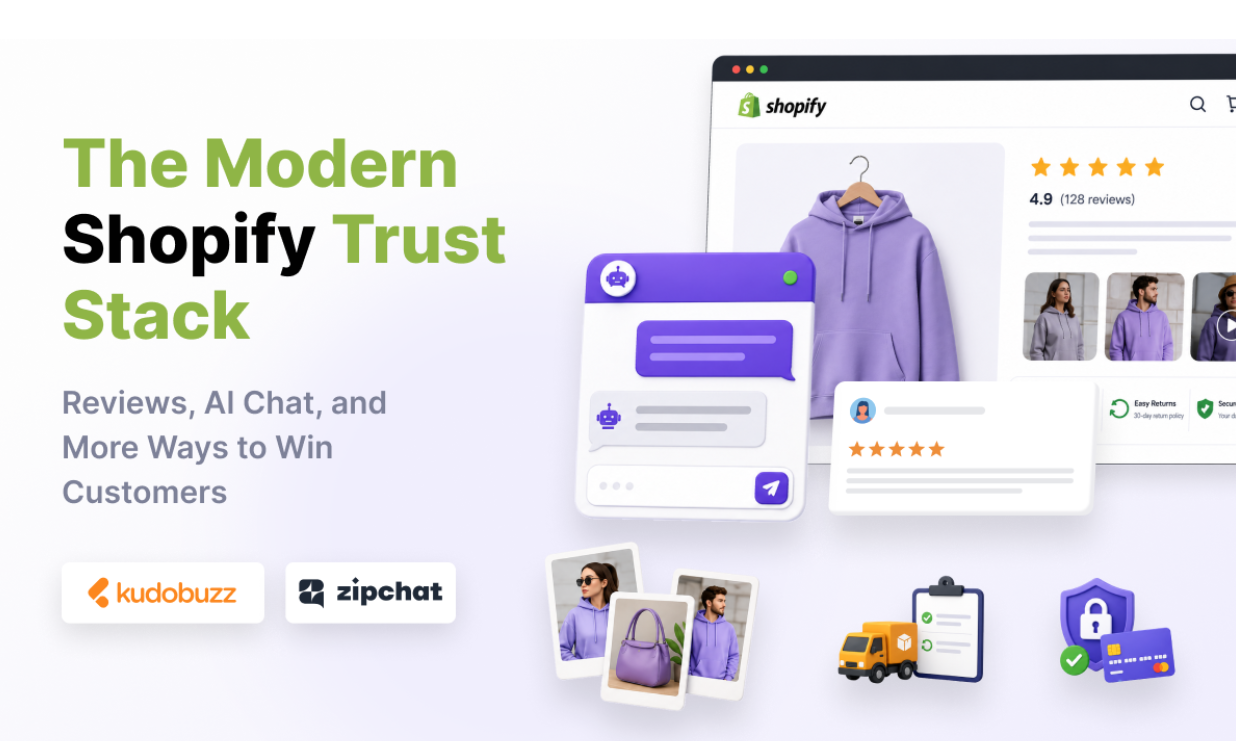
The Shopify trust stack is the combination of signals and tools that give a shopper enough confidence to complete a purchase. It has four layers: social proof (reviews and ratings), authenticity (real customer photos and video), transparency (visible shipping and return policies, plus trust badges that vouch for security and payment), and real-time reassurance (AI chat that answers specific questions before a shopper leaves).
Each layer removes a different kind of doubt. No single feature builds trust on its own. A five-star rating means little if the shipping cost is hidden until checkout. A slick chat widget can’t rescue a product page with zero reviews. The layers work together, and the gaps between them are where sales leak out.
The average documented cart abandonment rate sits at 70.22% (Baymard Institute, 2025). Most of that number is not price. It’s unanswered questions and unmet expectations, which is exactly what the trust stack is built to fix.
Trust, not traffic, is the 2026 conversion bottleneck
AI-powered ads, search, and social can put visitors in front of your store in minutes. Converting them is the hard part, and it’s getting harder because shoppers have grown skeptical. Two-thirds of consumers now trust online reviews less than they did five years ago, and 90% say fake reviews are a concern (PowerReviews, 2025).
That skepticism raises the bar for every store. Generic marketing copy no longer clears it. Shoppers want proof from other buyers and straight answers to their own questions, delivered before their patience runs out.
So the job shifts. You still need traffic, but the growth lever in 2026 is closing the trust gap on the pages you already have. That’s cheaper than buying more clicks, and it compounds, because a trusted store keeps the customers it converts.
Reviews close the “can I trust this product?” gap
Reviews are the single most effective trust signal you can add, and the data is not subtle. Purchase likelihood climbs 270% once a product shows five reviews, and the effect is stronger on expensive items: conversion rose 190% for lower-priced products and 380% for higher-priced ones in the Spiegel study (Medill Spiegel Research Center, 2025).
Verified reviews and customer testimonials answer the questions marketing copy can’t credibly answer itself. Is it worth the price? Does it match the photos? Is the quality consistent? Would a real buyer do it again? A review platform like Kudobuzz collects verified reviews automatically after purchase, then displays them as star ratings, written feedback, and product Q&A across the store.
One detail matters more than volume: authenticity. Verified-buyer badges alone lift purchase odds by 15% (Medill Spiegel Research Center, 2025), and shoppers rank authenticity as the top factor when deciding which reviews to trust (eMarketer, 2025). Five reviews from confirmed buyers beat fifty anonymous ones.
Real customer photos beat studio shots
Professional photography sells the ideal. Customer photos sell the reality, and shoppers increasingly want the reality. User-generated images answer questions a studio shot can’t: “What does this look like off the model?” “Does the color match?” “How does it fit a body like mine?” “How are people actually using it?”
The conversion effect is measurable. Shoppers who engage with customer photos and user-generated content convert at far higher rates than those who read text alone, with photo-review interaction driving conversion lifts of around 90% in PowerReviews research (PowerReviews, 2025). Kudobuzz supports photo and video reviews directly on product pages, so a hesitant buyer can browse other people’s real results before deciding.
Pair customer photos with written reviews and the trust signal is stronger than either alone. The more a shopper can picture the product in their own life, the smaller the leap to buy.
AI chat closes the “is this right for me?” gap
Reviews prove the product is good. They can’t tell one specific shopper whether it’s right for them. That’s the second gap, and it’s about validation, not discovery. Shoppers hesitate over sizing, compatibility, delivery, and returns, the details that decide a single purchase.
Those questions have short fuses. Half of consumers have abandoned a purchase in the past six months because they couldn’t find enough product information (Syndigo, State of Product Content 2024, June 2024). When “does this fit true to size” or “will it arrive before the weekend” goes unanswered, the shopper leaves to search elsewhere, and often doesn’t come back.
An AI chat agent like Zipchat answers those questions in seconds, in 95+ languages, at any hour. It reads your catalog, policies, and customer data instead of running from a script, so it can give personalized size and fit advice, explain delivery windows, or handle shipping and return questions without a support agent on shift.
The payoff shows up in conversion. Shoppers who engage in chat are 2.8 times more likely to buy than those who don’t (Forrester, 2018), and more recent data shows shoppers who use AI chat converting at four times the rate of those who don’t (Rep AI, 2025).
Reviews vs AI chat: what each layer actually does
The two are not competitors. They answer different questions at different moments, and the strongest stores run both.
| Dimension | Customer reviews | AI chat |
|---|
| Question answered | ”Can I trust this product?" | "Is this right for me?” |
| Timing | Before and during browsing | The moment a specific doubt appears |
| Coverage | Shared, repeated concerns | Personal, variable, high-stakes questions |
| Format | Static social proof on the page | Live, back-and-forth conversation |
| SEO value | High (indexable text, rich snippets) | Low (sits behind an interaction) |
| Best on | Every product, especially high-priced | Complex, high-consideration, high-AOV items |
| Tool example | Kudobuzz | Zipchat |
Reviews build baseline credibility for every visitor. AI chat rescues the specific shopper who is 90% convinced and stuck on one question. Remove either layer, and you lose a distinct slice of buyers.
Shipping and return policies: the trust layer stores keep hiding
The fastest way to break trust is to hide the cost. Unexpected shipping, taxes, and fees are the single biggest reason shoppers abandon a checkout, cited by 39% of them (Baymard Institute, 2025). The problem is rarely the cost itself. It’s the surprise.
So surface the information early. Show estimated delivery times, shipping costs before checkout, return and exchange terms, and refund timelines where shoppers can find them without hunting. Shoppers don’t expect free shipping and unlimited returns from every store. They expect honesty about what they’re signing up for.
This is also where reviews and chat reinforce transparency. Reviews often mention real delivery speed and return experience, and an AI agent can answer WISMO and delivery-date questions the instant they come up. A store that’s upfront about the boring details earns trust on the exciting ones.
Shopify trust badges: the reassurance layer at checkout
Shopify trust badges are the small visual marks, security seals, payment icons, and guarantee stamps that tell a shopper a store is safe to buy from. They reassure buyers at each stage of the customer journey, from the product page to the payment screen. Secure payment badges carry the most weight, because they appear right where the card details go.
Badges won’t rescue a bad product, but their absence creates doubt. When a checkout page shows no sign of who handles the payment or how data is protected, a cautious shopper hesitates. The right badges answer that worry before it forms.
Security badges
Security trust badges indicate encryption and secure payment processing. They tell a shopper the connection is protected and their card details won’t leak. Security badges indicate a site is Payment Card Industry (PCI) compliant, the standard that governs how card data is stored and handled. Place them near the checkout button, where hesitation peaks.
Payment badges
Payment badges display accepted payment methods like Visa and PayPal. Seeing a familiar logo tells a shopper they can pay the way they already trust. Using trusted payment methods reduces buyer hesitation at checkout, and payment badges enhance customer trust in online transactions by making the options clear before the card comes out.
Policy badges
Policy badges turn your promises into visible stamps: money-back guarantee, free returns, secure checkout. They repeat the transparency your shipping and return policies establish, right at the point of decision. Endorsement badges signal approval from third-party organizations, such as the Better Business Bureau or Google, and add outside credibility your own copy can’t.
Badges are one on-page cue among several. Fast-loading websites with clean designs contribute to buyer trust and lower abandonment rates, so the badge layer works best on a store that already feels quick and uncluttered. Adding badges is straightforward. Shopify’s tech stack includes thousands of apps, including badge, review, and chat tools you can install in minutes.
Why reviews and AI chat compound
Watch a real decision play out. A shopper is browsing running shoes. They see a 4.7-star rating, read a dozen reviews, and scroll through customer photos of the shoes on real feet. They’re almost there. Then one question stops them cold: “Which size should I choose?”
Without chat, that’s where the session ends. They open a new tab, search a competitor, and the momentum reviews built evaporates. With chat, they ask, and the agent recommends a size, confirms the shoes will arrive by Saturday, explains the free-return policy, and suggests matching socks, all inside the product page.
Reviews got them to 60%. Chat closed the last 40%. That’s the compounding effect: each layer raises the value of the other, and the shopper never has to leave to get certain. It maps directly to revenue.
Monthly revenue = Traffic x Conversion rate x AOV
Worked example:
- A store gets 30,000 monthly product-page sessions
- At a 2.8% conversion rate
- And a $70 AOV
That generates $58,800 a month.
Reviews plus AI chat lift conversion to 3.3%. New revenue: 30,000 x 0.033 x $70 = $69,300. That’s $10,500 a month, or $126,000 a year, from closing doubts the traffic budget already paid to create. Zipchat’s reduce-cart-abandonment playbook breaks down where those recovered sales come from.
When the trust stack backfires
Both layers have failure modes, and pretending otherwise is its own trust problem.
Reviews backfire when they look fake or forced. With 90% of consumers already worried about fake reviews (PowerReviews, 2025), a wall of five-star raves with no verified badges and no critical feedback reads as manufactured. Show verified-buyer reviews, keep the honest three-star ones, and never buy reviews. A perfect score is a red flag, not a win.
AI chat backfires when the data behind it is thin or stale. An agent that can’t see live inventory or current policy will answer confidently and wrongly, which is worse than not answering. Connect it to real catalog and order data, and test it before launch. Chat also rarely pays on low-traffic, low-AOV pages where the subscription outruns the recovered revenue.
Transparency backfires only when it’s missing. There’s no downside to clear policies, but burying them, or worse, hiding costs until checkout, undoes every other layer in one step.
Where store trust is heading in 2026 and beyond
Two shifts are already underway. First, shoppers now vet stores through AI assistants that summarize reviews and policies before a human ever visits, which means your review content and policy pages must read cleanly to a machine, not only to a person. Second, chat is moving from answering to acting: confirming fit, checking stock, and guiding checkout inside the conversation.
The stores that win the next two years won’t be the ones with the most traffic. They’ll be the ones whose trust signals are consistent across every touchpoint, from a Google AI summary to a product-page photo to a midnight chat reply. Trust is becoming the product’s packaging. Ship it deliberately.
How to build your trust stack
Five concrete moves, in priority order:
- Get verified reviews on every product. Prioritize your highest-priced and highest-traffic items first, where the conversion lift is largest.
- Turn on photo and video reviews. Ask buyers for images post-purchase and display them next to your studio shots.
- Add AI chat that reads your store. Point it at your live catalog and policies so it answers sizing, delivery, and return questions accurately.
- Surface shipping and returns before checkout. Kill the late-stage surprise that drives 39% of abandonments.
- Review the honest reviews. Keep critical feedback visible and use it to fix the product or the page. Credibility beats a flawless score.
FAQ
What is a Shopify trust stack?
It’s the combination of signals that convince a shopper to buy: customer reviews and ratings, real customer photos and video, transparent shipping and return policies, and AI chat that answers questions in real time. Each layer removes a different doubt, and they work best together.
Do customer reviews actually increase conversions?
Yes, significantly. Purchase likelihood is 270% higher for a product with five reviews than for one with none, and the lift reaches 380% on higher-priced items (Medill Spiegel Research Center, 2025). Verified-buyer badges add another 15% to purchase odds.
Should I use reviews or AI chat, not both?
Both. Reviews answer “can I trust this product?” for every visitor, while AI chat answers “is this right for me?” for the specific shopper stuck on a question. Across 17 million shopping sessions, 12.3% of shoppers who engaged with AI chat converted versus 3.1% of those who didn’t, which is a 4x lift (Rep AI, 2025), so the two layers close different gaps.
Why do so many shoppers abandon their carts?
Extra costs are the top reason. 39% of shoppers abandon a checkout because of unexpected shipping, taxes, or fees (Baymard Institute, 2025), and the average abandonment rate is 70.22%. Most of that is unanswered questions and unmet expectations, not price alone.
Are photo reviews worth the effort?
For most stores, yes. Shoppers who engage with customer photos convert at markedly higher rates than those who read text alone, with photo-review interaction driving conversion lifts near 90% in PowerReviews research (PowerReviews, 2025). Photos answer fit, color, and real-use questions that studio shots can’t.
Can AI chat give wrong answers and hurt trust?
It can if the data behind it is thin or stale. An agent that can’t see live inventory or current policy will answer confidently and incorrectly. Connect it to real catalog and order data, test it before launch, and it becomes a trust builder rather than a liability.
Conclusion: build trust in layers, not features
Trust isn’t one feature you bolt on. It’s an experience you assemble. Reviews prove the product delivers. Customer photos make it real. Clear policies remove the surprises. AI chat answers the one question standing between a shopper and checkout. Miss a layer and the doubt it was meant to cover walks out with the customer.
For Shopify merchants, the move is to pair a verified-review platform like Kudobuzz with an AI chat agent like Zipchat and make your policies impossible to miss. Traffic gets people to the page. The trust stack gets them to buy.