
The best Shopify upsell apps in 2026 each win for a different store profile. This guide compares 11 apps on placement coverage, AI offer selection, pricing model, and post-purchase depth, with a verdict by store size and vertical. AfterSell leads post-purchase, Rebuy leads premium AI personalization, and Zipchat adds the AI sales conversation that produces the cart in the first place.
How we picked the apps
Selection criteria, in order:
- Native Shopify integration. 1-click install, post-purchase extension support, theme compatibility. API integrations bolted on top of non-native architectures fall behind on every Shopify update.
- AI selection capability. Can the app pick offers per customer, or does it use static rules? AI selection becomes the default in 2026.
- Pricing transparency. Apps with hidden per-order fees and undisclosed enterprise upcharges are excluded.
- Track record on Shopify App Store. Minimum 4-star rating, 500+ reviews, active update cadence in the last 90 days.
- Coverage of upsell mechanics. Pre-checkout, cart, post-purchase, and email follow-up. Apps covering only one slice ranked lower.
- Pricing model transparency. Flat monthly, order-volume tiers, or revenue share. Revenue-share models (a percentage of upsell revenue) can become the most expensive option at scale, so we flag them.
Ratings, review counts, and prices were checked on each app’s Shopify App Store listing in June 2026.
Shopify-native beats Shopify-integrated. 1-click install plus cart awareness plus checkout hooks. API integrations add weeks and break.
For the broader cluster context, see the upselling and AOV cluster overview.
Why upsells matter in 2026
Upsells and cross-sells are the cheapest revenue you will add this year, because they lift order value on traffic you already paid for, which feeds directly into your gross merchandise value. The average ecommerce order value sits near $145 (Shopify, Sep 2025). Personalized offers convert and earn about 30% more than generic ones (IDC, via Shopify, Sep 2025), and shifting budget from blanket discounts to personalized promotions can return up to 3x more (BCG 2024, via Shopify, Sep 2025).
The ceiling is friction: roughly 70% of carts are abandoned (Baymard Institute, 2025), so the best upsell happens at moments that do not add steps, like a one-click post-purchase offer or an in-chat recommendation. Stores that ran bundles and upsells during BFCM 2024 saw about 8% higher AOV than peers (Shopify, 2026). Industry guides in 2026 report post-purchase one-click take rates in the 10% to 20% range, varying with offer relevance.
Quick verdict by store profile
| Store profile | Best app | Why |
|---|
| Wants AI sales conversation that produces the cart | Zipchat | AI sales assistant recommends, answers, and acts in chat across every channel |
| Mid-market multi-product Shopify | AfterSell | Best price-to-feature on native checkout and post-purchase |
| Catalog-heavy store with deep affinity data | Rebuy | Mature AI recommendations across cart and checkout |
| Post-purchase / thank-you page depth | ReConvert | Most-reviewed dedicated post-purchase funnel builder |
| Budget full-funnel, international | Selleasy | Full-funnel coverage and multi-language at a low floor |
| Single-product DTC funnel brand | Zipify OneClickUpsell | Funnel flows with A/B testing baked in |
| Cart-drawer upsell | UpCart | Slide-cart with rewards bar, free gift, BXGY |
| Slot-based in-cart suggestions | In Cart Upsell | Mature in-cart placement engine |
| Multi-vertical with theme constraints | Cross Sell & Upsell by SSC | Wide theme compatibility, full funnel |
| Sub-$50K starter store | Bold Upsell | Simple, cheap, fast to ship |
| Repeat-purchase brand growing AOV through loyalty | Love Loyalty | Paid membership upsell at checkout, VIP tiers and in-cart point redemption, built natively for Shopify |
Full comparison table
| App | Rating | Reviews | Starting price (Jun 2026) | AI selection | Placement coverage |
|---|
| Zipchat | 4.8 | ~175 | From $64/mo, billed annually (Starter), 7-day trial | Yes (AI sales assistant) | Conversation across PDP, cart, checkout moments, every channel |
| AfterSell | 4.8 | ~860 | $34.99/mo | Limited (Smart Funnel) | Cart, checkout, post-purchase |
| Rebuy | 4.7 | ~818 | ~$99/mo | Yes (mature) | PDP, cart, checkout, post-purchase, email |
| ReConvert | 4.8 | ~2,836 | Free / $4.99/mo + 0.75% rev | Limited | Post-purchase, thank-you page |
| Selleasy | 4.9 | ~2,404 | Free (≤50 orders) / $8.99/mo | Limited | PDP, cart, checkout, post-purchase |
| Zipify OneClickUpsell | 4.5 | ~519 | $35/mo + 1% upsell rev | Limited (rule-based) | Pre and post-purchase funnels |
| UpCart | 4.7 | ~800 | Free / $14.99/mo | Limited | Cart drawer |
| In Cart Upsell | 4.8 | ~959 | Free / ~$19.99/mo | Limited | In-cart, product page |
| Cross Sell & Upsell by SSC | 4.9 | ~967 | Free plan available | Limited | PDP, mini-cart, checkout, post-purchase |
| Bold Upsell | 4.4 | ~581 | $9.99/mo | No (rule-based) | Pre and post-purchase |
| Love Loyalty | 5.0 | 366 | $79/mo for paid memberships, 14-day trial | Yes | PDP, cart, checkout, customer account, POS |
Zipchat holds 4.8 stars across roughly 175 reviews on the Shopify App Store (confirmed June 2026). Read the table, then check the detailed reviews below for the picks that fit your profile.
Detailed reviews
1. AfterSell: best native post-purchase and checkout
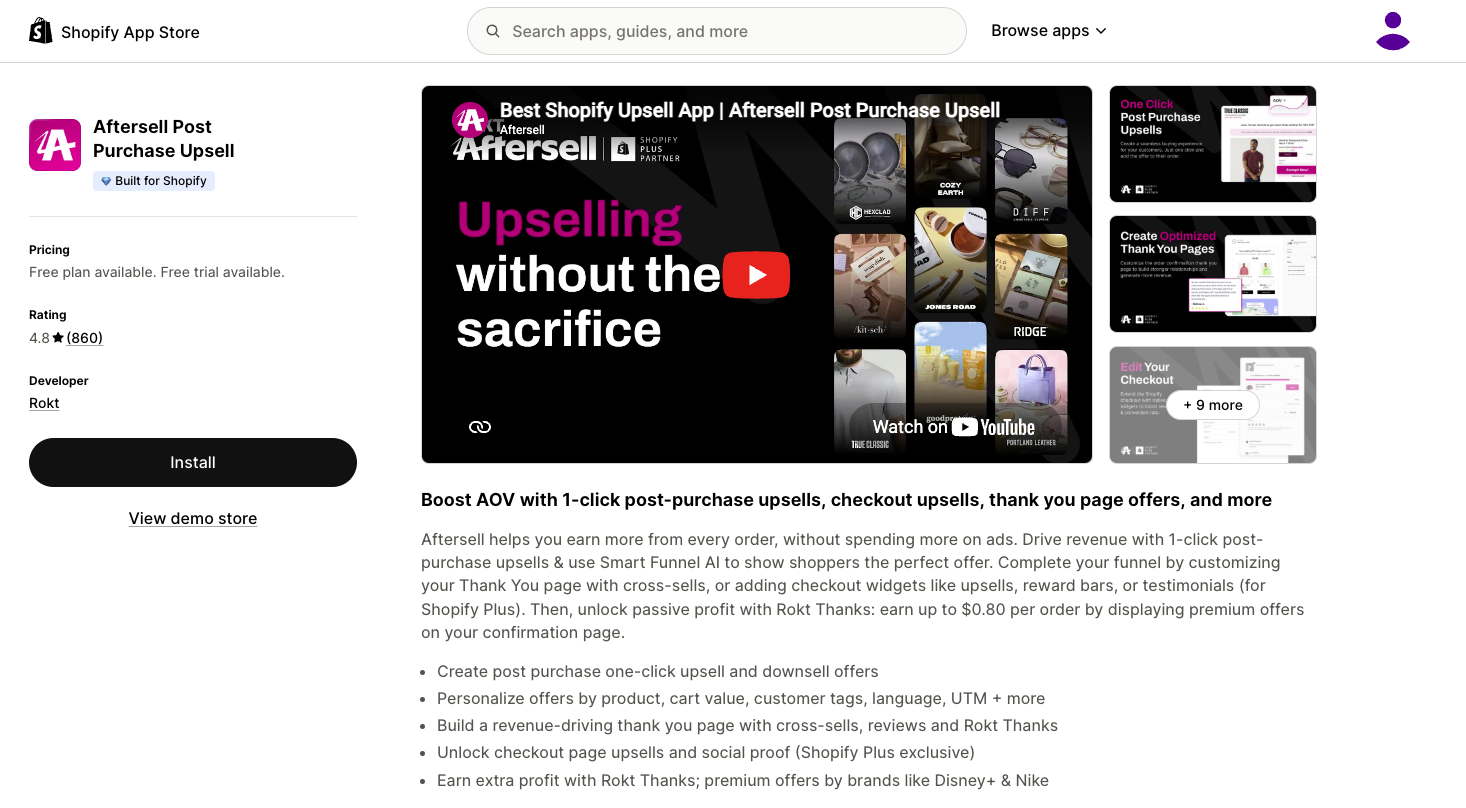
Owned by Rokt, AfterSell is the price-to-feature winner for post-purchase and checkout upsells. Native checkout extension support means the offer does not feel bolted on.
- Strength: native Shopify checkout integration, fast setup (under an hour), thank-you page customization and post-purchase sequencing.
- Weakness: AI offer selection is limited; the slide-cart module (UpCart) is sold separately.
- Best for: mid-market multi-product stores, $50K to $1M monthly revenue.
- Pricing: from $34.99/mo (volume-based), as of June 2026. Rating 4.8 across ~860 reviews.
2. Zipchat: best AI sales assistant that produces the cart
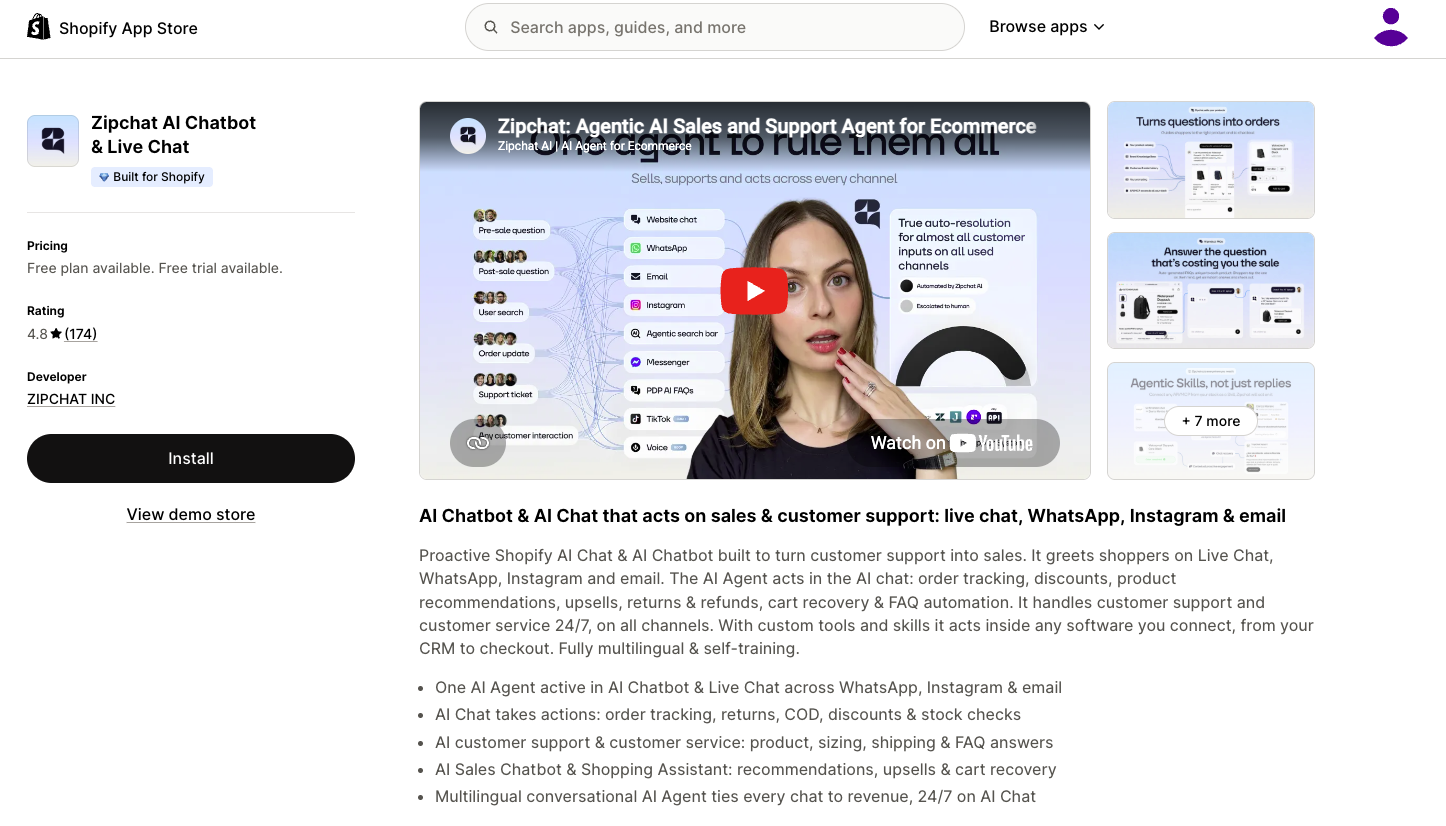
Zipchat is a different category from cart-level upsell apps. It is the AI sales assistant that recommends products, answers buying questions, and upsells inside the conversation, across website chat, WhatsApp, Instagram, and email. It reads your live catalog from day one and pairs with a post-purchase app rather than competing with it.
- Strength: AI product recommendations in chat, AI product questions on every product page, Agentic Skills that apply discounts and act through your tools, proactive engagement at high-intent moments, any language, setup under 30 minutes. Twitter Bike USA hits 90%+ accuracy in product recommendations, Shelly drove 8 to 12 times monthly ROI, and Ring Automotive runs a 12% conversion rate and higher AOV.
- Weakness: it is a conversational AI layer, not a one-click post-purchase offer funnel with automatic order merging. Zipchat can sit on the cart page and the thank-you page, where it proactively pops a message, answers questions, and recommends, but stores that want a classic one-click upsell after checkout should pair it with AfterSell, ReConvert, or Zipify.
- Best for: any Shopify store that wants AI sales recommendations and conversation alongside a post-purchase mechanic. See how it works for ecommerce.
- Pricing: plans start from $64/month, billed annually (Starter), with a 7-day free trial and a 30-day money-back guarantee, as of June 2026. Rating 4.8 across ~175 reviews on the Shopify App Store.
3. Rebuy: premium full-journey AI personalization
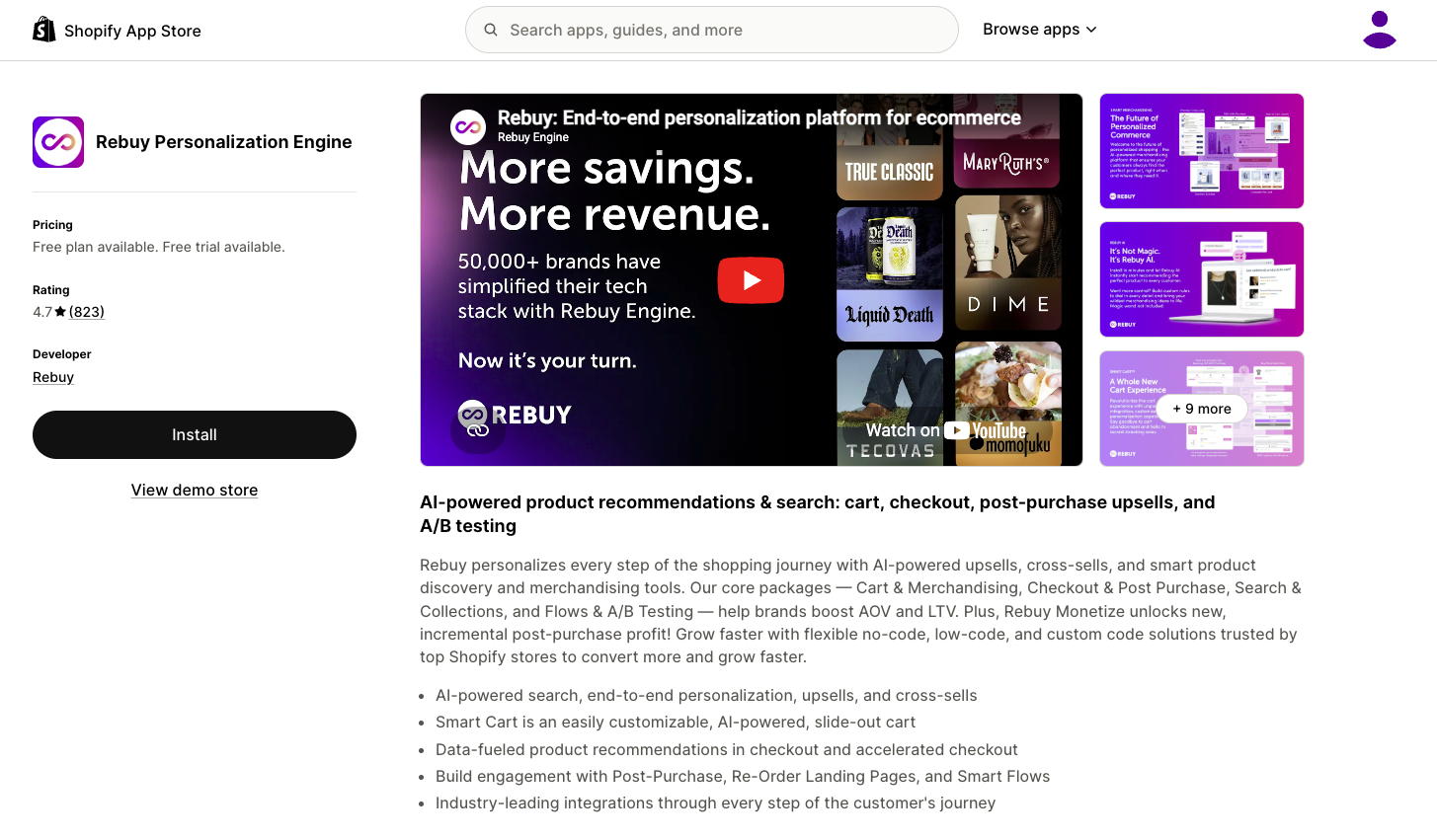
Rebuy reads catalog, cart, customer history, and inventory to surface dynamic upsells across cart, checkout, and post-purchase. The price reflects the depth.
- Strength: mature AI selection across every surface, Smart Cart, developer-friendly customization.
- Weakness: premium pricing; heavier JavaScript payload, a consideration for mobile-first stores; setup complexity.
- Best for: catalog-heavy stores ($1M+ monthly revenue), Shopify Plus merchants with deep affinity data.
- Pricing: entry tier around $99/mo, scaling with orders, as of June 2026. Rating 4.7 across ~818 reviews.
4. ReConvert: deepest post-purchase and thank-you page
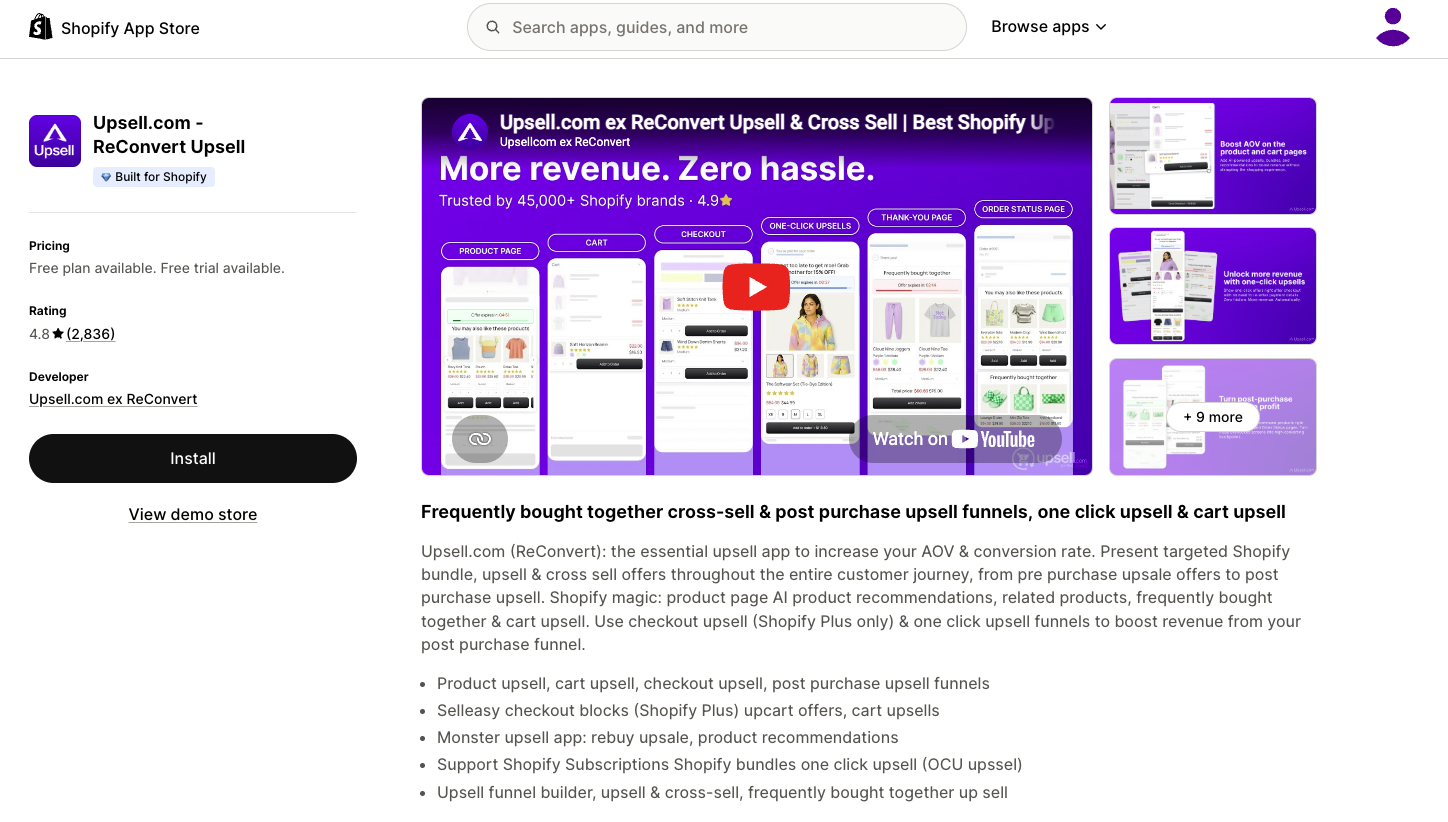
ReConvert is the review-volume leader in dedicated post-purchase upsell, praised for thank-you page depth and AOV analytics.
- Strength: drag-and-drop post-purchase funnels, one-click offers, strong analytics.
- Weakness: free plan carries a 0.75% revenue share, which adds up at scale; focused on post-purchase, so pair it for cart-stage offers.
- Best for: stores prioritizing post-purchase and thank-you page revenue.
- Pricing: free / from $4.99/mo plus 0.75% revenue on the free tier, as of June 2026. Rating 4.8 across ~2,836 reviews.
5. Selleasy: best budget full-funnel, international
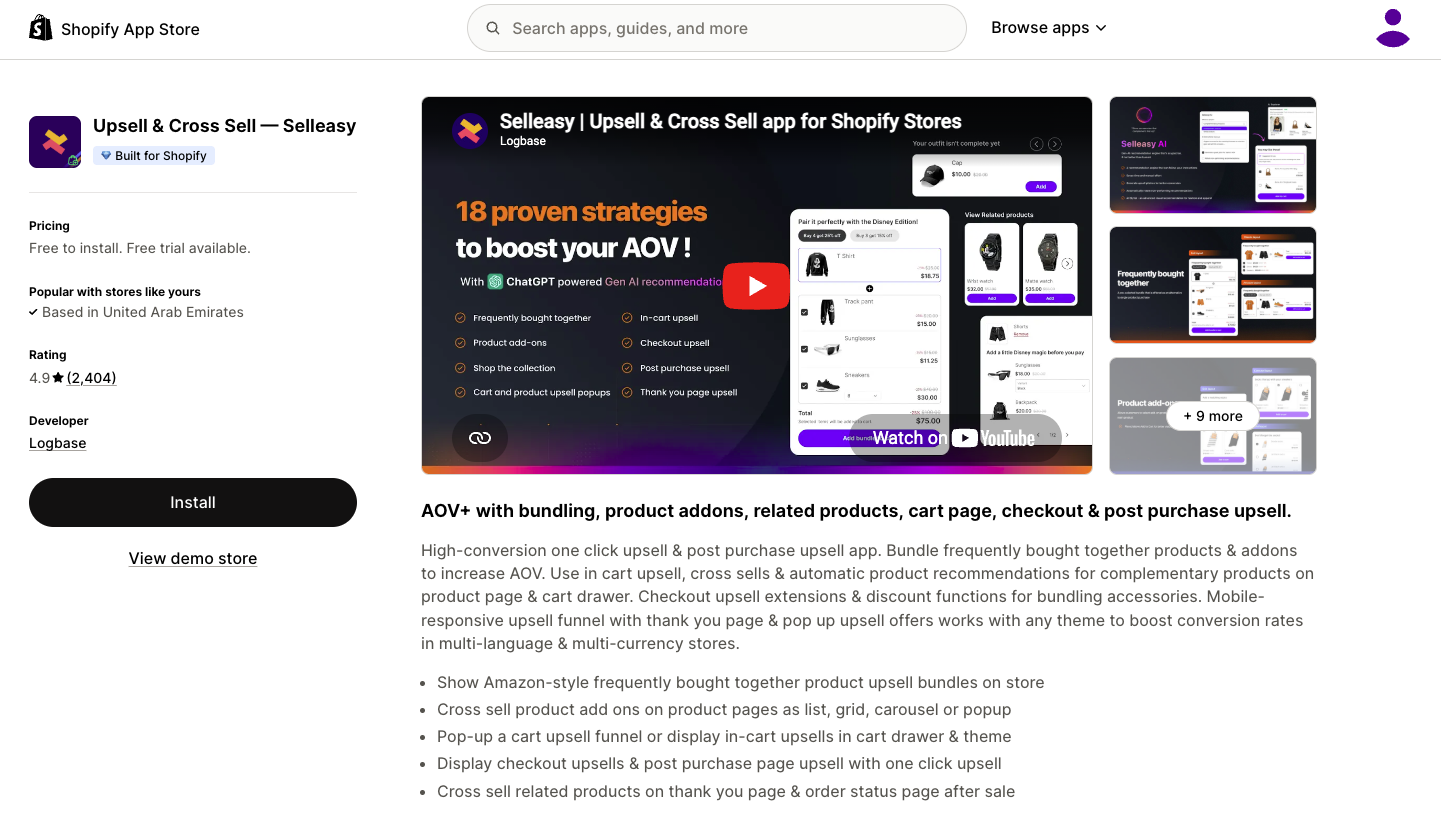
Selleasy (by Logbase) offers Amazon-style frequently-bought-together bundles plus cart and checkout upsells, with multi-language and multi-currency support.
- Strength: full-funnel coverage at a low floor, strong support, international-friendly.
- Weakness: AI selection is limited; rule-based offer logic.
- Best for: budget-conscious and international stores wanting full-funnel coverage without premium pricing.
- Pricing: free up to 50 orders/mo, then from $8.99/mo, as of June 2026. Rating 4.9 across ~2,404 reviews.
6. Zipify OneClickUpsell: funnel builder with A/B testing
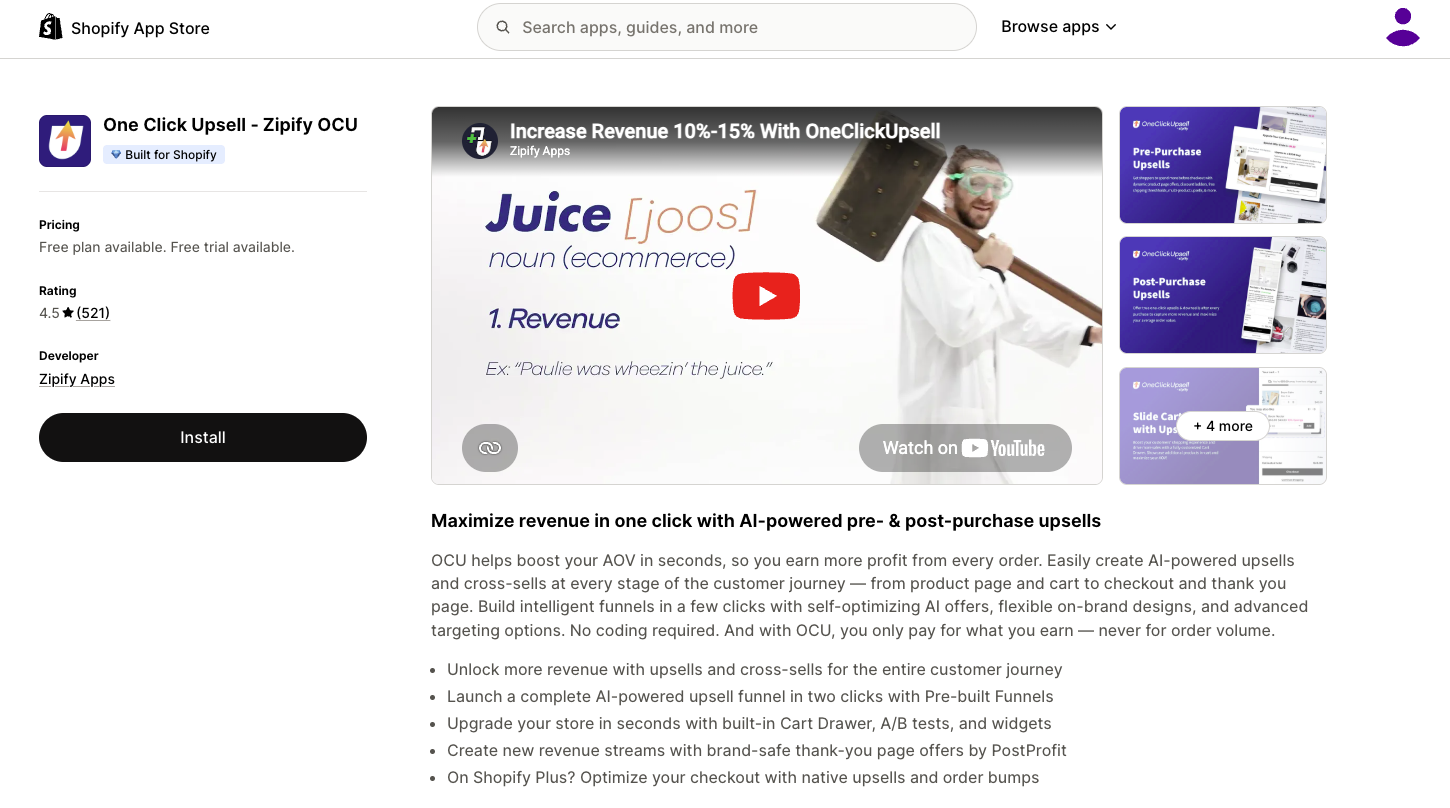
The post-purchase funnel app for brands running paid acquisition on a small SKU set, with A/B testing on every offer and downsell logic.
- Strength: funnel builder, A/B testing, one-click post-purchase, downsell on decline.
- Weakness: designed for one to five hero products; revenue-share pricing (1% of upsell revenue on top of the base fee) gets expensive at scale.
- Best for: DTC funnel brands and single-funnel stores doing $50K to $5M monthly revenue.
- Pricing: from $35/mo plus 1% of upsell revenue, as of June 2026. Rating 4.5 across ~519 reviews.
7. UpCart: cart-drawer upsell specialist
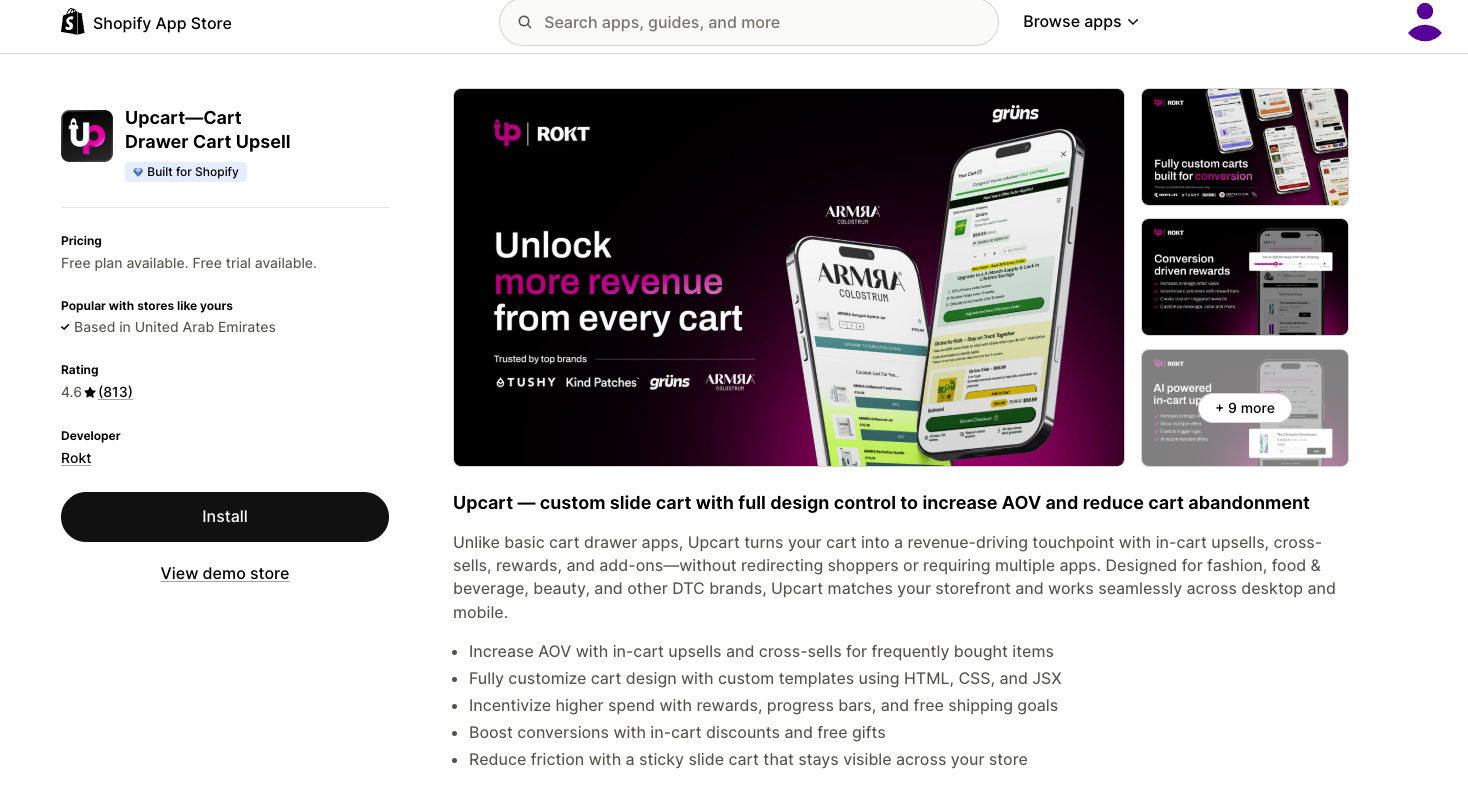
UpCart (also by Rokt) builds a slide-cart experience with a progress bar, free-gift triggers, and BXGY mechanics that lift cart-stage AOV without a separate post-purchase app.
- Strength: polished cart drawer, rewards and free-gift mechanics, complements post-purchase tools.
- Weakness: cart-stage only; no post-purchase funnel.
- Best for: stores that want to maximize the cart drawer before checkout.
- Pricing: free / from $14.99/mo, as of June 2026. Rating 4.7 across ~800 reviews.
8. In Cart Upsell: slot-based in-cart engine
Specialist app for conditional in-cart upsell suggestions (“if cart contains X, show Y”), with auto-add for gift-with-purchase mechanics.
- Strength: mature in-cart placement with conditional rules, wide theme compatibility.
- Weakness: no post-purchase mechanic; best as a complement.
- Best for: stores prioritizing in-cart upsell and gift-with-purchase tiers.
- Pricing: free / from ~$19.99/mo, as of June 2026. Rating 4.8 across ~959 reviews.
9. Cross Sell & Upsell by SSC: full-funnel, wide theme support
Balanced coverage across product page, mini-cart, checkout, and post-purchase, strong for stores that have hit theme conflicts with other apps.
- Strength: works across more themes than most, multi-stage coverage, free-tier entry.
- Weakness: limited AI selection; lower brand recognition.
- Best for: stores with custom themes or theme conflicts, multi-vertical operations.
- Pricing: free plan available, as of June 2026. Rating 4.9 across ~967 reviews.
10. Bold Upsell: simple, cheap entry
A reliable rule-based upsell engine that has been on the App Store since the early days.
- Strength: cheapest flat option, simple rule builder, pre and post-purchase variants.
- Weakness: no AI selection; dated UI; slower innovation.
- Best for: sub-$50K monthly revenue starter stores not ready for premium AI tooling.
- Pricing: from $9.99/mo, as of June 2026. Rating 4.4 across ~581 reviews.
11. Love Loyalty: best loyalty-driven upsell and paid memberships
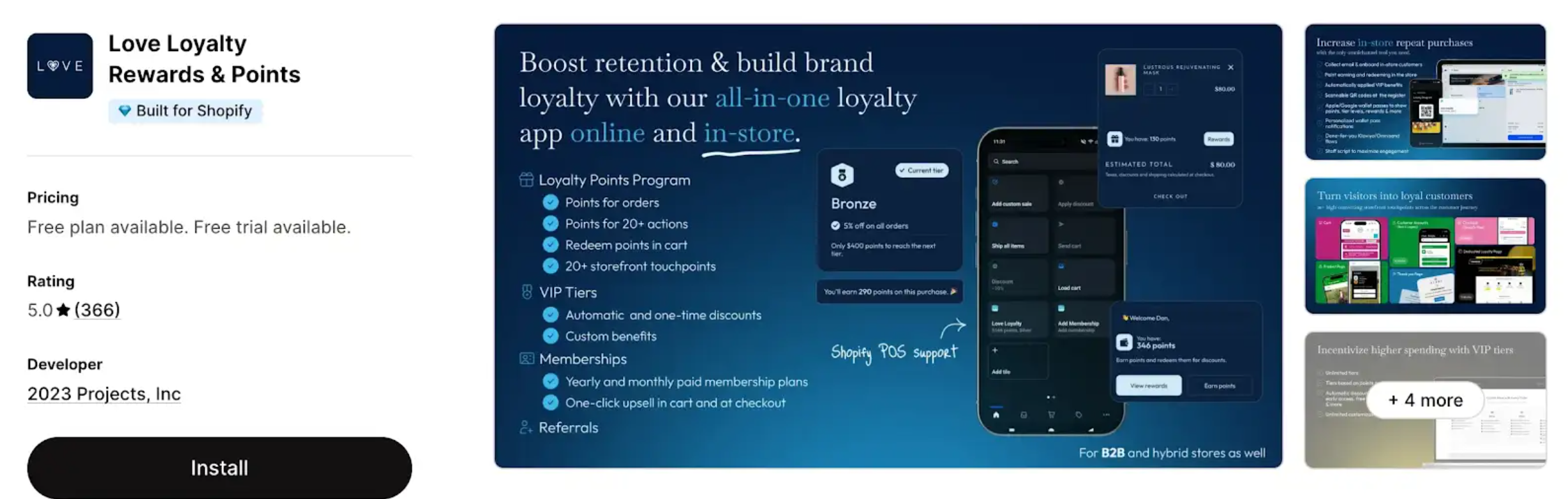
Love Loyalty is the best all-in-one customer loyalty app for Enterprise Shopify plus brands, and it lifts order value through loyalty programs. It offers reward points, VIP tiers, paid memberships referrals, and is built natively for Shopify with all customer loyalty data stored in Shopify metafields, so widgets load instantly with no extra API calls.
Strength: one-click paid membership upsell at checkout that applies member pricing and free shipping to the same order (Rubino earns around 30% of revenue from paid members), points shown on product pages, point redemption directly in the cart, VIP tiers that upgrade on spend, Klaviyo flows for points balance and tier in email.
Weakness: Paid memberships carry a 1.8% transaction fee on Growth (0.8% on Plus); checkout extensions and API access are Plus only.
Best for: repeat-purchase brands (beauty, supplements, food, pet) that want AOV to grow across orders, not just inside one cart.
Pricing: paid memberships and VIP tiers from $79/mo (Growth, 2,000 orders), unlimited orders plus checkout extensions at $399/mo (Plus), with a 14-day free trial, as of September 2026. Rating 5.0 across ~366 reviews.
Honorable mentions
- Kaching Bundles & Upsells: 5.0 rating across thousands of reviews, the highest-rated bundle-and-quantity-break app, free plan available (as of June 2026). Add it when bundles, not funnels, are the priority.
- Candy Rack (by Digismoothie): 4.9 rating, all-in-one AI offer selection with a built-in slide cart, EU-built and GDPR-first, from $29.99/mo (as of June 2026). A strong fit for European merchants.
How to choose
The decision tree:
Is the store under $50K monthly revenue?
  Yes → Bold Upsell or AfterSell
  No → continue

Is the store funnel-shaped (1-5 hero products)?
  Yes → Zipify OneClickUpsell
  No → continue

Does the store have $1M+ monthly revenue and deep affinity data?
  Yes → Rebuy + Zipchat
  No → continue

Is post-purchase / thank-you page the priority?
  Yes → ReConvert + Zipchat
  No → continue

Default mid-market: AfterSell + Zipchat
For established upsell programs, prefer flat-fee or order-volume apps over revenue-share apps (Zipify’s 1%, ReConvert’s 0.75%), which get more expensive as upsell revenue grows.
The ”+ Zipchat” pairing reflects a separation of concerns. The cart-level app handles the cart-level mechanic. Zipchat handles the AI sales conversation that produces the cart. They run in parallel without conflict.
The native Shopify question
Shopify now ships more upsell tooling natively, which changes the bottom tier of this market. Shopify Bundles (a free native app) handles fixed bundles and multipacks. As of Winter ‘26, checkout UI extensions are available on every paid plan, not just Plus, so upsell blocks, trust badges, and post-purchase offers can run natively inside checkout. Shopify Search & Discovery powers basic product recommendations on product and collection pages.
What native does not yet do well: AI offer selection, true one-click post-purchase funnels with order merging, A/B testing, and cross-surface revenue attribution. Use the free native tools for simple bundles and related products, and pay for an app when you need those higher-value mechanics. The August 2026 sunset of checkout.liquid for Plus stores also makes native checkout extension support a hard requirement, which narrows the serious post-purchase field to apps built on the new extensions.
Setup complexity comparison
| App | Setup time | Engineering required |
|---|
| Zipify OneClickUpsell | 2-4 hours | None |
| AfterSell | 30-60 minutes | None |
| Rebuy | 4-8 hours | Optional (theme dev for advanced placements) |
| ReConvert | 30-60 minutes | None |
| Selleasy | 30-60 minutes | None |
| UpCart | 30-60 minutes | None |
| Bold Upsell | 30-60 minutes | None |
| In Cart Upsell | 1-2 hours | None |
| Cross Sell & Upsell by SSC | 1-2 hours | None |
| Zipchat | Under 30 minutes | None |
| Love Loyalty | 7 days | Founder led support |
Setup in minutes, not weeks. The traditional helpdesk install is a multi-week project. AI-native platforms deploy in a day. This is the single biggest time-to-value gap in the market, and it shows up across the upsell category too.
When none of these apps fit
Three patterns where every paid Shopify upsell app underperforms:
Pattern 1: low-margin core products. A 15% AOV lift on a 5% margin SKU does not move the P&L. Audit margin first; if core margin is under 25%, the upsell stack is not the priority.
Pattern 2: under 5,000 monthly orders for under 6 months. AI-driven apps need data. Below that volume, rule-based apps perform similarly at lower cost.
Pattern 3: multi-channel stores where Shopify is one of three platforms. A Shopify-only upsell app does not solve for Amazon, eBay, and TikTok Shop traffic. Pair the app with a multi-channel orchestration layer (Zipchat handles cross-channel recommendations).
Frequently asked questions
What is the best Shopify upsell app in 2026?
There is no single best app; it depends on store size and the upsell moment that matters. AfterSell leads native post-purchase and checkout, Rebuy leads premium AI personalization, ReConvert leads thank-you page depth, and Zipchat adds the AI sales conversation that produces the cart. Most stores pair a cart-level app with Zipchat.
How much do Shopify upsell apps cost?
Most start free or under $35 per month and scale with order volume. Watch for revenue-share pricing (a percentage of upsell revenue), which can become the most expensive model at scale. Zipchat starts from $64/month, billed annually, with a 7-day free trial.
Do Shopify upsell apps actually increase average order value?
Yes, when offers are relevant and low-friction. Personalized offers earn about 30% more than generic ones (IDC, via Shopify, 2025), and stores using bundles and upsells during BFCM 2024 saw around 8% higher AOV than peers (Shopify, 2026). One-click post-purchase offers are the lowest-friction lever because they run after the sale is confirmed.
What is the difference between an upsell app and an AI sales assistant?
An upsell app shows a cart-level or post-purchase offer based on rules or affinity data. An AI sales assistant like Zipchat holds a conversation, understands intent, recommends the right product, and can act through connected tools. The two are complementary: one produces the cart, the other lifts its value.
Does Shopify have native upsell features?
Yes. Shopify Bundles handles simple bundles, and checkout UI extensions (now on all paid plans as of Winter ‘26) allow native checkout and post-purchase offers. Native tooling does not yet cover AI offer selection, one-click funnels with order merging, or A/B testing, which is where paid apps still win.
Can I run more than one upsell app at once?
Yes, and most mid-market stores do. A common 2026 stack is a cart or post-purchase app for the mechanic, plus Zipchat for the AI sales conversation. They run in parallel without conflict.
Final word
The best Shopify upsell app depends on store size, vertical, and the upsell mechanic that matters most. Use the decision tree to pick the cart-level app, then layer Zipchat on top to handle the AI sales conversation that produces the cart. Most stores ship the wrong combination first; the right combination shows up in AOV within 60 days.
Ready to layer AI sales recommendations on your existing upsell stack? Start a free Zipchat trial or book a demo to see the AI sales assistant working your Shopify catalog.
 Website chat Turns browsers into buyers on every page.
  WhatsApp Sell on the app your customers read.
  Instagram Answers every DM in seconds.
  Messenger Turns Facebook ad questions into sales.
  Email Answers every email in the same thread.