
An AI agent that can’t touch an order is a chatbot. That’s the test we used to rank the best AI agents for ecommerce: which tools look up, change, refund, or discount an order, and which only talk about one.
Zipchat is our top pick for stores that want one agent across search, product pages, chat, email, WhatsApp, and social DMs. Yuma AI and Siena AI go deepest on support actions for Shopify brands running a helpdesk. Intercom Fin and Ada suit large teams with enterprise support budgets. We checked every price on the vendor’s own site as of October 2026.
What is an ecommerce AI agent, and how is it different from a chatbot?
An ecommerce AI agent is software that understands a shopper’s request, decides what to do, and completes the task in your store’s systems. It reads your catalog and policies. It uses a large language model (LLM) to work out the customer’s intent, even from a vague or misspelled message. Then it calls tools: order lookup, a returns portal, a discount engine, your CRM.
A chatbot answers. An agent answers and acts. Ask a chatbot “can I swap this for a medium?” and you get a link to the exchange policy.
Ask an agent the same thing, and it checks stock, starts the exchange, and sends the label. That only works if the agent is connected to the systems that do those jobs, which is where most of the differences on this list come from.
| Chatbot | Ecommerce AI agent |
|---|
| ”Where’s my order?” | Links the tracking page | Finds the order and replies with its status |
| ”This is too expensive” | Repeats the price | Creates a discount within limits you set |
| ”I need a smaller size” | Quotes the exchange policy | Checks stock and starts the exchange |
| Works from | Scripts or a knowledge base | Your catalog, policies and live store data |
| You measure it by | Questions answered | Tasks completed and revenue influenced |
Plenty of tools now call themselves agents but answer from a help center and pass anything with an order number to a person. That can be fine for a small catalog. It’s a problem when half your inbox starts with an order number.
One naming note. An “AI shopping agent” can also mean an assistant like ChatGPT that shops on a buyer’s behalf. That’s the other side of the same shift, covered in our agentic commerce guide. This list covers agents that work for the store, as a customer support agent and sales assistant in one.
Why AI agents matter more in ecommerce this year
Analysts expect agents to take over most routine service work. Gartner predicts that by 2029, agentic AI will resolve 80% of common customer service issues without human help (Gartner, March 2025). For operational efficiency, Gartner expects that shift to cut operational costs by 30%.
Service teams see the same curve. In Salesforce’s survey of 6,500 service professionals, teams expect AI to handle half of all cases by 2027, up from 30% today (Salesforce State of Service, November 2025).
How we picked these AI agents for ecommerce
We started with the agents ecommerce prospects compare us with on Zipchat sales calls. Then we scored each one on five questions buyers ask before they sign:
- Actions: can it complete order tasks (returns, refunds, edits, discounts), or only answer?
- Channels and memory: does one agent cover website chat, email, WhatsApp, and Instagram, with one view of the customer?
- Ecommerce depth: does it read your catalog and store data, and which platforms does it support?
- Pricing model: per seat, per resolution, per reply, per visitor, or by quote, and what that does to your bill as volume grows.
- Time to value: does it work from your catalog on day one, or does it need months of past tickets first?
We didn’t score voice agents separately. A few tools here offer voice, and we note it, but phone support is its own buying decision.
AI agents for ecommerce compared (October 2026)
| Agent | Best for | Type | Pricing model | Starting price | Order actions |
|---|
| Zipchat | One agent for the whole shopping journey | Ecommerce-first agent | Per AI reply | $64/month (750 AI replies) | Native lookup and discounts; more via custom skills |
| Yuma AI | High-volume Shopify support | AI layer on a helpdesk | Per full resolution | $14,400/year | Refunds, returns, edits, cancellations |
| Siena AI | DTC brands with heavy support volume | AI layer on a helpdesk | Platform fee plus per ticket | Custom pricing | Refunds, returns, address changes, subscriptions |
| Intercom Fin | Teams already on Intercom | Helpdesk add-on | Per outcome plus seats | $0.99 per outcome; seats from $29/month | Returns, exchanges; more via Procedures |
| Ada | Enterprise retailers | Enterprise agent platform | Quote | Quote only | Returns, refunds, address changes, coupons |
| Richpanel | Subscription brands switching helpdesk | AI-native helpdesk | Seats plus AI usage | $299/month entry | Edits, exchanges, cancellations; refunds need approval |
| Chatbase | Chat checkout across web and social DMs | General AI agent platform with a Shopify app | Per message credit | $32/month billed yearly (700 credits) | Order tracking, order creation, exchanges with approval |
| Rep AI | Proactive selling on Shopify | Sales-first agent | Per visitor | $104/month | Order status, returns, cancellations, discounts |
| Manifest AI | Small Shopify stores testing AI | Shopping assistant | Free plan; paid on demo | Free | Order tracking |
| Octane AI | Product quizzes and guided discovery | Quiz builder | Per plan (credits) | $50/month | None (not a support agent) |
The 10 best AI agents for ecommerce, reviewed
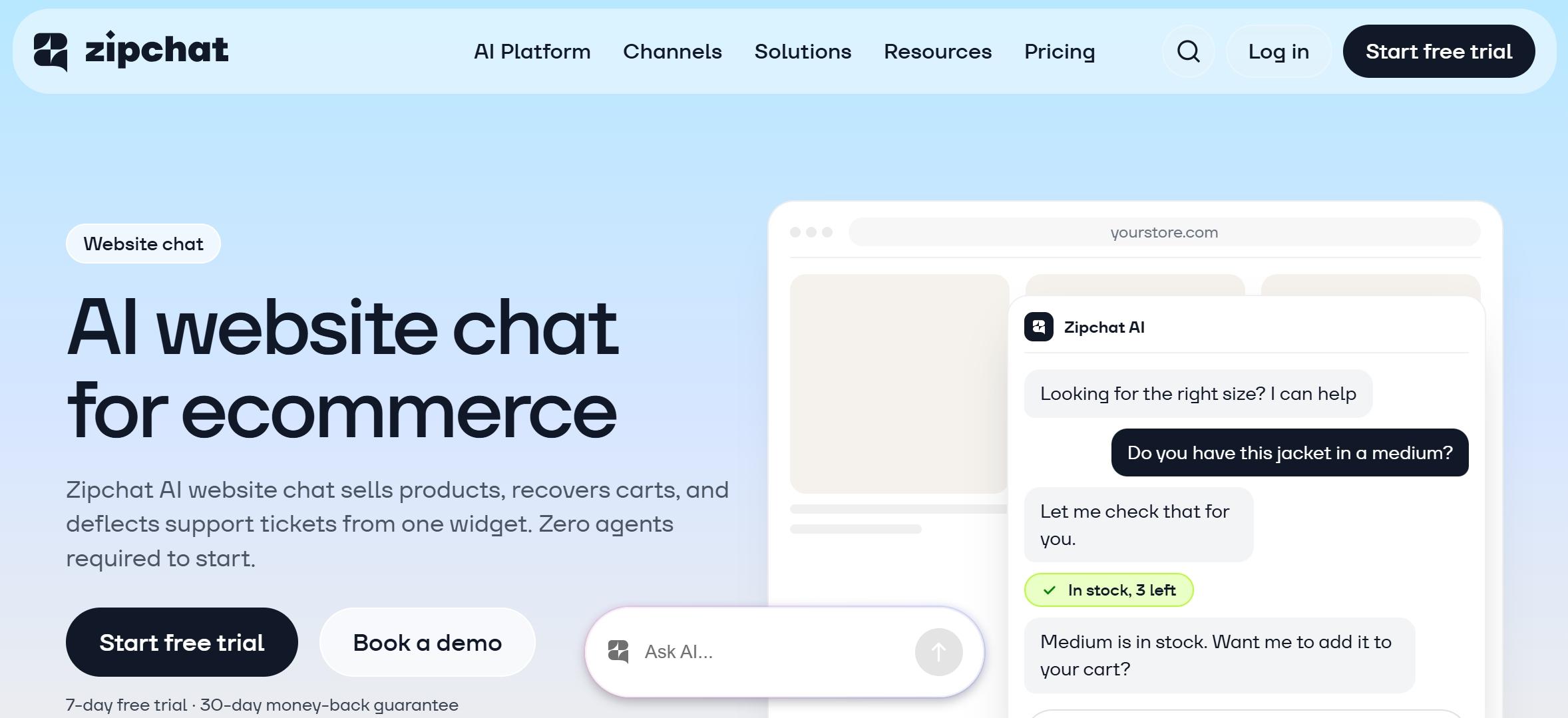
Zipchat is one AI agent for the entire shopping journey. The same agent runs Zipchat AI Search, answers product-page questions, sells and supports in website chat, and handles email, WhatsApp, Instagram, and Messenger.
It was built as an agent first and stays vertical on ecommerce. Most helpdesks and search tools add AI on top of software designed years earlier. That difference shows up in setup: Zipchat trains on your catalog and pages from day one, so it doesn’t need weeks of past tickets before it performs.
Key features
- Native tools: order lookup, human escalation, discount creation (Shopify, with a maximum you set), and marketing subscription updates.
- Custom skills: merchants add Agentic Skills that call their own systems, such as a returns portal or loyalty platform, when the merchant provides instructions and a reachable API.
- Shared memory: one memory of each customer across every channel, so a shopper doesn’t repeat themselves.
- Per-channel control: each tool can run on all channels or only some, for example, returns on email only.
- 95+ languages from the same knowledge base.
Pricing: Starter is $64/month for 750 AI replies, Pro is $240 for 3000 replies, Scale is $480 for 6000 replies, and Scale Plus is $960 for 14,000 replies. There’s a 7-day free trial.
Rating: 4.9 from 208 reviews on the Shopify App Store, with the Built for Shopify badge.
Pros
- Sales and support in one agent. Tropicfeel automated 85% of customer inquiries, and Family Nation automated 80%.
- Runs on Shopify, WooCommerce, Magento, BigCommerce, Wix, and custom stores.
- Live on catalog data from the first day, with no ticket-history requirement.
Cons
- Every AI reply counts toward the plan, so long back-and-forth chats use the allowance faster.
- Refunds, order edits, and returns run through custom skills, so you need an API for those systems. No native SMS or voice.
Best for: growing stores that want one agent selling and supporting across every channel, and that don’t want to run a separate AI layer on a helpdesk. See how Zipchat’s team of AI agents splits the work.
2. Yuma AI: Best for high-volume Shopify support automation
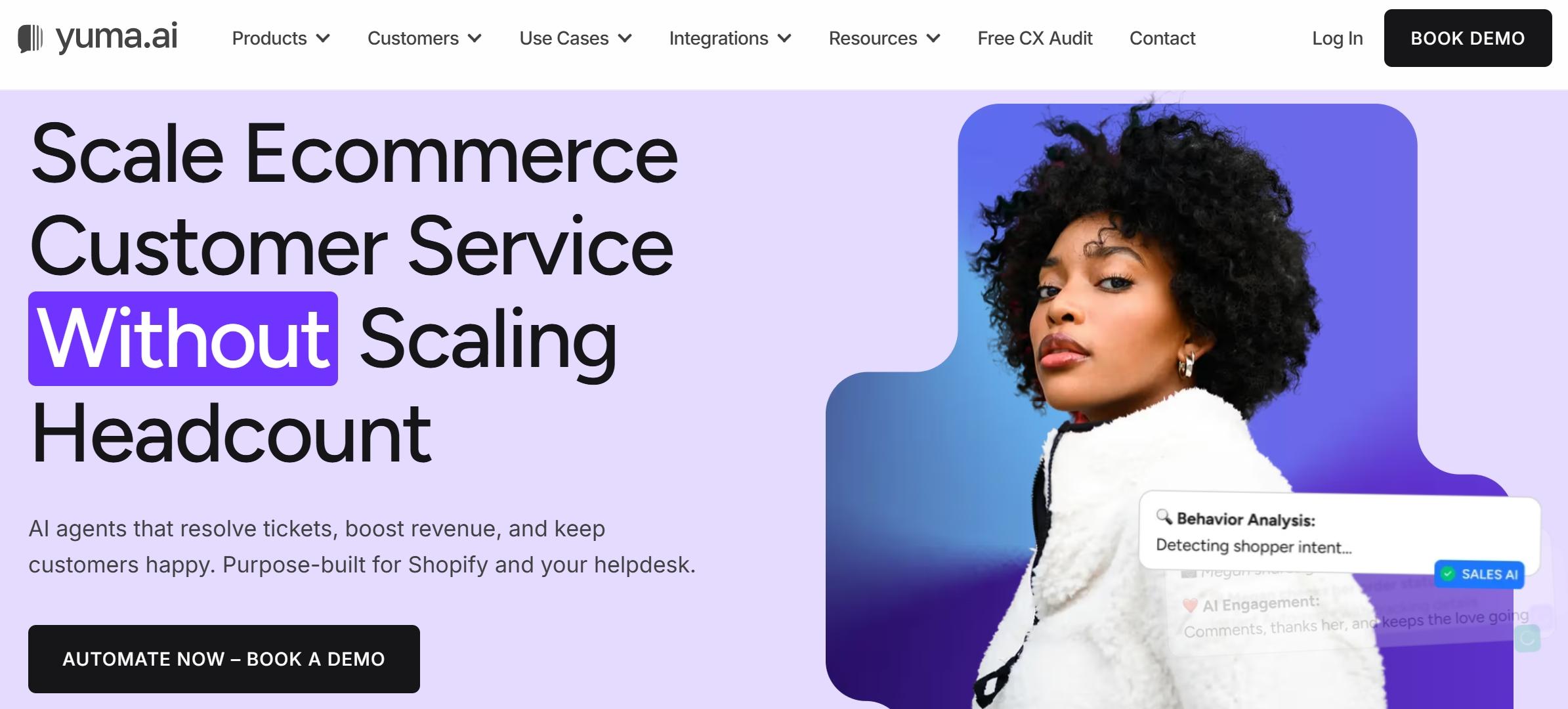
Yuma AI resolves support tickets end to end for Shopify brands. It sits on top of your helpdesk and bills only when a ticket closes with no human touch.
Key features
- Refunds, cancellations, returns, exchanges, and subscription changes.
- Shopify permissions that cover order edits, discounts, gift cards, and store credit.
- Email, chat, social and SMS, with voice as a paid add-on.
- Connects to Kustomer, Re:amaze, Salesforce, Recharge, and Loop.
Pricing: Annual plans with a 12-month commitment. Starter is $14,400/year for 12,000 resolutions (about $1.20 each), Growth is $40,000/year for 48,000 resolutions (about $0.83 each), and Scale is $90,000/year for 120,000 (about $0.75 each).
Rating: 5.0 from 9 reviews on the Shopify App Store.
Pros
- Deep native order actions on Shopify.
- You pay for resolved tickets, not for attempts.
Cons
- High entry price and a 12-month contract.
- Few public reviews to judge it by.
Best for: Shopify brands with thousands of monthly tickets and an existing helpdesk they plan to keep.
3. Siena AI: Best for DTC brands that want action-heavy support

Siena AI sells “empathic AI agents” to consumer brands such as Spanx, FIGS, and Bombas. Like Yuma, it runs on top of a helpdesk rather than replacing it.
Key features
- Order tracking across 2,000+ carriers.
- Address updates, return labels, refunds and replacements.
- Applies a discount and refunds the difference after a price drop.
- Subscription skip, pause, and swap.
Pricing: Quote-based. Siena’s pricing page shows a $750/month platform fee plus $0.90 per automated ticket.
Rating: 4.8/5 on G2.
Pros
- One of the widest native action lists in the category.
- Proven with large DTC brands.
Cons
- The platform fee rules out most small stores.
- You still need, and pay for, a separate helpdesk. Its channels depend on that helpdesk.
Best for: mid-market and enterprise DTC brands with high post-purchase volume.
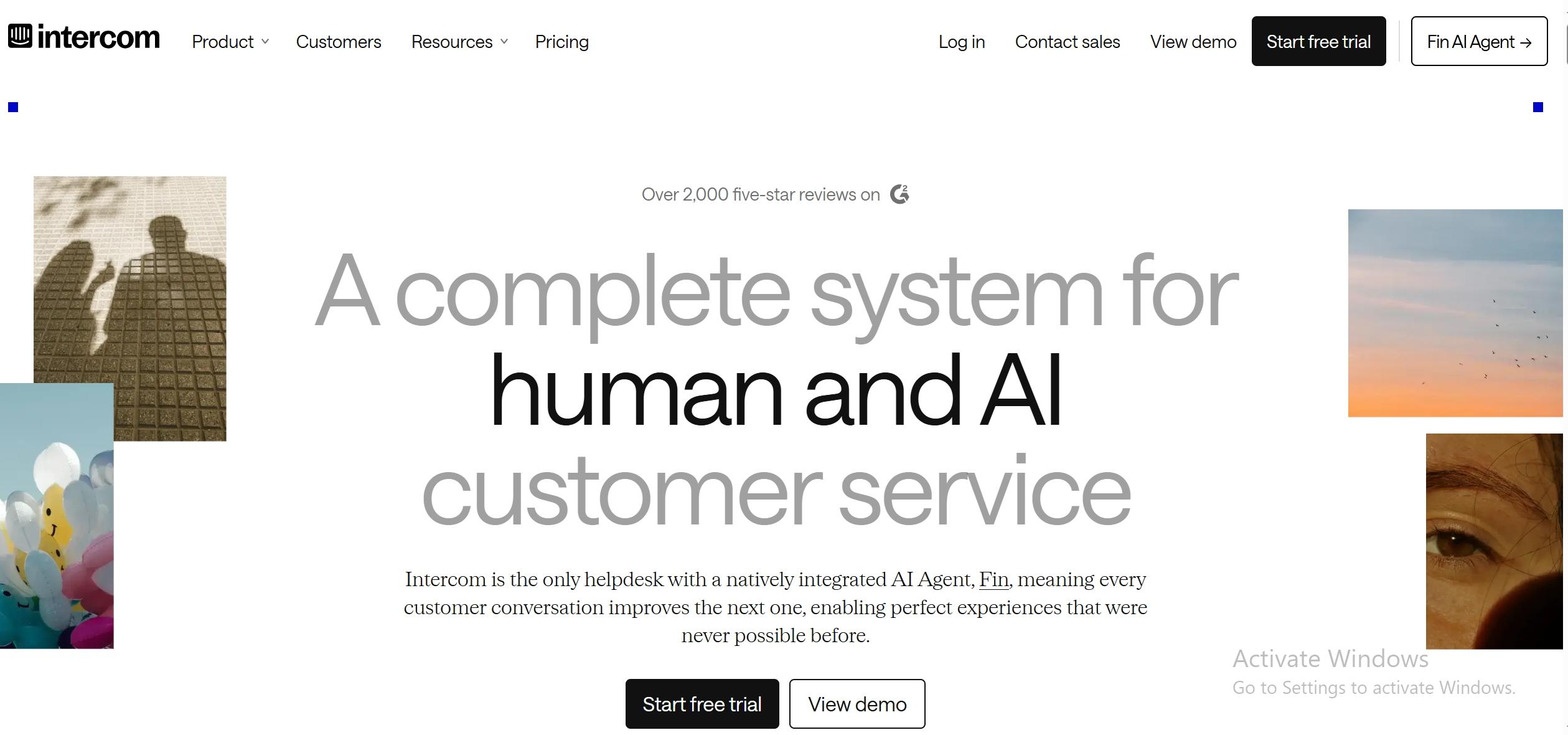
Fin is Intercom’s AI agent. Its ecommerce version, Fin for Ecommerce, connects to Shopify order data and runs multi-step “Procedures” for tasks like returns.
Key features
- Order updates, returns and exchanges, plus product recommendations with add-to-cart.
- Procedures and connectors that update external systems.
- Chat, email, WhatsApp, SMS, Instagram, Messenger, and voice.
- Can also run on a helpdesk other than Intercom’s, with a 50-outcome monthly minimum.
Pricing: $0.99 per outcome. An outcome is a resolution or a handoff after a Procedure. Intercom helpdesk seats cost $29, $85, or $132 per seat per month.
Rating: 4.5/5 on G2.
Pros
- Strong reasoning and wide channel coverage.
- Natural fit if your team already lives in Intercom.
Cons
- Fin for Ecommerce is Shopify-only and requires Intercom, per Intercom’s own page.
- Seat costs and per-outcome fees stack. A Procedure handoff to a person still counts as a billable outcome.
Best for: support teams already on Intercom with a Shopify store.
5. Ada: Best for enterprise retailers with voice and many markets
Ada is an enterprise AI agent platform for customer service. It’s not ecommerce-only, but it has a retail track with customers such as IPSY and iHerb.
Key features
- Returns and exchanges with return labels, refunds, and order tracking through “Playbooks.”
- Address changes, coupons, and inventory checks.
- Voice, messaging, email, WhatsApp, SMS, and in-app.
- Connects to Shopify, Salesforce, and other order management systems through APIs.
Pricing: Quote only.
Rating: 4.6/5 on G2.
Pros
- Voice and messaging from one platform.
- Built for multi-market, multi-language retail operations.
Cons
- No public pricing and an enterprise sales process.
- How much it can do depends on the API work your team puts in.
Best for: enterprise retailers that need voice and messaging under one agent. For more options at this size, see our guide to enterprise AI for ecommerce.
6. Richpanel: Best for subscription brands ready to switch helpdesk

Richpanel calls itself an “AI-native helpdesk.” The AI agent and the inbox come together, so buying it means replacing your current helpdesk.
Key features
- Tracking, address edits, exchanges, store credit and cancellations.
- Subscription skips and pauses through Recharge and Skio.
- Refunds and discounts gated behind approval by default.
- Email, chat, social, SMS, and WhatsApp.
Pricing: Helpdesk seats are $99/seat/month. AI usage works out to about $0.20 per AI-handled conversation, with a $200 monthly minimum. That puts the entry price with AI at $299/month.
Rating: 4.7 on G2 and 4.8 on Shopify.
Pros
- Low per-conversation AI cost.
- Sensible guardrails on refunds and discounts out of the box.
Cons
- You have to migrate helpdesks.
- AI cost is metered on tokens, so it can shift with the model used.
Best for: subscription and DTC brands unhappy with their current helpdesk.
7. Chatbase: Best for chat checkout across web and social DMs
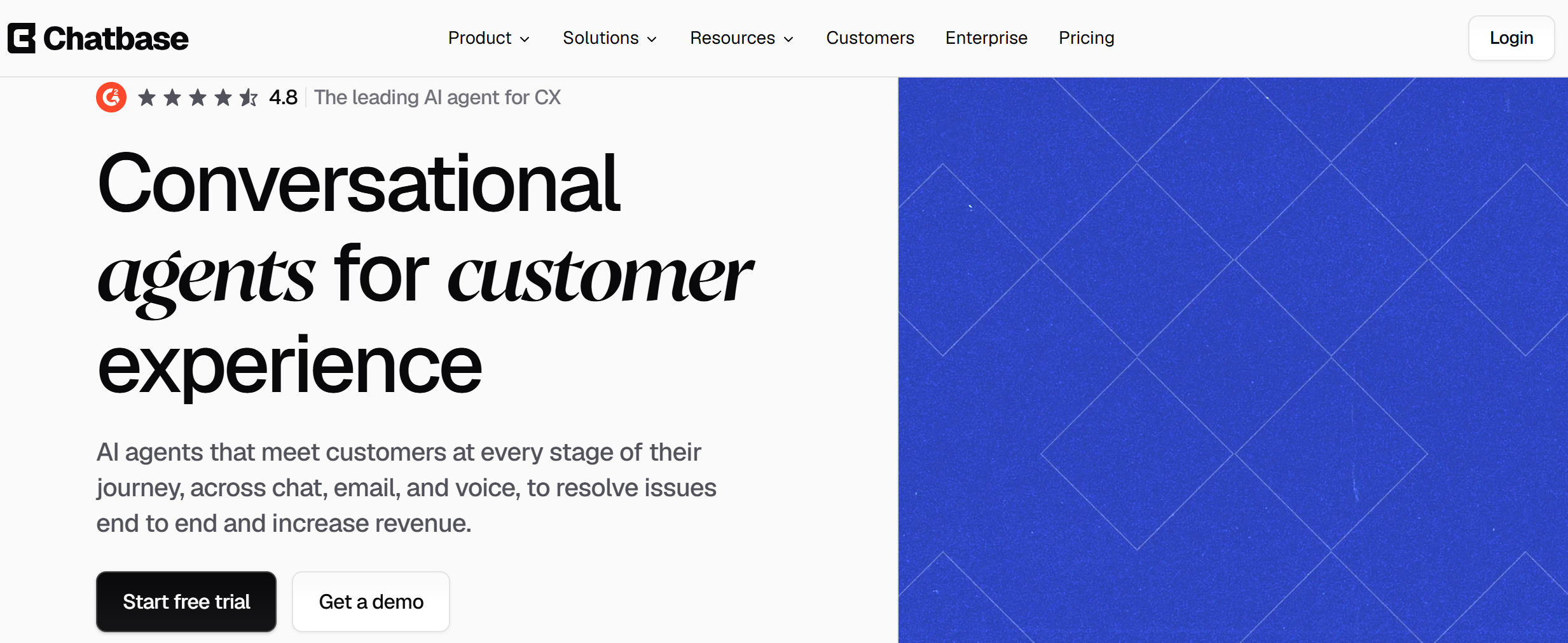
Chatbase is a general AI agent platform with a Shopify app launched in January 2026. On Shopify, the agent answers questions, finds products by text or photo, and creates orders inside the conversation.
Key features
- Product search by text or photo, with add-to-cart in chat.
- Order creation with a checkout link or cash on delivery.
- Order tracking, plus exchanges drafted for your team to approve.
- Store chat, WhatsApp, Instagram, and Messenger; email and voice on higher plans.
Pricing: Hobby is $32/month for 700 credits, Standard is $120/month for 4,000 credits, and Pro is $400/month for 15,000 credits.
Rating: 4.8 on the Shopify App Store.
Pros
- Low entry price, with a free plan to test.
- Orders can close inside WhatsApp, Instagram, and Messenger.
Cons
- It’s built for every industry, so ecommerce is one use case among many.
- The helpdesk inbox and voice need the Standard plan or above.
Best for: Shopify stores that sell through social DMs and want shoppers to check out in the chat.
8. Rep AI: Best for proactive selling on Shopify
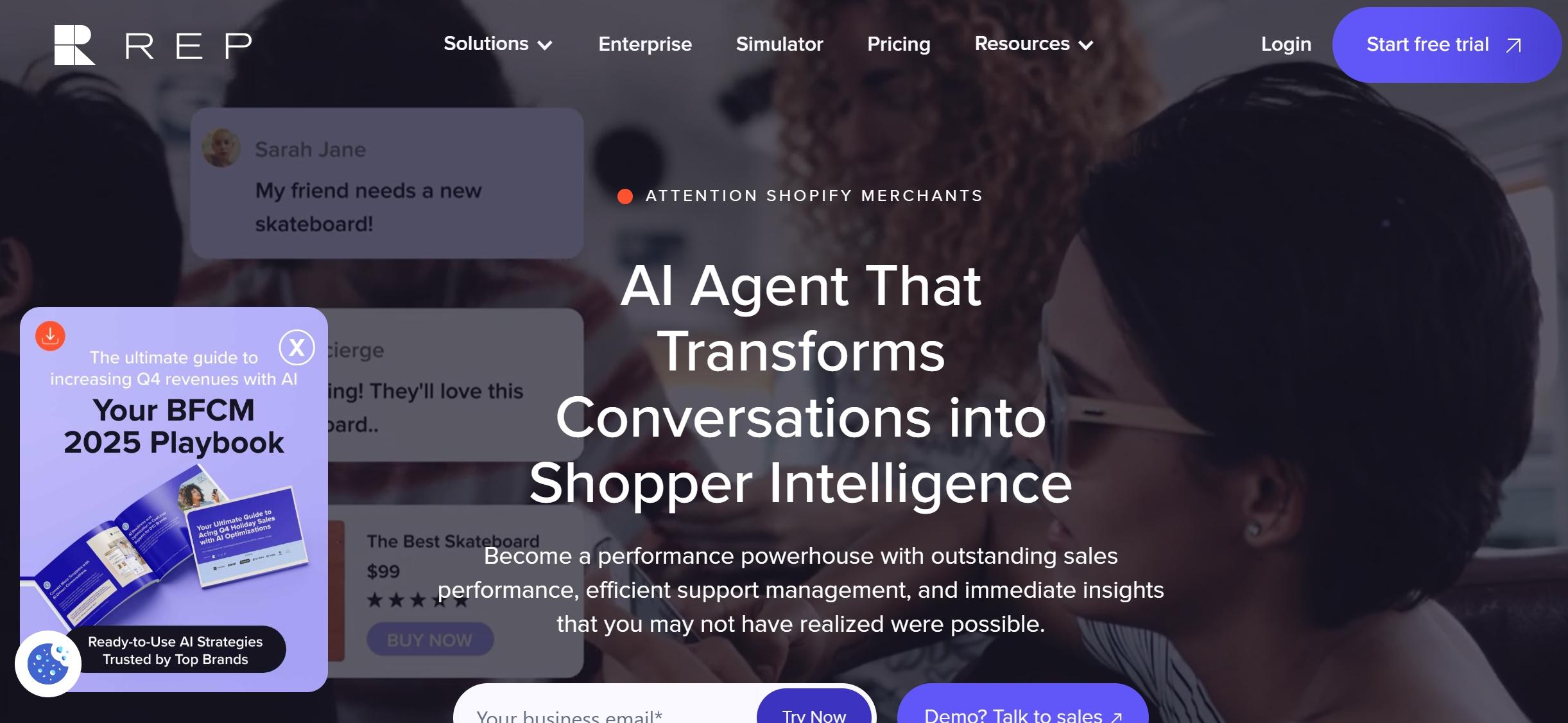
Rep AI watches shopper behavior and opens a conversation when someone hesitates. Support features sit on top of a sales-first core.
Key features
- Behavioral triggers that start proactive chats.
- Order status, returns, cancellations and discounts.
- Upsells and cart recovery.
- Website chat, email, Facebook, Instagram and WhatsApp (omnichannel is in beta).
Pricing: Starter is $104/month for 10,000 visitors, then Basic is $209 for 25,000, and Standard is $368 for 50,000. Extra traffic costs $12 per 1,000 visitors.
Rating: 4.6 on the Shopify App Store.
Pros
- Strong focus on conversion, not only deflection.
- Proactive engagement is built in.
Cons
- Your bill rises with traffic, even in months when sales don’t.
- Its own helpdesk and omnichannel features are still in beta.
Best for: Shopify stores with high traffic and a conversion problem.
9. Manifest AI: Best for small Shopify stores testing AI
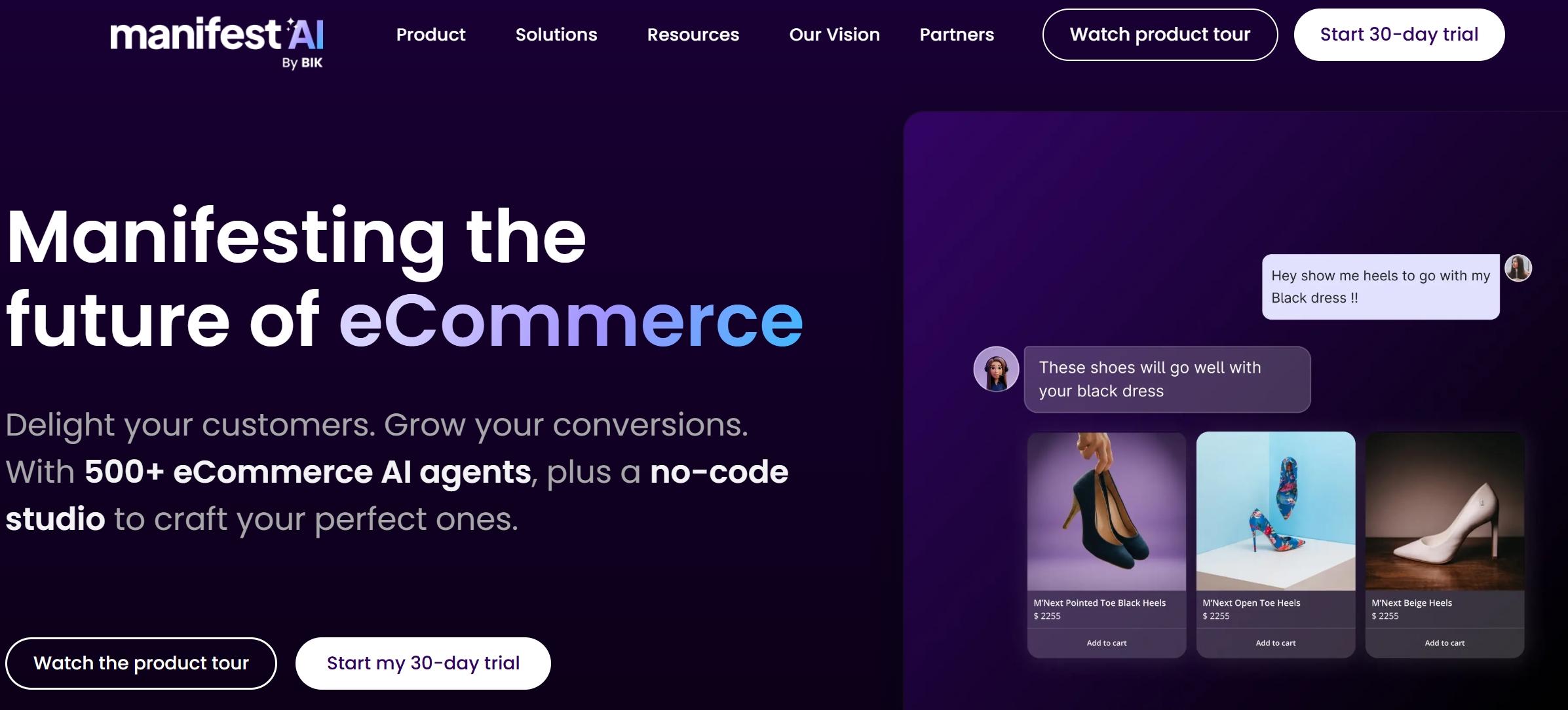
Manifest AI, built by BIK.ai, is a ChatGPT-powered shopping assistant for Shopify. It’s the lightest tool here and the easiest to try.
Key features
- Product recommendations and quizzes.
- Cart and checkout recovery.
- Order tracking, with workflows built in “Agent Studio.”
- Web chat, with email replies shown in its listing.
Pricing: The Shopify listing shows a free plan. Paid plans are quoted after a demo.
Rating: 4.6/5 on the Shopify App Store.
Pros
- Free to start.
- Quick install for small catalogs.
Cons
- Paid pricing isn’t published.
- We couldn’t confirm native refunds, returns, or address changes.
Best for: small Shopify stores that want a shopping assistant before they need order actions.
10. Octane AI: Best for guided discovery through quizzes
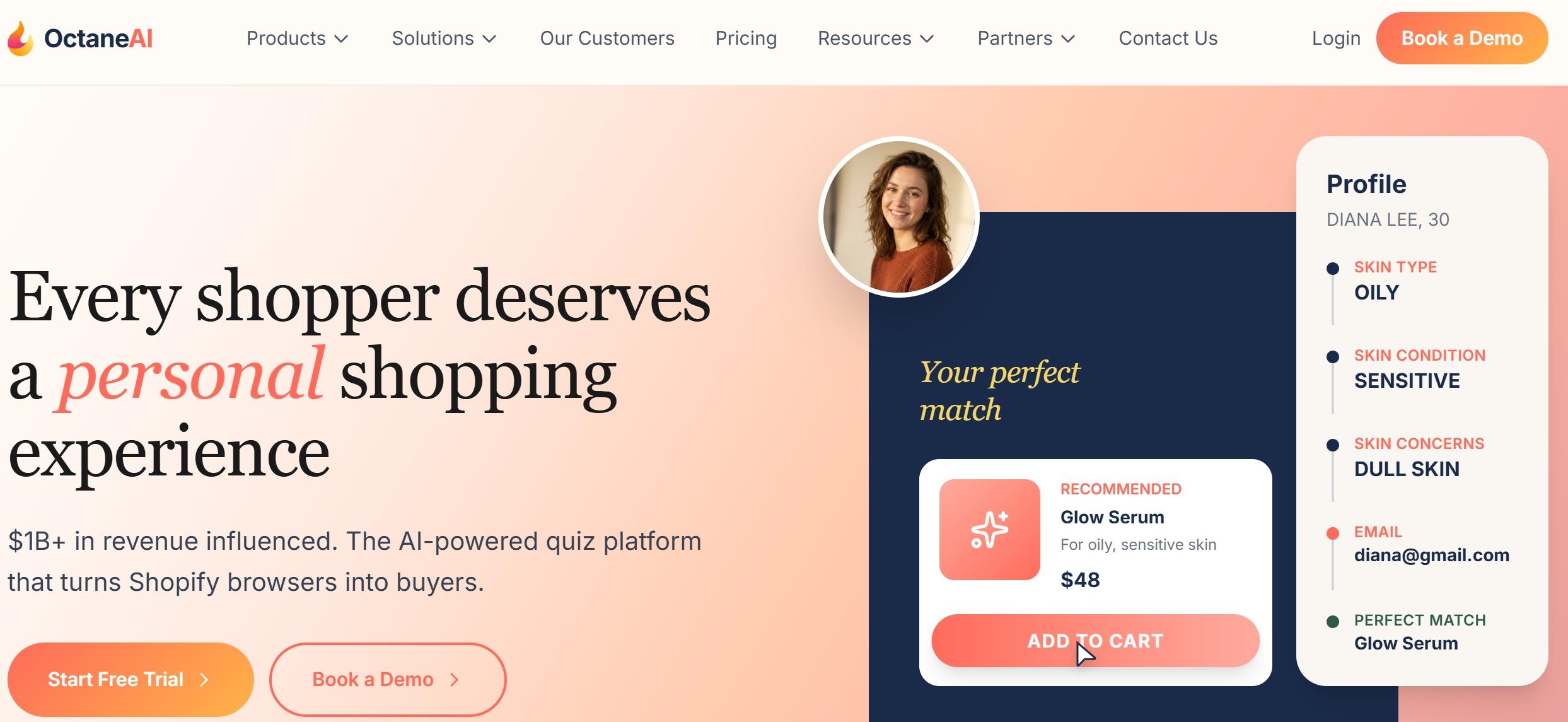
Octane AI is on this list because buyers ask about it, but it’s not a support agent. It’s an AI quiz builder that collects shopper preferences and recommends products.
Key features
- AI-built product quizzes.
- Zero-party data that syncs to email and SMS tools.
- Quiz analytics.
- An MCP server that lets AI assistants query your quiz data.
Pricing: Basic is $50/month, Plus is $200/month, and Enterprise starts at $500/month.
Rating: 4.7 on the Shopify App Store.
Pros
- Strong for catalogs where shoppers need help choosing.
- Builds first-party data for marketing.
Cons
- No support conversations and no order actions.
- You’ll still need an agent for post-purchase questions.
Best for: beauty, wellness, and apparel brands that pair a quiz with a separate AI agent.
Which AI agents take actions, and which only answer?
Most of these agents can find an order. Far fewer can change one. This table shows what each vendor lists as an action.
| Agent | Order tracking | Returns or exchanges | Refunds | Order edits or cancellations | Discounts | Subscription changes |
|---|
| Zipchat | Native | Custom skill | Custom skill | Custom skill | Native (Shopify) | Custom skill |
| Yuma AI | Yes | Yes | Yes | Yes | Yes | Yes |
| Siena AI | Yes | Yes | Yes | Address changes | Yes | Yes |
| Intercom Fin | Yes | Yes | Via Procedures | Via Procedures | Not listed | Via Procedures |
| Ada | Yes | Yes | Yes | Address changes | Coupons | Via Playbooks |
| Richpanel | Yes | Yes | With approval | Yes | With approval | Yes |
| Chatbase | Yes | Exchanges, with approval | Not listed | Order creation | Not listed | Not listed |
| Rep AI | Yes | Yes | Not listed | Cancellations | Yes | Not listed |
| Manifest AI | Yes | Not confirmed | Not confirmed | Not confirmed | Not confirmed | No |
| Octane AI | No | No | No | No | No | No |
“Custom skill” means the merchant connects the action. In Zipchat, you write plain-language instructions for when to call an endpoint and what to do with the result. API keys are stored as encrypted variables and never shown to shoppers.
That’s how SuperDokan automates returns alongside product recommendations. The limit is real, though: the agent can only act on systems that expose an API you can reach.
Can one AI agent cover website chat, email, WhatsApp, and Instagram with the same memory?
Yes, but only some agents do it, and “omnichannel” on a pricing page doesn’t guarantee it. There are three setups on the market.
- Separate bots per channel. Each channel has its own bot and its own history. The shopper repeats the story every time.
- Helpdesk-unified. The helpdesk merges tickets by customer record, and the AI reads that ticket history. Siena, Yuma, and Fin on another helpdesk work this way.
- Agent-native memory. The agent itself keeps one memory of each customer across channels. Zipchat works this way.
Here’s what that looks like in practice. A shopper asks in website chat whether a jacket runs large and leaves her email. The next day she writes to support: “You said the medium was roomy. Can I still swap if it’s too big?”
The agent already has the chat in memory. It confirms the earlier advice, checks the exchange window, and answers without asking her to start over.
How are AI agents for ecommerce priced?
Vendors charge on six meters. The meter matters more than the headline price, because it decides what happens to your bill in peak season.
| Pricing model | Who uses it | What raises your bill | Watch out for |
|---|
| Per AI reply | Zipchat | More AI messages | Long conversations use more replies |
| Per resolution or outcome | Yuma AI, Intercom Fin | More resolved tickets | How the vendor defines “resolved” |
| Platform fee plus per ticket | Siena AI | More automated tickets | A high fixed fee before any volume |
| Per seat plus AI usage | Richpanel, Intercom | More agents and more AI use | Paying twice as you grow |
| Per message credit | Chatbase | More AI messages | Top-ups at $40 per 1,000 credits |
| Per visitor | Rep AI | More traffic | Paying for visitors who never chat |
Run your own numbers with one formula:
Monthly cost = platform fee + (seats × seat price) + (billable units × unit price)
Here’s an illustrative store: 1,000 AI-handled conversations a month, 600 fully resolved, about three AI replies per conversation and three human agents. List prices as of October 2026, before taxes and add-ons.
| Agent | How the bill is built | Estimated monthly cost |
|---|
| Chatbase | 3,000 credits on Standard (4,000 credits), assuming one credit per AI message | $120 |
| Zipchat | 3,000 AI replies on the Pro plan | $240 |
| Richpanel | $200 AI usage + 3 seats × $99 | $497 |
| Intercom Fin | 600 outcomes × $0.99 + 3 seats × $29 | $681, plus any Procedure handoffs |
| Yuma AI | Starter, $14,400/year | $1,200 |
| Siena AI | $750 + 600 × $0.90 | $1,290, plus helpdesk |
Two notes before you trust any table like this. Per-reply pricing favors short, focused conversations. Per-resolution pricing favors stores where the agent closes most tickets alone.
What merchants automate first, and what comes in month two
Most merchants start with the questions that fill the inbox every day. Order status, shipping times, sizing, and return policy come first, because they need little setup and show results in week one.
Month two is when actions arrive. Merchants turn on discount creation for hesitant shoppers, connect WhatsApp and Instagram, and add their first custom skill, often returns or loyalty points.
The requests that still go to people are the ones that need judgment. Damaged items, chargebacks, and angry repeat contacts top that list.
How to choose: Helpdesk add-on or ecommerce-first agent?
Start with what you already own. If your team is happy in its helpdesk, an AI layer on top fits your support operations as they are. If you’re choosing from scratch, an ecommerce-first agent usually costs less and covers sales too.
| If your store… | Prioritize | Shortlist |
|---|
| Wants one agent for sales, search and support | Ecommerce-first, shared memory | Zipchat |
| Runs a helpdesk your team likes, with 5,000+ monthly tickets | Deep native order actions | Yuma AI, Siena AI |
| Already uses Intercom and sells on Shopify | Native helpdesk fit | Intercom Fin |
| Needs voice plus messaging at enterprise scale | Multi-market platform | Ada |
| Wants to replace its helpdesk anyway | AI and inbox together | Richpanel |
| Sells on WooCommerce, Magento or a custom platform | Platform coverage | Zipchat, Ada |
| Sells mostly through Instagram and WhatsApp DMs | Checkout inside the chat | Chatbase, Zipchat |
| Needs an AI agent for Shopify that sells proactively | Conversion triggers | Rep AI, Zipchat |
| Is small and testing AI for the first time | Low entry price, quick install | Zipchat, Manifest AI |
A helpdesk add-on inherits the helpdesk’s data and its limits. It’s strongest after the sale. An ecommerce-first agent reads the catalog from day one, so it’s strongest before the sale and good after it.
If most of your volume is pre-sale questions, the add-on model leaves money on the table. If you’re still deciding whether you need an agent at all, start with our list of best AI chatbots for ecommerce.
When an AI agent is the wrong buy
An agent can’t fix a broken process. If your returns policy changes weekly or your order data lives in spreadsheets, the agent will give inconsistent answers. Fast, wrong answers hurt customer satisfaction more than slow, correct ones. Fix the source first.
Low volume is another reason to wait. A store with 50 support emails a month will get more from a clear FAQ page and a good inbox than from an agent.
And don’t buy an agent to remove humans. Gartner found that 87% of customers say companies using GenAI for service must offer a route to a human (Gartner, August 2026). Keep the handoff easy to find.
Frequently Asked Questions
What is an AI agent in ecommerce?
An AI agent in ecommerce is software that understands a shopper’s request and completes it inside your store’s systems. It answers product and policy questions, then acts: looking up orders, creating discounts, starting returns, or escalating to a person. Good agents work across chat, email, and messaging apps.
What is the difference between an AI agent and a chatbot?
A chatbot answers questions from a script or knowledge base. An AI agent answers and takes action through connected tools, like checking orders, issuing discounts, or creating returns. Ask both “where’s my order?” A chatbot links to the tracking page. An agent finds the order and replies with its status.
Can AI agents process returns and refunds?
Some can. Yuma AI, Siena AI, and Ada list returns and refunds as native actions. Richpanel gates refunds behind approval by default. Zipchat handles returns through custom skills when the merchant provides instructions and a reachable returns API. Check each vendor’s refund limits before going live.
Do AI agents work outside Shopify?
Many don’t. Fin’s ecommerce product is Shopify-only, and Yuma AI and Manifest AI are built for Shopify. Zipchat runs on Shopify, WooCommerce, Magento, BigCommerce, Wix, and custom stores through a script. Ada connects other order systems through APIs. Chatbase’s order actions run through its Shopify app.
Are AI agents safe to let act on orders?
They’re safe when you set limits. Cap discount size, require approval for large refunds, and restrict which channels each action runs on. Zipchat lets merchants set a maximum discount and turn each tool on per channel. Test every action in a sandbox or test chat before shoppers see it.
Which AI agent is best for a small ecommerce store?
For most small stores, pick an agent with a flat monthly price and no setup project. Zipchat starts at $64/month for 750 AI replies and trains on your catalog from day one. Manifest AI lists a free plan for Shopify. Yuma, Siena, and Ada are priced for larger teams.
Can an AI agent replace my support team?
No, and you shouldn’t want it to. Agents take the repetitive volume: order status, sizing, policies, and discounts. Your team keeps exceptions, complaints, and judgment calls. Even at Tropicfeel’s 85% automation rate with Zipchat, 15 in every 100 inquiries still need a person.
Our Pick for 2026
If you already run a helpdesk you like, and your volume is mostly post-purchase, Yuma AI and Siena AI are the strongest add-ons. Intercom Fin is the natural choice for Intercom teams.
For most growing stores, though, the better buy is one agent that sells and supports everywhere a shopper shows up. That’s Zipchat: one memory per customer, native order tools, custom skills for the rest, and pricing per reply instead of per seat. Meet Zipchat’s team of AI agents and start a 7-day free trial.