
TL;DR
An AI chatbot for ecommerce answers pre-sale and post-sale questions across your website, WhatsApp, Instagram, and email, on any store platform. This guide ranks 8 tools on two axes most lists skip: support deflection and conversion lift. Top pick: Zipchat, for stores that want to sell and support in one agent.
Most ecommerce chatbots are scored on one thing: how many tickets they deflect. That misses half the money. An AI chatbot for ecommerce is software that reads your catalog, policies, and pages, then answers shopper questions and guides buyers toward checkout across channels like a website widget, WhatsApp, Instagram DMs, and email.
It runs on Shopify, WooCommerce, Magento, and custom stores. The good ones deflect support volume. The best ones also recover sales; a pure helpdesk never counts. This list scores each tool on both.
How we picked these AI chatbots
We evaluated each tool against what an ecommerce operator cares about, not a generic help desk buyer. Six things drove the ranking.
Platform fit came first: native Shopify app, a snippet for WooCommerce and custom sites, or Magento and enterprise support. Real-time catalog and inventory integration is vital for accurate chatbot responses, so we weighted how deeply each tool syncs product and stock data. Then channel coverage across website, WhatsApp, Instagram, Messenger, and email.
Then pricing transparency and model, whether that’s a flat plan, per-resolution, or per-visitor billing. Then ratings from a named source. Then setup time and languages.
And last, the split that decides ROI: does the tool only deflect tickets, or does it also lift conversion?
Ratings are sourced from G2 and the Shopify App Store. Every price is marked “as of” its check date, because the category repriced hard in early 2026, with several vendors moving to per-resolution or pay-per-task models. Where a tool is strong, we say so. Where it’s weak, we say that too, Zipchat included.
Best AI chatbots for ecommerce at a glance
| Name | Best for | Starting price | Rating | Channels | Platforms |
|---|
| 1. Zipchat | Sales and support in one agent | $64/month (Starter) | 4.8/5 Shopify App Store; 4.8/5 G2 | Website, WhatsApp, Instagram, Messenger, email, AI Search | Shopify (native), WooCommerce, Magento, Wix, BigCommerce |
| 2. Chatbase | Shopify actions with a choice of built-in or existing helpdesk | Free plan; paid plans from $40/month | 4.8/5 Shopify App Store | Website chat, email, WhatsApp, Instagram, Messenger, voice | Shopify (native app); website widget for other stores |
| 3. Ada | Enterprise multichannel automation | Quote-based | 4.6/5 G2 | Web, social, email, voice | Enterprise integrations |
| 4. Gorgias | AI helpdesk with sales tools | $10/month (Starter); AI Agent from $1.50/resolution | 4.6/5 G2 | Email, chat, SMS, WhatsApp, social | Shopify, BigCommerce, and more |
| 5. Rep AI | Proactive selling on Shopify | From $200/month (80,000 visitors) | 4.7/5 Shopify App Store | Website widget | Shopify only |
| 6. eesel AI | Support automation on your helpdesk | Pay-per-task, $0.40 per ticket | 4.6/5 G2 | Helpdesk, Slack, Teams, web | Platform-agnostic (helpdesk, docs) |
| 7. Freshchat | Multichannel live chat with AI | Free tier; Growth from $19/agent/month | 4.5/5 G2 | Web, WhatsApp, social, email | Platform-agnostic (snippet) |
| 8. Wizybot | Low-cost Shopify sales and support | From $69.99/month | 4.6/5 Shopify App Store | Website, WhatsApp | Shopify only |
Pricing and ratings as of September 2026.
The 8 best AI chatbots for ecommerce
1. Zipchat, best for sales and support in one agent
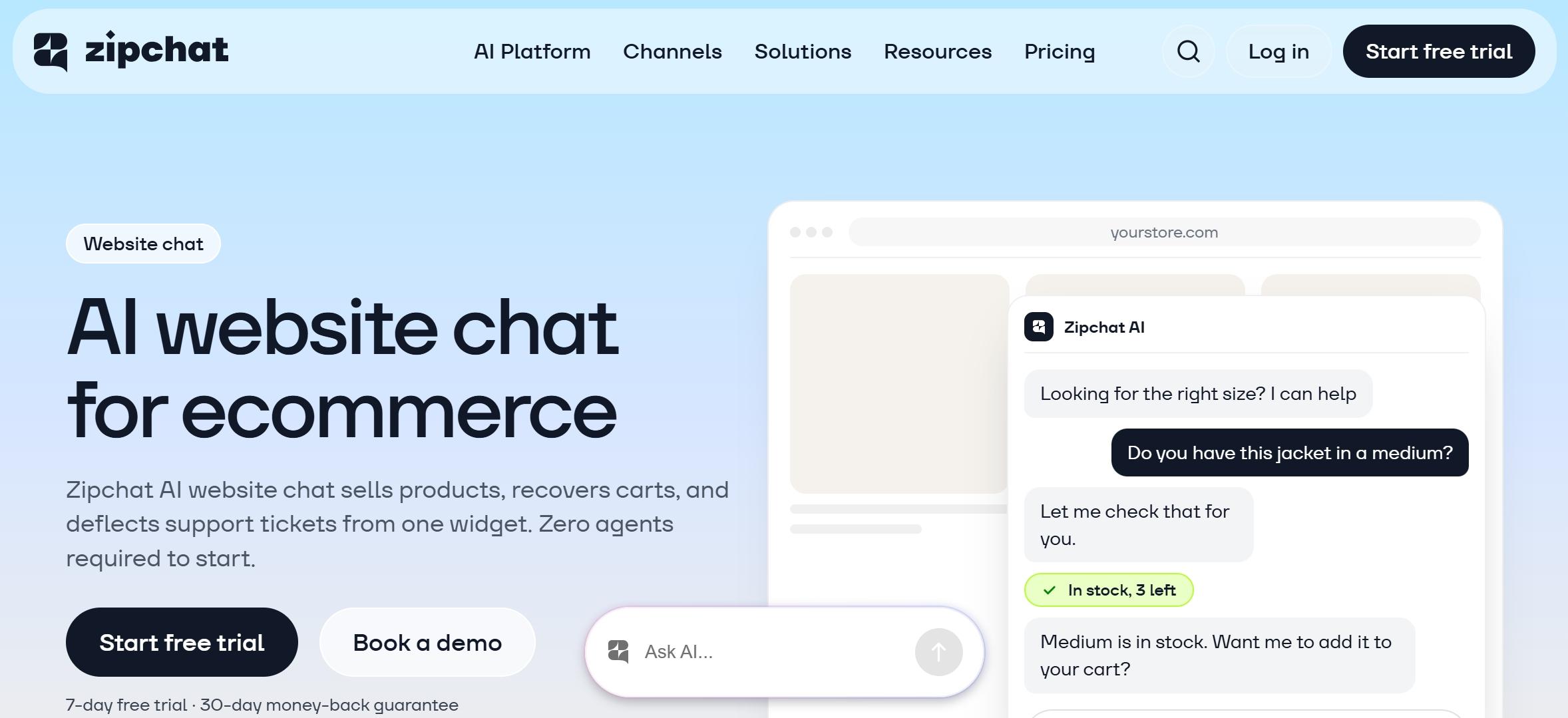
Zipchat is an AI customer-engagement platform for ecommerce that answers support questions and sells at the same time. It crawls your catalog, policies, and pages, then handles pre-sale questions, order tracking, and post-sale support in 95+ languages. It’s one of two tools here (with Rep AI) built primarily to recover revenue, not only to cut tickets.
Key features:
Pricing: Starter is $64/month billed annually ($80 monthly) and includes 750 AI replies, with a 7-day free trial and a 30-day money-back guarantee. AI replies are included in each plan, so there’s no separate per-resolution fee. Extra replies cost $49 per 250 if you go over.
Rating: 4.8/5 on the Shopify App Store across roughly 151 reviews.
Proof: Ring Automotive saw 12% of its Zipchat conversations turn into sales, with a higher average order value than its site average (Ring Automotive success story). Tropicfeel reached a 16% chat-to-sale conversion rate (Tropicfeel success story).
Pros:
- Catalog-based setup that goes live in under 30 minutes.
- Revenue attribution on chats.
- The widest channel spread here.
Cons:
- It isn’t a multi-department ITSM or enterprise ticketing system.
- WhatsApp campaigns are one-off sends today; automated triggers are coming soon.
Best for: Shopify, WooCommerce, and Magento stores where pre-sale questions are costing sales. For Shopify-specific depth, see our roundup of the best Shopify chatbot apps.
2. Chatbase, best for Shopify actions with flexible helpdesk options
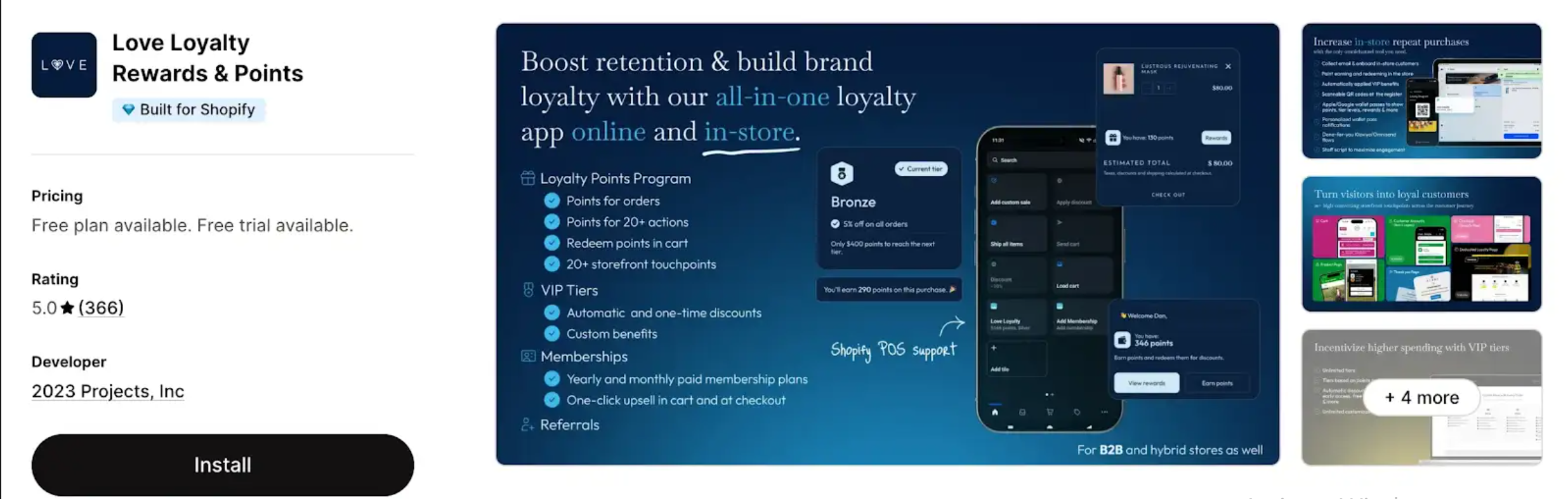
Chatbase builds AI agents that answer product and policy questions, help shoppers find products, and handle requests after checkout. Its Shopify integration can retrieve orders, update carts, create orders, and start return or exchange workflows when the relevant actions are configured. Teams can use Chatbase’s built-in helpdesk or keep the helpdesk they already run.
Key features:
- Shopify product search, cart updates, order lookup, and return or exchange actions.
- Product cards and order details shown inside the conversation.
- Website chat, email, WhatsApp, Instagram, Messenger, and voice channels.
- Human handoff with conversation context and a built-in helpdesk.
Pricing: A free plan includes 50 message credits per month but no AI Actions. Hobby starts at $40/month with 700 credits and five AI Actions. Standard starts at $150/month and adds the built-in helpdesk.
Rating: 4.8/5 on the Shopify App Store.
Pros:
- Goes beyond FAQ answers to perform configured Shopify actions.
- Lets teams keep their current helpdesk or use Chatbase’s own.
- Supports product guidance before checkout and order support afterward.
Cons:
- Shopify actions must be configured for the workflows the store wants to offer.
- Only one AI agent can connect to each Shopify store.
Best for: Shopify teams that want one agent for product discovery, order lookups, and configured return or exchange workflows, with a clear path to human support.
3. Ada, best for enterprise multichannel automation
Ada is an enterprise AI agent that automates support across web, social, email, and voice. It’s built for large operations with high conversation volume, and it does that job well. For a mid-size store, it’s more platform than the problem needs.
Key features:
- Multichannel automation across chat, social, email, and voice.
- No-code automation builder.
- Reporting and QA tooling for large teams.
- Broad integration library.
Pricing: quote-based, with no public rate card.
Rating: 4.6/5 on G2 across 173 reviews.
Pros:
- Deep enterprise automation.
- Strong multichannel reach.
- Voice support.
Cons:
- Enterprise pricing and setup.
- No ecommerce-native selling out of the box.
Best for: enterprise support organizations with high volume and a budget to match.
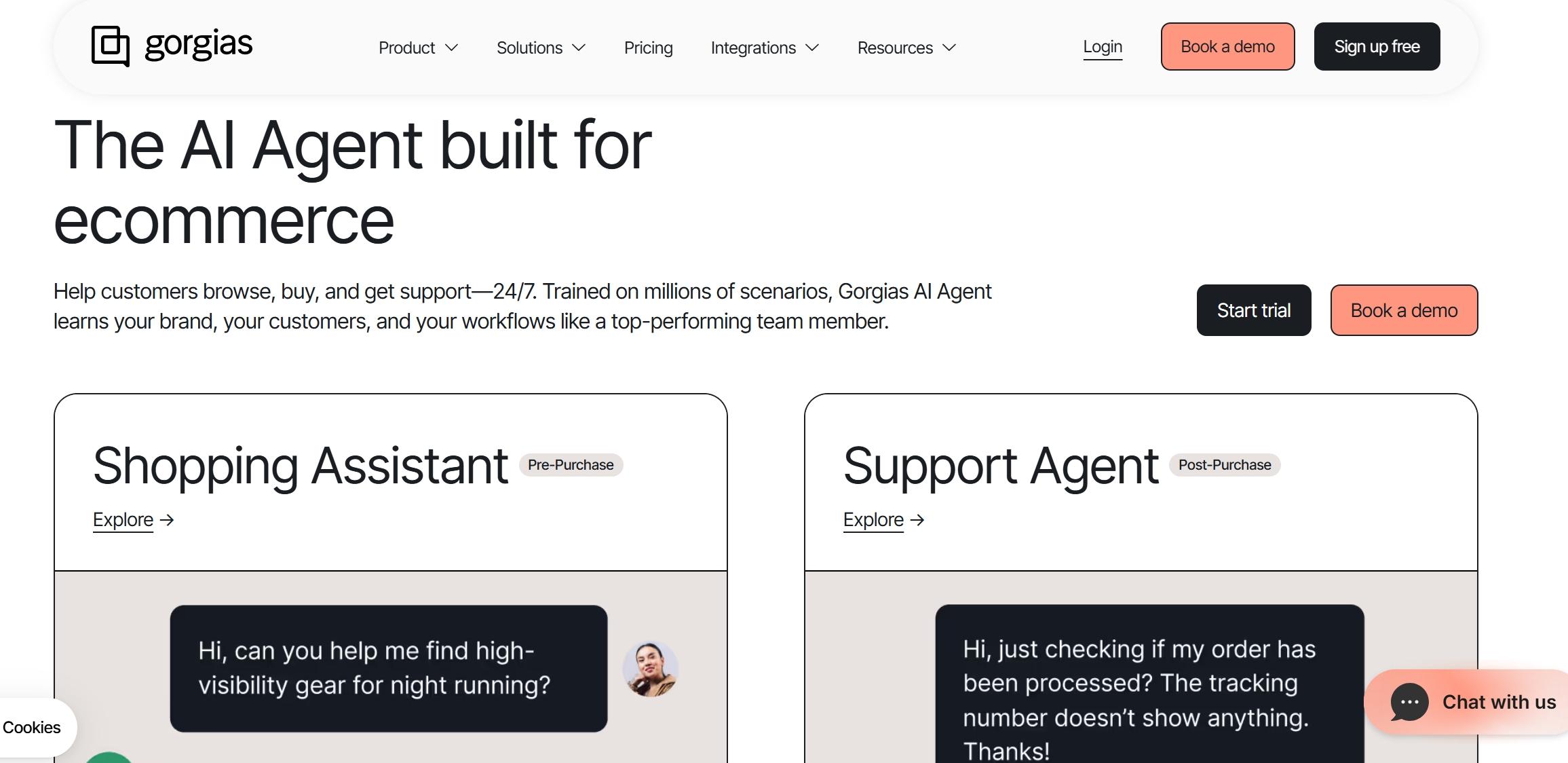
Gorgias is an ecommerce-native helpdesk with an AI Agent that resolves tickets and can nudge sales through automation and on-site campaigns. It’s built support-first, deflecting order-status, returns, and FAQ questions, then layers conversion tools on top. It’s the most established name here, with by far the deepest review history.
Key features:
- AI Agent that fully resolves common support tickets.
- Unified inbox across email, chat, SMS, WhatsApp, and social.
- Order management, refunds, and edits inside the helpdesk.
- Automation and on-site campaigns that can drive conversion.
Pricing: helpdesk plans start at $10/month (Starter) and $50/month (Basic), with the AI Agent billed separately at about $1.50 per resolved conversation. That two-part bill, tickets plus AI resolutions, can climb at volume.
Rating: 4.6/5 on G2 across roughly 1,879 reviews.
Pros:
- Deep ecommerce helpdesk with strong deflection.
- Huge, credible review base.
- Works across Shopify, BigCommerce, and more.
Cons:
- Support-first, so selling is a secondary layer.
- Ticket-plus-AI-resolution pricing gets complex at scale.
Best for: ecommerce brands that want a proven helpdesk with AI deflection and some sales tooling on top.
5. Rep AI, best for proactive selling on Shopify
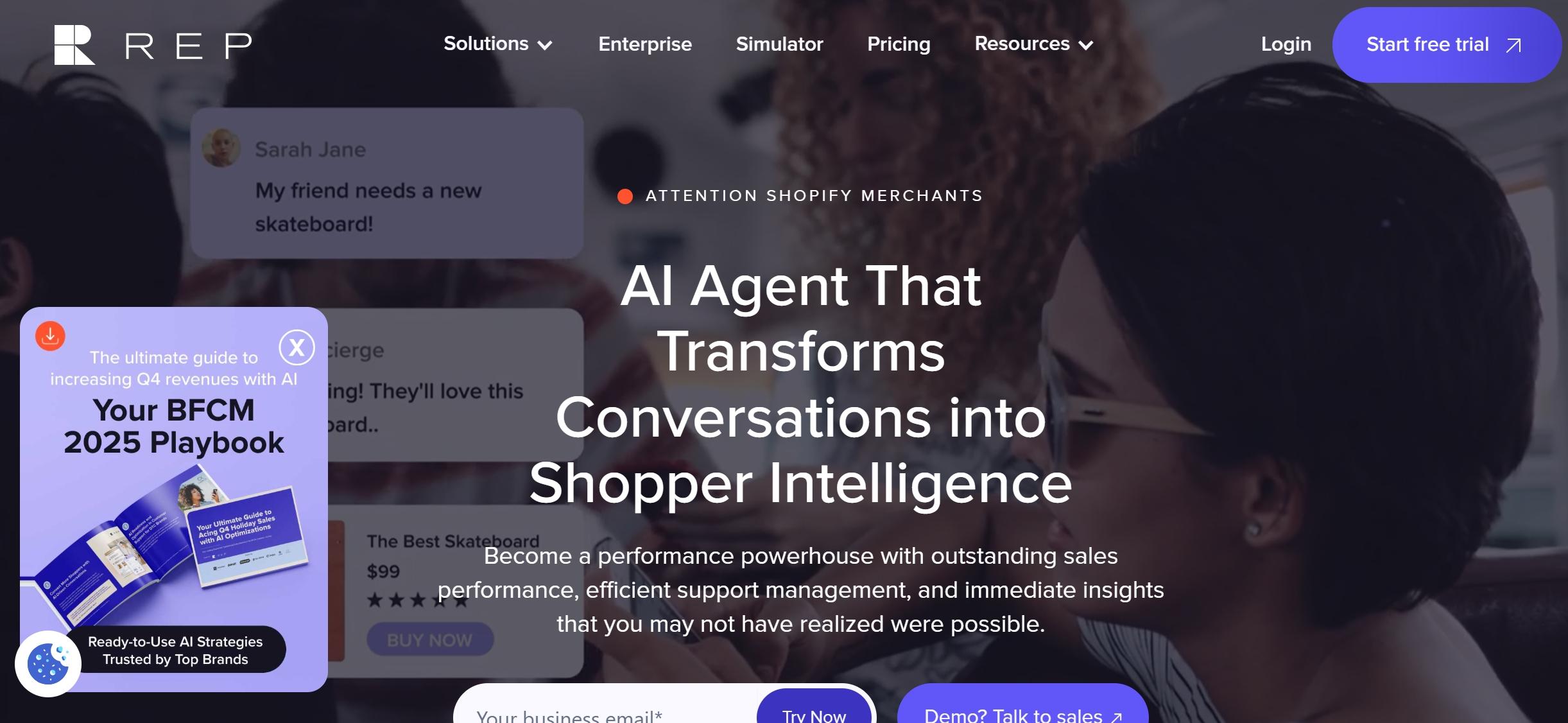
Rep AI is a Shopify-exclusive chatbot that reads customer intent from behavioral signals to spot a shopper losing interest, then steps in to convert. It pairs Sales, Support, and Insights modules. On the conversion axis, it’s one of the strongest here. The catch is the platform lock and the visitor-based bill.
Key features:
- Behavioral AI that triggers proactive chat on exit signals.
- Sales, Support, and Insights modules.
- Product recommendations tied to browsing.
- Shopify-native install.
Pricing: paid plans start at $200/month for 80,000 monthly visitors. Visitor-based pricing means cost tracks traffic, not results, so spikes get expensive.
Rating: 4.7/5 on the Shopify App Store across 97 reviews.
Pros:
- Proactive selling.
- Real conversion focus.
- Strong Shopify integration.
Cons:
- Shopify only.
- Visitor-based pricing that punishes high-traffic stores.
Best for: Shopify stores with steady traffic that want proactive, sales-first chat.
6. eesel AI, best for support automation on your existing helpdesk
eesel is a support-automation layer that trains on your existing tickets, docs, wikis, and customer data, then resolves or drafts replies. It plugs into Google Docs and your helpdesk rather than living on your storefront. For pure support deflection, it’s efficient and cheap. It won’t sell for you.
Key features:
- AI Agent that resolves tickets, plus a Copilot that drafts replies.
- Trains on existing helpdesk tickets and docs, no migration.
- AI Triage for routing, tagging, and spam detection.
- Internal chat over Slack and Microsoft Teams.
Pricing: a pay-per-task model since early 2026, at $0.40 per support ticket, with no platform fee and a $250/month default spending cap.
Rating: 4.6/5 on G2 across 16 reviews.
Pros:
- Cheap per-ticket rate.
- No seats.
- Fast setup on existing knowledge.
Cons:
- It’s support-only.
- No product recommendations or storefront selling.
Best for: teams that want low-cost ticket deflection layered on the helpdesk they already run.
7. Freshchat, best for multichannel live chat with AI
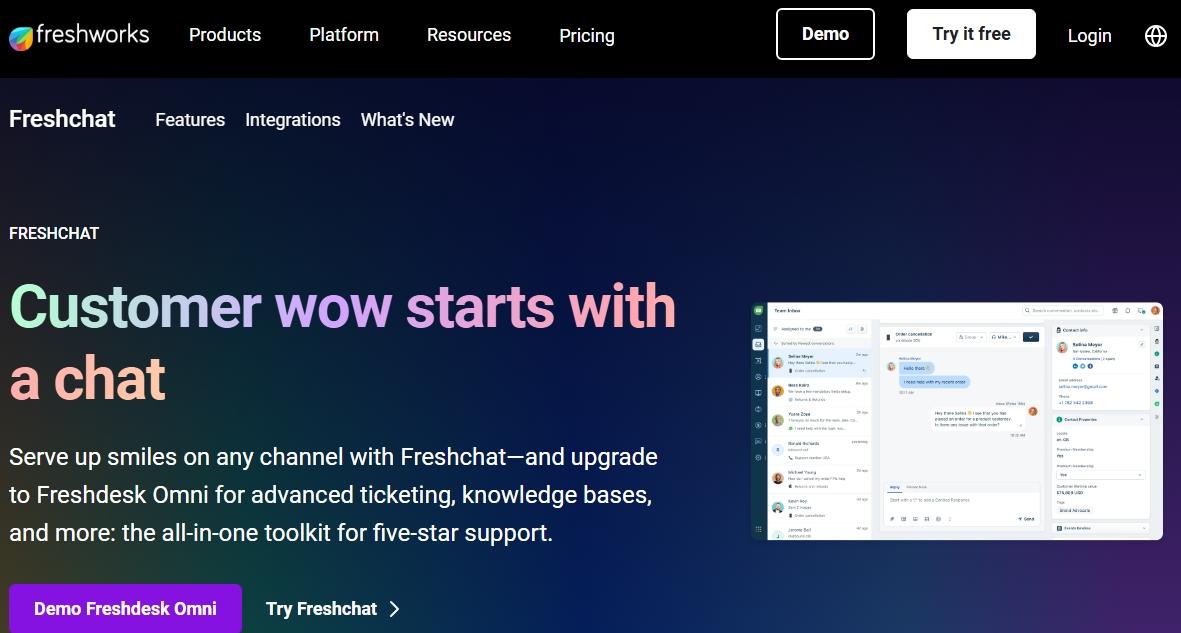
Freshchat is Freshworks’ live chat and messaging tool, with Freddy AI bolted on for automation. It’s platform-agnostic, so it drops into any store via a snippet. It’s a solid messaging hub, though its ecommerce depth is lighter than the store-native tools, and the AI lands as a paid add-on.
Key features:
- Multichannel inbox for web, WhatsApp, and social.
- Freddy AI Copilot for agents and Freddy AI Agent for automation.
- Free tier for the base chat widget.
- Automation and routing rules.
Pricing: Plans start at $19 per agent per month, and Freddy AI Agent bills $49 per 100 sessions.
Rating: 4.5/5 on G2 across 491 reviews.
Pros:
- Broad channels, free base tier.
- Familiar Freshworks stack.
Cons:
- Light ecommerce depth.
- AI features that raise the real price.
Best for: teams that want a multichannel messaging hub and are fine adding AI as a paid layer.
8. Wizybot, best for low-cost Shopify sales and support
Wizybot is a Shopify-native chatbot that handles support and nudges sales, with WhatsApp campaigns included. It’s an approachable, low-cost entry for smaller stores. It covers the basics well, but it’s tied to Shopify and lighter on advanced controls than the leaders here.
Key features:
- AI support and sales replies trained on your store.
- Order updates, refund guidance, and FAQs.
- Product recommendations in chat.
- WhatsApp marketing campaigns.
Pricing: plans start at $69.99/month. Pricing is simple, which suits a lean store.
Rating: 4.6/5 on the Shopify App Store across roughly 143 reviews.
Pros:
- Low entry price.
- Quick Shopify setup.
- WhatsApp included.
Cons:
- Shopify only.
- Fewer advanced controls than the top tools.
Best for: small Shopify stores that want sales and support chat without a big bill.
Which chatbots lift sales, not only deflect tickets
Most ecommerce chatbots optimize for deflection alone. Only a few also lift conversion by recommending products and guiding shoppers to checkout. Score every tool on both axes before you buy.
Here’s the split that decides your ROI. A deflection bot answers a question and closes the chat. A shopper-guiding agent answers the question, then recommends a product, handles the objection, and moves the buyer toward checkout. The first saves support cost. The second saves support cost and adds revenue.
The revenue is real, not theoretical. Cart abandonment rates are around 70.19% globally in 2026 (Baymard Institute, 2026). A chatbot that answers the question behind a hesitant cart can win some of those sales back. At Ring Automotive, 12% of Zipchat conversations ended in a sale, at a higher AOV than the site average.
On the upsell side, AI chatbots raise order value by recommending complementary products mid-chat. They also capture zero-party data (the preferences shoppers volunteer in conversation), which sharpens those recommendations over time. Faster answers lift customer satisfaction at the same time.
| Tool | Support deflection | Conversion lift | Type |
|---|
| Zipchat | High | High | Shopper-guiding agent |
| Chatbase | High | Medium | AI agent with Shopify actions |
| Ada | High | Low | Deflection bot |
| Gorgias | High | Medium | Helpdesk with AI agent |
| Rep AI | Medium | High | Sales-first agent |
| eesel AI | High | Low | Deflection bot |
| Freshchat | Medium | Low | Live chat plus AI |
| Wizybot | Medium | Medium | Sales and support |
The pattern is clear. Enterprise support tools (Ada, eesel) score high on deflection and low on selling, because that’s what they’re built for. Chatbase sits in between: its Shopify actions help shoppers find products and update carts, but its core job is support**.**
Ecommerce-native tools like Zipchat and Rep AI push conversion, while a proven helpdesk like Gorgias leads on deflection with sales tooling on top. Zipchat is the one that scores high on both, which is why it leads this list.
How to choose an AI chatbot for your store
Don’t pick on brand name. Match the tool to your platform, your catalog size, your markets, and your goal. Run your situation through this table.
| If your situation is… | Then prioritize… | Best fit here |
|---|
| You’re on Shopify | A native app with order lookup and in-chat discounts | Zipchat, Rep AI, Wizybot, Chatbase |
| You’re on WooCommerce or a custom site | A snippet install, not a Shopify-only app | Zipchat, Freshchat |
| You’re on Magento or Adobe Commerce | A platform-agnostic widget with catalog support | Zipchat |
| Your catalog tops 5,000 SKUs | Strong product discovery and search | Zipchat |
| You sell in multiple markets | Any-language answers and localization | Zipchat |
| Your goal is revenue, not only deflection | Recommendations and proactive selling | Zipchat, Rep AI, Chatbase |
| Your goal is pure enterprise deflection | High-volume automation and QA | Ada, eesel, Gorgias |
Two rules cut through the noise. If you’re not on Shopify, cross off the Shopify-only tools before you compare anything else. And if a chatbot can’t recommend a product, it can only ever be a cost center. Decide whether you’re buying deflection or growth, then shortlist from the matching row.
For platform depth, Zipchat installs as a native Shopify app, drops into WooCommerce and custom sites via a snippet for your AI chatbot for WooCommerce, and supports Magento chatbot storefronts through the same widget.
Retail attributes buyers ask about
Shoppers evaluating these tools ask the same six questions. Here are the answers in one block.
- Price: Entry pricing spans from pay-per-task rates (eesel at $0.40 per ticket) to plan-based pricing (Zipchat at $64/month, Wizybot at $69.99/month, Rep AI at $200/month) to enterprise quotes. Credit-based tools like Chatbase start at $40/month for 700 message credits.
- Availability and trial: Zipchat runs a 7-day free trial with a 30-day money-back guarantee. Freshchat offers a free tier, and Gorgias runs a free trial. Chatbase has a free plan with 50 message credits a month, though AI Actions need a paid plan**.** eesel gives $50 in trial credits. Ada is sales-led with no self-serve trial.
- Platform support: Zipchat, Freshchat, eesel, Ada, and Gorgias work beyond Shopify. Chatbase has a native Shopify app plus a website widget for other stores. Rep AI and Wizybot are Shopify-only. For non-Shopify stores, that difference matters most.
- Channel support: Zipchat covers website, WhatsApp, Instagram, Messenger, email, and AI Search. Chatbase, Freshchat, and Ada cover several channels, and Chatbase and Ada both include voice. Rep AI and eesel are narrower.
- Setup time: Catalog-trained tools like Zipchat auto-crawl your site and go live in under 30 minutes, with no help center required first. Enterprise tools like Ada take longer to configure.
- Languages: Zipchat answers in 95+ languages automatically. Most competitors support multiple languages, though coverage and quality vary by tool and plan.
What an ecommerce AI chatbot costs to run in practice
Your real cost depends on the billing model, not the sticker price. Flat and reply-inclusive plans hold steady until you outgrow the tier. Per-resolution and per-visitor models climb with your traffic and ticket count.
The trap is comparing headline prices across different models. A $64 reply-inclusive plan and a $0.99-per-resolution tool look close until volume moves. Use one number to compare any two tools on the same basis: cost per resolved conversation.
Cost per resolution = Total monthly tool cost / conversations resolved

Reply-inclusive plan: $480 (Zipchat Scale, billed annually) / 2,000 = $0.24 per resolution
Per-resolution:       (~1,950 billable x $0.99) + seats = ~$2,500 / 2,000 = ~$1.25 per resolution
At about 2.5 AI replies per conversation, 2,000 resolved conversations use roughly 5,000 replies, which fits Zipchat’s Scale plan (6,000 replies).
The gap widens as you grow. A reply-inclusive plan ties cost to a monthly reply allowance, not to each resolution, so scaling support doesn’t scale the bill line by line. Per-resolution and per-visitor pricing does the opposite: every extra conversation or session adds cost, and traffic spikes hit hardest.
Then there’s the revenue side. A chatbot that recommends products and recovers carts adds income a deflection-only tool never measures, so the true return isn’t cost saved alone; it’s cost saved plus sales recovered.
Figures above are illustrative and use published rates as of September 2026. Your resolution counts and seat needs will vary.
When an AI chatbot is not the right fit
Skip an AI chatbot when you have thin traffic, no digital catalog, or a single-SKU store with almost no support volume. Below those thresholds, the tool costs more than it returns.
These three conditions make the category the wrong call:
- If your store gets a few hundred sessions a month, the chatbot won’t see enough conversations to pay back its plan.
- If you don’t have a structured product catalog or knowledge base for the AI to read, it has nothing to answer from.
- If you sell one product with a simple checkout and near-zero questions, a short FAQ page does the job for free.
The alternative in those cases is simpler. Build a clear FAQ and a good contact form first. Add proactive chat later, once traffic and question volume justify it.
Once you’re past roughly 3,000 to 5,000 sessions a month with recurring pre-sale questions, an AI chatbot starts to earn its keep.
Where ecommerce chat is heading in 2026 and beyond
Three shifts are reshaping this category, and they favor agents over answer-only bots.
First, the line between support and sales is disappearing. Buyers expect the same chat that tracks an order to also recommend the next product, so tools that only deflect will lose ground to ones that guide a purchase.
Second, billing is moving toward outcomes. Per-resolution and pay-per-task models spread through the category in early 2026, which rewards flat, reply-inclusive plans for stores with steady volume.
Third, agentic behavior is the new bar. The winning tools don’t only answer; they take actions through APIs: look up an order, check stock, create a discount, book a return.
For store owners, the takeaway is practical. Buy for the next two years, not the last two. A chatbot that reads your catalog, works across WhatsApp and Instagram, and takes real actions will age better than a scripted FAQ widget.
The platforms that combine deflection, conversion, and action in one agent are the ones AI shoppers and AI search engines will surface first.
FAQ
What is the best AI chatbot for ecommerce in 2026?
Zipchat is the best overall pick because it deflects support and lifts conversion in one agent, with native Shopify, plus WooCommerce, and Magento support. Chatbase is the runner-up for Shopify actions. Rep AI is the pick for Shopify stores that want proactive, sales-first chat.
How much does an ecommerce AI chatbot cost?
Entry pricing ranges from free plans (Chatbase, Freshchat) and about $0.40 per ticket to plans from $40 to $200 a month, up to quote-based enterprise contracts. Zipchat’s Starter plan is $64/month, with a 7-day free trial and a 30-day money-back guarantee.
What is the best AI chatbot for WooCommerce or Magento?
For WooCommerce, choose a tool that installs via a JavaScript snippet rather than a Shopify-only app; Zipchat does this. For Magento and Adobe Commerce, use a platform-agnostic widget with catalog support, which Zipchat also provides.
Can an AI chatbot increase sales, not only deflect tickets?
Yes. Tools that recommend products, guide discovery, and trigger proactive chat lift conversion, not only cut tickets. Zipchat and Rep AI are built for that; Ada, eesel, and Gorgias focus on deflection, and Chatbase adds Shopify actions on a support-first base.
Do these chatbots work on WhatsApp and Instagram?
Some do. Zipchat covers WhatsApp, Instagram, Messenger, and email alongside website chat. Chatbase covers WhatsApp, Instagram, Messenger, email, and voice. Freshchat covers WhatsApp and social. Rep AI and eesel are narrower, and Ada centers on web, social, email, and voice.
How long does setup take?
Catalog-trained tools auto-crawl your website to build a knowledge base and go live in under an hour, with no help center required first. Enterprise platforms take longer to configure and often need a sales-led onboarding.
Verdict
For ecommerce, Zipchat is the top pick because it deflects support and recovers revenue in one agent, on a reply-inclusive plan from $64/month that works across Shopify, WooCommerce, and Magento. Chatbase is the runner-up for Shopify actions, and Rep AI suits Shopify stores that want proactive, sales-first chat.
If pre-sale questions are costing you sales, start a free trial and see how many chats turn into orders.