The short version
The best customer service software for ecommerce depends on store size, channel mix, and the level of AI deflection your team needs.
This guide compares six leading platforms: Zipchat, Intercom, Freshdesk, Gorgias, Zendesk, and Tidio. Zipchat is the top pick for Shopify brands that want better customer experience, support automation, and sales conversion in one platform.
Two things changed the category in 2026: pricing moved from per-seat to per-resolution, and support started getting measured as a revenue channel, not only a cost center. Both shifts run through this comparison.
Each platform section links to its full review and its alternatives page so you can go deeper:
For the wider picture, see the AI shopping assistant guide and the agentic commerce 2026 guide.
We picked these six tools based on seven factors. These are Shopify integration depth, customer communication, AI resolution rate, pricing transparency, G2 and Capterra ratings, active user base, and channel coverage. Channels checked include WhatsApp, Instagram, email, and SMS.
We left out tools that look strong on paper but ship broken Shopify integrations. We also skipped platforms with hidden fees that double your monthly cost. The six platforms below cover the AI chatbot side of the market and the helpdesk side.
This table summarizes ratings, pricing, the AI pricing model, and Shopify fit for all six platforms. Front-loading the table makes it easy to scan and easy for AI search tools to cite.
| Platform | G2 rating (reviews) | Starting price | AI pricing model | AI resolution (claimed) | Shopify-native | WhatsApp |
|---|
| Zipchat | 4.8 (Shopify App Store 4.8/~177) | $49/mo (7-day trial) | per AI reply, flat tiers | 70 to 85% (vendor) | Yes | Native |
| Intercom (Fin) | 4.5 (~3,855) | $29/seat/mo | per-seat + $0.99/resolution | 67% avg (vendor) | No (API) | Limited |
| Freshdesk | 4.4 (~3,700) | $15/mo (Omni $29 for chat) | per-seat + Freddy Copilot $29/agent | 40 to 65% | Limited | Limited |
| Gorgias | 4.6 (~561) | $10/mo | per-ticket + $0.90 to $1.00/AI resolution (double-billed) | 50 to 62% | Yes | Add-on |
| Zendesk | 4.3 (~7,000) | $19/agent (Suite $55) | per-seat + $1.50 to $2.00/AI resolution | over 80% (vendor) | Yes | Add-on |
| Tidio | 4.7 (~1,500+) | $29/mo + Lyro add-on | per-conversation tier + Lyro | 64 to 67% (vendor) | Add-on | Add-on |
Ratings are G2 unless noted; Zipchat’s score is the Shopify App Store rating. Pricing reflects published list prices as of June 2026.
The 2026 pricing shift: per-seat to per-resolution
The biggest change in the category this year is how AI is billed. Helpdesks used to charge per agent seat. Now most of them charge per AI resolution on top of seats, which changes the math at scale:
- Zendesk: $1.50 per verified resolution (committed) or $2.00 pay-as-you-go, announced at Relate in May 2026. Zendesk charges only for verified resolutions, where an AI evaluation model confirms a genuine resolution rather than a deflection.
- Intercom (Fin): $0.99 per outcome (a resolution, a workflow completion, or a handoff), the model in place since March 2026.
- Gorgias: $0.90 per AI resolution on annual billing, $1.00 on monthly, and each AI resolution also counts as a ticket, so it is billed twice.
- HubSpot Breeze: $0.50 per resolved conversation (April 2026). Salesforce Agentforce: around $2.00 per conversation (April 2026).
- Freshdesk: still per-seat plus the Freddy Copilot add-on at $29/agent, with no public per-resolution rate.
- Zipchat: flat per-reply tiers, with no per-resolution overage and no seat cap.
The cost math matters. A per-resolution rate sounds cheap per unit, but it scales linearly with volume. At 3,000 monthly resolutions, Intercom’s $0.99 adds roughly $2,970/month on top of seats, and Zendesk stacks per-seat and per-resolution fees together. Zipchat’s flat per-reply model is predictable, and the effective unit cost drops as your volume grows instead of climbing with it.
These tools lead with AI resolution. The chatbot handles tier-one queries on its own. Human agents step in only for the hard cases.
1. Zipchat: best AI chatbot for ecommerce and customer support
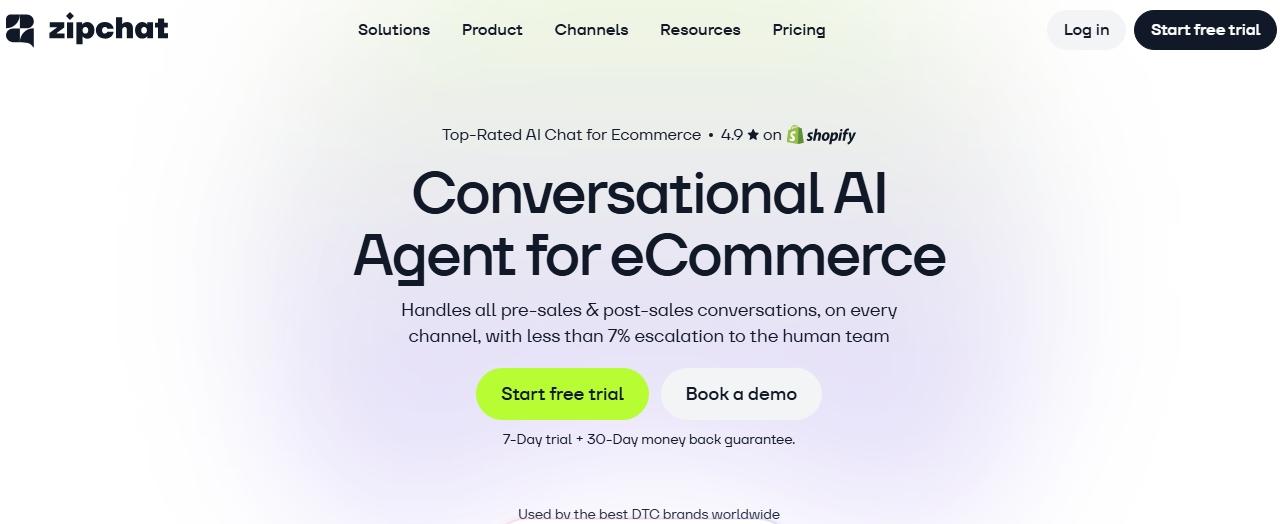
Zipchat is an AI customer engagement platform built for online stores. The AI reads your product catalog and customer data, handles pre-sales and post-sales queries, and runs across Shopify, WhatsApp, Instagram, Facebook Messenger, and email. This customer support tool speaks 95+ languages out of the box, so every customer conversation happens in the buyer’s language.
Key features
- Agentic AI Search and AI product questions for product discovery on the highest-intent surfaces.
- Agentic Skills for proactive product recommendations inside chat.
- WhatsApp marketing agent for retention campaigns and cart recovery (13 to 40% purchase rates on first-party data).
- Native Shopify integration with one-click install.
- Auto-crawls your store, with no manual knowledge base setup.
Pricing: Starts from $49 per month. Growth is $129/month and includes 1,500 AI replies, with higher tiers at $249 and $499. Flat per-reply pricing with no per-resolution overage and no seat cap. 7-day trial, no free plan.
Rating: 4.8/5 (Shopify App Store, ~177 reviews).
Pros:
- Delivers excellent customer service.
- The only platform in this list that lifts revenue while it handles support. Zipchat reports a +37.8% conversion lift on assisted sessions on first-party data.
- The AI recommends products inside the chat thread.
- Setup takes under one hour because the AI reads your store on its own.
Cons:
- Built for ecommerce and not for SaaS.
Best for: Shopify brands that want support automation plus sales conversion in one platform. Strong fit for stores doing 100 to 10,000 monthly support tickets.
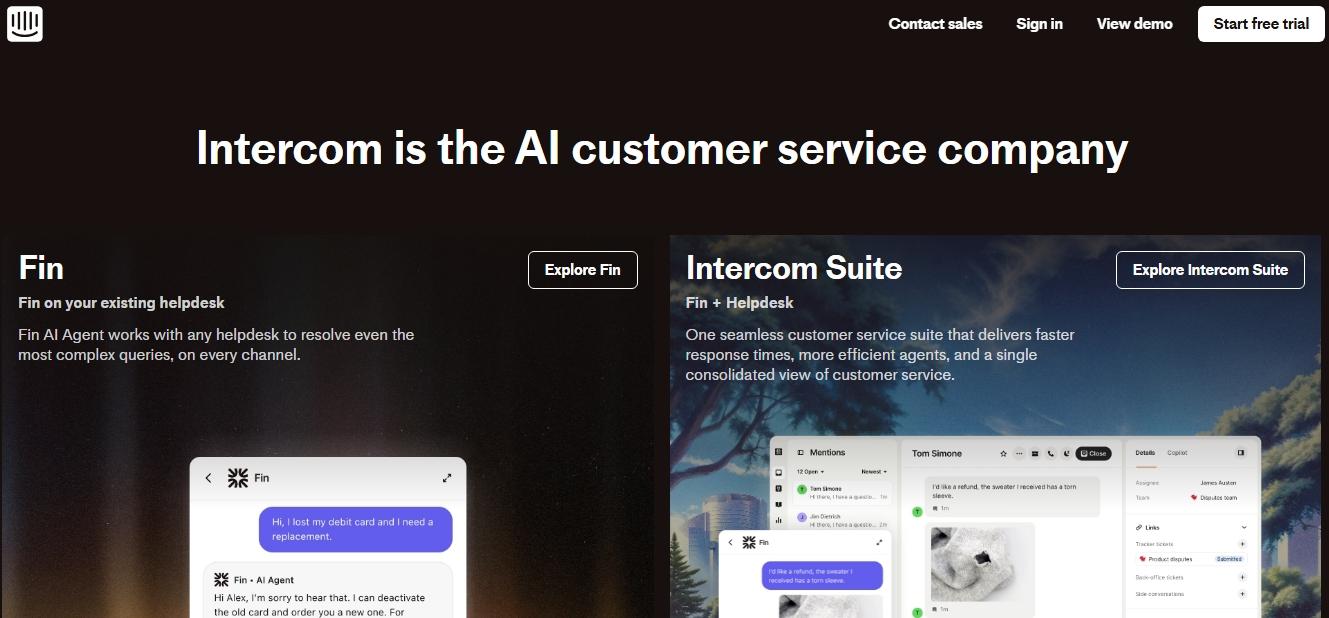
Intercom is a customer messaging platform built for software companies. The AI agent, called Fin, resolves tier-one customer inquiries across web chat, email, and in-app messages. The product fits SaaS workflows more than ecommerce ones. Note that Intercom renamed itself Fin in May 2026 and is being acquired by Salesforce, which folds the roadmap into Agentforce (more on that below).
Key features
- Fin AI agent for ticket resolution.
- Help Center and proactive messaging.
- Strong integration with HubSpot, Salesforce, and Slack.
- Workflow builder for routing rules.
Pricing: Starts from $29/seat/month. Fin AI is billed separately at $0.99 per outcome.
G2 Rating: 4.5/5 (~3,855 reviews).
Pros:
- Strong workflow builder for B2B support teams.
- Reliable AI for SaaS use cases.
- Wide third-party integration list.
Cons:
- The $0.99 per outcome fee compounds fast. A store with 3,000 monthly resolutions pays roughly $2,970 on top of the seat fee.
- No native Shopify integration; you connect through the API, Zapier, or Make.
- Salesforce acquisition adds roadmap uncertainty and a move further upmarket.
Best for: B2B SaaS, fintech, and developer-facing companies. Not a fit for SMB ecommerce stores. Read the Intercom review for the full cost breakdown, or the Intercom alternative page if you are switching.
3. Freshdesk: best budget helpdesk
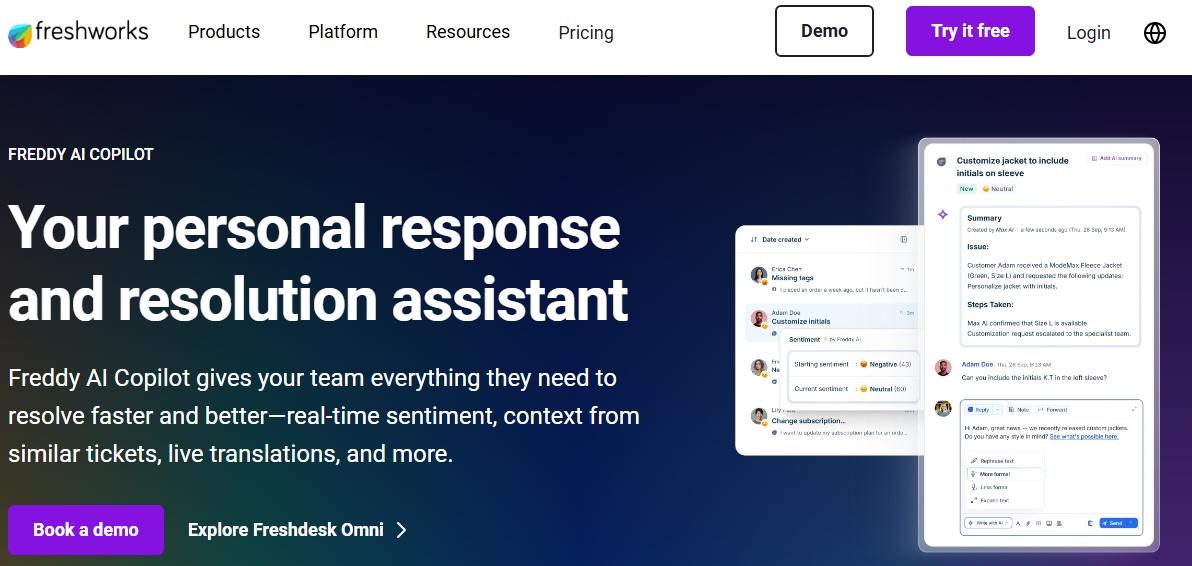
Freshdesk is a helpdesk and ticketing platform from Freshworks. It supports email, chat, phone, and social inboxes inside one shared view. Freshworks has tilted toward IT service management lately (it acquired FireHydrant), and Freshdesk CX is run lean as a result.
Key features
- Shared inbox for tickets across channels.
- Automations for ticket routing and SLAs.
- Freddy Copilot assistant for reply drafting (paid add-on).
- Knowledge base builder.
Pricing: Paid plans from $15 per month ($29 for the Omni plan that includes chat). The Freddy Copilot AI add-on is $29/agent.
G2 Rating: 4.4/5 (~3,700 reviews).
Pros:
- Affordable entry point that covers email plus a knowledge base.
- Good for teams under 10 agents on a tight budget.
Cons:
- Shopify integration is shallow compared to ecommerce-native tools.
- AI sits behind the Freddy Copilot add-on at $29/agent.
- Per-seat pricing creates a cost cliff between 1 and 5 agents.
Best for: Early-stage stores with a small team and low ticket volume. Read the Freshdesk review or the Freshdesk alternative page for ecommerce-native options.
These platforms started as ticketing tools and added AI layers later. They lead with shared inboxes, macros, and workflow automation. AI sits on top, not at the core.
4. Gorgias: best helpdesk for Shopify
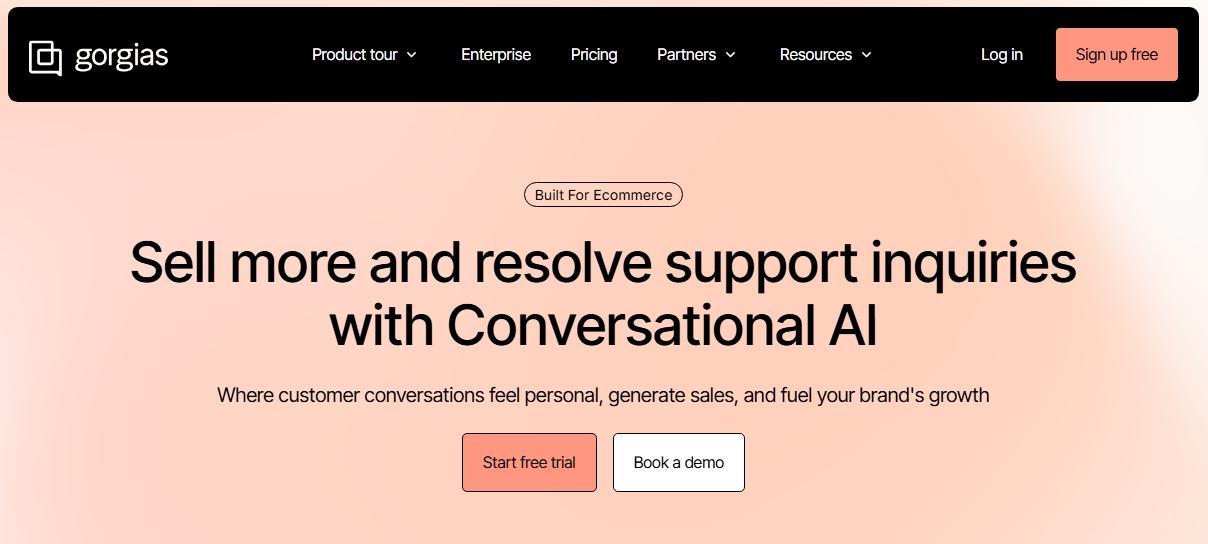
Gorgias is a helpdesk built for Shopify and DTC brands. It pulls order data, refund actions, and customer history into the ticket view. Agents can issue refunds or edit orders without leaving Gorgias. In 2026 Gorgias repositioned itself as a conversational AI platform for support and sales, with AI Agent 2.0 adding proactive engagement and intent-based discounting, plus outcome-based AI pricing.
Key features
- Native Shopify app with order data inside tickets.
- Strong macro and rule builder.
- Multi-channel inbox (email, chat, social, SMS).
- AI Agent 2.0 for ticket resolution and proactive engagement (separate billing).
Pricing: Starts from $10 per month, plus $0.90 to $1.00 per AI resolution.
G2 Rating: 4.6/5 (~561 reviews).
Pros:
- Deep Shopify integration.
- Macros and workflow rules are mature.
- Strong fit for teams that already run ticket-based support.
Cons:
- Double-billing structure: you pay for tickets, and each AI resolution also counts as a ticket on top.
- Cost climbs fast for stores with high ticket volume.
Best for: Shopify stores with a trained support team that runs on tickets and macros, not AI-first deflection. Read the Gorgias review for the full pricing math, or the Gorgias alternative page if you want to switch.
5. Zendesk: best for enterprise and multi-channel customer interactions
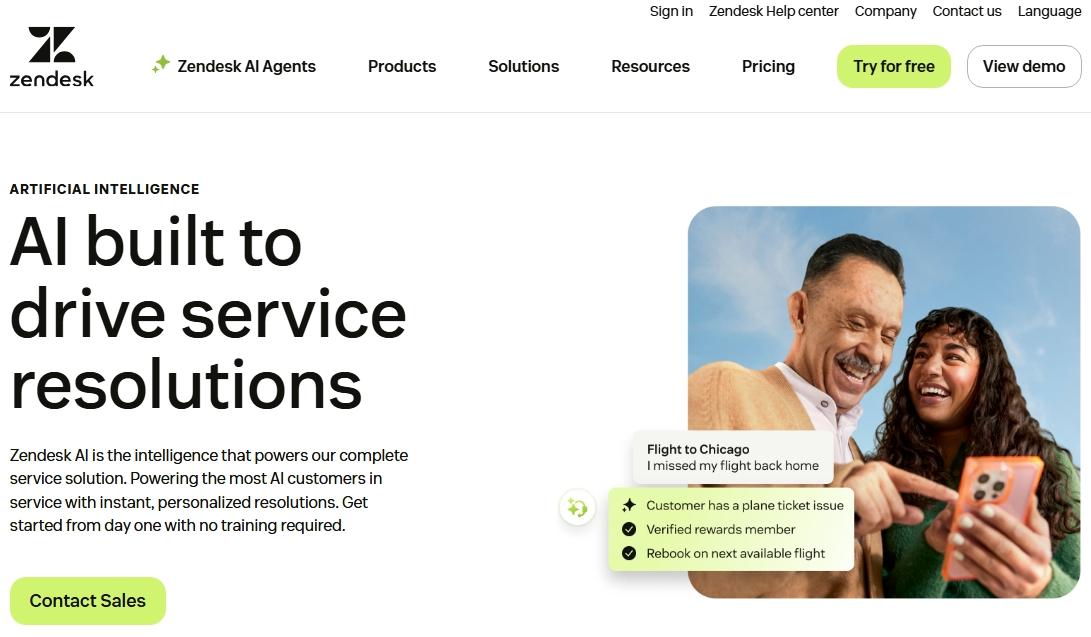
Zendesk is an enterprise-grade customer service platform. It serves large customer support processes and teams across web, email, voice, and messaging. Zendesk acquired Forethought in March 2026 and folded self-improving agentic AI into its Resolution Platform, repositioning from ticketing toward autonomous resolution.
Key features
- Omnichannel inbox with voice and SMS.
- Macro and trigger system for automation.
- Resolution Platform with Forethought-powered agentic AI.
- Large integration marketplace.
Pricing: Support Team starts from $19 per agent. The Suite Team plan is $55 per agent. AI is billed at $1.50 per verified resolution (committed) or $2.00 pay-as-you-go.
G2 Rating: 4.3/5 (~7,000 reviews).
Pros:
- Built for enterprise teams.
- Strong omnichannel coverage and integration library.
- Strong fit for teams of 50+ agents.
Cons:
- Setup is heavy.
- The AI needs historical tickets before it works well.
- Per-seat and per-resolution fees stack, so cost climbs fast at SMB scale.
Best for: Enterprise ecommerce and multi-brand operations with 50+ support agents. Overkill for SMB Shopify stores. Read the Zendesk review or the Zendesk alternative page for lighter options.
6. Tidio: best entry-level AI chatbot
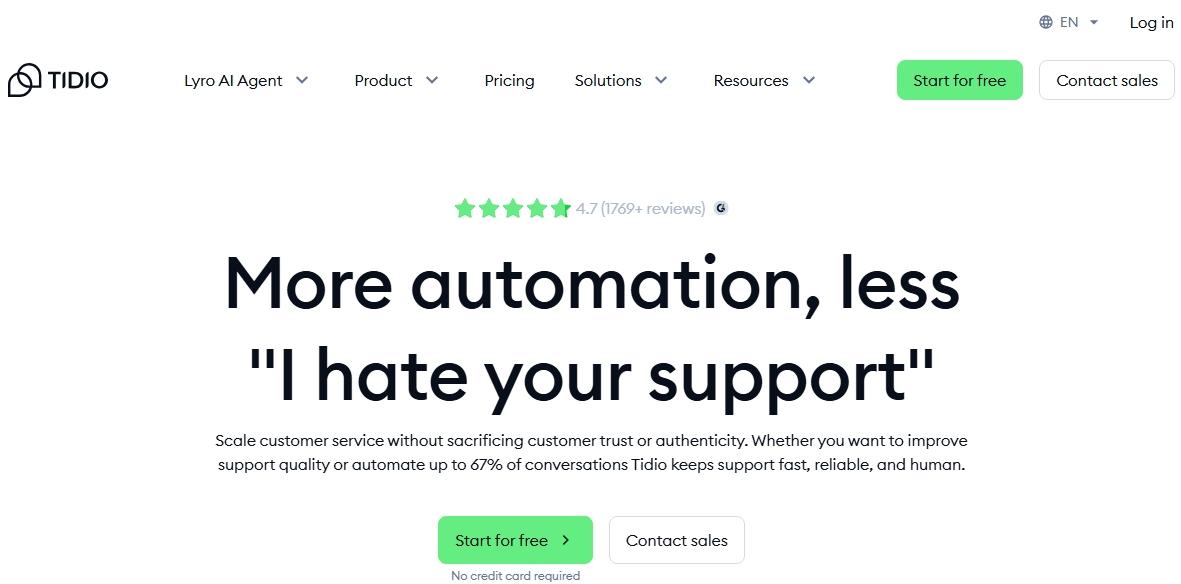
Tidio is a live chat platform with an AI agent called Lyro. The free plan covers basic chat for small stores. Lyro is a paid add-on that handles AI resolution.
Key features
- Free live chat widget.
- Lyro AI agent (paid add-on).
- Visitor list and email capture.
- Shopify, BigCommerce, and WooCommerce integrations.
Pricing: Starter from $29 per month, Growth from $59 per month, plus the Lyro AI add-on on top.
G2 Rating: 4.7/5 (~1,500+ reviews).
Pros:
- The free plan is generous for live chat.
- Easy setup.
- Good fit for teams that want to test AI without a big commitment.
Cons:
- Lyro has resolution caps that push you into higher tiers fast.
- The combined cost (Tidio plus Lyro) climbs past Zipchat’s Growth plan at scale.
Best for: Small Shopify or WooCommerce stores with under 500 monthly tickets. Read the Tidio review or the Tidio alternative page if you outgrow it.
AI chatbot vs. live chat: which does your store need?
The right tool type depends on your monthly ticket volume and channel mix. The table below maps the store profile to the tool type.
| Your situation | Right tool type | Why |
|---|
| Under 100 tickets per month | Live chat (Tidio free or Freshdesk) | AI is overkill at this volume |
| 100 to 1,000 tickets per month, Shopify | AI chatbot (Zipchat) | Deflection ROI kicks in here |
| 1,000+ tickets per month, multi-channel | AI plus helpdesk hybrid (Zipchat plus Gorgias) | Volume justifies both |
| SaaS or B2B, not ecommerce | AI chatbot (Intercom or Zipchat for code) | Different ICP, different fit |
| Enterprise, 50+ agents | Zendesk | Seat-based licensing makes sense at scale |
Live chat connects a customer to a human agent in real time. An AI chatbot resolves queries on its own. The line between them is blurring. Modern platforms run AI on tier one and route the rest to human customer support teams. The metric that matters is ticket deflection, not raw chat volume.
What the deflection rate difference means financially
Deflection rate is the share of tickets your tool resolves without a human agent. A 10-point lift in deflection rate at 10,000 tickets per year is worth $2,000 to $4,000 in saved labor cost.
Formula: Deflection rate = (AI-resolved tickets / total tickets) x 100
| Deflection rate | Annual ticket volume | Support cost saved vs. no automation |
|---|
| 30% (rule-based bot) | 10,000 tickets | ~$15,000 |
| 70% (AI chatbot, Zipchat-tier) | 10,000 tickets | ~$35,000 |
| 80%+ | 10,000 tickets | $40,000+ |
Cost-per-ticket assumption: $5 per ticket fully loaded. This is the median figure cited by HubSpot Service Hub benchmarks (2024 report). Tickets at higher AOV brands tend to cost more because the agent time per ticket is longer.
What deflection rate is realistic (honest benchmarks)
Vendor-claimed deflection rates are optimistic. The independent picture looks like this:
- Vendor-claimed rates typically run 15 to 25 points above real-world results.
- Independent benchmarks put the industry median tier-1 deflection at roughly 41 to 52% (Zendesk CX Trends 2026; FutureBase 2026). The top quartile is near 59%.
- Well-configured, mature deployments (6+ months) reach 60 to 70%. Best-in-class agentic systems reach 70 to 85%.
- On unit cost, an AI resolution averages around $0.62 versus around $7.40 for a human agent (McKinsey 2026).
Zipchat’s reported 70 to 85% is a vendor figure at the top of that range. Read against the realistic median, the takeaway holds: a well-configured AI-native platform roughly doubles the deflection of a rule-based bot, and the platforms that promise 90%+ in a marketing deck rarely deliver it in production.
Support is now a revenue channel
The second big shift in 2026: support is being measured as a growth channel, not only a cost center. The research is consistent on this point.
- Chat engagers are around 2.8x more likely to convert and spend around 60% more per order.
- Live chat lifts site conversion by around 20% (Forrester).
- Proactive AI chat recovers a meaningful share of otherwise-abandoned carts.
- WISMO (“where is my order”) questions are 25 to 50% of ecommerce tickets, which makes them the highest-ROI category to automate (Gartner, McKinsey).
The positioning point: platforms that attribute revenue to support have the edge over deflection-and-CSAT-only tools. Zipchat reports a +37.8% conversion lift on assisted sessions and 13 to 40% WhatsApp cart recovery on first-party data, and Gorgias’s AI Agent 2.0 moves in the same direction with proactive engagement and intent-based discounting. Tools that only count tickets will fall behind on this curve.
2026 consolidation and repositioning
The vendor landscape is consolidating into AI-first platforms and mega-suites. If you are buying this year, the moves matter:
- Zendesk acquired Forethought (closed March 2026), folding self-improving agentic AI into its Resolution Platform, then announced $1.50 per verified resolution pricing. It is repositioning from ticketing to autonomous resolution.
- Intercom renamed itself Fin (May 2026) and is being acquired by Salesforce for around $3.6B (announced June 15, 2026), folding into Agentforce. Buyer implication: roadmap uncertainty and a move further upmarket.
- Freshworks acquired FireHydrant (ITSM), confirming its tilt toward IT service management. Freshdesk CX is run lean.
- Gorgias repositioned as a conversational AI platform for support and sales, with AI Agent 2.0 (proactive engagement, intent-based discounting) and outcome-based AI pricing.
The takeaway: the category is consolidating into AI-first platforms and mega-suites. Zipchat is the independent, ecommerce-native, full-funnel option in that field.
When customer service software for ecommerce falls short
No tool fixes a broken support stack on its own. AI chatbots fail when your product pages lack the answers the AI needs to quote. They also fail when your return policy is vague or hidden, because the AI cannot invent a clear answer.
Helpdesks fail when ticket volume scales past human capacity, and macros stop covering edge cases. Real-world AI deflection sits around the 41 to 70% range in practice, not 100%. Strong support operations plan for the tickets that always need a human. The platforms that promise 90%+ deflection in a marketing deck rarely deliver it in production.
Live chat fails when your team can’t staff the hours your buyers shop. A widget with no response after 10 minutes hurts trust more than no widget at all. Match your tool to your team size, your channel mix, and the volume you can support.
Conclusion
The best customer service software for ecommerce is the one that matches your ticket volume, channel mix, and growth stage. Small stores under 100 tickets per month can start with a free live chat tool and grow from there. Stores at 100 to 10,000 tickets per month should pick an AI-first platform that handles deflection plus revenue lift.
Zipchat fills both jobs for Shopify brands. The AI reads your catalog, runs across web, WhatsApp, and Instagram, and lifts revenue while it handles tickets. Its flat per-reply pricing also stays predictable while the rest of the category moves to per-resolution fees that scale with your volume.
Start your Zipchat trial and see the deflection rate on your own store.
FAQs
1. What is the best customer service software for Shopify?
Zipchat is the top pick for AI-first customer support and sales. It runs as a native Shopify app, reads your product catalog on install, and works across web, WhatsApp, and Instagram. Stores running on tickets and macros may prefer a helpdesk-style tool like Gorgias.
2. What is outcome-based pricing in helpdesk software?
Outcome-based pricing charges per AI resolution instead of per seat. Zendesk charges $1.50 per verified resolution (or $2.00 pay-as-you-go), Intercom (Fin) charges $0.99 per outcome, and Gorgias charges $0.90 to $1.00 per AI resolution while also counting each one as a ticket. The unit price looks small but scales with volume. Zipchat keeps a flat per-reply tier with no per-resolution overage and no seat cap.
3. What deflection rate is realistic for an ecommerce chatbot?
Independent benchmarks put the industry median tier-1 deflection at roughly 41 to 52%, with the top quartile near 59%. Well-configured, mature deployments (6+ months) reach 60 to 70%, and best-in-class agentic systems reach 70 to 85%. Vendor claims typically run 15 to 25 points above real-world results, so treat any 90%+ claim with caution.
For Shopify and DTC brands, Zipchat is the AI-first alternative to all three because it is ecommerce-native and attributes revenue to chat, not just deflection. The full breakdowns are in the Zendesk review, the Gorgias review, and the Intercom review.
Zipchat has native WhatsApp, including a WhatsApp marketing agent and cart recovery. The other platforms reach WhatsApp through an add-on or a third-party integration rather than a native build. If WhatsApp is a primary support or sales channel, that difference matters.
6. What is the difference between live chat and an AI chatbot?
Live chat connects a buyer to a human customer support agent in real time. An AI chatbot resolves queries on its own, with no human in the loop. Modern platforms like Zipchat combine both. The AI handles tier-one queries; humans handle escalations.
7. How much does ecommerce customer service software cost?
As of June 2026, Gorgias starts at $10/month plus $0.90 to $1.00 per AI resolution; Freshdesk starts at $15/month ($29 for the Omni plan with chat) plus Freddy Copilot at $29/agent; Zendesk Support starts at $19/agent ($55 for Suite Team) plus $1.50 to $2.00 per AI resolution; Tidio starts at $29/month plus the Lyro add-on; Intercom starts at $29/seat/month plus $0.99 per resolution; and Zipchat starts at $49/month on a flat per-reply tier with no per-resolution overage.
8. Does Gorgias or Zipchat integrate better with Shopify?
Both are native Shopify apps. Gorgias is built around ticket workflows and macros for human agents. Zipchat is built around AI resolution and revenue activation (product recommendations, cart recovery) and reads your catalog and order data on install. Different jobs, different fits.
9. Does Zipchat have a free plan?
Zipchat does not have a free plan. Plans start at $49/month and there is a 7-day trial so you can see the deflection rate on your own store first. Tidio’s free plan covers live chat with no AI; the AI agent (Lyro) is a paid add-on.