The short version: a Shopify warranty app replaces manual email-and-spreadsheet claims with automatic product registration, a self-serve claims portal, and structured resolution flows. Brands handling more than 50 claims a month gain the most, because manual handling creates backlogs, inconsistent decisions, and post-purchase churn. This guide ranks the 6 best Shopify warranty apps for 2026 with pricing and Shopify App Store ratings, then gives you a framework to match one to your store. Dyrect leads for full omnichannel coverage; the right pick depends on claims volume, product type, and sales channels.
Warranty management automation lets Shopify brands replace manual email-and-spreadsheet claims handling with self-serve customer portals, automatic registration, and structured resolution flows. Without it, brands handling more than 50 claims a month face backlogs, inconsistent decisions, and customers who churn because the post-purchase experience is frustrating.
This guide ranks the 6 best Shopify apps to automate warranty management in 2026, with pricing, ratings sourced from the Shopify App Store, and a decision framework to match the right tool to your store. Top pick for full omnichannel coverage: Dyrect.
A customer emails to ask whether their product is still under warranty. Your rep opens Shopify, finds the order, cross-references a spreadsheet, and then replies asking for proof of purchase. Two days later, they approve the claim and log it somewhere. That single ticket took four emails and half an hour.
Multiply by 80 tickets a month. Then 200.
That is where Shopify warranty management breaks down for most growing brands. The problem is not the absence of a policy. It is the absence of a system to enforce that policy without burning your team’s time on every case. Registration data lives in one place, order history in another, and claims sit in an email thread nobody fully owns.
The right warranty app fixes that. Customers register their product automatically, submit claims through a self-serve portal, track resolution status without contacting support, and get notified at every step. Your team handles the exceptions, not the routine.
This guide covers the 6 best Shopify apps to automate warranty management in 2026, what separates them, and how to pick the right one for your store.
What warranty management automation does for your Shopify store
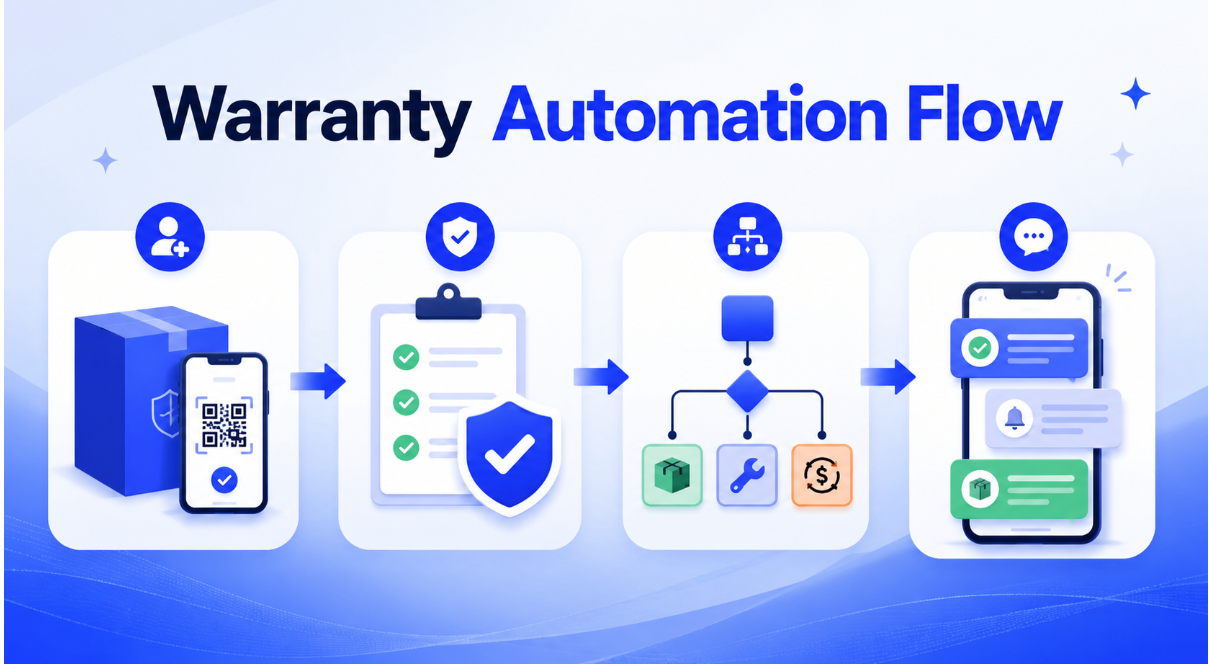
Most merchants think of warranty management as claims processing. It is four connected problems that all need solving together.
Registration is where it starts. A customer buys your product and needs a way to record their ownership. On most Shopify stores, this either does not happen at all or requires the customer to email you. Automated registration gives customers a QR code on the packaging, a post-purchase page, or a brand-hosted URL where they can register in under two minutes. That registration creates a verified ownership record that your team can reference later.
Verification is what makes claims fast. When a customer submits a claim, the app checks the order date, the product, and the serial number on its own. Without verification, your team has to do this manually for every ticket.
Claims routing is the operational layer. Approved claims need to trigger the right next step: a replacement order, a repair ticket, a store credit, or a refund. Apps that route this work remove manual decisions from routine cases so your team only touches the edge cases.
Customer communication runs across all three. Buyers should receive a confirmation when they register, an acknowledgement when they submit a claim, and a status update when anything changes. Without automated notifications, customers email support to ask for updates, which stacks ticket volume on top of claims volume.
93% of consumers say they are more likely to buy from brands that offer product warranties or quality guarantees. But the warranty only builds trust if the experience of using it is smooth. An app that automates these four layers is what makes that possible at scale.
Signs your Shopify store needs a warranty management app

Your team handles every claim through email
If your support team copies order numbers out of Shopify, pastes them into a spreadsheet, and replies to warranty requests one at a time, you have hit the ceiling of what manual handling can do cleanly. Brands moving to a dedicated platform can cut the average claim handle time from 5-7 minutes per ticket to under a minute. The math on that change matters at any meaningful volume.
If the only way a buyer can find out whether they are covered is to email your support team, every one of them will email your support team. A self-serve portal removes that category of inbound ticket. Customers check their own status, and your team hears from them only when something needs attention.
You sell through more channels than your Shopify store
A customer who buys from a retail partner, a marketplace, or a distributor is not in your Shopify order history. Without a registration system that works beyond your online store, you have no visibility into who owns your products or whether they qualify for service. This is one of the most common gaps in how physical-product brands run post-purchase operations.
What to look for in a Shopify warranty management app
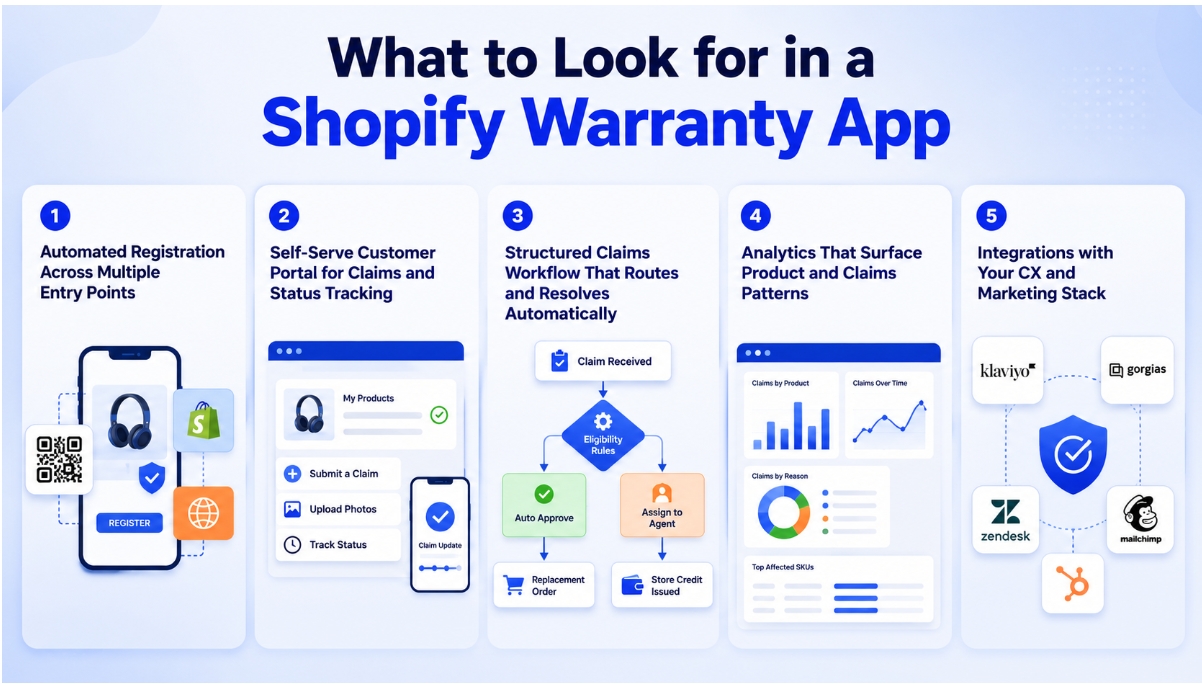
1. Automated registration across multiple entry points
The best apps give customers more than one way to register. QR codes on packaging, post-purchase pages triggered by Shopify checkout, and standalone brand-hosted registration URLs all serve different purchase scenarios. If the only registration path runs through Shopify order data, you will miss every customer who bought offline, through retail, or through a third-party marketplace.
2. A self-serve customer portal for claims and status tracking
Customers need to submit claims, upload photos, and check resolution status without contacting support. Look for a portal that is brandable, mobile-compatible, and linked to your existing order data so customers find their products without entering order numbers manually.
3. Structured claims routing that resolves cases automatically
Manual approval works at low volume. It does not scale. Look for apps that let you set eligibility rules so routine claims approve automatically, assign complex cases to specific team members, and trigger resolution actions like replacement order creation or store credit issuance without someone executing each step. This is the difference between using an app as a tracking tool and using it as an operations layer.
4. Analytics that surface product and claims patterns
Warranty data tells you which SKUs fail most often, which batch had a quality issue, and where resolution times are slowing down. Apps with analytics that connect claim patterns to specific products and time periods give your operations and product teams something they can act on, not a static ticket count.
5. Integrations with your CX and marketing stack
A product registration should be able to trigger a Klaviyo email flow. A warranty claim should be visible in Gorgias or Zendesk alongside the customer’s other support history. If warranty data lives in a silo, it cannot contribute to retention or support operations. For the broader picture of how this connects to retention, see our guide on enhancing the post-purchase experience.
Quick compare: 6 best Shopify warranty apps at a glance
| | | | | |
|---|
| # | App | Best for | Starting price (USD/mo) | Rating | Core lever |
| 1 | Dyrect | Omnichannel registration and full claims automation | Free, paid from $19 | 5.0 | Captures every buyer across channels, not only Shopify orders |
| 2 | Propel Warranty Registration | Small brands needing fast, low-cost setup | Free, paid from $9.95 | 5.0 | Drag-and-drop forms in under an hour |
| 3 | My Product Registration | Growing brands wanting all-in-one at a flat rate | $15 | 4.9 | Unlimited registrations on every plan |
| 4 | Webkul Warranty Management | Budget stores needing basic warranty display | $9 | 4.2 | Lowest cost on the list |
| 5 | AfterShip Returns & Exchanges | High-volume brands managing returns and warranties together | Free, paid from $23 | 4.7 | Returns and warranty in one portal |
| 6 | SeriaLogic | Brands selling serialized products that need unit traceability | From $9.99 | 4.3 | Auto-assigns serial numbers at fulfillment |
1. Dyrect: best for omnichannel registration and full claims automation
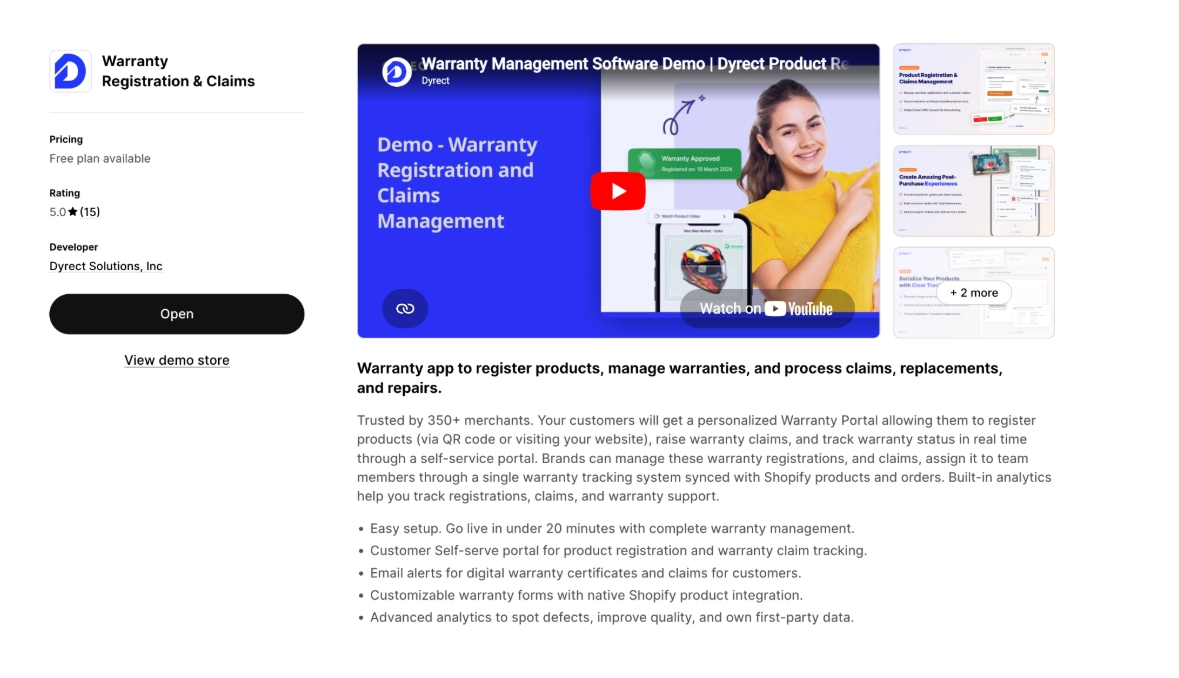
Dyrect is the most complete warranty management app on the Shopify App Store in 2026. It covers product registration, warranty activation, claim submission, team-based routing, repair and replacement flows, serial number tracking, and a customer-facing self-serve portal, all synced with your Shopify products and orders from one dashboard.
What separates Dyrect from every other app on this list is how it handles brands selling beyond Shopify. Most warranty tools are built around Shopify order data, which means they only know about customers who bought directly from your store. Dyrect gives every customer a path to register, regardless of channel. A buyer who picked up your product at a retail partner, a marketplace, or an offline event can scan a QR code on the packaging or visit your brand-hosted page and register in under two minutes. That registration creates a first-party ownership record your team would not otherwise have.
Key features:
- Self-serve warranty portal for registration via QR code, post-purchase page, or brand URL
- Automated claims routing with team assignment and structured resolution flows
- Repair and replacement workflows, including automatic Shopify order creation
- Serial number tracking and validation for unit-level traceability
- Integrations with Gorgias, Zendesk, HubSpot, Klaviyo, Mailchimp, and Zoho Desk
Pricing: Free plan available. Paid plans from $19/month (registration-focused), $49/month (registration plus claims), $149/month (advanced with repair, replacement workflows, and full analytics).
Shopify App Store rating: 5.0.
Pros:
- The broadest feature set in the warranty category on Shopify.
- Omnichannel registration captures buyers from retail, marketplace, and offline channels.
- Analytics connect warranty data to product quality and retention decisions.
Cons:
- More setup than lightweight tools.
- Advanced features like repair workflows and OEM billing sit on higher tiers.
Best for: Mid-sized and larger omnichannel Shopify brands in electronics, home, outdoor, wellness, and appliances. Also strong for fast-growing DTC brands that want to build a post-purchase data and retention layer early.
2. Propel Warranty Registration: best for fast, low-cost setup
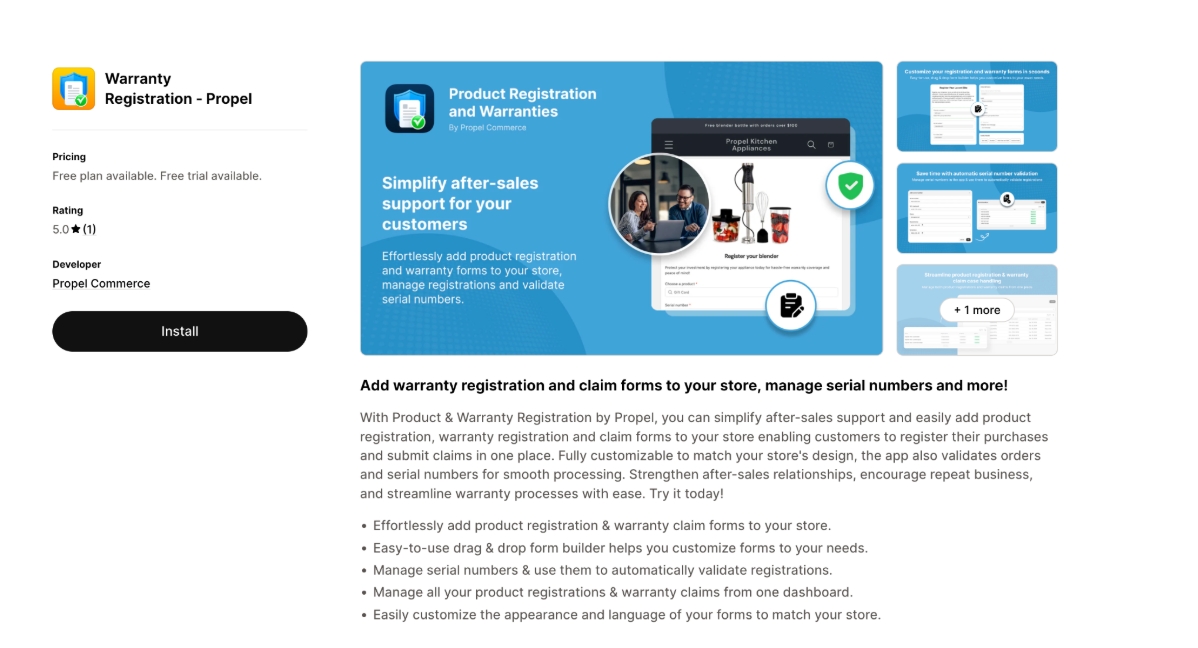
Propel is a clean, focused warranty registration and claims app built by Propel Commerce. It gives small to mid-sized Shopify brands a fast path to structured warranty management without a complex setup or a high monthly cost. If your current process is a shared inbox and a spreadsheet, Propel gets you into a proper system in under an hour.
The drag-and-drop form builder is what most merchants notice first. You can create custom registration and claims forms with fields for serial numbers, proof of purchase, defect photos, and any other data your team needs. Serial number validation runs at submission, so duplicate registrations and ineligible claims get caught before they reach your dashboard. Where Propel runs short is depth: no repair or replacement automation, no analytics, and limited CX integrations. For brands at an early stage, that trade-off is fine. For brands growing into higher claims volume, those gaps start to matter.
Key features:
- Drag-and-drop form builder for custom registration and claims forms
- Automatic serial number validation against Shopify order data
- Unlimited registration pages and forms on the Pro plan
- Central dashboard to manage all registrations and claims
- Brand-matching form appearance and language
Pricing: Free plan available. Pro plan: $9.95/month, includes unlimited registrations, unlimited pages, serial validation, warranty claims, and priority support.
Shopify App Store rating: 5.0.
Pros:
- Free plan available.
- Live in under an hour.
- Clean experience for both merchants and customers.
Cons:
- No repair or replacement workflow automation.
- No analytics.
- Limited CX integrations.
Best for: Small to mid-sized Shopify brands that want a fast, affordable registration and claims setup with serial validation.
3. My Product Registration: best all-in-one flat-rate option
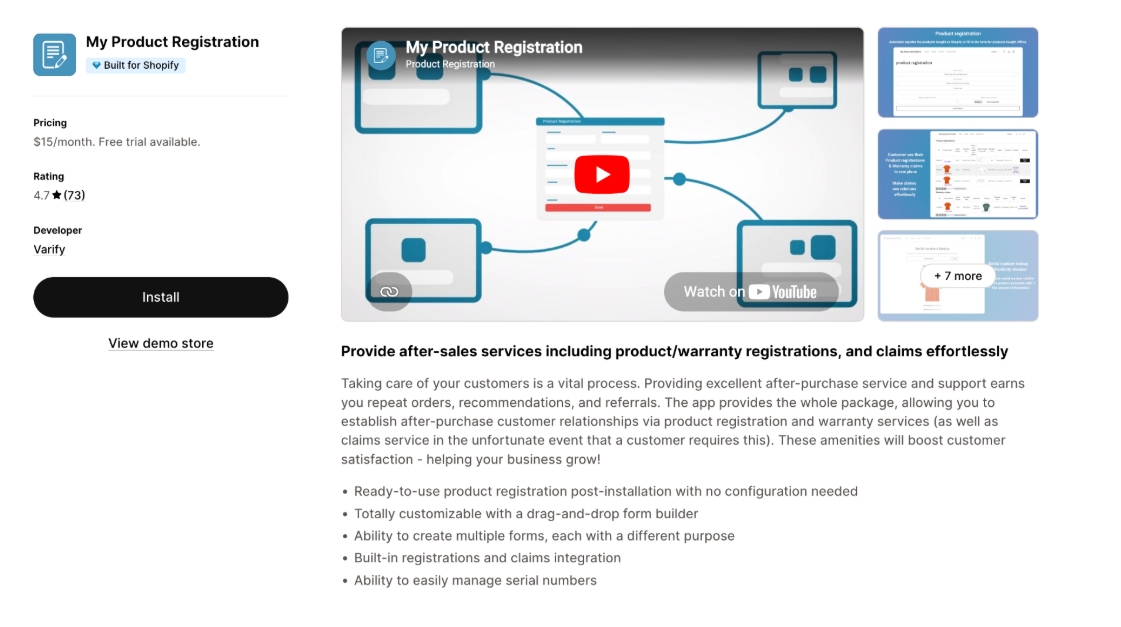
My Product Registration, built by Varify, is one of the most established warranty and registration apps on the Shopify App Store. It has been running since 2017 and carries Shopify’s “Built for Shopify” badge. The appeal is straightforward: unlimited registrations, unlimited registration pages, serial number management, warranty claims, an authenticity checker, and a customer-facing account view for one flat monthly fee.
It supports Shopify POS, which matters for brands that sell in physical locations and want registration to work consistently, whether the buyer purchased online or in-store. Multiple forms can be configured for different product lines, each with its own fields and branding. Where it falls short is on the operational side. Repair workflows, replacement order automation, and CX integrations are either absent or limited. If your claims process involves anything beyond approve-and-respond, you will hit the ceiling fairly quickly.
Key features:
- Unlimited product registrations and warranty registration pages
- Warranty claims management with serial number validation
- Authenticity checker to verify product ownership
- Shopify POS integration for in-store serial assignment
- The customer account section shows all registrations and claim history
Pricing: $15/month. Free trial available.
Shopify App Store rating: 4.9.
Pros:
- One of the most reviewed warranty apps on the Shopify App Store.
- “Built for Shopify” badge confirms platform reliability.
- Flat $15/month with no volume caps.
Cons:
- Limited depth on repair and replacement workflows.
- Fewer CX integrations than Dyrect.
Best for: Growing Shopify brands that want a proven, flat-rate registration and claims system with Shopify POS support and a long track record.
4. Webkul Warranty Management: best for basic warranty display at the lowest cost
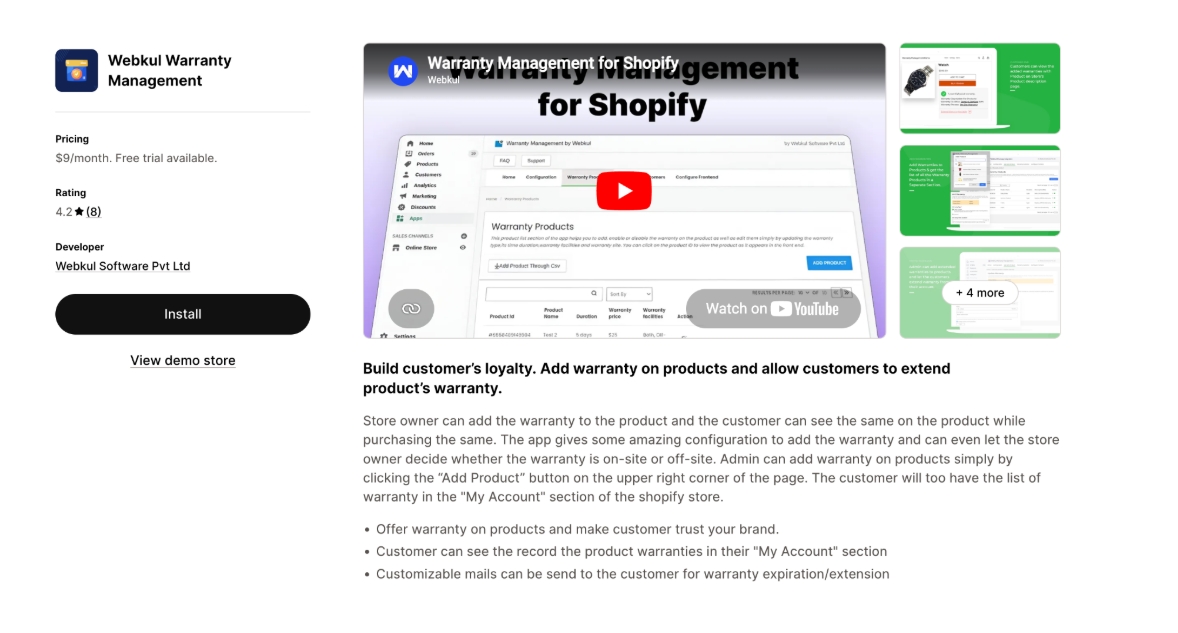
Webkul Warranty Management is a low-cost option for Shopify stores that need to display warranty terms on product pages and give customers a simple warranty record in their account. Merchants can add warranty details to individual products from the Shopify admin, decide whether the warranty is handled on-site or links out to an external service page, and configure email reminders for expiration and extension.
The honest limit is scope. There is no registration portal, no claims submission workflow, no QR code option for offline buyers, and no analytics. If a customer needs to file a claim, they still email your support team. Webkul tells them what they are covered for; it does not give them a way to act on that coverage themselves. For small stores with a handful of SKUs and low claims volume, that trade-off is acceptable. For any brand where warranty claims are a regular part of support, Webkul will not reduce that workload meaningfully.
Key features:
- Add warranty terms to individual products from the Shopify admin
- On-site or off-site warranty handling configuration
- Customer-facing warranty list in the “My Account” section
- Customizable warranty expiration and extension email notifications
- Per-product enable/disable
Pricing: $9/month. 10-day free trial.
Shopify App Store rating: 4.2.
Pros:
- Most affordable option on this list.
- Works with the latest Shopify themes out of the box.
- Simple enough to set up without technical help.
Cons:
- No claims submission or automated workflow.
- No registration portal, QR option, or omnichannel capture.
- No analytics.
Best for: Budget-conscious Shopify stores that need warranty terms displayed on product pages and do not require claims automation or registration flows.
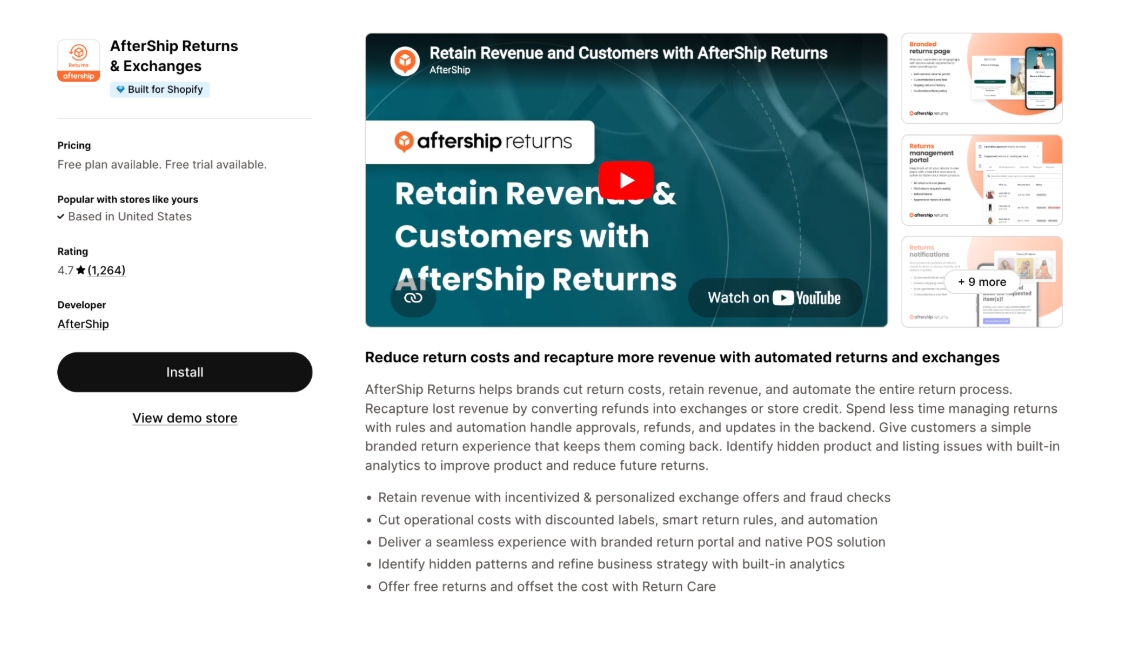
AfterShip Returns & Exchanges is primarily a returns platform that has expanded to include warranty coverage as part of a broader post-purchase suite. It carries the “Built for Shopify” badge and is one of the most widely used post-purchase apps in the Shopify ecosystem.
For brands where returns volume is the main challenge and warranty claims are a secondary need, AfterShip handles both from one dashboard. The platform automates return rules, generates shipping labels, and provides a branded self-serve portal where customers can initiate returns, exchanges, or warranty claims without contacting support. The trade-off is depth on the warranty side specifically. AfterShip is built around returns first. Warranty-specific features like QR-based registration, omnichannel ownership capture, and product quality analytics are absent or lighter than those of dedicated warranty platforms.
Key features:
- Branded self-serve returns and warranty portal
- Automated return rules, routing, and shipping label generation
- Exchange and store credit options to retain revenue on returns
- Integrations with Gorgias, Klaviyo, and 1,200-plus shipping carriers
- Built-in analytics for return patterns and product issue tracking
Pricing: Free plan (3 returns/month). Essentials: $23/month. Pro: $59/month. Premium: $239/month. Additional returns are charged per ticket beyond plan limits.
Shopify App Store rating: 4.7.
Pros:
- Strong returns automation with warranty coverage in one platform.
- Large merchant base and established track record.
- Broad carrier and integration support for global operations.
Cons:
- Warranty features are secondary to returns.
- No QR-based registration or omnichannel ownership capture.
- Pricing scales with return volume.
Best for: Higher-volume Shopify brands where returns processing is the primary challenge and warranty claims are a secondary need.
6. SeriaLogic: best for serial number automation
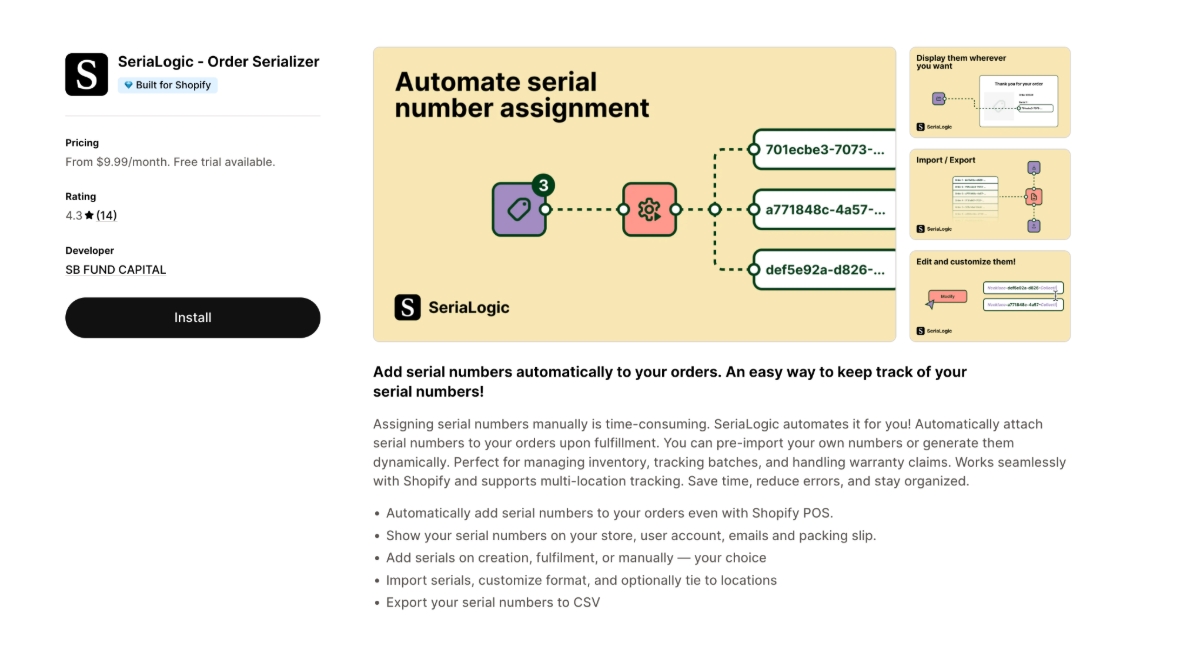
SeriaLogic takes a different approach from every other app on this list. It does not manage registration pages, claims portals, or resolution flows. What it does is solve the prerequisite that makes warranty management possible for serialized products: automatically attaching a unique serial number to every Shopify order at fulfillment.
For brands selling electronics, medical devices, tools, collectibles, or any product where each unit needs a unique identity, serial numbers are the foundation of warranty validation. SeriaLogic pulls from a pre-imported list, generates serials dynamically using configured logic, or applies batch-based rules, then attaches the assigned serial to the order confirmation and customer-facing emails so there is no ambiguity about which unit the customer owns. It works best as one layer in a two-app stack: pair it with Dyrect or My Product Registration, and you get full traceability from fulfillment through registration to claim validation without either app being stretched outside its lane.
Key features:
- Automatic serial number assignment to orders at fulfillment
- Import custom serial numbers or generate them dynamically
- Serials are displayed on order confirmation emails and customer-facing records
- Shopify POS support for in-store serial assignment
- Multi-location tracking for brands with multiple fulfillment points
Pricing: Starter: $9.99/month (100 orders). Professional: $24.99/month (500 orders). Scale: $49.99/month (1,000 orders), plus $0.03 per order beyond the limit. 14-day free trial on all plans.
Shopify App Store rating: 4.3.
Pros:
- Solves a specific, important problem cleanly.
- Shopify POS integration covers physical retail sales.
- Pay-as-you-grow pricing on higher plans.
Cons:
- Does not handle registration, claims, or customer portals on its own.
- Small review sample.
Best for: Shopify brands selling serialized products where unit-level traceability is a prerequisite for any warranty workflow, particularly electronics, premium gear, appliances, and medical devices.
How to choose the right warranty management app for your store
The right app depends less on feature lists and more on the specific problem your warranty process needs to solve.
| | |
|---|
| If your store is… | Start with | Why |
| Selling across Shopify, retail, and marketplaces | Dyrect | Only app on the list with omnichannel registration via QR codes and brand-hosted URLs |
| New to structured warranty and wants something live fast | Propel | Free starting point, simple catalog, live in under an hour |
| Wanting unlimited registrations at a flat rate | My Product Registration | Long track record, “Built for Shopify” badge, $15/month with no caps |
| Only displaying warranty terms on product pages | Webkul | Cheapest entry point, no claims process to manage |
| Drowning in returns with a warranty as a secondary need | AfterShip Returns & Exchanges | Returns and warranty in one branded portal |
| Selling serialized products | SeriaLogic (paired with Dyrect or My Product Registration) | Solves the unit-traceability layer that the others assume already exists |
Two-volume signals to factor in. If your claims volume is under 15 per month, a structured email template and a shared inbox still work, and no app’s ROI justifies the cost. If your claims volume is above 100 per month and growing, you need workflow automation and analytics, not a portal alone.
Why stores pick the wrong warranty app (diagnostic framework)
| | |
|---|
| Symptom | Likely cause | Fix |
| Same warranty questions hit support every day | No self-serve portal | Add a claims portal where customers can search themselves |
| Retail buyers never register | Registration runs only through Shopify checkout | Use QR codes and brand-hosted URLs |
| Claims approval is inconsistent across reps | No structured rules | Set eligibility rules in the app |
| Warranty data has no connection to retention | App sits in a silo | Pick a tool with Klaviyo and Gorgias integrations |
| Cannot identify which SKU is failing the most | No analytics layer | Pick a tool that reports the claim rate by product |
If two or more of these match your store, your tooling is the bottleneck, not your team.
When a warranty management app will not solve your problem
Warranty apps work when the policy they are replacing has clear rules. They do not work when the underlying policy is ambiguous. If your team cannot answer “which products are covered, for how long, and under what conditions” with a consistent answer, no app will fix that. It will automate the inconsistency instead.
Three situations where you will not see full value from any app on this list:
- Warranty terms differ across product lines with no documented rules. Apps enforce rules; they cannot create them. Define your coverage terms by category first.
- You sell exclusively through retail with no direct relationship to the buyer. Omnichannel registration helps, but if none of your customers have ever interacted with your brand directly, registration rates will stay low regardless of the tool.
- The claims volume is fewer than 10 to 15 per month. ROI does not materialize at that level. A structured email template and a shared inbox handle it cleanly.
Where Shopify’s warranty management is heading in 2026 and beyond
Three shifts are reshaping how Shopify brands run warranty operations.
First-party data is becoming the primary reason to invest in registration. With third-party tracking less reliable, the post-purchase registration moment is one of the few remaining opportunities to collect verified customer data directly. Brands that connect registration to their CRM or email platform turn that data into measurable retention outcomes.
AI-powered claims triage is starting to appear in more mature platforms. The ability to assess claim images, cross-reference history, and flag suspicious submissions before a human reviews them is moving from enterprise warranty software into the Shopify app category. Brands processing more than 100 claims a month see the biggest lift.
Warranty revenue is starting to get treated like a product line, not a cost. The global extended warranty market is projected to reach $286.4 billion by 2032, growing at an 8.4% CAGR (Allied Market Research). Shopify brands selling electronics, appliances, and durable goods are starting to offer extended plans at checkout as a structured revenue stream. The brands building this capability now will have a head start as the category matures.
Frequently asked questions about Shopify warranty apps
What is a Shopify warranty app?
A Shopify warranty app automates product registration, claims submission, and resolution tracking for physical-product brands. It connects to your Shopify order and product data so customers register ownership, file claims through a self-serve portal, and check status without emailing support. Your team handles exceptions instead of every routine case.
When does a Shopify store need a warranty app?
Most stores need one once claims pass 30 to 50 per month. Below that, a shared inbox and a structured email template handle the volume. Above it, manual lookups, inconsistent approvals, and customer follow-ups create enough drag that an app pays for itself.
Does Shopify have built-in warranty management?
Shopify has no native warranty registration or claims management. Without an app, warranty handling defaults to email, manual order lookups, and spreadsheets. A dedicated app connects to your Shopify data to automate registration and claims verification.
How much does a Shopify warranty app cost?
Pricing ranges from about $9 per month to $149 per month by capability. Webkul and SeriaLogic start near $9. My Product Registration is $15 flat. Dyrect runs from $19 to $149 depending on whether you need claims automation, repair workflows, and analytics. Several apps, including Dyrect and Propel, offer a free starting tier.
Can a customer claim warranty on a product bought from a retail store?
Yes, if your app captures ownership beyond Shopify checkout. Most Shopify-only tools cannot, because the sale is not in your order history. Apps with QR-code registration on packaging and brand-hosted URLs let a retail or marketplace buyer register in under two minutes, creating a verified ownership record.
How does Zipchat fit alongside a warranty app?
Zipchat runs one AI agent across website chat, WhatsApp, Instagram, Messenger, and email on a single knowledge base, in any language. Connected to your order data, it answers “is my product still covered?” and points buyers to the right registration or claims flow, so warranty questions resolve in chat instead of becoming tickets. Zipchat customers see up to 97% deflection and a +37.8% average conversion lift. Start a Zipchat trial.
Conclusion
For most Shopify brands in 2026, the highest-impact warranty stack starts with Dyrect for omnichannel registration and full claims automation. Brands at the smaller end can launch with Propel or My Product Registration and upgrade as claims volume grows.
If you want to see how warranty connects to the broader post-purchase moment, start a Zipchat trial and connect AI chat to your order data so customers can check warranty status, file claims, and get answers without ever opening a support ticket.
FAQs
What is the best Shopify app to automate warranty management in 2026?
Dyrect is the most complete option for brands that need registration, claims, analytics, and CX integrations working together. Propel is the best entry point for smaller brands wanting a fast, low-cost setup. My Product Registration is the strongest flat-rate option with a long track record. The right choice depends on claims volume, product type, and which channels you sell through.
Can Shopify handle warranty registration automatically without a third-party app?
Shopify does not include native warranty registration or claims management. Without an app, warranty management defaults to email, manual order lookups, and spreadsheets. Apps like Dyrect and Propel connect to your Shopify order and product data to automate registration triggers and claims verification.
How much does a Shopify warranty management app cost?
Costs vary by capability. Dyrect and Propel offer free plans. Webkul and SeriaLogic start at $9 to $9.99/month. My Product Registration is $15/month flat. Dyrect’s paid plans run from $19/month to $149/month, depending on whether you need claims automation, repair workflows, and analytics. AfterShip starts at $23/month and scales with return volume.
Do I need a separate app for serial number tracking on Shopify?
Not always. Dyrect, My Product Registration, and Propel all include serial validation as part of their registration and claims workflows. If your primary need is automatic serial assignment to every order at fulfillment, SeriaLogic handles that specifically and can be paired with a registration or claims app.
What if a customer bought my product from a retail store and wants to make a warranty claim?
Most Shopify-only warranty tools cannot handle this because the transaction is not in your order history. Apps like Dyrect address it through QR-based registration on packaging and brand-hosted URLs that work independently of Shopify checkout. The customer scans the code, completes a short form, and your brand has a verified ownership record even when the original sale happened outside your store.
When should a Shopify brand switch from email-based warranty management to a dedicated app?
The breaking point for most brands is around 30 to 50 claims per month. Below that, a shared inbox and a structured email template handle the volume without significant friction. Above it, the combination of inconsistent handling, manual lookup time, and customer follow-ups creates enough drag that an app pays for itself.
Is warranty management worth the investment for small Shopify stores?
It depends on what you sell. If you sell electronics, appliances, outdoor gear, or any product with a meaningful failure rate or a complex coverage policy, yes. If you sell low-cost consumables with no real warranty obligation, the ROI is less clear. The clearest signal is whether warranty questions and claims show up regularly in your support inbox.