AI assistants now answer the shopping question your homepage used to. The store that gets cited in that answer wins the click.
The short version
AI visibility means your Shopify store gets cited when ChatGPT, Perplexity, Gemini, and Google AI Overviews answer a shopping question. You earn it with structured data, an llms.txt file, an open robots.txt for AI crawlers, and fresh lastmod dates. The 10 apps below cover both classic SEO and these newer AI signals.
There is a version of SEO most Shopify merchants still optimize for, and then there is where search actually sits in 2026. The gap between them keeps widening.
Google’s AI Overviews now appear in roughly 13% of all queries (Search Engine Land, AI Overviews now show on 13% of queries, March 2025, https://searchengineland.com/google-ai-overviews-13-percent-queries-453265). ChatGPT has a shopping feature. Perplexity recommends products. Gemini summarizes categories. When a shopper asks an AI assistant which protein powder to buy or which store has the best candle selection, the answer is not a blue link to your homepage. It is a synthesized recommendation pulled from sources the AI has indexed, understood, and judged trustworthy.
Your store either shows up in that answer or it does not. Working with a certified Shopify Partner can help you optimize for both. The work that gets you there differs from the keyword stuffing and backlink chasing that passed for SEO a few years ago.
The apps below cover both sides: the technical SEO fundamentals Google has rewarded for years, and the AI-specific signals now separating stores that get discovered from stores that do not. Where an app is strong at one but weak at the other, we say so.
Why AI visibility matters now: the traffic and conversion data
AI-referred shopping traffic is growing faster than any other acquisition channel, and the visitors convert better. Adobe found AI-referred retail traffic up 4,700% year over year and that AI-referred shoppers convert about 42% better than visitors from traditional search (Adobe Analytics, Online shopping data via generative AI sources, Q1 2026, https://business.adobe.com/resources/holiday-shopping-report.html).
Visibility inside AI answers is not a vanity metric. Cited brands see roughly 35% more organic clicks and 91% more paid clicks than uncited ones, according to BrightEdge research on generative-engine citation (BrightEdge, Generative AI search impact on brand visibility, 2025, https://www.brightedge.com/resources). When an AI engine names your store as a source, that citation pulls qualified, high-intent shoppers who already trust the recommendation.
Store-level citation-rate data does not yet exist as a reliable public benchmark, so treat per-store citation lift as directional, not guaranteed. The mechanism is clear: AI engines cite content they can parse, verify, and trust. The apps below make your store parseable.
The two things worth optimizing for right now
Two distinct optimization targets share one foundation. Both pull from the same well of structured, crawlable, trustworthy content.
Traditional SEO. Google rankings, Core Web Vitals, structured data, meta tags, page speed, backlinks. This still matters, a lot. Stores that abandon it to chase AI search exclusively make a mistake. AI search draws heavily from what already ranks well in traditional search.
Generative Engine Optimization (GEO). Making your content visible to AI-powered tools like ChatGPT, Perplexity, and Google AI Overviews. This involves llms.txt files, thorough structured data, clear product information architecture, and content depth that gives AI systems enough to cite you with confidence.
The best apps on this list do both. A few specialize in one. We tell you which is which.
How AI crawlers actually read your store
AI engines read structured signals before they read your HTML, and they use specific crawlers you can allow or block. Understanding four mechanics tells you what these apps are really configuring under the hood.
Structured data gets read first. Product, Offer, and FAQ schema in JSON-LD give AI systems clean facts (price, availability, ratings, answers) without parsing your page layout. Google’s AI Overviews pull product facts and reviews straight from this markup. Schema is the most reliable way to hand an AI engine citable data.
llms.txt maps your store for AI. An llms.txt file at your root sits in the same family as robots.txt and sitemap.xml. It lists your products, collections, blog posts, and pages in a format AI systems parse when deciding what to cite. It is a proposed standard (llmstxt.org), not yet universally honored, so treat it as a low-cost signal rather than a guarantee.
robots.txt controls which crawlers get in. AI engines run their own crawlers. If your robots.txt blocks them, you remove yourself from their index. Keep it open to the agents you want citing you.
OAI-SearchBot is not GPTBot. OpenAI runs two distinct crawlers. GPTBot collects data for model training. OAI-SearchBot powers ChatGPT’s live search and product citations (OpenAI, OpenAI bots documentation, 2025, https://platform.openai.com/docs/bots). Block GPTBot if you want to opt out of training, but keep OAI-SearchBot allowed or you vanish from ChatGPT shopping results. Treating them as one toggle is the most common AI-visibility mistake.
lastmod freshness is a citation signal. AI engines favor recently updated content. A sitemap with accurate lastmod dates, refreshed when products and pages change, tells crawlers your information is current and worth citing.
The apps
1. Speedboostr – A Shopify Speed & SEO App
Rating: 4.6 / 110+ reviews
Pricing: Free plan available; Startup from $9.99/month
Badge: Built for Shopify
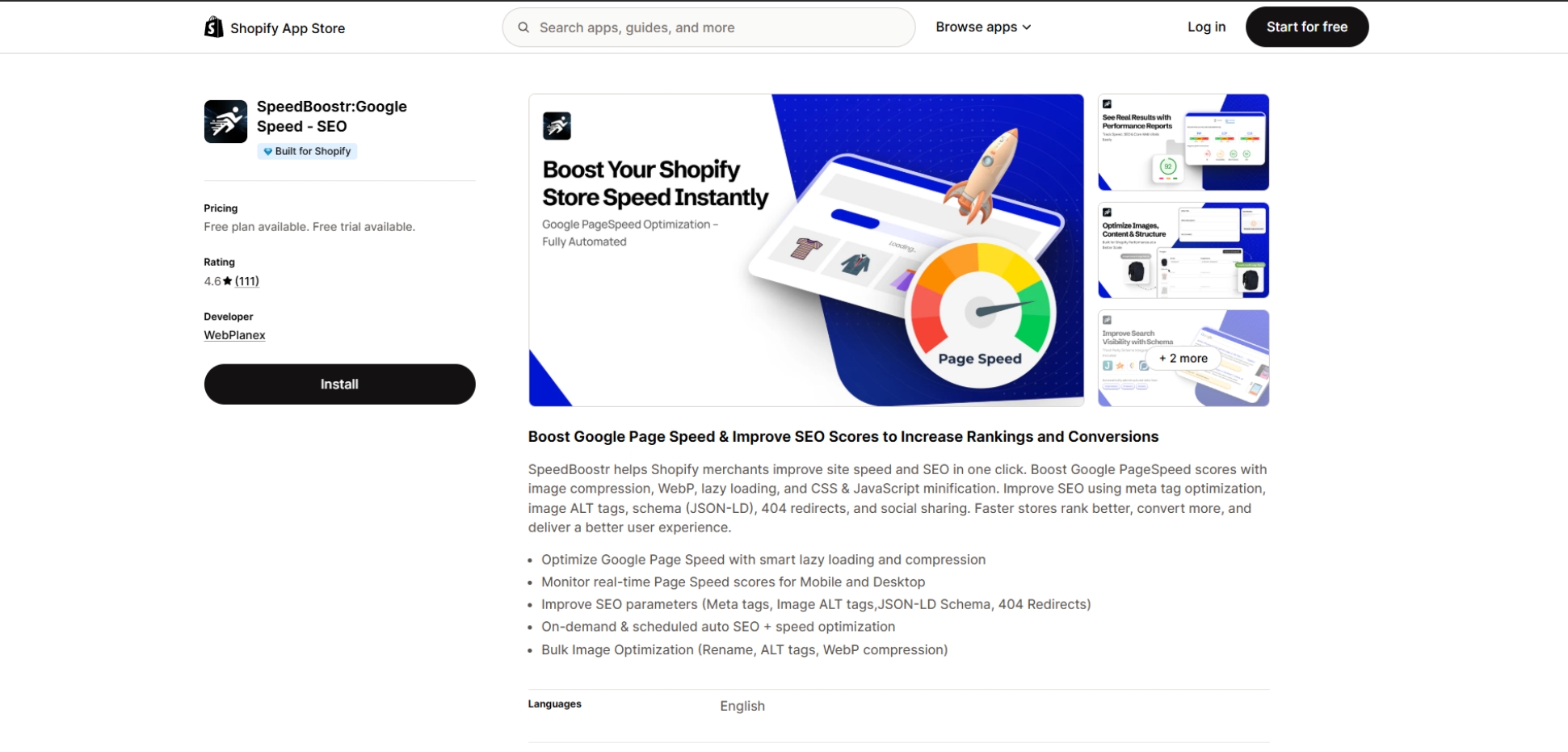
Most speed and SEO apps are separate tools solving separate problems. SpeedBoostr is the rare case where one team built both into one place and got both right.
The speed side is aggressive. CSS and JS compression, third-party app JavaScript lazy loading, image compression with WebP conversion, real-time PageSpeed monitoring across mobile and desktop, and an automated scheduling feature that runs optimizations on a weekly or monthly cadence without you remembering to do it. That last part matters more than it sounds. Stores that ran a speed audit three months after launch and never again are everywhere. Automation keeps performance from quietly decaying as you add apps and products.
The SEO side has expanded fast. Structured data in JSON-LD, automated meta tags and image alt text, 404 redirect management, Search Console integration via OAuth, and, as of March 2026, two features that directly address AI search visibility: an LLMs.txt Generator and an Advanced Robots.txt Manager.
The LLMs.txt feature generates a structured file that maps your products, collections, blog posts, and pages in a format ChatGPT, Gemini, Perplexity, and Claude can parse when deciding what to cite. It updates as your catalog changes, and you control which content types get included. StoreSEO and Tapita offer the same category of feature, but SpeedBoostr pairs it with real performance infrastructure rather than treating it as a standalone checkbox.
The Robots.txt Manager lets you set crawl rules at the user-agent level (Googlebot, AdsBot, AhrefsBot, and AI crawlers) without touching code. For stores with pages they do not want indexed (staging sections, checkout variants, internal search results), that control in a clean dashboard beats developer access.
At $9.99/month for Startup, SpeedBoostr sits in the same bracket as Tapita and Sherpas, with a broader technical footprint than either.
2. Tiny SEO Speed Image Optimizer
Rating: 5.0 / 2,000+ reviews
Pricing: Free plan; paid from $14/month
Badge: Built for Shopify
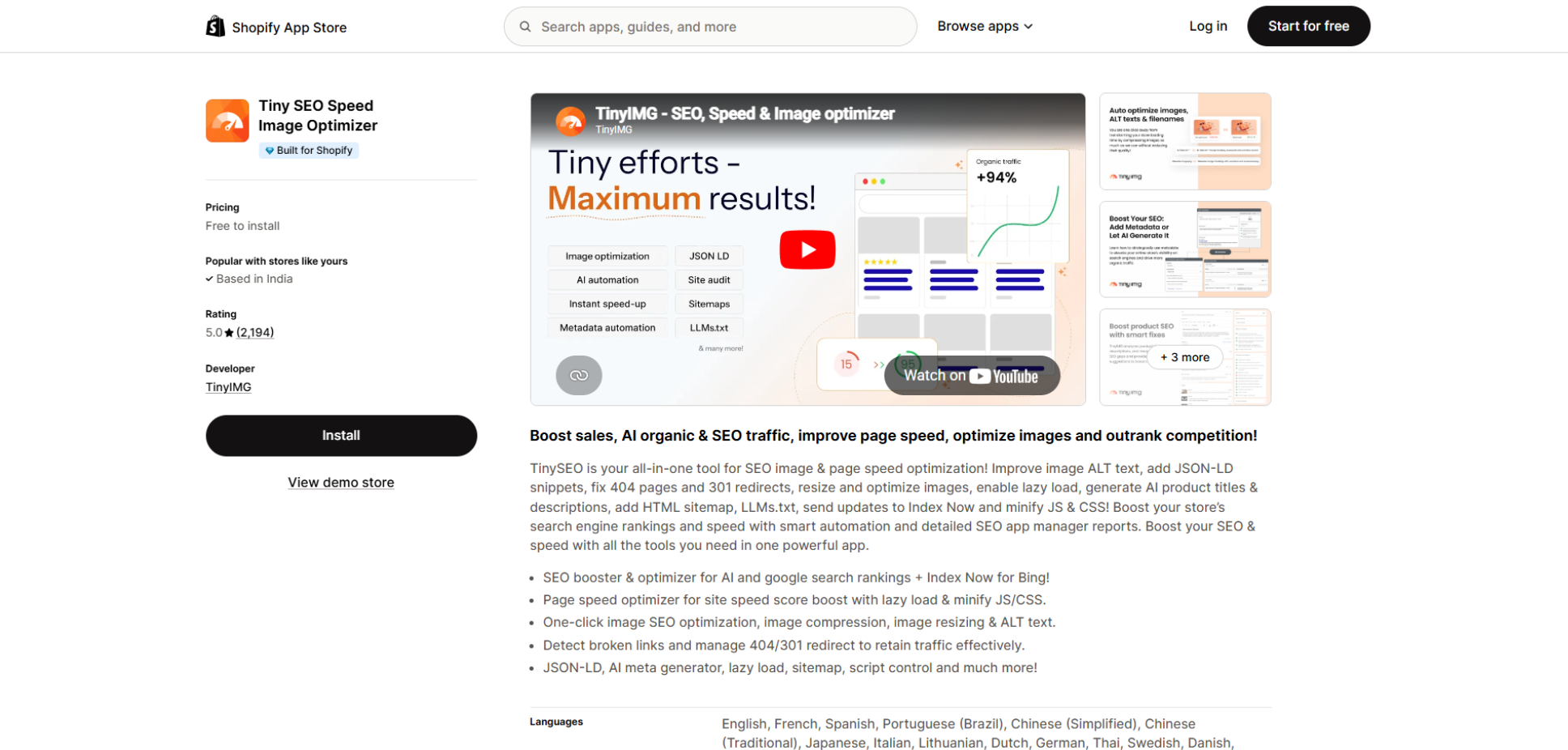
Page speed is the SEO conversation nobody wants to have because the fix is not glamorous. Compressing images is dull. But a store with a 40-point PageSpeed score is a store Google already penalizes, and no keyword work overcomes that drag.
TinyIMG compresses more aggressively than most alternatives. The app reports PNG reduction up to 94% and JPG around 54% without visible quality loss at normal display sizes (TinyIMG, app listing, apps.shopify.com, accessed June 2026). It also handles lazy loading, asset preloading, alt text generation, and filename optimization automatically.
The LLMs.txt generation feature was added recently, giving it double-duty value: image performance plus a baseline of AI search readiness. For stores with hundreds or thousands of product images, the speed gain alone tends to pay for the app within weeks.
3. Booster SEO & Image Optimizer
Rating: 4.8 / 4,000+ reviews
Pricing: Free plan; paid from $39/month
Badge: Built for Shopify
Four thousand reviews across any Shopify app category is a lot. Booster SEO earned that volume by being reliable and not demanding attention. You set it up, and it fixes broken links, compresses images, generates meta tags, and maintains structured data without you revisiting the dashboard weekly.
For owners who do not want SEO to be a project, that is the value. It is not the most advanced app for AI search specifically, but it handles the foundational work well enough that the technical issues that silently hurt rankings stop accumulating.
Automated fixes work much better if you spend time upfront auditing properly instead of installing and walking away. Put in 20 minutes at the start, and you barely touch it afterward.
4. StoreSEO: AI SEO Blog & Image
Rating: 5.0 / 600+ reviews
Pricing: Free plan available; paid from ~$14.99/month
Badge: Built for Shopify
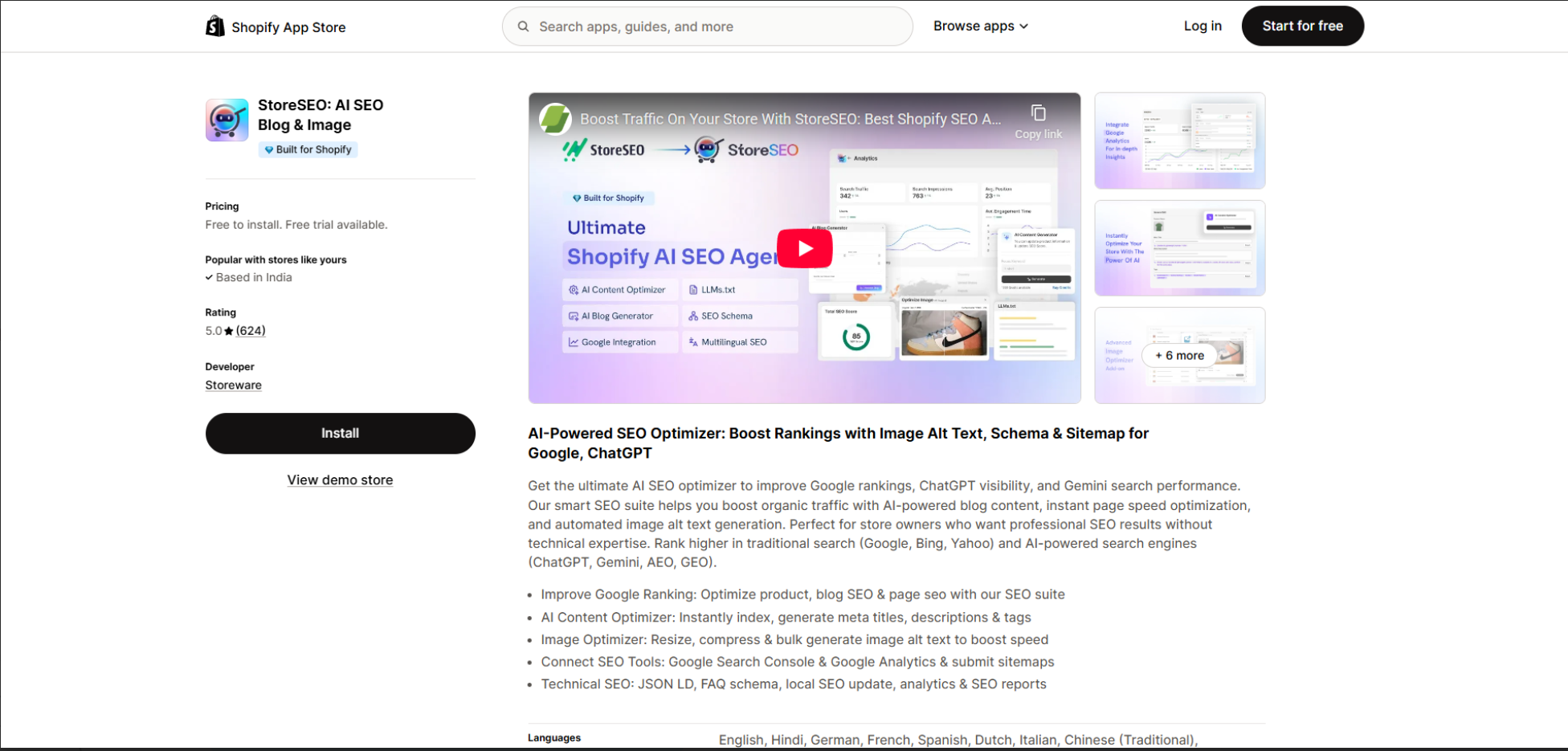
Most Shopify SEO apps are still catching up to where search sits in 2026. StoreSEO is not. What sets it apart is the LLMs.txt generator. It produces a file that explains your store to AI models like ChatGPT, Gemini, Grok, and Claude, so they know what you sell and how to read your site.
The rest is solid rather than groundbreaking. You get Google Search Console integration that turns raw GSC data into clear suggestions, structured data setup, sitemap management, and AI-generated meta tags. Good, but not the star.
What makes it work is the dashboard, which prioritizes what to fix instead of throwing a wall of red flags at you. If you install one SEO app and your concern is performance in AI-driven search (AI Overviews, ChatGPT product recommendations, Perplexity results), this is a strong place to start.
5. SearchPie: SEO, Speed & Schema Best for beginners
Rating: 4.9 / 2,000+ reviews
Pricing: Free plan; paid from $39/month
Badge: Built for Shopify
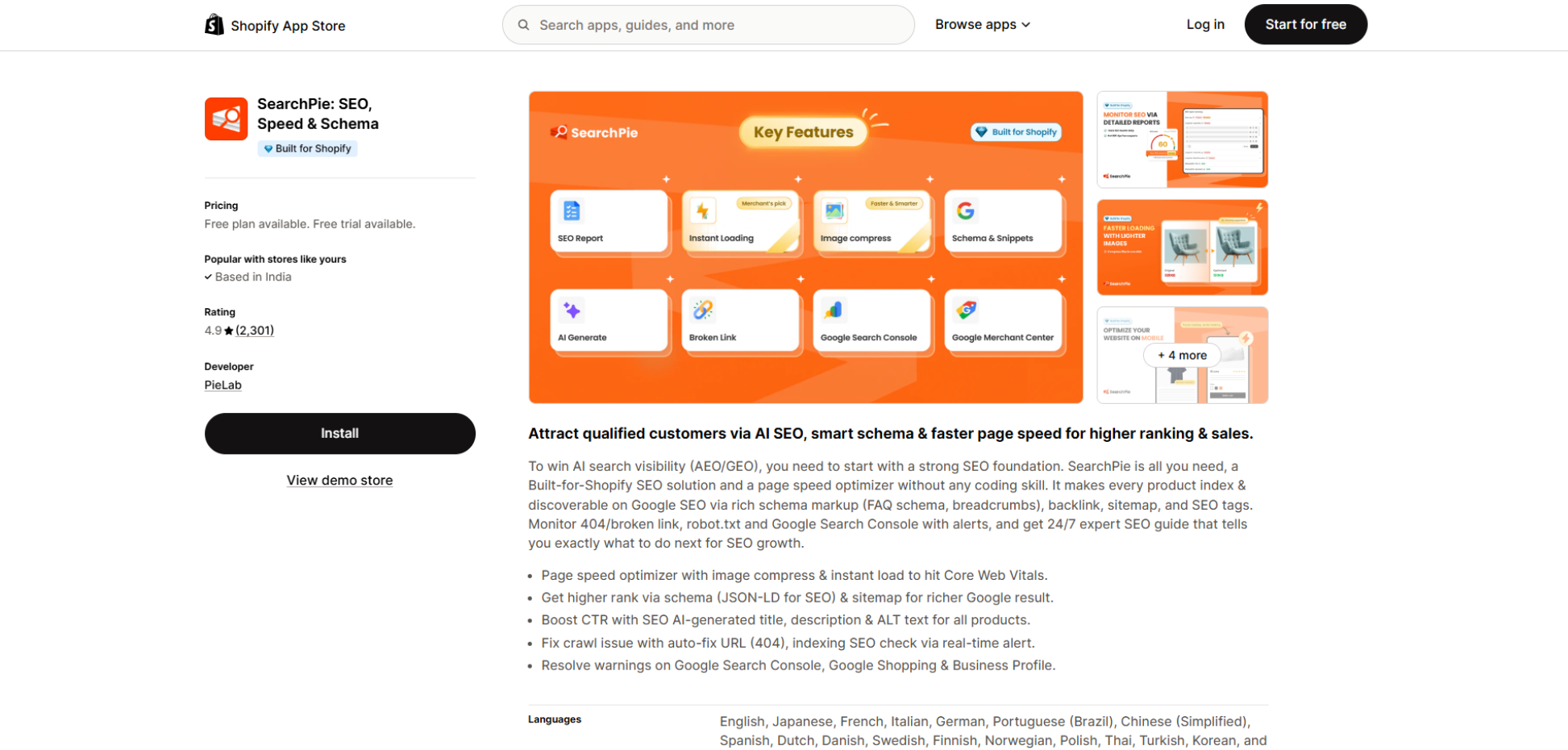
The common complaint about Shopify SEO apps is that they surface many problems with no guidance on which three to fix first. SearchPie avoids that. It walks you through the process step by step, explains each optimization in plain language, and assumes no prior SEO knowledge.
The 24/7 live chat support shows up in almost every positive review, and there are many. For an owner who has never touched SEO and finds the category overwhelming, a real person rather than a help article shortens the learning curve.
The schema and speed features are solid, not exceptional. For a beginner working through SEO systematically for the first time, the guided experience is the real value.
6. Sherpas: Smart SEO
Rating: 4.9 / 900+ reviews
Pricing: Free plan; paid from $14.99/month
Badge: Built for Shopify
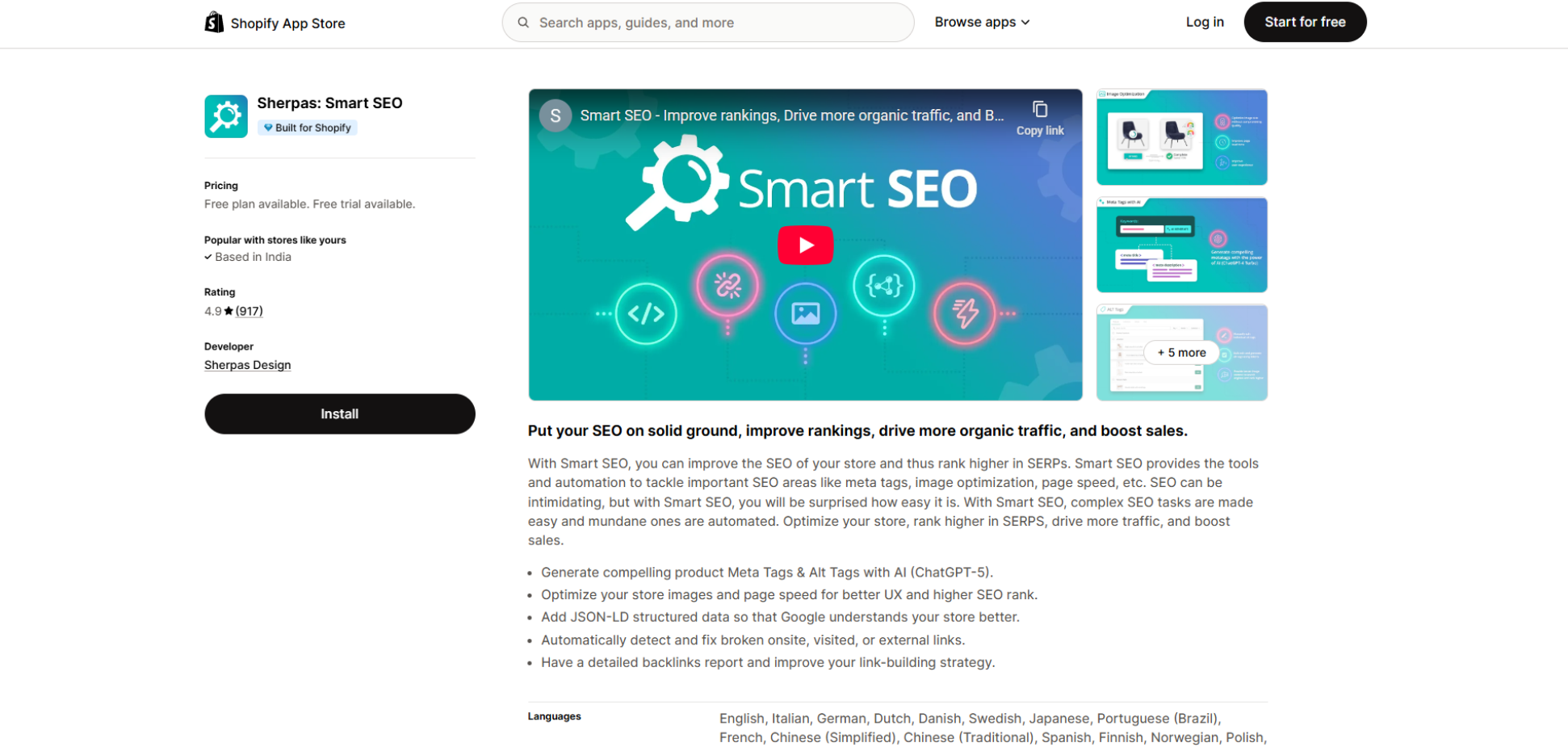
Most SEO apps focus on on-page factors. Sherpas is unusual: it monitors backlinks, the incoming links from other domains that drive a significant ranking signal most Shopify merchants never see.
Beyond backlinks, it handles broken link detection and automatic fixes, image compression with predictive loading, and AI-powered metadata generation. Predictive loading starts fetching pages before the user clicks, which improves perceived load times in high-traffic situations.
At $14.99 for the entry paid tier, it is one of the more affordable full-featured options here. Stores running long enough to accumulate meaningful inbound links get the most from the backlink monitoring.
7. Tapita: AI SEO Optimizer & Speed
Rating: 5.0 / 2,000+ reviews
Pricing: Free plan; paid from $9.99/month
Badge: Built for Shopify
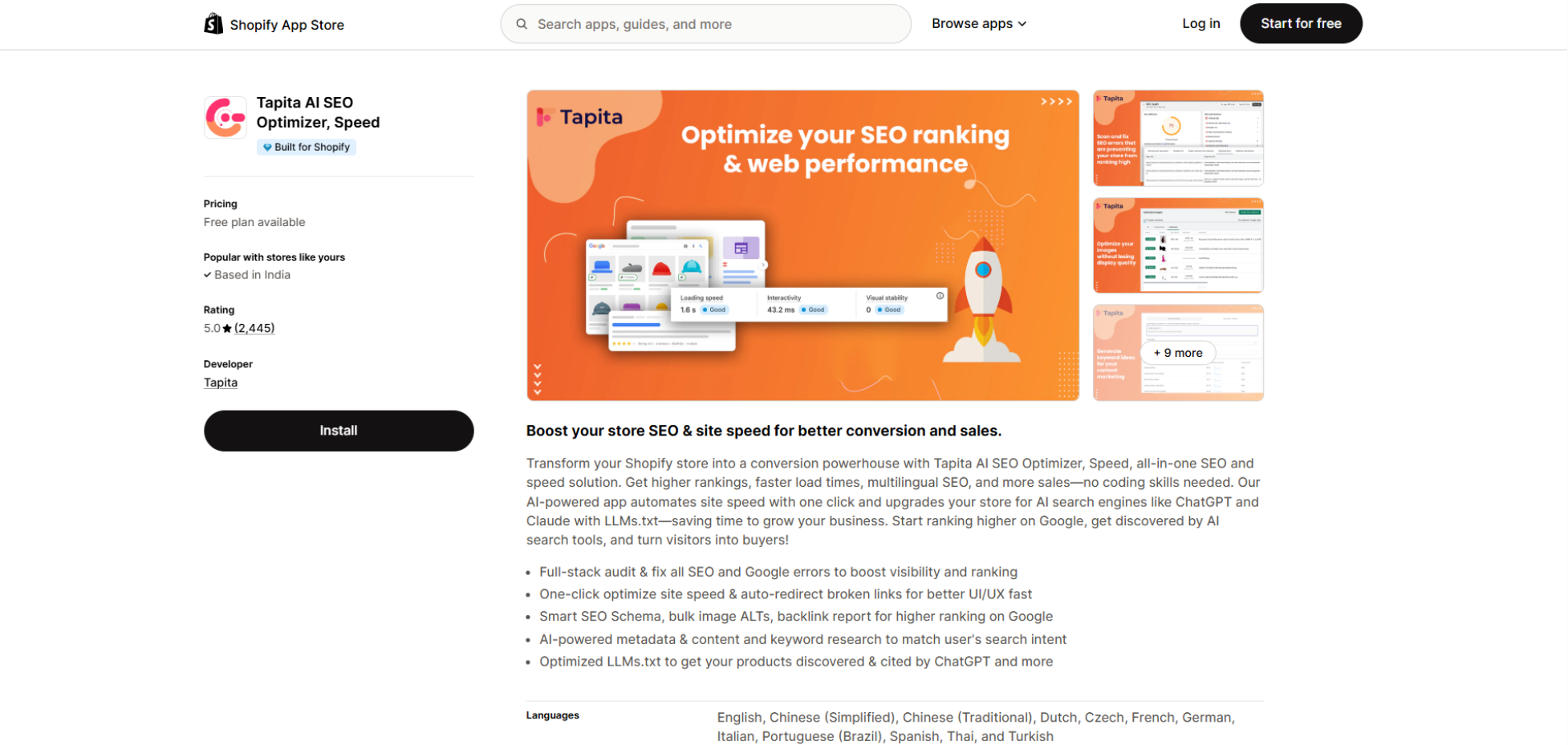
Merchants who launched on tight budgets frequently name Tapita as the app that made the most difference per dollar. The free plan is genuinely functional, not the stripped-down “try it for five minutes” version some apps ship. The paid entry tier at $9.99 unlocks bulk optimization, where the real time savings start.
The package: SEO audit, keyword research, structured data setup, Google Search Console integration, speed booster, LLMs.txt generation for AI search, and a content optimization tool giving page-by-page suggestions based on what you actually rank for. That is unusually complete at this price.
The honest caveat: Tapita’s interface is denser than most apps in this category. It does not hold your hand the way SearchPie does. If you are comfortable with SEO concepts and need a tool to execute them efficiently, that density is a feature.
8. Yoast SEO
Rating: 4.6 / 100+ reviews
Pricing: $19/month
Badge: Available on Shopify
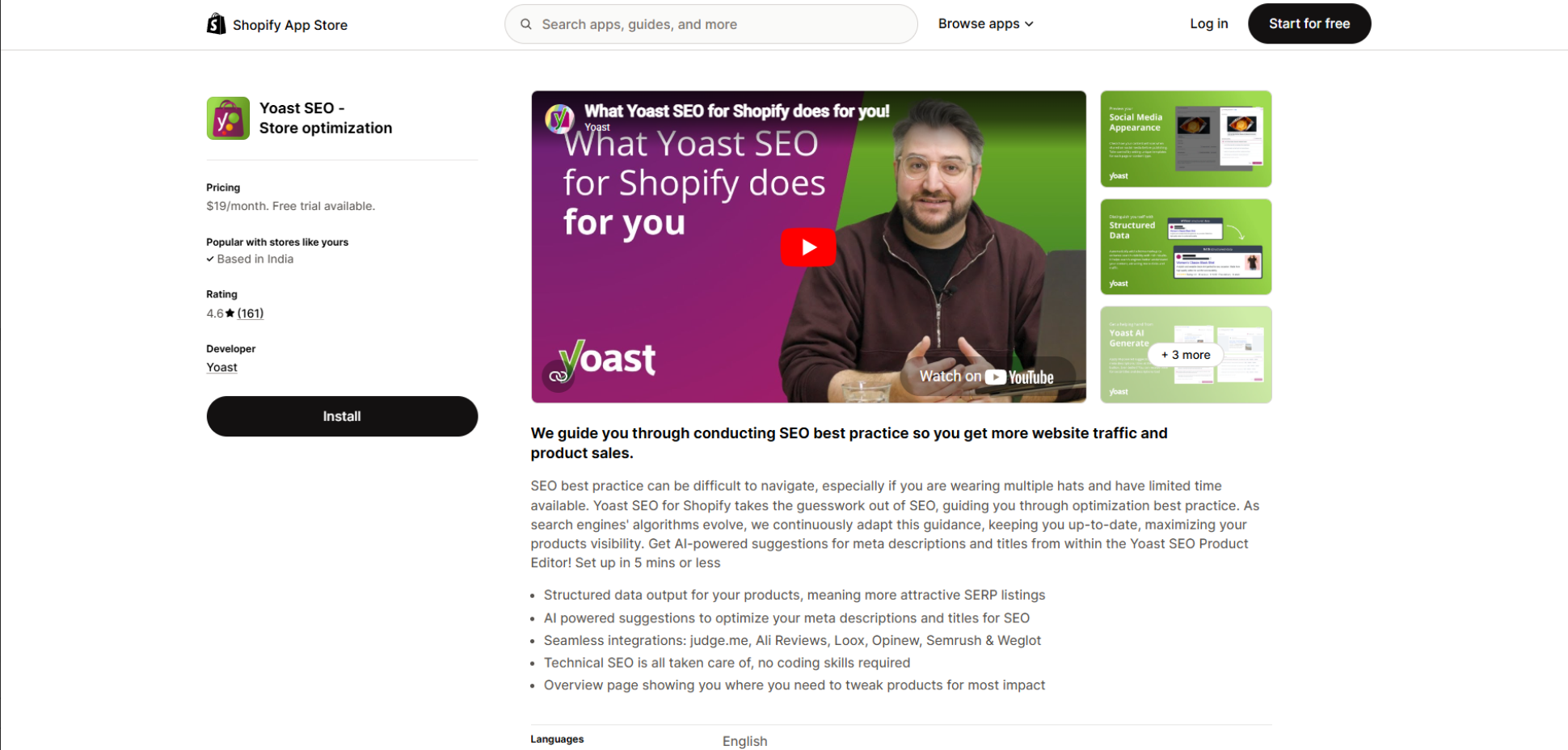
If you have built sites on WordPress, you know Yoast. For more than ten years it has been the go-to SEO plugin in that space. The Shopify version is newer and does not offer everything the WordPress one does, which is worth knowing up front.
What works well on Shopify: it checks how readable your product descriptions and blog posts are, so you write for people as well as Google. It manages meta tags and suggests content structure. If you know the WordPress version, the traffic-light system (red, orange, green) carries over and shows at a glance whether your content hits the mark.
The gap is technical. Yoast for Shopify lacks the depth of structured data, speed optimization, and AI search features that purpose-built Shopify apps offer. It is a content SEO tool, not a technical one, which suits stores producing a lot of editorial content that needs to rank.
9. SEO Instant Indexer
Rating: 4.0 / 15+ reviews
Pricing: Paid from $4.99/month
Badge: Available on Shopify
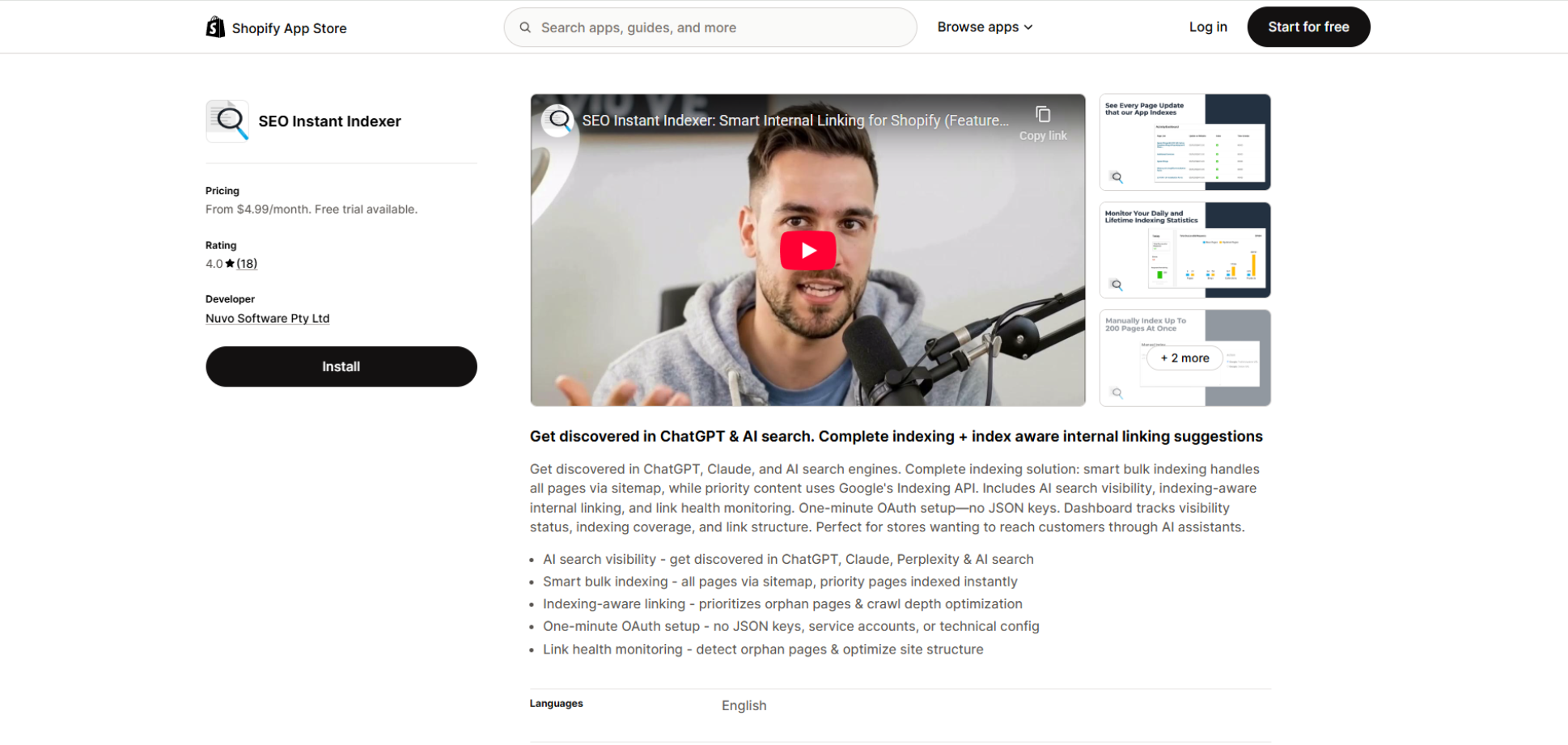
There is an SEO problem nobody talks about enough: pages that exist on your store but have not been indexed yet. New products, new collections, recently migrated content. Google’s crawl schedule does not care about your launch timeline. This app submits pages directly via the Google Indexing API, skipping the wait.
The more recent addition is AI platform indexing, submitting your pages to Bing AI and other AI-powered tools that run indexing pipelines separate from traditional crawlers. You would use it alongside StoreSEO or Tapita rather than instead of them. For stores that launch products regularly and do not want to wait two weeks for Google to find them, it fills a real gap.
10. GP JSON-LD Schema for SEO
Rating: 4.9 / 40+ reviews
Pricing: Free plan; paid from $8.99/month
Badge: Built for Shopify
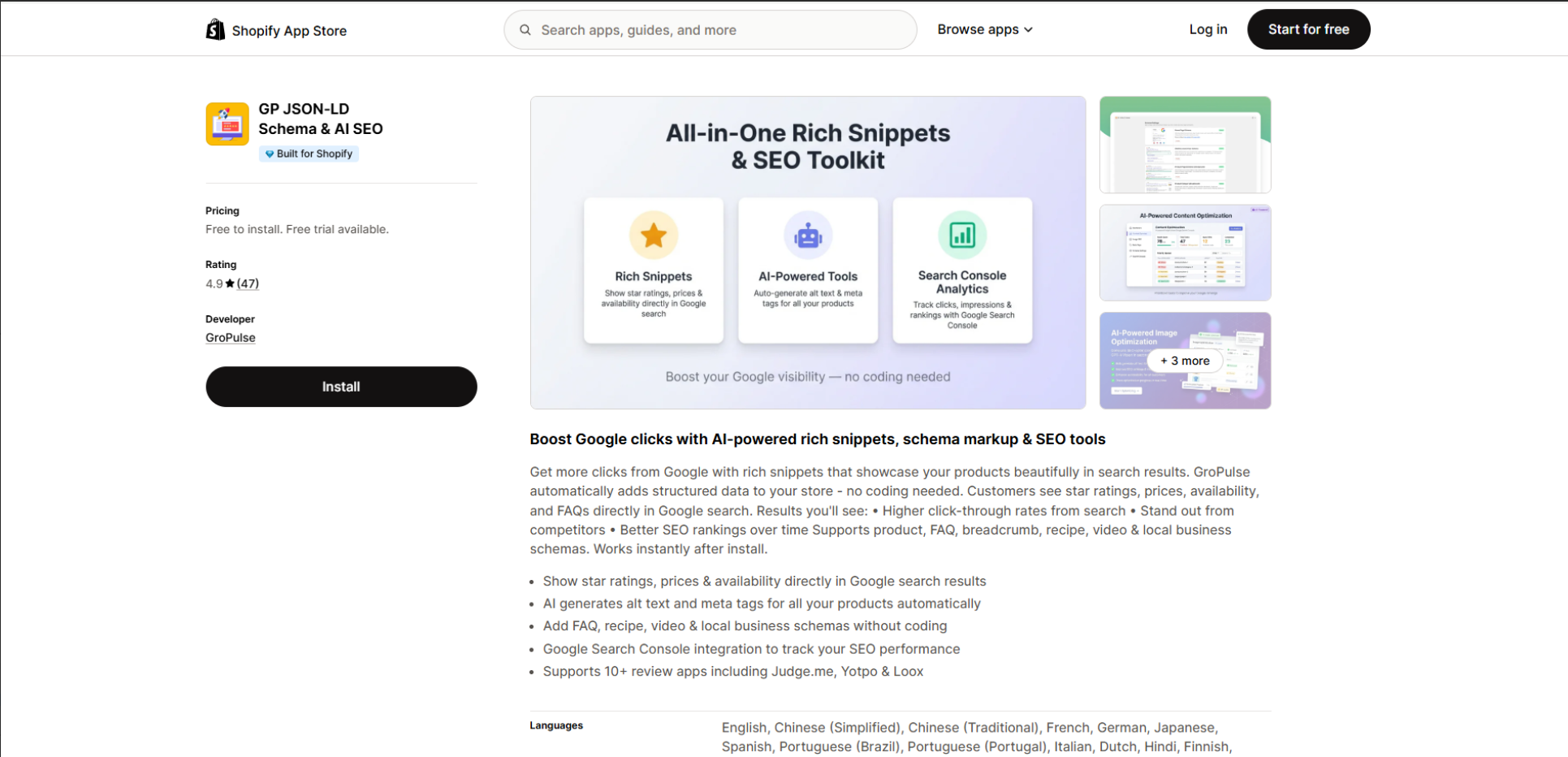
Rich snippets (star ratings, prices, availability) appear when you add structured data markup. That markup lets search engines read the info and show it in results. Most broad SEO apps include a version, but GP JSON-LD does it more thoroughly and with more schema types than any all-in-one tool.
Product, review, breadcrumb, organization, FAQ, article: the schema types cover most of what an ecommerce store realistically needs. This matters for AI search specifically. Google’s AI Overviews and other AI answers use structured data to extract product facts, pricing, and reviews when deciding what to surface.
Setup is code-free. You configure schema types through the dashboard, and the app handles implementation. For stores that tried manual JSON-LD and found it confusing, or developers who want a maintained solution instead of custom code, this is worth the install.
Which apps cover AI visibility vs traditional SEO
Use this table to match an app to the gap you actually have. Most stores need coverage across speed, schema, and the AI signals (llms.txt, robots.txt control, AI indexing), not all from one app.
| App | llms.txt | Structured data | Robots.txt / AI crawler control | AI indexing | Speed | Entry price |
|---|
| Speedboostr | Yes | Yes | Yes (user-agent level) | No | Strong | $9.99/mo |
| Tiny SEO (TinyIMG) | Yes | Partial | No | No | Strong | $14/mo |
| Booster SEO | No | Yes | No | No | Strong | $39/mo |
| StoreSEO | Yes | Yes | No | No | Moderate | ~$14.99/mo |
| SearchPie | No | Yes | No | No | Strong | $39/mo |
| Sherpas | No | Yes | No | No | Moderate | $14.99/mo |
| Tapita | Yes | Yes | No | No | Strong | $9.99/mo |
| Yoast SEO | No | Partial | No | No | No | $19/mo |
| SEO Instant Indexer | No | No | No | Yes (Bing AI) | No | $4.99/mo |
| GP JSON-LD | No | Yes (deep) | No | No | No | $8.99/mo |
Free plans exist on several apps above and are fine to start with; those are third-party apps with their own pricing models.
How many apps do you actually need?
Most stores need two, maybe three SEO apps. App stacks carry real cost: money, page load time, and the overhead of maintaining them.
Run one comprehensive app for meta tags, structured data, and audit reporting. Add one image optimizer if your catalog is large or your PageSpeed score sits below 70. Then optionally a specialist: SEO Instant Indexer for rapid indexing, GP JSON-LD for rich snippet depth, or Sherpas if backlink monitoring matters to you.
Avoid installing five apps that all compress images and generate meta tags. They conflict, and you end up worse off than with one good app and nothing else.
The AI search piece (llms.txt generation, thorough structured data, content AI systems can parse and cite) is harder to bolt on after the fact than image compression. It works better when it is part of how your store is structured early. If you have not started on that side, StoreSEO or Tapita are reasonable places to begin today.
When these apps will not move the needle
Apps configure signals; they do not create the substance AI engines cite. If your underlying content and catalog data are thin, no app fixes that.
| Condition | Why apps stall | What to fix first |
|---|
| Thin product descriptions | No facts for AI to extract or cite | Write specific, attribute-rich product copy |
| robots.txt blocks AI crawlers | App writes signals nothing can read | Open robots.txt to OAI-SearchBot and similar agents |
| No reviews or ratings | Schema has nothing to populate | Collect reviews before adding review schema |
| Stale catalog, old lastmod | Freshness signal works against you | Refresh sitemap lastmod when products change |
| Five overlapping SEO apps | Conflicting markup, slower pages | Consolidate to one or two apps |
Structured data only helps when there is real information behind it. An llms.txt file pointing at empty collection pages gives an AI engine nothing worth citing.
Being answerable on your own surface
AI visibility is fundamentally about being answerable: can a machine read your store, understand what you sell, and return a confident answer. Structured data and llms.txt make your store answerable to external AI engines. The same principle applies to the shoppers already on your site.
Zipchat is an AI sales agent that makes your store answerable on its own surface. It reads your catalog and answers product questions in chat, on the page, in any language, so a shopper deciding between two products gets a confident answer instead of bouncing to ask ChatGPT. Its Agentic AI Search turns vague queries (“something warm for a winter trip”) into specific product recommendations, the same job an AI engine does externally, run on your domain where the sale happens.
The connection to AI visibility runs both ways. Clear, structured answers on your store (the FAQ content, the product facts, the recommendation logic) are the same material AI engines read when deciding whether to cite you. A store built to answer its own shoppers is a store built to be cited.
Zipchat works across website chat, WhatsApp, Instagram, Messenger, and email, with first-party results of a +37.8% conversion lift and 16.3% chat-to-conversion. Pricing starts from $64/month, billed annually (Starter) with a 7-day trial and a 30-day money-back guarantee. It is a native Shopify app, so setup connects your catalog in under 30 minutes.
Stores using Zipchat report a +37.8% conversion lift. See how the AI sales agent answers, recommends, and recovers carts across every channel.
Where AI visibility is heading in 2026 and beyond
Shopping is moving from “search and click” to “ask and get cited recommendations,” and the citation layer is becoming the new shelf. The 13% of queries with AI Overviews today is a floor, not a ceiling, and AI-referred retail traffic up 4,700% year over year signals where buyer behavior is heading (Adobe Analytics, Q1 2026).
Three shifts to plan for. First, agentic commerce: AI agents that complete purchases on a shopper’s behalf will read structured product and offer data directly, making clean schema a transaction requirement, not just a visibility nice-to-have. Second, crawler fragmentation: more engines will run distinct search and training bots, so granular robots.txt control (the OAI-SearchBot vs GPTBot distinction) becomes standard hygiene. Third, freshness as ranking: lastmod accuracy and llms.txt adoption will weigh more heavily as engines compete to cite current information.
The stores that win are the answerable ones, on external AI surfaces and on their own. Build the structured foundation now, keep it fresh, and make sure every surface a shopper or a crawler touches can return a confident answer.
FAQ
What does AI visibility mean for a Shopify store?
AI visibility is how easily your store gets surfaced and cited in AI-driven results: AI search engines, voice assistants, and tools that summarize or recommend products. When your content is clear, structured with schema, and crawlable by AI agents, systems like ChatGPT and Google AI Overviews can read it and recommend you with confidence.
Can Shopify apps really improve SEO and AI visibility?
Apps help, but they are not magic. They make it easier to handle meta tags, structured data, page speed, image optimization, llms.txt, and crawler rules. Results still depend on real content substance: thorough product descriptions, reviews, and accurate catalog data. An app that writes schema for an empty page gives AI engines nothing to cite.
What is the difference between OAI-SearchBot and GPTBot?
GPTBot collects data to train OpenAI models. OAI-SearchBot powers ChatGPT’s live search and product citations. They are separate crawlers with separate robots.txt rules. Block GPTBot to opt out of training, but keep OAI-SearchBot allowed, or your store disappears from ChatGPT shopping recommendations. Treating both as one toggle is a common, costly mistake.
Do I need multiple SEO apps for better results?
Usually two or three, not more. Run one comprehensive app for meta tags, structured data, and audits, one image optimizer if your catalog is large, and optionally a specialist for indexing or schema depth. Too many overlapping apps conflict with each other, slow your site, and leave you worse off than with one good app.
Will these apps guarantee my store gets cited by AI engines?
No app guarantees citation, and reliable per-store citation-rate benchmarks do not yet exist publicly. What the apps do is make your store readable and trustworthy to AI crawlers through structured data, llms.txt, open robots.txt, and fresh lastmod dates. Citation follows readable, substantive content, so these are the prerequisites, not a promise.