TL;DR
Most Shopify stores need one privacy app, not seven. The app’s job is to capture consent before tracking fires, serve the right banner by region (EU under GDPR, US states under CCPA and similar laws), pass consent to Google and Meta, log every choice, and handle data requests.
Shopify’s native settings now cover the basics; an app covers script blocking, US state targeting, audit-grade logs, and DSAR workflows. Quick picks by need are below.
This article is information, not legal advice. Confirm your obligations with a qualified advisor before relying on any setup.
What does a Shopify store actually need for GDPR in 2026?
You need four things working together: consent captured before non-essential cookies and pixels load, a region-aware banner, a way for shoppers to exercise data rights, and records that prove what happened. Shopify gives you a native consent banner and Customer Privacy API as a foundation. A dedicated Shopify GDPR app fills the operational gaps that the native tools leave open.
Best Shopify GDPR apps by use case (2026)
| Use case | Top pick from this list | Starting price | Shopify-native app |
|---|
| Full GDPR + US-state coverage, no developer | Consentmo | Free plan | Yes |
| Most-reviewed CMP, ad-tech certified | Pandectes | Free plan | Yes |
| Fast, simple banner for a small store | Avada | Free plan | Yes |
| Cookie scanning across non-Shopify sites too | Cookiebot | From ~$14/month | No (connector) |
| Familiar CMP already used elsewhere in your stack | CookieYes | Free plan | Yes (newer) |
| Enterprise data governance across many systems | OneTrust | Custom | No |
| Consent plus third-party vendor risk monitoring | Osano | From $199/month | No |
Starting prices reflect each app’s Shopify App Store or vendor listing as of June 2026; verify current rates before installing, since plans change. Full feature-by-feature detail for each tool is in the comparison below.
Running a Shopify store in 2026 means collecting data from everywhere: AI assistants, ad platforms, analytics tools, and email systems. That data powers your growth, but it also comes with legal responsibility.
Privacy laws like GDPR, CCPA/CPRA, and LGPD have moved from policy documents to active enforcement. Regulators now expect more than a banner; they expect proof:
- Documented consent for every data collection touchpoint
- Verified opt-outs that are actually enforced upstream
- Tools that prevent data collection before consent is given, not just after a banner is displayed
There’s one more layer worth noting. AI tools and chat solutions like Zipchat operate on user data, browsing behavior, intent signals, and conversational inputs. When that data is collected without a valid consent framework in place:
- It creates legal exposure under active enforcement regimes.
- It degrades the quality of the inputs feeding your AI tools, making them less reliable over time.
The compliance app category has grown significantly, and not every tool covers the same ground. Below, we break down what separates them and which apps are worth considering in 2026.
What GDPR and CCPA actually require of a Shopify store (plain terms)
Strip away the jargon, and the rules come down to four obligations. They apply the moment you sell to people in a regulated region, even from one store.
1. Consent before tracking (GDPR, EU, and UK). If you reach shoppers in the EU or UK, non-essential cookies and pixels cannot fire until the visitor agrees. Consent must be freely given, specific, informed, and a clear opt-in, and declining must be as easy as accepting (GDPR.eu cookie guide). A visible banner that loads trackers anyway is not valid consent.
2. A real opt-out (CCPA and US state laws). Around 20 US states have comprehensive privacy laws in effect in 2026, led by California (MultiState, 2026). Shoppers can opt out of the sale or sharing of their data, and you must honor browser opt-out signals. From January 1, 2026, California also requires you to show that an opt-out was received and processed (California DOJ, CCPA, 2026).
3. Data subject requests. People can ask to access, correct, delete, or port their data, and withdraw consent. You need a working way to receive and act on these requests, not just a policy that mentions them.
4. Records that prove it. Keep timestamped consent logs and a basic record of what data you process and why. If a regulator asks, the documentation is the difference between a fix and a fine. GDPR penalties reach up to 20 million euros or 4% of global annual turnover, whichever is higher (gdpr-info.eu, accessed June 2026).
Everything else a privacy app does sits on top of these four jobs.
What differentiates compliance apps (beyond a cookie banner)
Most consent tools can display a banner and record a basic opt-in. The real operational differences appear when the stakes increase: multi-region enforcement, audit requirements, and AI-connected data flows. These are the dimensions that matter in practice:
- Rating (Reviews): The overall score and review volume on the Shopify App Store. Volume matters alongside score; a high rating with consistent feedback across many store types typically signals reliability at scale, and whether the tool holds up under real-world conditions, not just demo setups.
- Geo-Targeting (incl. US states): Whether the app serves different consent experiences based on the visitor’s location, at both the country and US state level. A US merchant selling nationwide needs separate handling for:
- California (CCPA/CPRA)
- Virginia (VCDPA)
- Connecticut (CTDPA)
- Other regulated states - not a single blanket banner for the entire country
- Google Consent Mode v2: Required for Google Ads and Analytics to function correctly in regulated regions.
- Without it: declining consent blocks all tracking signals entirely.
- With it: Google receives anonymous aggregate signals that keep attribution and ad performance functioning within legal bounds.
- Script Blocking Before Consent: Whether third-party scripts, analytics, pixels, and chat tools are prevented from loading until the user gives consent. If scripts fire before consent, the banner is cosmetic, and the store isn’t actually compliant.
- Consent Logs: A timestamped record of every consent action taken by visitors, stored in a format that holds up in a regulatory audit. Required under GDPR and expected under most other major frameworks.
- DSAR Pages: Data Subject Access Request pages let users exercise their rights:
- Access
- Deletion
- Correction
- Opt-out
- Under GDPR and CCPA, a functional mechanism for these requests isn’t optional.
- UX Features (e.g., smart banner): Consent tools that aggressively interrupt the shopping session reduce conversion rates. The best apps minimize disruption through:
- Smart scroll-triggered collapsing
- Clean design
- Mobile-aligned layouts that don’t break the storefront experience
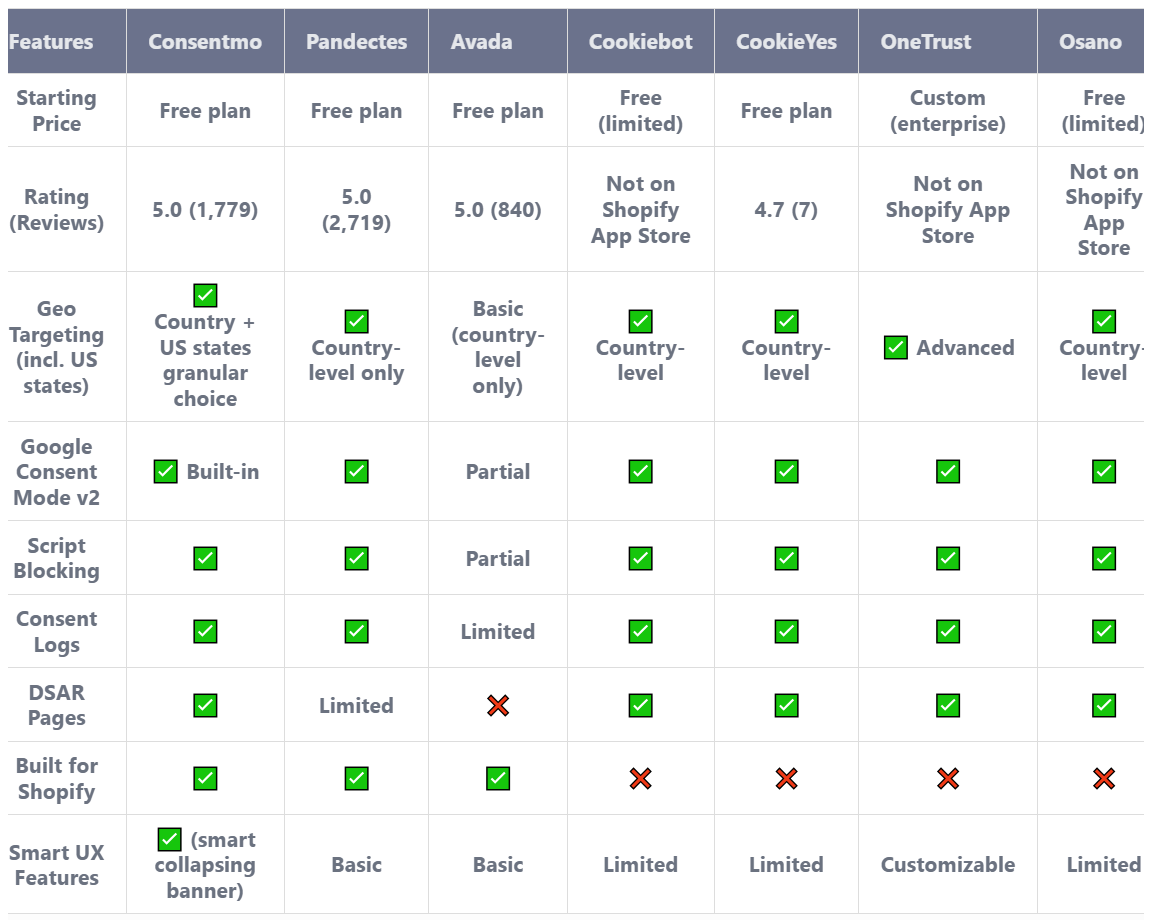
With that lens, here’s how the main options compare.
Built for Shopify
5.0 (1,779 reviews)
Consentmo is built specifically for Shopify and covers the full compliance lifecycle in a single install. Where most compliance apps focus on consent collection, Consentmo extends into DSAR workflows, accessibility standards, and tight integration with major ad and analytics platforms, without requiring any developer work.
Used by merchants operating across the EU, US, and beyond, it’s one of the few Shopify-native tools that handles state-level compliance targeting for regulated US markets alongside its global framework coverage.
What defines Consentmo operationally:
- Geo-targeted banners at the country and US state level: Visitors from the EU see a GDPR-compliant experience; California visitors get CCPA/CPRA handling; other regulated US states receive the appropriate version automatically, with no manual configuration per region.
- Built-in Google Consent Mode v2: Google signals pass correctly when consent is declined, preserving basic attribution and ad platform functionality without data loss.
- Automatic script blocking before consent: Third-party scripts are blocked from loading until consent is collected, making compliance real rather than cosmetic.
- Consent logs stored and audit-ready: Every consent action is timestamped and stored in a format ready for regulatory audits.
- DSAR pages for GDPR, CCPA, LGPD, and more: Visitors can request access, correction, or deletion of their data through a built-in page, meeting the legal requirements across major frameworks.
- Smart collapsing banner: The consent banner reduces to a small widget on scroll, keeping the shopping experience intact while maintaining full compliance.
- Native mobile banner experience: The banner aligns with iOS and Android UI conventions rather than applying a scaled-down desktop layout to mobile screens.
- Integration with Google, Meta, and other tracking tools: Consent signals are passed directly to connected platforms, keeping ad tracking functional within legal limits.
- Multi-language support: Banner content adapts to the visitor’s language for stores serving global audiences.
- Cookie widget for easy consent withdrawal: Visitors can update or withdraw consent at any time through a persistent, accessible widget.
Pricing: Free plan available. Scalable paid plans based on store size and feature requirements.
Pandectes GDPR Compliance
Built for Shopify
5.0 (2,719 reviews)
Pandectes is one of the most widely reviewed compliance apps on the Shopify App Store, with certified status from both Google and Microsoft. It’s a strong option for merchants who want configuration flexibility alongside a compliance track record that has held up across thousands of live stores.
What defines Pandectes operationally:
- Google and Microsoft Certified CMP: Pandectes holds certified status with both platforms, which directly affects how consent signals are validated and forwarded in connected ad accounts.
- IAB TCF v2.3 integration: Supports the industry consent framework required for programmatic advertising environments.
- Geo-targeted banners (country-level): Different consent experiences are served by country. US state-level targeting is not available at a granular level.
- Google Consent Mode v2: Available from the Plus plan ($9/month) and above.
- Cookie scanner: Automatically scans and categorizes cookies with recommendations for proper handling, keeping the inventory accurate as new scripts are added.
- DSAR support (limited): Customer data requests can be managed with email notifications, though the workflow is less comprehensive than dedicated DSAR tools.
- Automated Cookie Policy generation: A policy is generated and updated automatically based on scan results.
- Checkout extensions: The consent banner can appear at Shopify checkout, not just on the main storefront.
- Integration with GTM, GA4, Meta Pixel, TikTok Pixel, and Microsoft UET: Consent signals are forwarded to major tracking platforms.
Pricing: Free plan available. Plus at $9/month, Premium at $29/month, and Enterprise at $49/month.
Avada GDPR Cookies Consent
Built for Shopify
5.0 (840 reviews)
Avada is a popular entry point for Shopify merchants who need basic compliance coverage quickly. Its strength is speed of setup: pre-built templates and minimal configuration get a functional banner live in minutes. For smaller stores with straightforward compliance needs, it provides a reliable starting point.
What defines Avada operationally:
- Pre-built banner templates: Multiple design templates can be applied without custom configuration, making initial setup fast.
- Basic geo-targeting (country-level): Visitors can be served different banner experiences by country. US state-level targeting is not available.
- Partial script blocking: Some script-blocking functionality is included, but coverage is more limited compared to full compliance tools.
- Basic consent tracking: Consent events are recorded, though the depth of logging is less than audit-grade solutions require.
- Lightweight implementation: Designed to have minimal impact on page load performance.
- No built-in DSAR tools: Data subject access requests must be handled outside the app.
- Partial Google Consent Mode v2 support: GCM v2 functionality is available but not fully implemented across all configurations.
Pricing: Free plan available. Paid plans are available for additional features.
Cookiebot
Cookiebot is a well-established consent management platform used across multiple website types, including Shopify. It operates as a platform-agnostic tool rather than a Shopify-native app, which means integration requires custom code or a third-party connector rather than a simple install from the App Store.
What defines Cookiebot operationally:
- Automated cookie scanning and categorization: Cookiebot scans your site and categorizes cookies by purpose, keeping the inventory current as new scripts are introduced.
- Geo-targeted banners (country-level): Different consent experiences can be served by country of origin.
- Google Consent Mode v2 support: GCM v2 signals are supported and passed correctly to Google platforms.
- Consent logs and audit-ready documentation: Detailed consent records are maintained for regulatory review.
- DSAR support: Tools for managing data subject requests are included in the platform.
- Integration with Google Tag Manager: Works through GTM for tracking signal management across platforms.
- Non-native Shopify experience: Setup requires more technical effort than an app install. The tool isn’t built around Shopify’s theme architecture or checkout flow, which can create alignment gaps for Shopify-specific setups.
Pricing: Free for sites under 100 pages. Paid plans start from approximately $14/month.
CookieYes GDPR Cookie Banner
CookieYes is a well-known consent management platform with a large user base across WordPress and other CMS platforms. The Shopify app is newer and carries fewer reviews than established Shopify-native alternatives, but it brings Google certification and a familiar feature set for merchants already using CookieYes elsewhere in their stack.
What defines CookieYes operationally:
- Cookie scanning and categorization: Automated scanning identifies and organizes cookies by category.
- Geo-targeting by region (country-level): Visitors receive different consent experiences based on their country.
- Google Consent Mode v2 support: Google-certified CMP status with GCM v2 integration for compliant signal passing.
- IAB TCF v2.3 support: Compatible with programmatic advertising consent standards.
- Consent logs and reporting: Records of consent events are stored for compliance documentation.
- DSAR tools: Data subject request functionality is included.
- Limited Shopify-native track record: The Shopify app currently has significantly fewer reviews compared to established Shopify-first options, making it harder to assess reliability across different store configurations.
Pricing: Free plan available. Paid plans are available for additional features and higher traffic volumes.
OneTrust
OneTrust is an enterprise-grade compliance platform that covers consent management as part of a broader data governance and privacy operations suite. It’s built for large organizations managing complex compliance requirements across multiple regions, platforms, and business units.
What defines OneTrust operationally:
- Advanced consent management across regions: Highly configurable for complex multi-region setups with granular control over how consent is captured, documented, and enforced.
- Full DSAR and data governance workflows: Sophisticated request management with automation, audit trails, and integrations with internal legal and data systems.
- Consent logs and reporting: Extensive documentation capabilities built for enterprise audit requirements.
- Google Consent Mode v2 support: Integrated with major ad and analytics platforms.
- Deep enterprise integrations: Connects with CRMs, data warehouses, and legal tools beyond typical marketing stack integrations.
- Not a Shopify-native app: Requires custom implementation and typically involves professional services for setup and ongoing management.
- Enterprise pricing and implementation overhead: Licensing costs and setup complexity make it impractical for most Shopify merchants. It’s designed for organizations with dedicated privacy and legal teams.
Pricing: Custom enterprise pricing. Not suited for most Shopify merchants in terms of cost or implementation requirements.
Osano
Osano combines consent management with vendor monitoring and privacy risk visibility. It’s positioned for brands that treat data governance as a core operational concern rather than a minimum compliance requirement.
What defines Osano operationally:
- Consent management and script blocking: Consent is captured, and third-party scripts are prevented from loading until permission is granted.
- Geo-targeted banners (country-level): Visitors are served appropriate consent experiences based on location.
- Consent logs and monitoring: Records of consent activity are maintained and kept current.
- DSAR tools: Data subject request functionality is included in the platform.
- Vendor monitoring and risk insights: Osano tracks the privacy risk profiles of third-party tools connected to your store, flagging potential compliance exposure from individual vendors.
- Not a Shopify-native app: Osano operates as a platform-agnostic tool and requires custom integration with Shopify.
- Limited UX customization: Banner design flexibility is more constrained compared to Shopify-native options.
Pricing: Free plan for personal use. Business plans start from $199/month.
Does Shopify handle privacy compliance for you?
Short answer: no. Shopify provides a basic Customer Privacy API and some built-in privacy policy templates, but it does not:
- Block scripts before consent.
- Manage geo-targeted consent experiences by regulation.
- Produce audit-grade consent logs.
What Shopify includes is a foundation. The operational compliance work is left to you and the apps you install.
This gap creates a real risk. A store running analytics, ad pixels, and AI tools like Zipchat without a functioning consent layer is collecting data from visitors who haven’t agreed to it. Even if a banner is visible, if scripts fire before consent is registered, that consent isn’t legally valid.
A proper compliance app fills this gap:
- It gates data collection behind consent: Nothing fires until permission is granted.
- It routes that consent correctly to connected platforms: Ad tools, analytics, and AI systems receive the right signals.
- It builds the documentation you’d need if a regulator ever asked.
What Shopify handles natively in 2026 (and where an app still wins)
Shopify’s native privacy tools have grown, so the buying decision starts with what you no longer have to install. From your Shopify admin, you can now set consent on a per-region basis, publish a privacy policy, add a cookie banner, and give visitors an opt-out page (Shopify Help Center, accessed June 2026).
What Shopify now covers without a third-party app:
- A native cookie banner shown only in the regions you configure, which passes choices to the Customer Privacy API (Shopify.dev, accessed June 2026).
- Per-region consent settings and an opt-out page for the sale or sharing of data.
- Google Consent Mode v2 wiring, so consent signals reach Google tags for analytics and ads.
- Privacy policy templates and double opt-in for email and SMS marketing.
Where a dedicated Shopify cookie consent app still earns its place:
- Script blocking before consent. Native settings capture consent, but apps like Consentmo and Pandectes actively block third-party scripts until permission is granted, which is what makes the banner more than cosmetic.
- US state-level targeting. Serving the right experience to California versus Virginia versus Connecticut shoppers, rather than one blanket banner, is app territory.
- Audit-grade logs and DSAR workflows. Detailed consent records and built-in data-request pages go beyond the native baseline.
- Accessibility and ad-tech certifications, such as IAB TCF and Google or Microsoft CMP status.
Shopify routes the basics. An app does the operational compliance work around them.
A short Shopify privacy checklist you can act on today
Run through this before you trust your setup. It is a practical starting point, not legal advice.
- Confirm where you sell. EU or UK shoppers trigger GDPR; US shoppers trigger CCPA and similar state laws.
- Turn on a consent banner that blocks non-essential scripts until the visitor agrees, not after.
- Set region rules so EU visitors see opt-in and US visitors get a working opt-out.
- Enable Google Consent Mode v2 so analytics and ads keep functioning within consent limits.
- Add a data-request path for access, correction, and deletion.
- Keep consent logs with timestamps you could hand to a regulator.
- Gate every data tool behind consent, including analytics, pixels, and any AI chat or personalization layer.
If a tool collects shopper data, it belongs behind the consent layer. That includes AI chat for Shopify and any feature that uses chat to collect customer information; both should load only after consent, so the data feeding them stays valid.
How to handle a data subject request on Shopify
A data subject request is a shopper asking to see, correct, or delete the data you hold on them. The clock starts the moment they ask, so you need a path that does not rely on someone spotting an email.
Shopify gives you the basics in admin. Open Customers, select the profile, then More actions > Erase personal data; Shopify processes the erasure and gives you a 10-day window to cancel (Shopify Help Center). Order facts like what sold and when stay in your records, while the name and address are redacted.
What to do when a request comes in
- Verify who is asking. Confirm the request comes from the actual data subject before you act.
- Log the request with a timestamp, so you can prove you responded in time.
- Access, correct, or erase from the customer profile in the Shopify admin.
- Confirm back to the shopper once the request is complete.
Mind the deadlines. GDPR expects a response without undue delay and within one month (gdpr-info.eu, Article 12); CCPA gives you 45 days (California DOJ, CCPA). A compliance app adds a self-serve request page that logs every submission, so nothing slips past the clock.
This is the part most merchants overlook.
AI tools, chatbots, and personalization engines run on user data, behavioral signals, conversation history, and intent patterns. But that data is only legally usable and practically reliable if it was collected with valid consent in place.
Without a working consent layer:
- Chat tools may collect restricted data from visitors in regulated regions.
- Behavioral signals feeding AI personalization become legally questionable.
- Analytics loses reliability because opt-outs aren’t properly enforced upstream.
With a working consent layer in place:
- Data flows to tools only after the user consents.
- AI tools receive inputs that are both legally valid and statistically accurate.
- Tracking and attribution remain intact for users who do consent.
For Zipchat specifically, this matters across the full conversation lifecycle. Visitor intent, browsing behavior, and chat history should be tied to consented interactions, not collected speculatively and cleaned up later. A compliant setup isn’t just a legal safeguard; it makes your AI tools more reliable.
Final consideration
A compliance app isn’t a checkbox. It’s infrastructure for every data-dependent tool your store relies on, AI assistants, ad tracking, analytics, and beyond.
Some tools cover parts of the picture. Tools built outside the Shopify ecosystem require more implementation work for the same outcome, and that gap matters when enforcement is active.
Consentmo stands out for Shopify merchants who want end-to-end coverage without custom development: state-level geo-targeting, native Google Consent Mode v2, automatic script blocking, audit-grade consent logs, and DSAR handling, all inside a Shopify app that installs in minutes.
For stores where data compliance is operationally central, and in 2026, it should be for every store, the right choice covers the full picture from the first install, not just the most visible parts.
FAQ
Which GDPR apps does a Shopify store need in 2026?
Usually one. A single Shopify-native compliance app that captures consent, serves region-aware banners, passes signals to Google and Meta, logs consent, and handles data requests covers most stores. Consentmo and Pandectes both do this with free starting plans; Avada works for smaller stores with simpler needs.
Yes. Shopify now offers a native cookie banner, per-region consent settings, an opt-out page, privacy policy templates, and Google Consent Mode v2 wiring through the Customer Privacy API. It does not block scripts before consent, target individual US states, or produce audit-grade logs and DSAR pages, which is where an app adds value.
What does GDPR actually require of a store?
Four things: get clear opt-in consent before non-essential cookies and pixels load, honor data subject rights such as access and deletion, let shoppers withdraw consent easily, and keep records that prove it. Fines reach up to 20 million euros or 4% of global turnover.
Are there free Shopify compliance options?
Yes. Shopify’s native consent settings are included on every plan. Among apps, Consentmo, Pandectes, Avada, and CookieYes all offer free tiers; paid plans add script blocking, US state targeting, certifications, and advanced DSAR tools.
Do I need geo-targeting for CCPA and US state privacy laws?
If you sell nationwide, yes. Around 20 states have comprehensive privacy laws in 2026, and the right experience differs by state. An app that targets the US state level, not just by country, keeps you compliant without showing one blanket banner to everyone.