Choosing a 3PL in Europe comes down to warehouse placement, VAT and IOSS handling, returns, platform integrations, and a pricing model that scales with your order volume.
TL;DR
A 3PL in Europe stores your inventory in-region and ships orders on your behalf. The right partner cuts delivery times and handles cross-border VAT, including the EUR 150 IOSS threshold for imports. This guide covers what a 3PL is, how to choose one, five providers in depth, the tax rules, and when outsourcing pays off.
What is a 3PL in Europe?
Answer: A third-party logistics provider (3PL) stores your stock, then picks, packs, and ships each order for you, usually handling returns too. In Europe, the complication is fragmentation: you sell across 27 EU member states plus the UK, each with its own carriers, delivery norms, and VAT treatment.
Europe has over 450 million potential e-commerce customers (European Council, 2026), and reaching them means solving that fragmentation. The scale is real. Around 4.6 billion parcels entered the EU from non-EU countries in 2024, roughly 12 million a day, which is the customs and VAT load a European fulfillment setup has to absorb (European Commission, 2025).
Two fulfillment partners may appear similar on the surface, offering the same integrations, automation tools, and delivery promises. Yet beneath that parity often sit very different operating models.
As e-commerce matures, structural choices such as warehouse placement, automation depth, carrier strategy, returns infrastructure, and software architecture increasingly shape the customer experience, influencing everything from delivery reliability to return economics as much as branding or pricing.
Rather than comparing shipping times alone, businesses should examine where inventory intelligence sits, how much operational control remains in-house, how costs evolve as volumes grow, and how easily the logistics model adapts to new markets or sales channels.
The most effective fulfillment strategy is rarely the one with the longest feature list, but the one whose underlying structure mirrors the way a business intends to grow.
What third-party logistics services include
Third-party logistics is the practice of outsourcing storage and order fulfillment to an external specialist. In Europe, that provider becomes your operational backbone across borders.
Core logistics services a 3PL handles
A European 3PL bundles the work that would otherwise sit in-house:
- Receiving and storage. Your stock arrives at their warehouse and is logged into inventory.
- Pick and pack. Each order is picked, packed, and labeled for dispatch.
- Shipping and carrier routing. Orders move through the carrier best suited to the destination.
- Returns processing. In-country returns are received, inspected, and restocked.
- VAT and customs support. IOSS and OSS data flows into your tax returns.
Third-party logistics vs. a freight forwarder
The two are often confused. A freight forwarder moves bulk goods between businesses, ports, and warehouses. Third-party logistics runs the last stage: storing your stock and shipping single orders to your customers.
The strategic importance of e-commerce fulfillment
Today, fulfillment has become a strategic growth lever. The right third-party logistics (3PL) partner combines software, infrastructure, and operational expertise to reshape how brands scale by improving visibility, performance, and cost control rather than simply reducing workload.
First, proximity to customers turns geography into a competitive asset. Positioning inventory closer to demand shortens delivery windows, reduces last-mile costs, and improves conversion by aligning delivery expectations with real-world execution.
Second, automation and data intelligence transform fulfillment into a continuous feedback loop. Integrated platforms surface real-time performance signals, from stock imbalances to delivery exceptions, enabling merchants to respond faster and make smarter commercial decisions.
Third, carrier optimisation introduces solidity into the logistics model. By orchestrating multiple shipping partners instead of relying on a single provider, brands gain flexibility to adjust routes, manage regional disruptions, and balance speed with cost as market conditions shift.
How do I choose a 3PL in Europe?
Answer: Score every provider on six criteria before you look at price. The best 3PL for ecommerce is the one whose structure matches how you plan to grow, not the one with the longest feature list.
- Warehouse locations and coverage. Map their European fulfillment centers against where your orders ship today. One warehouse per demand cluster beats one central hub for both speed and cost. When you weigh regions, two stand out. Germany is Europe’s largest logistics economy (GTAI, 2026). Poland is the fastest-growing warehousing market in Europe (Poland Insight, 2026).
- VAT and IOSS handling. Confirm they support IOSS for imports and OSS for intra-EU sales, and that they produce the data your VAT returns need. This is where most cross-border setups break.
- Returns infrastructure. Ask for in-country returns addresses and a self-service returns portal. Cross-border returns to a single country quietly destroy margin.
- Platform integrations. For Shopify 3PL Europe setups, check for a native app and support for Shopify’s Fulfillment Orders workflow, not a brittle CSV sync.
- Pricing model. You want line items you can forecast: receiving, storage, pick and pack, shipping, and returns. Bundled “all-in” numbers hide how cost scales.
- Carrier mix and cross-border reach. Multiple carriers per country give you routing flexibility when a lane gets slow or expensive.
With these structural advantages in mind, the following five European fulfillment partners stand out not only for their operational capacity, but for how their underlying models shape long-term scalability.
1) Elogy
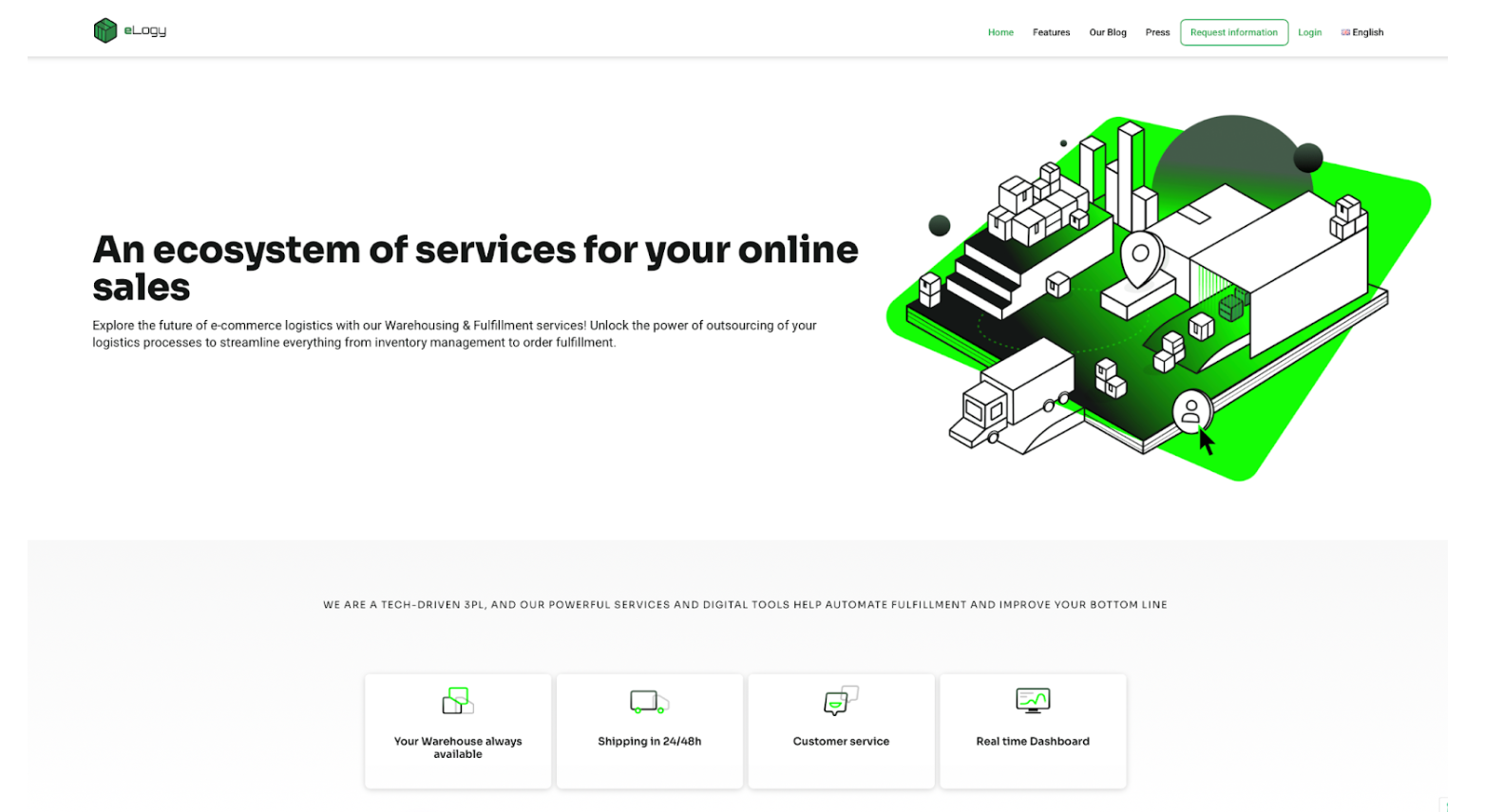
Headquartered in Rome and operating across a growing European network, the company combines physical warehousing with a proprietary digital platform that connects shipping, analytics, customer support, and day-to-day fulfillment workflows. Inventory is positioned near major demand clusters while algorithmic routing tools continuously adjust courier selection and delivery flows based on performance signals.
Core Capabilities
Strategic European Network: Warehouses across Italy, Spain, and Eastern Europe allow brands to shorten delivery distances and navigate regional fragmentation more efficiently. The emphasis is on proximity to demand rather than reliance on a single central hub.
AI-Driven Logistics: Through its SmartShip™ layer, courier selection is dynamically adjusted according to destination, parcel characteristics, and carrier reliability trends. Predictive inventory monitoring tracks sales velocity to reduce stock imbalances before they disrupt fulfilment.
Integrated Sales and Customer Operations: Beyond logistics, the platform incorporates customer-care workflows, including call-centre tooling, messaging channels such as WhatsApp, and automated retention mechanisms, extending fulfillment into the broader post-purchase experience.
Cash-On-Delivery Infrastructure: Native COD management, with tracking and reconciliation built into the system, reflects a strategic focus on Southern and Eastern European markets where alternative payment preferences remain significant.
Flexible Deployment Models: Brands can adopt Elogy as a fully outsourced logistics partner or layer its software and carrier orchestration onto existing warehouse operations, positioning it as both infrastructure and operational interface.
Elogy’s strength lies in its ecosystem approach, which reflects the growing importance of integrated logistics management in modern e-commerce. By aligning physical infrastructure with advanced software, this logistics partner allows brands to move beyond isolated fulfillment tasks and instead manage inventory, delivery performance, and post-purchase interactions as interconnected drivers of growth. The result is clearer operational insight, stronger delivery performance, and a more cohesive link between logistics execution and long-term strategic planning.
The model appears particularly aligned with:
- Direct-to-consumer brands expanding across multiple European markets.
- Omnichannel or dropshipping operations seeking centralised control.
- Merchants targeting emerging Southern and Eastern markets, where logistics complexity and payment preferences require specialised workflows.
2) Byrd
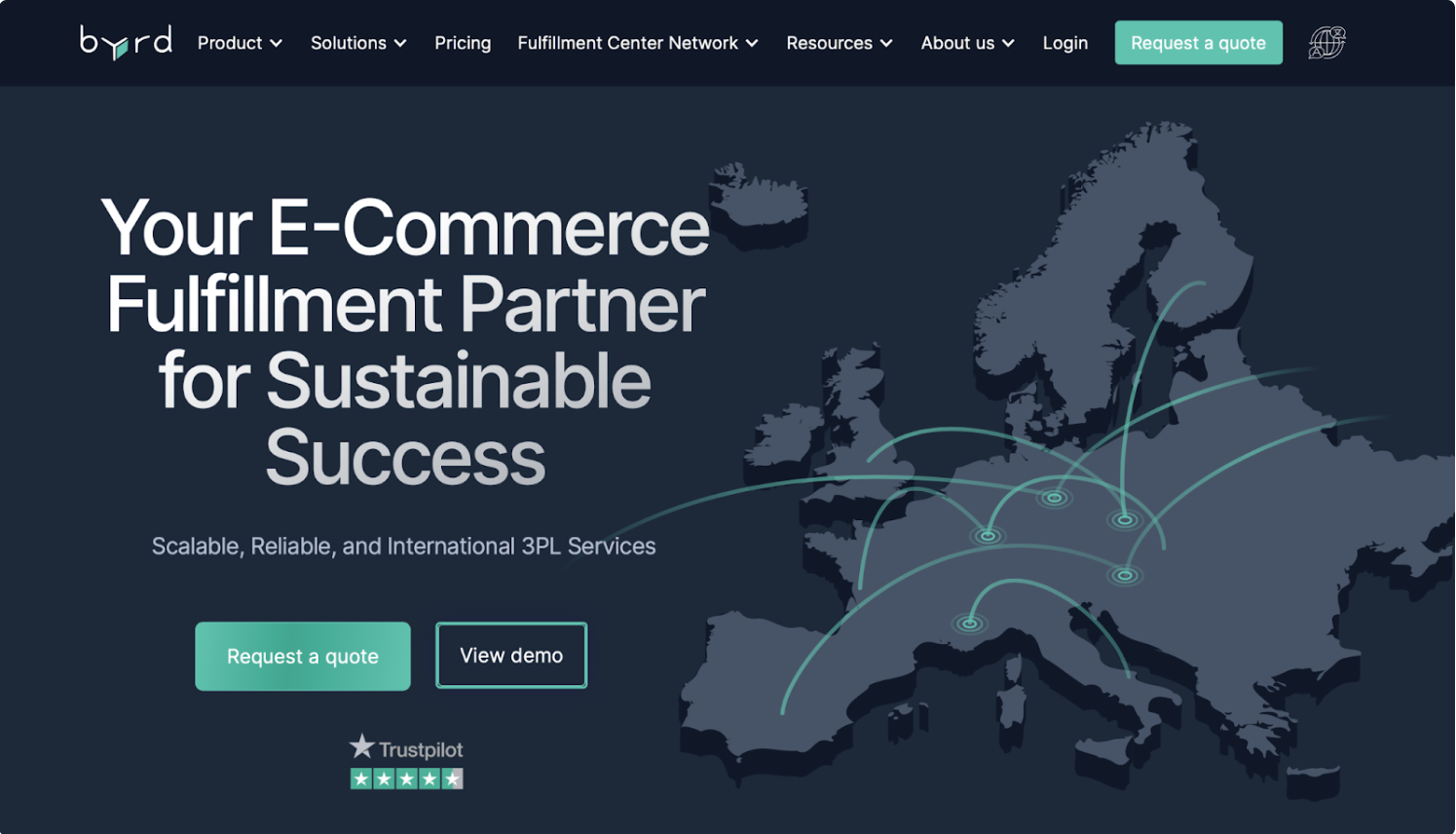
Byrd is a tech-enabled e-commerce fulfillment partner and third-party logistics (3PL) provider that specializes in helping businesses scale across the UK and Europe. It provides a scalable and tech-enabled solution designed to help retailers of all sizes, from startups to large enterprises, manage their logistics with less effort.
Core Capabilities
Pan-European Warehouse Network: Fulfillment centres across Germany, France, Austria, the UK, and other regions allow inventory distribution close to key markets.
Cloud-Based Logistics Dashboard: The “Click & Ship” platform centralises inventory management, order tracking, and fulfillment workflows with seamless integrations to Shopify, Amazon, WooCommerce, and other systems.
Brand-Focused Experience: Custom packaging options and self-service returns portals help maintain brand identity and improve customer satisfaction.
Byrd’s primary advantage is scalability. Its distributed network enables brands to test new European markets quickly, making it particularly relevant for cross-border growth strategies.
The model appears particularly aligned with:
- Brands seeking presence in Western and Central Europe.
- D2C brands that want to maintain a premium unboxing experience through custom branded packaging, inserts, and flexible branding elements.
- Suited for a wide range of company sizes and sectors, including Baby Products, Beauty, Electronics, Pet Supplies, and Jewelry.
3) Active Ants
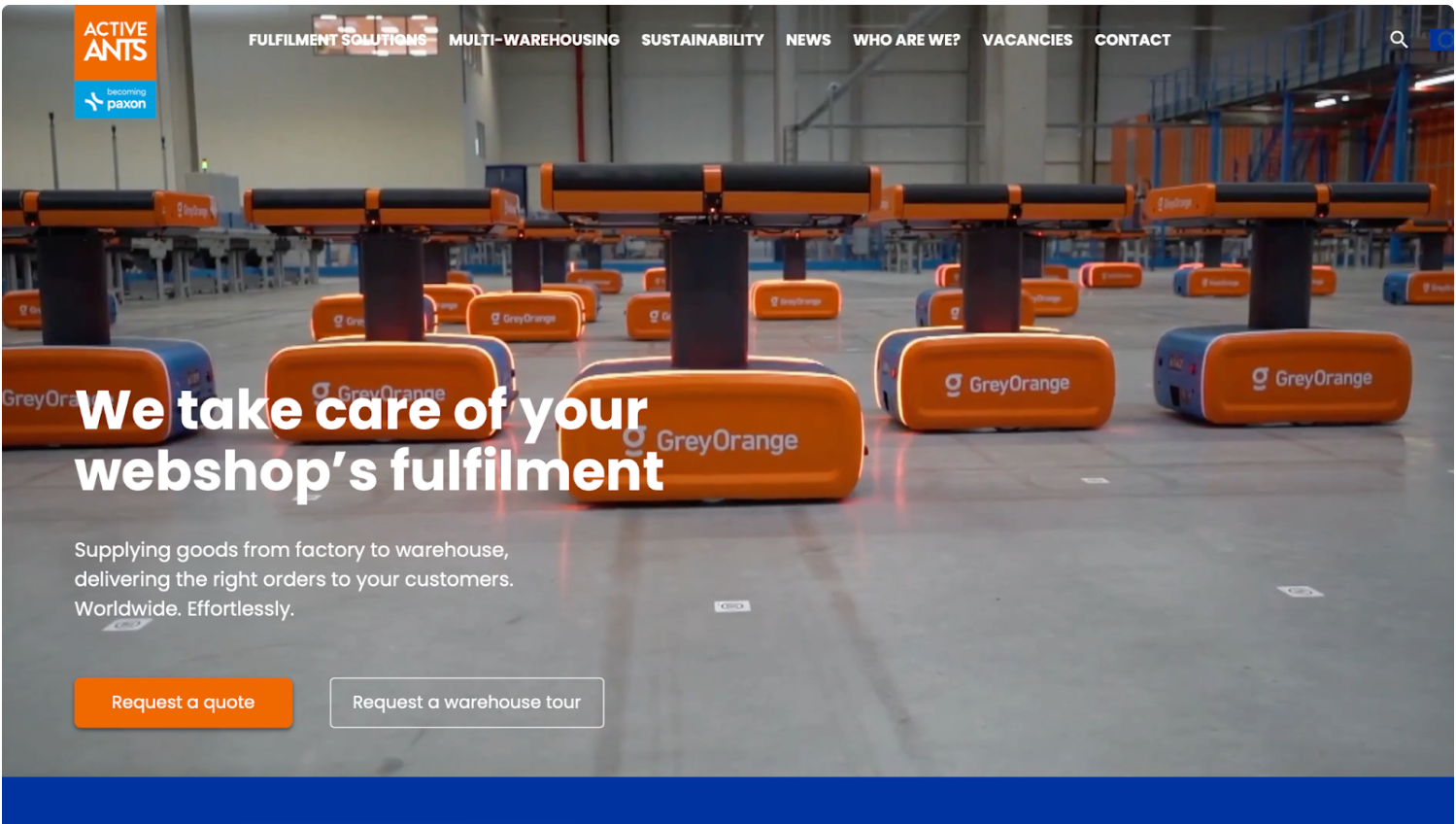
Active Ants is an international e-fulfillment partner that manages the entire supply chain for webshops, from the moment goods leave the factory to the final delivery to customers worldwide. Thanks to heavy investment in robotics and warehouse automation, its infrastructure is built around technology, enabling high-volume order processing with impressive efficiency.
Core Capabilities
Robotic Automation: Goods-to-person picking systems enable robots to automatically retrieve products, increasing speed and reducing human error.
AutoStore System: They utilize AutoStore for compact, efficient, and dust-free storage. This system is also theft-preventive and environmentally friendly.
Good-to-Person Picking: Instead of people walking through aisles, robots bring items directly to workstations. This “good-to-person” model ensures high-volume picking per hour with minimal errors.
Automated Packaging: Their packaging process is fully automated and sustainable. The system creates custom-sized boxes that fit the contents perfectly, which eliminates the need for filling material like plastic or paper.
Active Ants’ robotics-driven infrastructure is best suited to brands whose growth depends on operational efficiency at scale. Its automation-first infrastructure favours merchants with predictable product catalogues and steady order volumes, where standardisation drives lower handling costs and higher fulfilment accuracy.
The model appears particularly aligned with:
- High-SKU or high-volume ecommerce brands.
- Businesses focused on Western European markets.
4) Quicktron × Cubyn
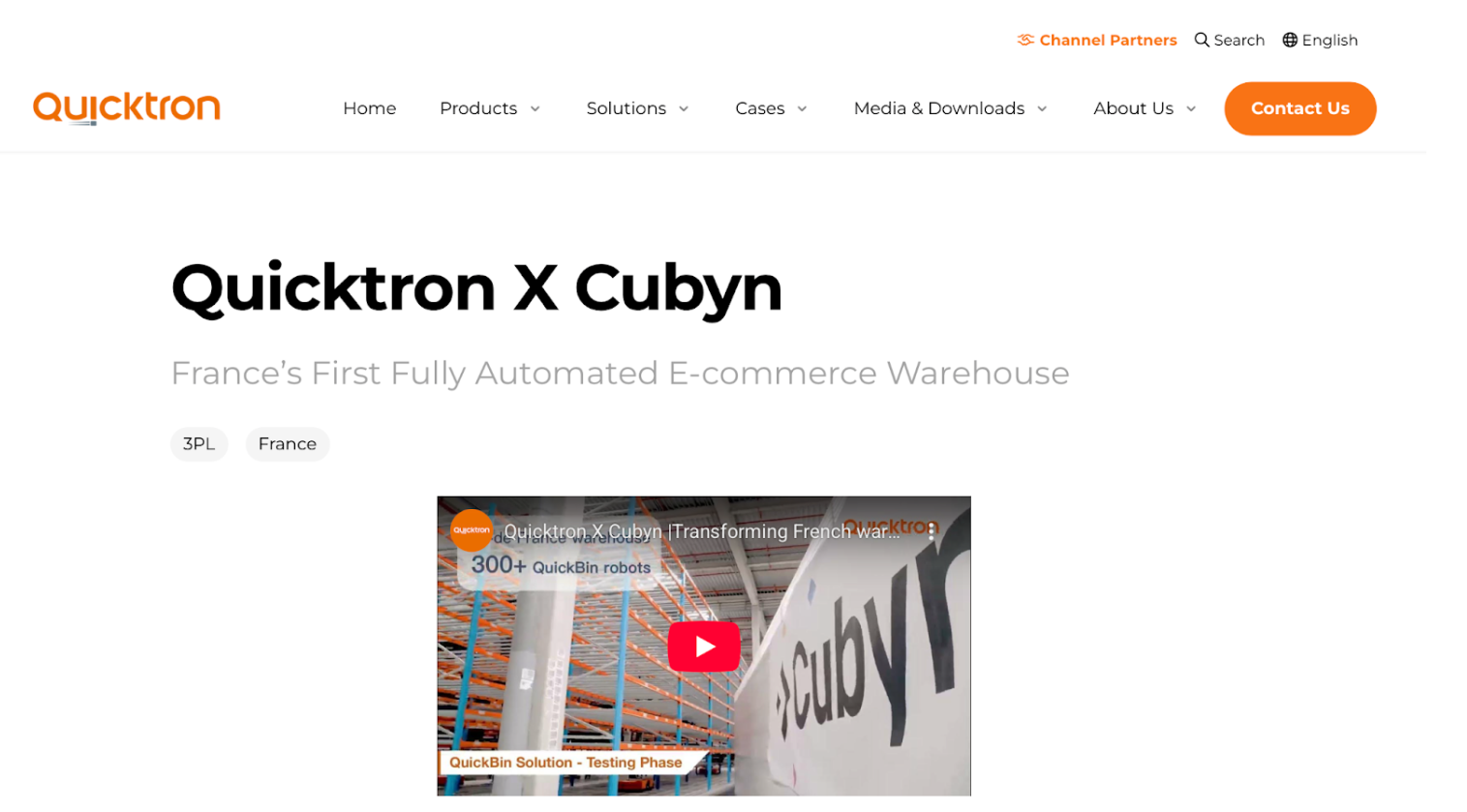
The partnership between robotics provider Quicktron and Paris-based logistics company Cubyn has produced one of Europe’s most advanced automated warehouses. By integrating autonomous mobile robots with Cubyn’s logistics software, the facility achieves significant gains in speed, accuracy, and sustainability.
Core Capabilities
Large-Scale Robotics Deployment: Hundreds of mobile robots operate within a 5,000 sqm automated area, supported by advanced warehouse control systems.
System Integration: The solution utilizes Quicktron’s QuickBin system, which seamlessly integrates Quicktron’s Robotic Control System (RCS) with Cubyn’s own Warehouse Management System (WMS).
Strategic Storage Intelligence: The system uses intelligent algorithms to store goods dynamically; high-demand items are strategically placed in the bottom and front rows of racks to accelerate picking speeds and overall efficiency.
Sustainability Achievements: The automated solution reduced energy consumption and carbon emissions.
The model appears particularly aligned with:
- Tech-driven ecommerce companies.
- Brands prioritising automation innovation.
- Businesses operating heavily in France and Western Europe.
5) Huboo
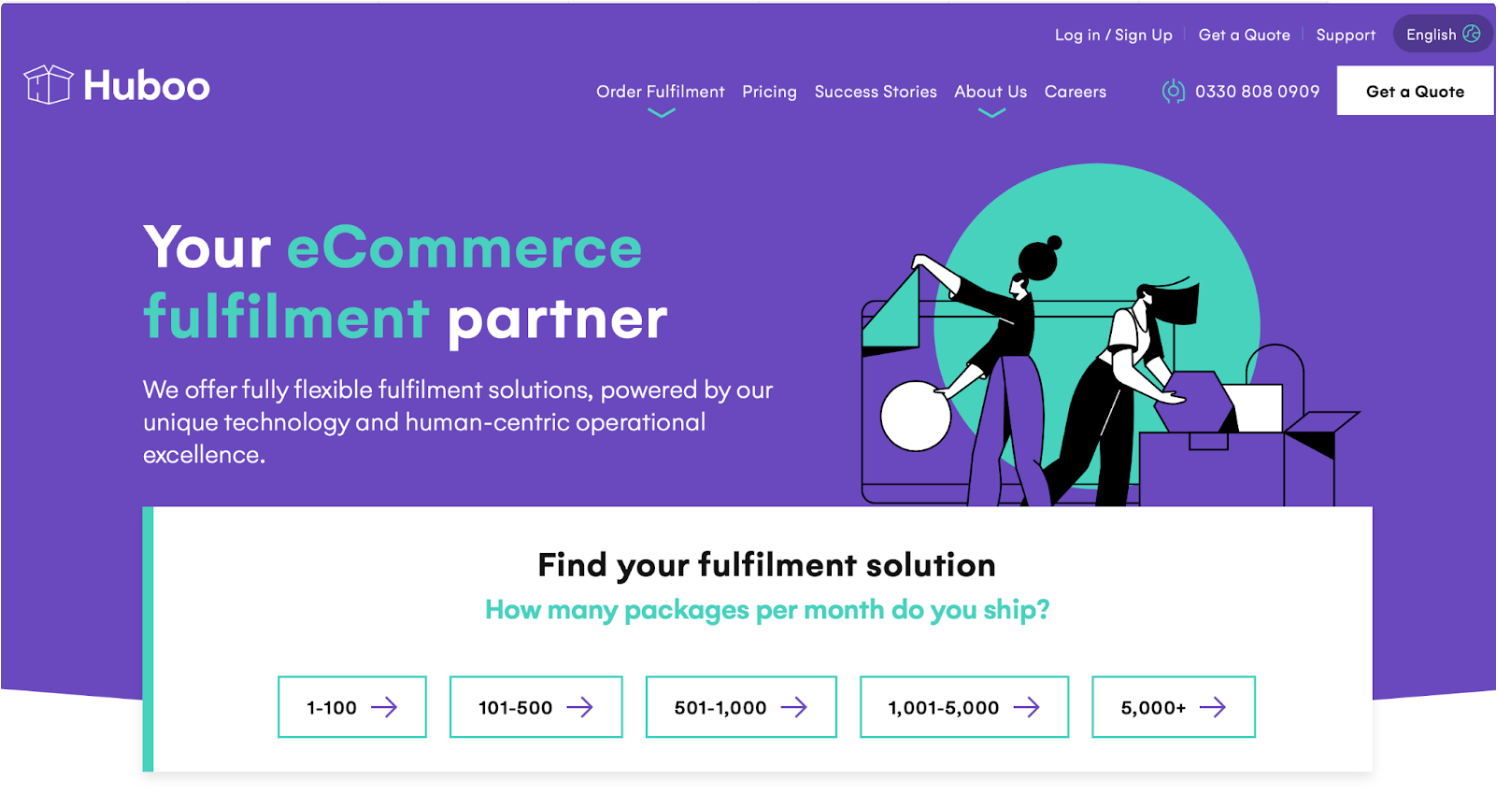
UK-based Huboo takes a more people-focused approach to logistics, combining proprietary technology with dedicated warehouse teams. Instead of heavy automation, the company emphasises operational flexibility and personalised support.
They position themselves as a “full stack” partner, meaning they own all their technology and warehouses rather than outsourcing, which allows them to move quickly and remain flexible for their clients.
Core Capabilities
SMEs and Startups: They offer dedicated services for owner-operators and sole traders who typically ship under 500 parcels per week, with entry points starting from £1,000 per month.
Large & Enterprise Businesses: They provide fully flexible solutions designed to adapt to the speed and scale that modern large-scale businesses demand.
End-to-End Fulfillment Services: Picking, packing, shipping, and returns management are handled through a centralised dashboard with real-time visibility.
Extensive Integrations: Huboo offers more than 35 integrations with major marketplaces, channels, and systems.
Social Commerce: They have proven expertise in TikTok Shop integration, allowing brands to add social sales channels without disrupting their existing fulfillment operations.
Fast Dispatch: They aim to ensure that orders are typically dispatched within 24 hours to maintain a high-quality customer experience.
European Network: They operate four warehouses across the UK and the European Union, supported by a global courier network to help brands reach international audiences.
Huboo stands out for accessibility and operational support. While it may not offer the same level of AI or robotics as other providers, it provides a reliable entry point for brands beginning their scaling journey.
The model appears particularly aligned with:
- Merchants scaling gradually across Europe.
- Businesses looking for flexible, human-centric fulfillment.
- Retailers selling via TikTok Shop.
3PL Europe compared: which providers cover the EU and UK?
Answer: The five providers above are profiled in depth. This table adds three more notable options, plus at-a-glance coverage, Shopify support, and pricing transparency, so you can shortlist against your own footprint.
| Provider | European coverage | UK + cross-border | Shopify | Pricing model | Best fit |
|---|
| Elogy | Italy, Spain, Eastern Europe | Cross-border EU focus | Yes | Quote | Southern/Eastern EU, COD markets |
| Byrd | 12 centers: DE, AT, FR, PL, UK | Yes, EU + UK | Native | Quote, per activity | DTC scaling across EU markets |
| Active Ants | NL, BE, DE, UK | Yes | Yes | Quote | High-SKU, high-volume Western EU |
| Cubyn (with Quicktron) | France, ships ES, PT, IT, DE, UK | Yes | Yes | Quote, all-in | France and Southern EU, automation |
| Huboo | UK, NL, ES | Yes | Yes | From GBP 1,000/month | SMEs and startups scaling gradually |
| ShipBob | 60+ centers incl. UK, EU | Yes, DDP | Native | Quote | Brands wanting EU plus US in one platform |
| Monta | 17+ centers, NL-anchored, UK, DE, FR | Yes | Native app | Configured quote | Benelux-first, multi-warehouse |
| Amazon MCF | UK, DE, FR, IT, ES | Per-country | Free app | Published per-unit | Sellers already using Amazon FBA |
How do cross-border VAT and IOSS work?
Answer: Two EU schemes cover most ecommerce. OSS handles goods already inside the EU shipped between member states; IOSS handles low-value goods imported from outside the EU in consignments up to EUR 150 (European Commission, 2026).
IOSS lets you charge EU VAT at checkout so the buyer faces no surprise import VAT or handling fee on delivery. It has run since 1 July 2021, and on the same date the old EUR 22 low-value import VAT exemption was abolished, so all commercial imports now carry VAT regardless of value (European Commission, 2026).
A seller not established in the EU must appoint an EU-based intermediary to use IOSS (European Commission, 2026). Registration is the other prerequisite. An EORI number is necessary for customs clearance in the EU (European Commission, 2026), so secure one before your first import.
For OSS, the old per-country distance-selling thresholds were replaced by a single EU-wide EUR 10,000 threshold; above it you charge the customer’s local VAT rate and file one OSS return (European Commission, 2026). Selling into the UK works differently: for consignments valued at GBP 135 or less sold directly to GB consumers, you register for UK VAT and charge it at the point of sale rather than at the border (GOV.UK, 2026).
| Order type | Threshold | What happens |
|---|
| Import to EU, consignment | Up to EUR 150 | Charge EU VAT at checkout via IOSS; no import VAT on delivery |
| Import to EU, consignment | Over EUR 150 | Import VAT and customs cleared at the border, outside IOSS |
| Intra-EU distance sales | Over EUR 10,000/yr EU-wide | Charge destination-country VAT, file one OSS return |
| Direct sale into GB | Up to GBP 135 | Register for UK VAT, charge at point of sale |
Two changes are worth planning for. The VAT in the Digital Age (ViDA) package was adopted on 11 March 2025, and its single VAT registration measures apply from 1 July 2028 (European Commission, 2025). Separately, the EUR 150 customs duty exemption is removed from 1 July 2026, with a temporary flat EUR 3 duty per item on low-value imports until the EU Customs Data Hub arrives (European Commission, 2026). Note the distinction: this is a customs duty change, not a new VAT threshold.
When should I outsource fulfillment?
Answer: Move from self-fulfillment to a 3PL when your fully loaded cost per order in-house rises above a 3PL quote at your volume, or when packing orders starts stealing time from product and marketing. For many brands, that crossover sits around 1,000 orders a month, the point Salesupply cites as a typical outsourcing trigger (Salesupply, 2026).
Run the math before you switch. Compare your true in-house cost, including labor, packaging, rent, and software, against a blended 3PL cost per order.
In-house cost/order = (Labor + packaging + rent + software) / Orders per month
3PL cost/order      = Receiving + storage share + pick & pack + shipping + returns
Outsource when       3PL cost/order < in-house cost/order at your volume
Here is an illustrative case, not a quote. A brand ships 1,200 orders a month. In-house, fully loaded, it runs about EUR 6.80 per order once a staffer’s time and warehouse rent are counted. A 3PL quotes roughly EUR 5.40 per order including shipping. That is EUR 1,680 saved a month, and the founder’s hours go back into the business. Below a few hundred orders a month, the fixed 3PL minimums usually make self-fulfillment cheaper.
What does 3PL pricing look like?
Answer: Most European 3PLs quote rather than publish, and the quote breaks into the same parts: onboarding and receiving, storage per pallet or shelf per month, a pick-and-pack fee per order, outbound shipping, and returns handling. Some add a monthly software or subscription fee.
Published anchors are rare but useful. Huboo starts from GBP 1,000 per month and itemizes fulfillment, packaging, storage, and subscription separately. Amazon Multi-Channel Fulfillment is the transparent outlier, with one all-inclusive per-unit fee that varies by size, weight, and country (Amazon, 2026). When you compare quotes, normalize everything to a cost per order at your real order profile, not the headline pick fee.
On Shopify specifically, the routes have shifted. Shopify Fulfillment Network is now an app that connects merchants to Flexport and other third-party providers, and its own fulfillment is available only out of the United States (Shopify, 2026). For European fulfillment, you connect a 3PL through a Shopify app or the Fulfillment Orders workflow, and can charge duties and import taxes at checkout, with EU VAT collected on orders up to EUR 150 and UK VAT up to GBP 135 (Shopify, 2026).
When a 3PL is the wrong move
Outsourcing is not always the answer. A 3PL adds margin overhead, a layer of coordination, and less hands-on control, so below certain thresholds it costs more than it returns.
| Condition | Threshold | Better move |
|---|
| Order volume | Under ~300/month | Self-fulfill until minimums pay off |
| Product handling | Fragile, custom, or assembled to order | Keep in-house or use a specialist |
| Market spread | Single country only | Local warehouse or in-house |
| Margin | Under ~30% after fulfillment fees | Reprice or renegotiate before outsourcing |
Watch two failure modes after you switch. Cross-border returns funneled to one country erode margin fast, so insist on in-country returns. And an all-in blended rate can mask rising storage costs on slow-moving SKUs, so review the itemized invoice monthly.
Where European fulfillment is heading
Three shifts will shape the next two years. Automation keeps spreading, with AutoStore grids and autonomous mobile robots moving from enterprise sites into mid-market 3PLs, as Active Ants and the Cubyn and Quicktron build show (Quicktron, 2026).
VAT is consolidating. ViDA’s single VAT registration from 2028 aims to let more sellers handle EU obligations through one registration, reducing the multi-country VAT drag that slows expansion today (European Commission, 2025). And duties are moving to the checkout, with platforms calculating and collecting them upfront so buyers stop abandoning at the door over surprise fees.
Where post-purchase support fits
Fulfillment does not end at dispatch. The moment a parcel ships, “where is my order” and “will I pay customs” questions hit support, and in cross-border Europe those are the two heaviest queues. An AI agent that can automate WISMO by reading live tracking and explain duties and taxes at checkout turns the post-purchase window from a cost center into retained revenue and repeat orders. Treat it as part of the fulfillment stack, alongside the rest of your ecommerce operations tooling, not a separate afterthought.
Frequently asked questions
How do I choose a 3PL in Europe?
Score providers on six criteria before price: warehouse locations near your buyers, VAT and IOSS handling, returns infrastructure, platform integrations, pricing model, and carrier mix. The right fit matches how you plan to grow across the EU and UK.
Which 3PLs cover the EU and UK?
Byrd, Active Ants, Cubyn, Huboo, ShipBob, Monta, and Amazon MCF all serve EU and UK markets. Byrd runs 12 EU and UK centers, Huboo covers the UK, Netherlands, and Spain, and Amazon MCF reaches the UK plus Germany, France, Italy, and Spain.
How do cross-border VAT and IOSS work?
IOSS lets you charge EU VAT at checkout on imported consignments up to EUR 150. OSS covers intra-EU sales above a EUR 10,000 EU-wide threshold with one return. Selling into the UK, you charge UK VAT at the point of sale on consignments up to GBP 135.
When should I outsource fulfillment?
Outsource when your fully loaded in-house cost per order exceeds a 3PL quote at your volume, often around 1,000 orders a month. Below a few hundred orders monthly, fixed 3PL minimums usually make self-fulfillment cheaper.
What does 3PL pricing look like?
Expect line items for onboarding and receiving, storage per month, pick and pack per order, outbound shipping, and returns, sometimes plus a software fee. Most European 3PLs quote rather than publish; Huboo starts from GBP 1,000 per month, and Amazon MCF uses a published per-unit fee.
Conclusion
The choice of a fulfilment partner increasingly comes down to strategic fit: whether a brand’s growth trajectory, market priorities, and operational complexity align with the structural logic behind each fulfilment model.
While many fulfilment providers offer similar technologies on the surface, they diverge in how they structure control, flexibility, and efficiency within the logistics stack. Some build integrated ecosystems designed to centralise data and operations, others prioritise network orchestration to enable rapid geographic expansion, and a third group engineers highly standardised environments where automation drives performance at scale.
These differences shape how inventory is positioned, how costs evolve as volumes scale, and how consistently customer expectations can be met across borders.
As European e-commerce becomes operationally demanding, fulfilment is no longer a secondary consideration but a foundational element of strategy. Choosing the right partner, therefore, means looking beyond surface-level features and assessing how each model supports long-term expansion, margin stability, and the ability to adapt as market conditions shift.