


How it works See how Zipchat reads your code and answers technical questions.
Use Cases
See all use casesIndustries
View all industriesCapabilities
See all capabilitiesUse Cases
See all use casesIndustries
View all industriesCapabilities
See all capabilitiesYour AI agent live in under 1 hour
No code. Trained on your catalog. Converts on every channel.
Start free trial Book a demo
Tidio has 300,000+ businesses on its platform and scores 4.6/5 on G2 and 4.7/5 on Capterra. Those ratings hide a pricing cliff, an architectural split, and a WhatsApp story that ecommerce merchants need to understand before signing.
Tidio is a live chat platform built for micro-businesses that added AI (Lyro) as a second product module in 2023. It wins on setup speed, Shopify FAQ automation, and affordable pricing for small teams.It breaks down on architecture (Flows and AI run as two separate, siloed systems), pricing (Growth starts at $49/mo for 250 billable conversations, with no self-serve middle tier before the $749/mo Plus plan — a 15x cliff), and ecommerce revenue features (no WhatsApp cart recovery, no revenue attribution). This review covers the full story.
| Tidio | Zipchat | |
|---|---|---|
| Best for | Shopify stores (3-10 agents), repetitive FAQ automation | Ecommerce stores wanting AI that sells + supports |
| Pricing | $49-$115/mo (real AI-enabled cost); $749+/mo at 11 agents | $49-$249/mo; no seat ceiling; no add-on maze |
| AI model | Claude LLM on manual knowledge base; Flows + Lyro run on separate logic tracks | AI-native agent; single AI across all channels from day one |
| Ecommerce capabilities | FAQ deflection, product recommendations (Lyro) | Cart recovery, proactive sales, upsells, revenue attribution |
| WhatsApp AI | Limited; poorly documented; user-reported issues in practice | Native: cart recovery, campaigns, upsells built in |
| Setup time | 30-60 min; 1-2 weeks to optimize AI | Minutes; catalog-grounded from first conversation |
| Cold-start requirement | 1-2 weeks of manual knowledge base work | None |
| G2 rating | 4.6/5 | 4.8/5 |
| Capterra rating | 4.7/5 | 4.8/5 |
| Free trial | Free plan (exhausted in 3-7 days) | 7-day trial, full access |
Tidio was founded in 2013 in Szczecin, Poland, by Tytus Gołas and Marcin Wiktor. The company raised $25M in a Series B in May 2022 (PeakSpan Capital) and remains private with 180+ employees. It serves 300,000+ businesses across ecommerce, healthcare, IT services, and automotive.
The founding story matters more than most review sites acknowledge. Tidio started as a digital advertising agency tool for micro-businesses that needed a cheap, quick-deploy live chat widget. No developer required. Up in minutes. That was the product-market fit in 2013, and it still is in 2026.
When AI became a market requirement in 2023, Tidio launched Lyro: a Claude-powered AI agent that learns from the store’s uploaded knowledge base. What they did not do was rebuild the platform. Lyro runs as a separate product module alongside the original rule-based automation engine (Flows). The two systems operate on different logic tracks.
If you run a Shopify store with 3-10 support agents and your primary goal is deflecting repetitive FAQ traffic on a budget, Tidio was built for you. If you want AI that actively generates revenue, keep reading.
Credit where it belongs.
Setup speed. Consistently the top-cited strength across G2, Capterra, and the Shopify App Store. Non-technical teams go live in 30-60 minutes. Multiple reviewers report going from signup to live chat in under one hour. At this price point, no competitor matches the onboarding simplicity.
Lyro AI for FAQ workloads. For stores with structured, repetitive FAQ content (shipping windows, return policies, order status), Lyro performs well. The Claude LLM base model produces fewer hallucinations than ChatGPT alternatives. Published case studies show resolution rates between 53% (Secureframe) and 89% (Axioma). For FAQ-heavy stores, this is reliable.
Shopify integration depth. Native catalog sync, real-time inventory checking, order lookup by order number or email, and customer purchase history surfaced in chat. Agents and Lyro see full Shopify order details without switching tabs. This is among the deepest Shopify integrations in the category.
Affordable SMB entry. At $49/mo for Growth (including Lyro AI and Flows), Tidio significantly undercuts Intercom ($600+/mo) and Zendesk ($465+/mo). For a store that has confirmed it will stay under 10 agents, the value is genuine.
Multi-channel inbox. Website chat, email, Instagram, Facebook Messenger, and WhatsApp in one dashboard. The consolidated view eliminates channel-switching for lean teams. Lyro supports 45+ languages.
In March 2025, Tidio won AI Company of the Year at the Global Business Tech Awards. That is a real signal.
Tidio’s current pricing runs three tiers: Starter at $24.17/mo (100 billable conversations, 50 Lyro AI conversations), Growth starting at $49.17/mo (from 250 billable conversations), and Plus at $749/mo. Lyro AI and Flows are now bundled into the plans — the add-on model is gone.
The problem is the cliff. Growth gives you 250 billable conversations as a floor. A growing Shopify store handling 1,000+ conversations a month outgrows that allocation fast. Conversation volume scales the bill up — but there is no self-serve middle tier when you need more capacity, higher seat count, or custom limits. The only option is Plus at $749/mo. That is a 15x jump with no intermediate step.
| Plan | Price | Conversation Limit |
|---|---|---|
| Starter | $24.17/mo | 100 billable conversations |
| Growth | from $49.17/mo | from 250 billable conversations |
| Plus | $749/mo | Custom |
Source: Tidio Pricing Page, April 2026.
Then there is the December 2024 incident. Tidio doubled bills for many existing customers overnight with no email notification. Multiple Trustpilot and Capterra reviewers documented bills going from $32 to $64 and from $25 to $120 in a single cycle. One reviewer tracked a four-year trajectory: $150 (2021), $190 (2022), $250 (2023), $500 (2024), with no notifications at any stage. That is the product of a pricing architecture that has not kept pace with the growth of the business using it.
The auto-upgrade mechanism compounds this. When a team hits 95% of its conversation quota, Tidio auto-upgrades the account to the next tier. The only warning is an in-app banner. No email is sent. If auto-upgrade is disabled, conversations stop entirely at 100% quota and customers cannot reach the business until the limit resets.
This is the most important architectural limitation in the product.
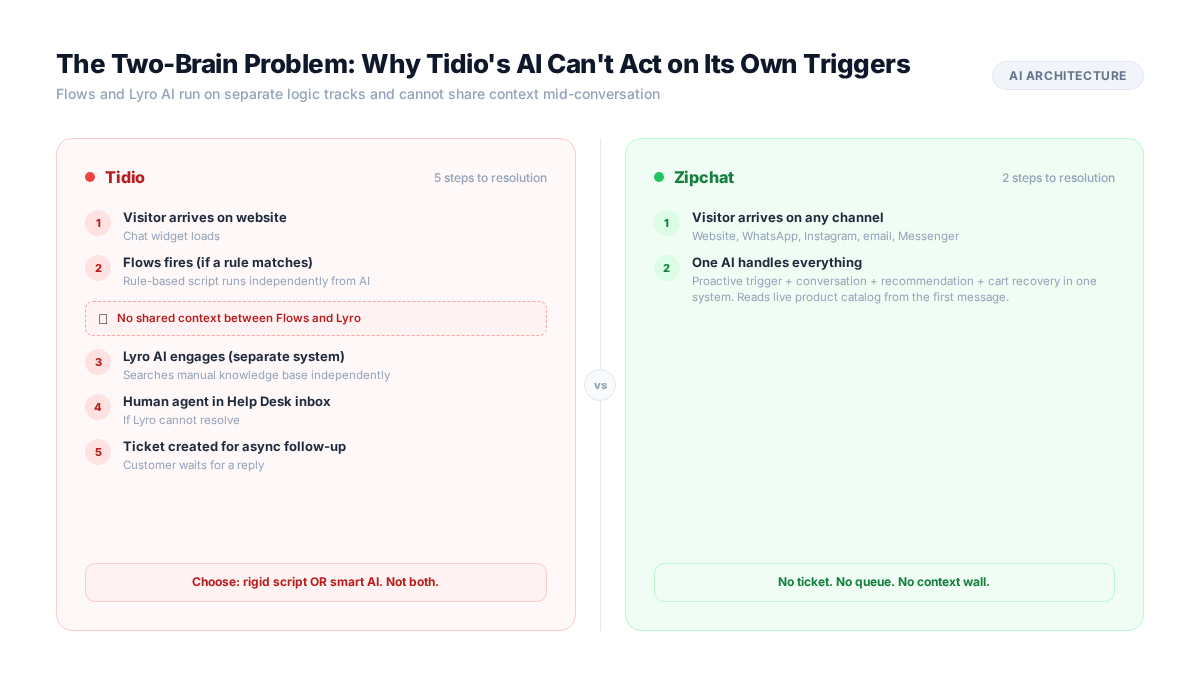
Tidio has two separate logic systems:
Flows (rule-based, created in the live chat era) and Lyro AI (launched 2023). A conversation that enters a Flow cannot escalate to Lyro mid-flow with full context, and a trigger from Lyro cannot feed back into a Flow. Third-party analysts describe it as “a wall between Flows and Lyro that stops you from creating truly smart, flexible automations and forces you to choose between a simple-but-rigid bot and a smarter-but-separate AI.”
For ecommerce teams, this creates a concrete ceiling. Imagine a proactive trigger: a shopper has been on a product page for 90 seconds, has items in their cart, and has not checked out. You want the AI to initiate a conversation, surface a relevant product question, and dynamically recommend a complementary item based on their cart. That requires a trigger (Flows) that seamlessly hands to an AI with full context (Lyro) that reads live catalog data. Tidio cannot do this cleanly. The two systems do not share logic. The merchant must choose between a scripted flow with no AI intelligence or an AI response with no proactive trigger.
Zipchat runs a single AI brain across all channels. The proactive trigger, the conversation, the product recommendation, and the cart recovery all happen inside the same system.
Tidio has three plans. Growth starts at $49/mo. The next step up is Plus at $749/mo. There is no tier in between.
Plus is also the only plan that lists “custom seat count” as a feature — which means Growth operates with an undisclosed seat cap. A store that needs more agents, higher conversation volume, or custom limits has one option: pay 15x more.
The gap between $49/mo and $749/mo, with no intermediate self-serve tier, is the clearest evidence that Tidio’s pricing architecture was built for teams that do not grow. For any Shopify store expecting to add agents or scale conversation volume over the next 12 months, this cliff should be a line item in every total cost of ownership calculation.
Tidio’s marketing includes WhatsApp as a supported channel. The reality is more constrained.
Multiple Capterra reviewers, particularly from Latin America, report that Lyro AI is not reliably available on WhatsApp without complex, poorly documented configuration. The integration is described as technically possible but practically unreliable for AI-driven conversations.
WhatsApp is not a checkbox. For ecommerce, it is the highest-performing cart recovery channel available. Zipchat’s WhatsApp AI recovers abandoned carts at 13-40% purchase rates across brands. Industry average email cart recovery runs 3-5%. The gap is 4-8x. For a store doing meaningful cart volume, that difference translates to measurable revenue each month.
Tidio cannot be the WhatsApp cart recovery layer. For stores where WhatsApp is a priority channel, the Tidio comparison ends here.
Tidio’s comparison pages against Intercom and Gorgias explicitly claim it provides better customer support quality than its competitors.
Its Trustpilot score is 4.0/5 across approximately 220 reviews. The AI-generated summary on Trustpilot specifically calls out “account suspensions without warning” and “unresponsiveness from the support team” as recurring themes. A scheduled support call was cancelled without explanation or reschedule, according to one Capterra reviewer (Paulo S., CEO, retail, June 2025). A Partner Program member reported multiple follow-up attempts with no response from Tidio’s team (Calvin J., Capterra, November 2025).
The 0.6-point gap between Trustpilot (4.0) and G2/Capterra (4.6-4.7) reflects where dissatisfied customers go when in-app support fails. A platform that positions its core value as “better support” while scoring modestly on the public review channel where support failures are most visible has a credibility problem that product updates cannot fix.
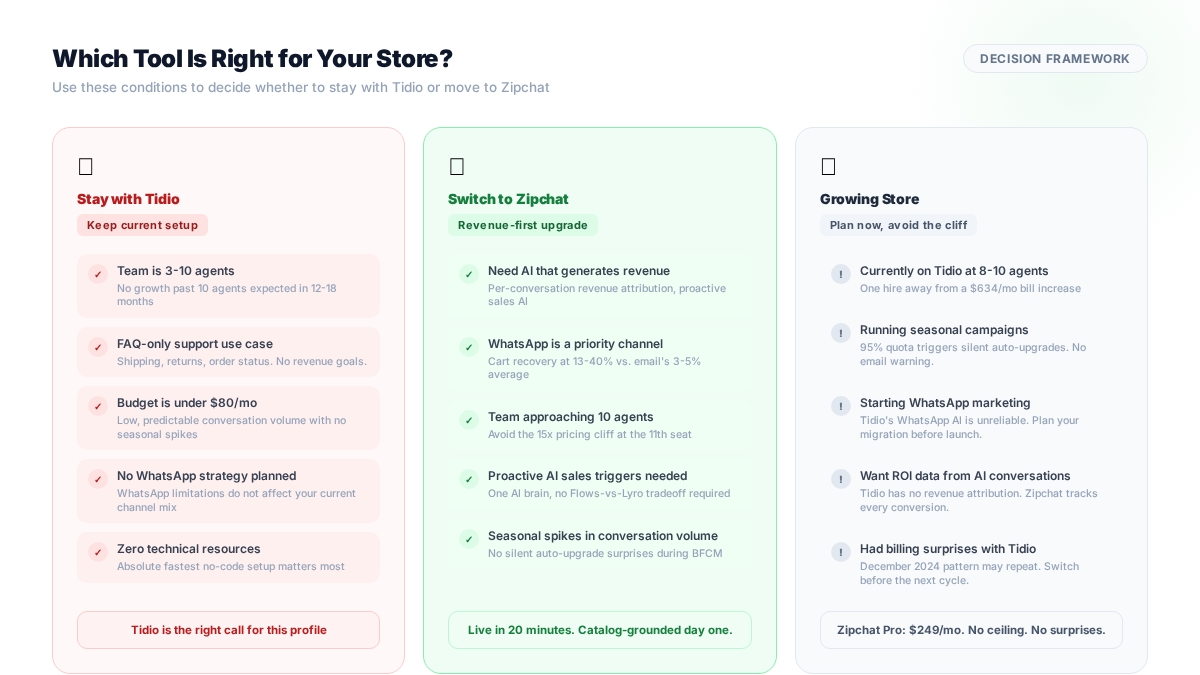
| Condition | Why Tidio Works |
|---|---|
| Small team with no growth plans for 12-18 months | No risk of hitting the seat ceiling |
| Primary use case is FAQ deflection (shipping, WISMO), just filtered and mostly escalated to human | Lyro performs well on structured, repetitive questions |
| Budget is under $80/mo and volume is predictable | Strong value-to-cost ratio at this price point |
| Seasonal spikes are minimal or predictable | No auto-upgrade risk at quota limits |
| No need for a strong AI, just basic FAQ answering | Simple knowledge-base built on FAQs |
| No WhatsApp marketing strategy planned | WhatsApp limitations are irrelevant |
If none of those conditions apply, Tidio’s architecture becomes overhead. Not advantage.
Shopify merchants outgrowing Tidio are not looking for another support tool. They are looking for an AI that generates revenue.
Zipchat was built in the AI era, for ecommerce, from the ground up. The AI is the platform, not a module. It runs conversations across website, WhatsApp, Instagram, email, and Messenger from a single logic system. There is no Flows-equivalent sitting beside the AI. There is no manual knowledge base to maintain. The AI trains from the product catalog on day one.
WhatsApp cart recovery. Zipchat recovers abandoned carts on WhatsApp at 13-40% purchase rates. Industry email average is 3-5%. For a store with 200 abandoned carts per month at a $60 average order value, a 20% recovery rate is $2,400/mo in recovered revenue. That is not support cost avoidance. That is new revenue.
Proactive AI sales triggers. A shopper browses a product page for 90 seconds without adding to cart. Zipchat initiates a conversation, offers contextual product information, and recommends complementary items from the live catalog. All from a single AI that reads the catalog in real time. No separate Flows system. No choice between a script and an AI.
Revenue attribution. Every conversation that produces a sale is tracked. Merchants see which AI interactions closed purchases, what the conversion rate per channel is, and what revenue the AI generated per month. Zipchat stores deliver 10-15x the industry average ecommerce conversion rate in documented case studies.
Ecommerce comparison: Zipchat vs Tidio
| Feature | Tidio | Zipchat |
|---|---|---|
| WhatsApp cart recovery | Limited; user-reported reliability issues | Native; 13-40% purchase rate |
| WhatsApp marketing campaigns | Not available | Built in from Growth ($129/mo) |
| Proactive sales AI | Flows only (separate from AI) | AI-native; no scripting needed |
| Revenue attribution per conversation | No | Yes |
| Upsells and cross-sells on WhatsApp | Not available | Built in from Starter ($49/mo) |
| AI knowledge source | Manual KB (URL scraping + uploads) | Live product catalog from day one + additional sources |
| Seat ceiling | 10 agents on self-serve plans | No seat ceiling |
[Internal link: automate support] [Internal link: WhatsApp AI cart recovery]
Tidio current pricing: Starter $24.17/mo (100 conversations), Growth from $49.17/mo (from 250 conversations), Plus $749/mo (custom limits, custom seat count — no middle tier).
Zipchat pricing:
| Plan | Price/mo | Replies/month | Features |
|---|---|---|---|
| Starter | $49 | 500 | All included |
| Growth | $129 | 1,500 | All included |
| Pro | $249 | 3,000 | All included |
| Scale | $499 | 6,000 | All included |
No add-on maze. No seat ceiling. See full Zipchat pricing.
Annual savings at the 11-agent growth stage:
Tidio Plus ($749/mo) - Zipchat Pro ($249/mo) = $500/mo saved
$500 x 12 = $6,000/year with Zipchat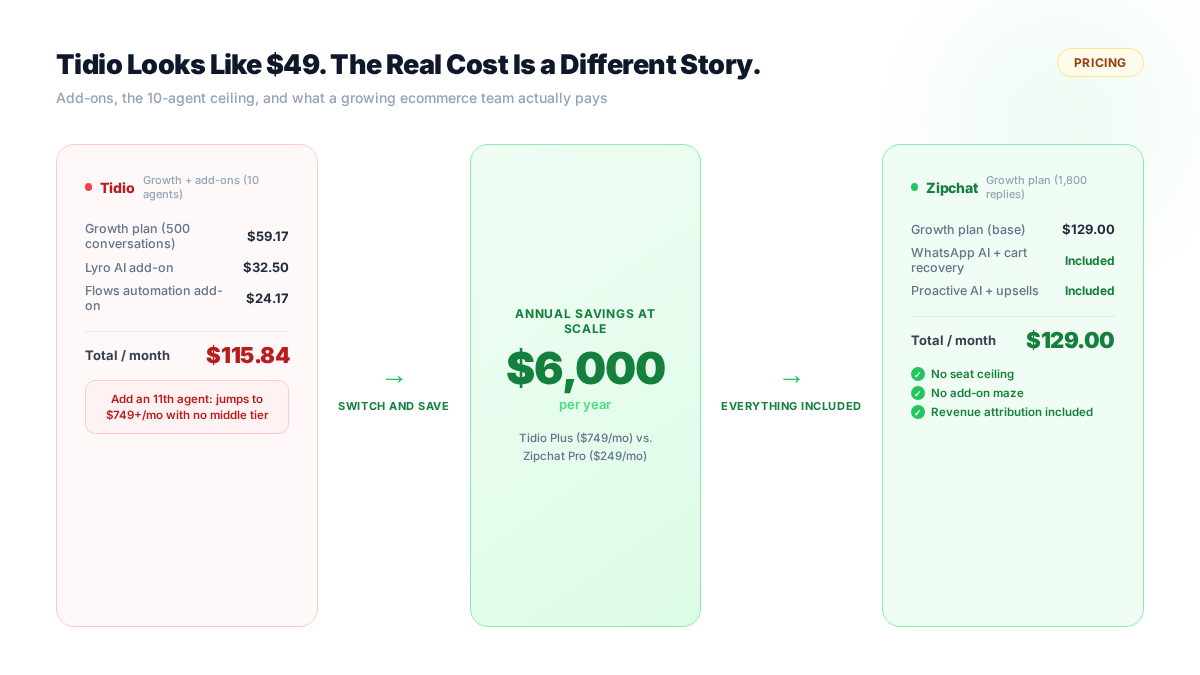
Tidio advertises 10-minute setup. In practice, the live chat widget goes live in 30-60 minutes. Lyro AI goes live on day one from scraped website content but requires 1-2 weeks of manual knowledge base optimization to reach reliable answer quality. A 10-agent team’s full implementation (chatbot flows, team training, integration setup) takes 10-20 hours per independent analysis.
Zipchat connects to your Shopify store, indexes the product catalog, and goes live in under 20 minutes. The first conversation is as good as the 1,000th. No manual knowledge base population. No optimization period.
Start your free trial with Zipchat
For ecommerce stores that need AI to generate revenue: Zipchat wins. Tidio handles support tickets. Zipchat turns support into revenue with WhatsApp cart recovery, proactive sales AI, and revenue attribution per conversation.
For stores hitting Tidio’s growth ceiling: Zipchat wins. The 15x pricing cliff (Growth $49/mo to Plus $749/mo, no middle tier) makes Tidio a growth blocker, not a growth tool.
For Shopify stores with low and predictable FAQ volume, no WhatsApp strategy, and no growth plans: Tidio wins. At $49/mo for Growth, the value is real and the setup speed is unmatched.
The question is structural. Do you want a tool that manages support conversations, or a tool that turns customer conversations into revenue?
For the full feature comparison and alternatives, see the Tidio alternative comparison.
Support and revenue merge into one function. The division between “customer support AI” and “sales AI” is a legacy of how helpdesks were built in 2010. AI-native platforms treat every conversation as a revenue opportunity: answer the question, recommend a product, recover the cart, upsell on the next message. Tools built as support deflection systems will either add revenue layers (as Tidio is attempting with Lyro product recommendations) or cede the category to platforms where revenue generation was the original architecture.
Conversation-based pricing replaces seat-based pricing. The per-seat model served enterprise helpdesk economics. Usage-based pricing (per reply or per conversation) better reflects AI economics, where the cost of a conversation is low and the value of a conversion is high. Tidio’s shift toward conversation-based billing is early evidence of this transition, but the add-on maze and agent ceiling remain seat-era constraints.
WhatsApp becomes the dominant ecommerce support channel. WhatsApp cart recovery outperforms email by 4-8x in documented campaigns. As Shopify merchants build WhatsApp audiences, the support platform that cannot deliver reliable AI on WhatsApp becomes a secondary tool, not a primary one. Tidio’s WhatsApp gap is not a feature request. It is a structural positioning problem for the next two years.
Is Tidio good for ecommerce? Answer: Tidio handles Shopify FAQ automation well: shipping questions, return policy, order status. It is weaker on revenue generation. There is no WhatsApp cart recovery, no revenue attribution per conversation, and no proactive AI sales triggers that do not require a separate Flows configuration. For support-only ecommerce use cases with under 10 agents, Tidio works. For stores that want AI to generate measurable revenue, the architecture is not built for it.
Is Tidio worth the price? Answer: Tidio Growth at $49/mo is genuine value for a small store with low, predictable conversation volume. The value breaks as you scale: conversation limits push costs up, the only next plan is Plus at $749/mo with no self-serve middle tier, and the December 2024 billing incident — where bills doubled overnight with no notice — makes the pricing harder to trust at any tier.
What are the main problems with Tidio? Answer: Four documented structural issues: (1) Flows and Lyro AI run on separate logic tracks and cannot share context mid-conversation; (2) Growth jumps directly to Plus at 15x the price ($49/mo to $749/mo) with no self-serve middle tier; (3) WhatsApp AI integration is unreliable in practice, per multiple user reports; (4) the December 2024 pricing incident doubled bills overnight with no email notification, a pattern that damaged trust across the customer base.
Can Zipchat replace Tidio for ecommerce? Answer: Yes. Zipchat handles AI support, proactive product recommendations, WhatsApp cart recovery (13-40% purchase rates), and post-purchase upsells from a single platform. Ecommerce brands on Zipchat deliver 10-15x the industry average conversion rate in documented cases. The Growth plan ($129/mo) includes WhatsApp marketing and cart recovery, which Tidio does not offer natively.
Can Zipchat and Tidio work together? Answer: There is no documented integration between the two platforms. Migrating from Tidio to Zipchat takes under 20 minutes: connect the Shopify store, and the AI indexes the product catalog immediately. No parallel run period is needed.
How long does it take to switch from Tidio to Zipchat? Answer: Under 20 minutes to connect and go live. No manual knowledge base migration is required. Zipchat trains from the live product catalog on day one. Tidio’s conversation history can be exported, but Zipchat does not require historical data to start performing.
Does Tidio have WhatsApp cart recovery? Answer: Tidio supports WhatsApp as a channel, but native Lyro AI on WhatsApp is not reliably available without complex configuration. Multiple users in Latin America and globally report that the WhatsApp AI integration does not work as documented. Tidio does not offer native WhatsApp cart recovery campaigns. Zipchat’s WhatsApp AI is a native revenue channel with documented 13-40% cart recovery rates.
What is the best Tidio alternative for growing Shopify stores? Answer: For Shopify stores approaching 10 agents or wanting WhatsApp cart recovery and revenue attribution, Zipchat is the most direct replacement. The Growth plan ($129/mo) covers all AI support, proactive sales, WhatsApp marketing, and cart recovery with no add-on fees and no agent ceiling.
Why is Tidio’s Trustpilot score lower than its G2 and Capterra scores? Answer: Trustpilot is where billing-dispute customers go when in-app support fails them. Tidio scores 4.0/5 on Trustpilot versus 4.6-4.7 on G2 and Capterra. The AI-generated Trustpilot summary specifically cites account suspensions without warning and unresponsiveness from the support team as recurring themes. The gap reflects where complaints land, not the full customer population.
This review is written by Luca Borreani, CMO & Co-Founder at Zipchat. We include Tidio’s genuine strengths and recommend it where it fits better than Zipchat.

Learn how to turn AI chat transcripts into A/B test hypotheses for ecommerce pages, offers, FAQs, cart recovery, and measurable CRO decisions.


Discover the best Shopify apps to automate warranty management in 2026. Compare features, pricing, and use cases to pick the right tool for your store.

The 9 best Shopify apps for fashion brands selling internationally in 2026. Compare pricing, ratings, and the right app to add first by problem.

Discover the 10 pre-order questions Shopify customers ask before buying, and how AI chatbots resolve ship-date and deposit tickets 24/7 in 2026.