


How it works See how Zipchat reads your code and answers technical questions.
Use Cases
See all use casesIndustries
View all industriesCapabilities
See all capabilitiesUse Cases
See all use casesIndustries
View all industriesCapabilities
See all capabilitiesYour AI agent live in under 1 hour
No code. Trained on your catalog. Converts on every channel.
Start free trial Book a demo
Freshdesk serves 75,000 companies and holds a 4.4/5 on G2 across 3,721 reviews. Those ratings are real. What they do not show is the 2.5/5 Trustpilot score from customers billing disputes, the $780/month AI plan that balloons to $1,580 in practice, and the architectural reason why a team using Freshdesk for ecommerce support is running a cost center, not a revenue channel.
TL;DR: Freshdesk is a ticket-based helpdesk built in 2010 for SMB IT teams. It consolidates inbound customer contacts into a queue, routes them through SLA policies, and lets agents (or Freddy AI) resolve them. It does this well. It wins on price for basic ticketing and on ease of setup for teams replacing a shared inbox. Where it breaks down: Freshdesk cannot initiate a conversation, cannot attribute revenue to a chat, cannot recover an abandoned cart, and cannot answer questions from a live codebase. This article covers who those gaps hurt most and what ecommerce and SaaS teams use instead.
| Freshdesk | Zipchat | |
|---|---|---|
| Best for | SMB ticket management, IT helpdesks, post-purchase support | Ecommerce revenue growth, SaaS technical support |
| Pricing model | Per agent/month + AI session overages + add-ons | Usage-based (replies/month); no per-seat charges |
| Full price range | $0–$109/agent/mo + $29 Copilot add-on + session overages | $49–$499/mo (standard plans) |
| AI architecture | Freddy: retrieval from manually-built knowledge base; reactive only | Trains on live product catalog or codebase; proactive + transactional |
| Setup time | Hours for basic email; 4–12 weeks for AI + Omni + full deployment | Minutes to hours (auto-crawl; no content authoring required) |
| Cold-start requirement | Knowledge base must be built manually before AI can deflect anything | None: active from day one |
| Proactive outreach | No: inbound-only by design | Yes: behavior-triggered chat, WhatsApp campaigns, Instagram DM automation |
| Revenue attribution | No revenue reporting tied to conversations | Conversation-to-purchase tracking built in |
| G2 rating | 4.4/5 | 4.8/5 |
| Capterra rating | 4.5/5 | 4.8/5 |
| Free trial | 14-day trial | 7-day trial, full access |
Freshdesk was created in 2010 by Girish Mathrubootham, who complained on Hacker News about being charged $900 for Zendesk. That complaint became a product, and that product has never stopped being fundamentally about cheaper ticketing.
Today, Freshworks (NASDAQ: FRSH) generates $838.8M in annual revenue and serves ~75,000 customers across ~170 countries. The company reached GAAP profitability for the first time in 2025. Freshdesk is the CX product line; Freshservice handles IT and employee experience, which is now the company’s primary growth bet (evidenced by the acquisitions of Device42 for $230M and FireHydrant in 2025).
The architecture has not changed since 2010 at its core: a customer contacts you, a ticket is created, automation routes it, an agent resolves it. Freddy AI, added after 2022, accelerates that resolution loop. It does not change the direction of the flow.
If you need a structured inbound queue with SLA management across email, chat, and social, Freshdesk was built for this. If you need to start conversations before customers are frustrated, recover carts, or attribute revenue to support interactions, a different architecture applies.
Ease of setup for basic ticketing. The #1 positive across G2 and Capterra is speed to live for basic email ticketing. Agents learn the queue in days. For teams replacing a shared inbox or spreadsheet-based tracking, the time-to-first-resolution is genuinely fast.
Automation depth at scale. Event-based and time-based triggers for routing, tagging, and escalation handle serious volume without manual intervention. Teams managing 10,000+ tickets/month benefit from the rules engine in ways that simpler tools cannot match.
Accessible entry pricing. The free plan (2 agents) and $15/month Growth tier are the most accessible in the helpdesk category. For a team whose only requirement is structured inbound ticketing with no AI and no omnichannel, no competing product matches this price point.
Integration ecosystem. Native or well-supported connections to Jira, Salesforce, HubSpot, Slack, Shopify (limited), Stripe, and FedEx. Teams already inside these stacks get working integrations without custom development.
Gartner recognition. Listed in the Gartner Magic Quadrant for CRM Customer Engagement Center annually since 2016; named Visionary in 2020 and 2021. For buyers using analyst coverage as a shortlist filter, this credibility is real.
The $15/month Growth plan is a loss-leader. Any ecommerce or SaaS team that needs AI, omnichannel (WhatsApp + chat), and phone support faces a very different bill.
Representative cost for a 10-agent team on Pro + AI Copilot (annual billing):
| Component | Monthly Cost |
|---|---|
| Pro + AI Copilot plan (10 × $78/agent) | $780 |
| Freddy AI session overages (~5,000 extra sessions @ $100/1,000) | $500 |
| Freshcaller phone add-on (if needed, 10 × $39) | $390 |
| Marketplace app subscriptions (Shopify integration, etc.) | $50–$200 |
| Total (no phone) | ~$1,330–$1,580/mo |
| Total (with phone) | ~$1,820–$2,070/mo |
The most common surprise: Freddy AI Agent sessions. The Pro plan includes 500 sessions/month. A moderately active ecommerce store burns through 500 sessions in days during peak periods. Additional sessions cost $100/1,000 and expire at month-end with no rollover.
The second surprise: seat management. Multiple Trustpilot reviewers describe being charged for seats months after deleting an agent, because deleting a user does not remove the billing seat. Self-serve seat removal does not exist. You contact support, which scores 2.5/5 on Trustpilot. One reviewer put it directly: “Great product, totally unfair business practice.”
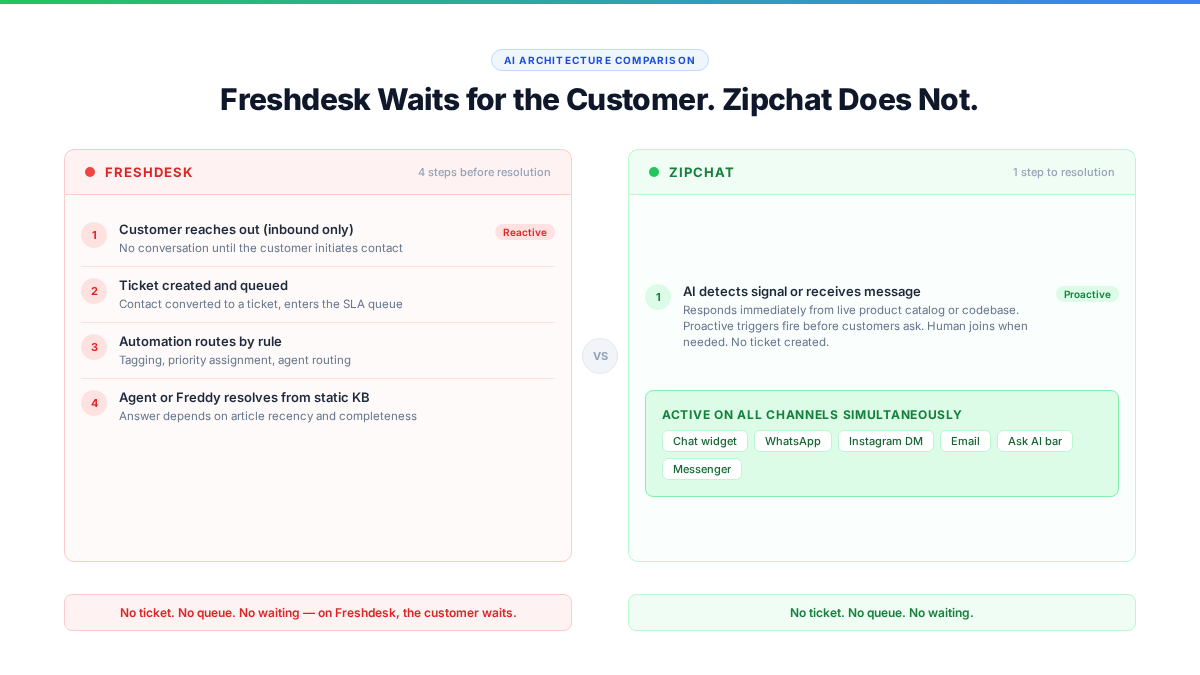
Every conversation in Freshdesk starts the same way: a customer contacts you. That is not a product gap. It is a design decision baked into the ticket model since 2010.
Freshdesk has no native proactive triggers. There is no mechanism to open a chat when a visitor has been on the checkout page for 90 seconds, to detect an abandoned cart and send a WhatsApp message, or to reach a customer before they become a complaint. The system optimizes for one direction: inbound volume, fast resolution.
For IT helpdesks and post-purchase support teams, this is fine. For ecommerce teams where the highest-value moment is the 30 seconds before a visitor leaves without buying, the reactive model means Freshdesk is never present at the moment that generates revenue.
Freddy AI Agent requires a populated knowledge base before it can answer a single product-specific question. On day one of a new Freshdesk deployment, with no articles written, the AI deflects zero tickets.
Building a useful knowledge base for an ecommerce store with 300+ SKUs takes days to weeks. During that window, you are paying for an AI plan that is not doing anything. When inventory changes, articles go stale until a human updates them. Freddy answers from last month’s catalog, not today’s.
This is not a solvable workflow problem. It is the structural output of an architecture that requires a static content layer between the AI and reality.
The Freshdesk Shopify integration shows order history in a ticket sidebar and allows refunds and cancellations. That is what it does. It does not connect to the product catalog. It cannot recommend products, suggest upsells, detect pre-purchase hesitation, or recover a cart.
The Vertical AI Agents launched in November 2025 added 50+ ecommerce workflows covering order tracking, returns, and shipping queries. These are support-resolution workflows. None of them initiate a conversation. None of them track revenue generated. None of them tell you whether that interaction produced a sale.
Freshdesk’s ecommerce analytics optimize for ticket close time and CSAT. Both are cost metrics. For a team where a 20-minute support conversation ends with a $340 upsell, Freshdesk reports the CSAT score and closes the ticket. The $340 does not appear anywhere in its reporting.
Freshdesk’s knowledge base is manually authored articles in a CMS. It does not sync with GitHub, GitLab, or any codebase. It does not read API specifications. It does not update when code ships.
For SaaS teams where 46% of documentation goes stale within three months ([NEEDS VERIFICATION: source this stat before publish]), every article Freddy answers from is potentially outdated. A customer asking “does your API support webhook retries?” gets an answer from the last time someone updated that article. If the article is six months old, the answer may be wrong.
The escalation path is Jira integration: tickets route to engineering when they exceed the knowledge base. This means engineering gets interrupted for questions the AI could not answer because the knowledge base was not current. The cost of that interruption compounds across sprints.
Freshdesk’s Trustpilot rating is 2.5/5 across 367 reviews, rated “Poor.” The company does not reply to negative reviews on the platform.
The dominant complaint themes are specific: auto-renewal billing for seats that were deleted, no self-serve way to remove a billing seat, slow or unresponsive support teams, and difficulty canceling or downgrading annual plans. These are not fringe cases. They appear repeatedly across reviews from 2023 through early 2026.
A customer support software company that cannot support its own customers’ billing disputes is a meaningful signal about operational priorities. It is worth factoring into any long-term partnership decision.
| Condition | Why Freshdesk Wins |
|---|---|
| IT helpdesk with Jira escalation paths and SLA requirements | Purpose-built for this; no better-priced alternative at scale |
| Team under 10 agents needing basic email + social ticketing | Free or $15/mo Growth plan is the most accessible in the category |
| Post-purchase support only, no pre-sales or proactive engagement | Reactive model matches the use case |
| Multi-brand SMB managing email and social in one queue | Multi-brand setup, multiple inboxes, one workspace |
| Budget-constrained team not ready to invest in AI | Entry pricing is unmatched for pure queue management |
If none of those conditions apply, Freshdesk’s architecture becomes overhead, not advantage.
Ecommerce merchants coming off Freshdesk are typically looking for the same thing: they wanted Freshdesk to solve pre-sale drop-off, and it could not. The tool is positioned as an ecommerce support platform, but the architecture is support-only.
Zipchat was built for ecommerce from the ground up. It connects to Shopify, WooCommerce, and Wix, indexes the live product catalog, and runs conversations across six channels: website chat widget, Ask AI bar, agentic AI search, WhatsApp, Instagram DM, and Facebook Messenger. On every one of those channels, it can initiate, not only respond.
Proactive sales triggers. When a visitor hovers on a product three times or sits on checkout for 90 seconds, Zipchat opens the conversation. Freshdesk waits for the visitor to submit a ticket. The majority of pre-purchase hesitation is never expressed as an inbound contact, which means Freshdesk never sees it.
WhatsApp cart recovery. Zipchat’s WhatsApp AI sends recovery messages to abandoned carts and sees a 13.8%–39.6% purchase rate on those messages. Email cart recovery averages 3–5%. The gap is structural: WhatsApp message open rates exceed 90%. One customer (pet brand, anonymized) recovered $123,800 in revenue from 8,911 messages. Freshdesk does not offer cart recovery in any form.
Revenue attribution. Every Zipchat conversation is tied to purchase outcomes. You see which conversations led to sales, which product recommendations converted, and what the AI’s revenue contribution was over any time period. Freshdesk shows CSAT scores and ticket close times.
Zero cold-start. Zipchat crawls the product catalog and website automatically. It answers questions about products, policies, and shipping from day one. No articles to write, no knowledge base to build.
| Feature | Zipchat | Freshdesk |
|---|---|---|
| Product recommendations | Yes (AI-driven, live catalog) | No |
| Cart recovery via WhatsApp | Yes (13.8–39.6% recovery rate) | No |
| Proactive sales triggers | Yes (behavior-based) | No |
| Discount code generation | Yes | No |
| Shopify integration | Full catalog + orders + transactional | Orders/refunds sidebar only |
| Revenue attribution | Yes | No |
| Conversion rate tracking | Yes | No |
SaaS support teams on Freshdesk consistently hit the same ceiling: the knowledge base cannot keep up with the product. Engineering gets interrupted. Pre-sales slows down. Tickets about features that shipped three months ago still escalate to devs because the Freshdesk article was not updated.
Zipchat Code connects directly to a Git repository (GitHub, GitLab, or Bitbucket) and indexes the live codebase. The AI answers product, technical, and integration questions from the actual shipped code, not from documentation that someone wrote after the last sprint.
87% fewer tickets escalated to engineering. When Zipchat Code can answer “does your API support pagination?” from the live endpoint code, the engineering team does not get the Slack message. That reduction in interruptions equals 40% more deep work time per engineer per week [Zipchat Impact Report, 2026].
96% answer accuracy. Because the source is the live codebase, not a stale wiki, the answer is grounded in what the product actually does today. Freddy’s accuracy depends entirely on when the relevant article was last updated.
Pre-sales velocity. A prospect on a demo asks whether the product supports OAuth2. With Zipchat Code, the sales rep gets the answer in 3.5 seconds from the codebase. With Freshdesk, the rep creates a ticket and follows up tomorrow.
| Feature | Zipchat Code | Freshdesk |
|---|---|---|
| Knowledge source | Live codebase (Git) | Manually authored articles |
| Source freshness | Real-time (updates when code ships) | Manual (stale until edited) |
| Answer accuracy | 96% | Depends on KB quality |
| Engineering escalation reduction | 87% | No published data |
| Response time (technical queries) | Under 3.5 seconds | Depends on agent/queue |
| Pre-sales technical answers | Yes (from live API specs) | FAQ-level only |
A 10-agent ecommerce team on Freshdesk’s AI plan (Pro + Copilot, no phone) pays approximately $1,330–$1,580/month after AI session overages and marketplace app subscriptions. That is the real number for any team that actually uses the AI features.
Zipchat pricing scales by conversation volume, not headcount. No per-seat charges. No expiring session allotments. No add-ons required for omnichannel.
| Plan | Price/mo | Replies/month | Channels |
|---|---|---|---|
| Starter | $49 | 500 | 2 |
| Growth | $129 | 1,500 | 3 |
| Pro | $249 | 3,000 | 5+ |
| Scale | $499 | 6,000+ | 10+ |
Every plan includes a 7-day free trial and a 30-day money-back guarantee.
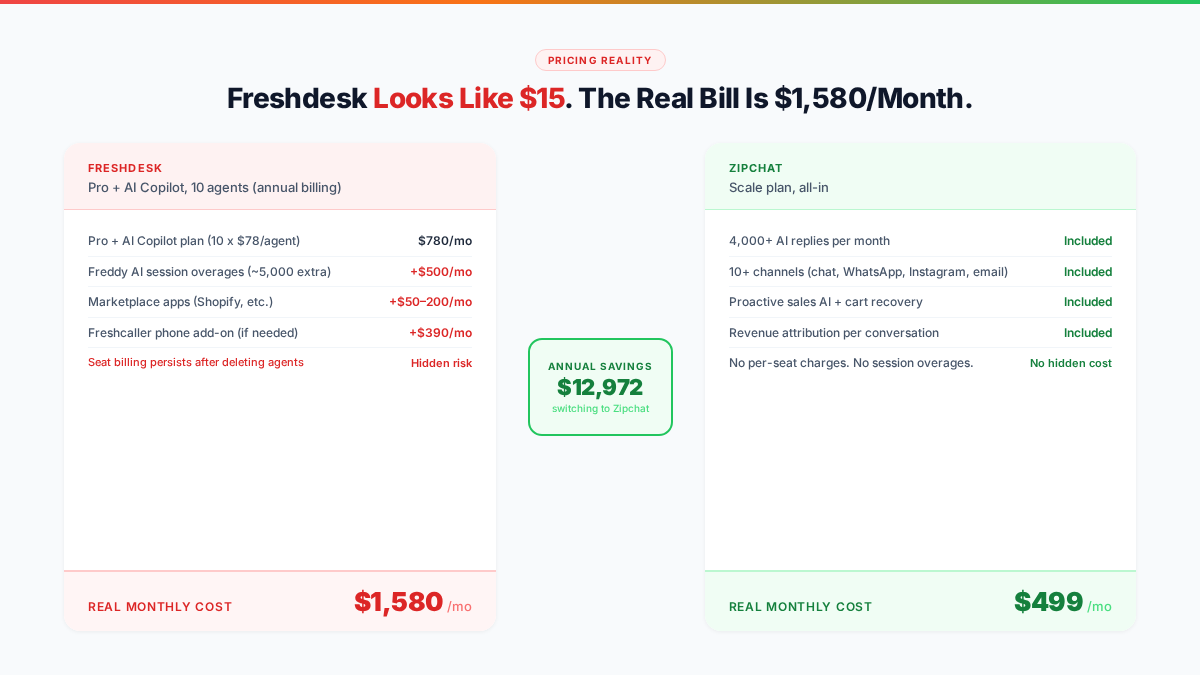
For the representative 10-agent Freshdesk scenario, the comparable Zipchat plan is Scale at $499/month.
Annual savings calculation:
Freshdesk (no phone): ~$1,330–$1,580/mo
Zipchat Scale: $499/mo

Monthly savings: $831–$1,081
Annual savings: $9,972–$12,972/yearFreshdesk’s basic email ticketing goes live in hours. Full deployment with Freddy AI, Freshdesk Omni, Shopify integration, DKIM configuration, and custom automation takes 4–12 weeks for most teams. Multiple Capterra reviewers describe the implementation as “painful” with onboarding sessions “where nothing was achieved.”
Zipchat connects to a Shopify store, crawls the product catalog, and is answering live customer questions within a few hours of installation. No content authoring required before go-live.
Create your free Zipchat Agent >>
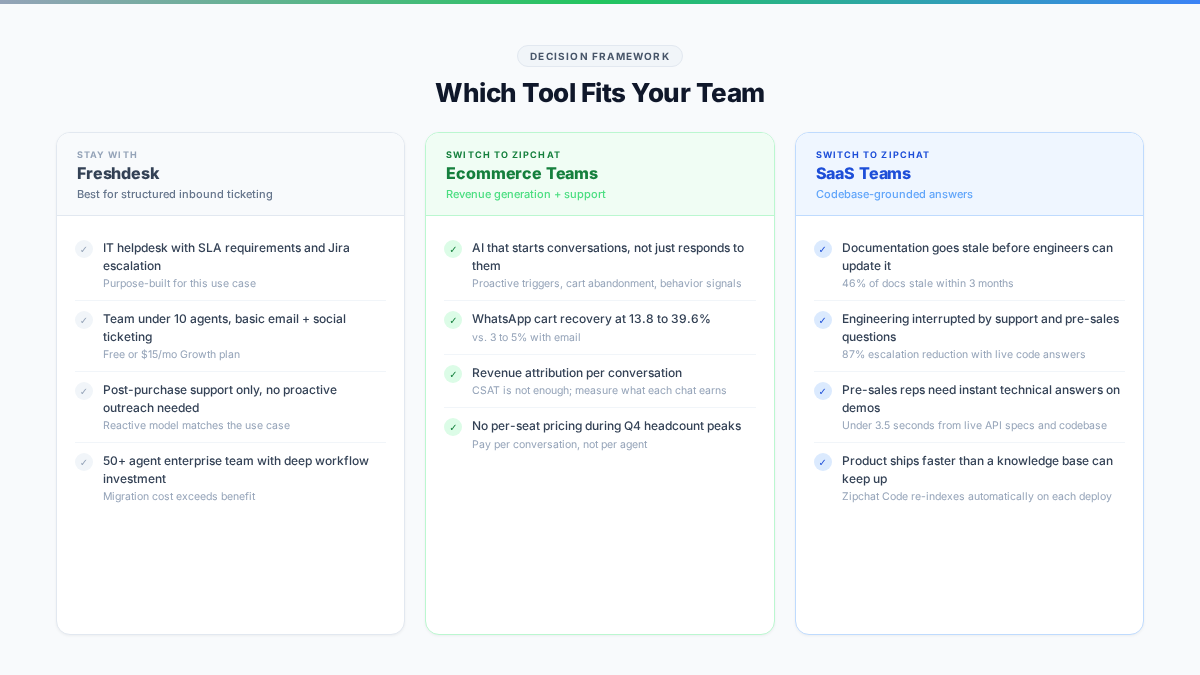
For ecommerce teams: Zipchat wins. Freshdesk cannot initiate conversations, recover carts, recommend products, or attribute revenue. Every metric it tracks is a cost metric. Zipchat measures conversion rate, cart recovery rate, and revenue per conversation.
For SaaS teams: Zipchat Code wins. Freshdesk’s knowledge base goes stale the moment code ships without a matching article update. Zipchat Code reads the live repository and answers from what the product actually does today, not from documentation written last quarter.
For IT helpdesks and structured post-purchase support: Freshdesk wins. SLA management, Jira escalation, multi-brand ticket routing, and a free tier for teams under 2 agents are genuine advantages in this use case.
The structural question is: do you want a system that optimizes for resolving problems after they arrive, or one that prevents them from arriving and converts the ones that do?
[Cross-link: See the full Freshdesk alternative page → [/alternatives/freshdesk]]
“The AI is active on day one. We didn’t write a single knowledge base article. It read our Shopify catalog and started answering questions immediately.”
— Burger Motorsports, Success Story
“Our WhatsApp cart recovery rate is 23%. With email, we were at 4%.”
— IntegroPet, Success Story
“The conversion rate from chat sessions is 28%. We track every sale the AI drove.”
— Nuvio, Success Story
The shift from cost-center to revenue-center. Ecommerce teams are measuring support differently. Ticket close time and CSAT are still reported, but the question driving tool selection has changed: “What revenue did support generate this month?” Tools that cannot answer that question are being replaced by ones that can.
Proactive AI replaces reactive queues. The next generation of support tools does not wait for customers to initiate. They operate across every channel simultaneously, trigger based on behavioral signals, and close the loop with purchase attribution. Freshdesk’s November 2025 Vertical AI Agents launch was a gesture in this direction. The architecture underneath it remains inbound-only.
Pricing models align with outcomes, not headcount. Per-seat pricing creates a conflict of interest: the vendor profits when you need more humans. Usage-based pricing aligns vendor revenue with customer conversation volume. As AI handles more interactions, the tools with per-seat models will resist automation to protect revenue. The tools with usage-based models will accelerate it.
Is Freshdesk good for ecommerce?
Answer: Freshdesk handles post-purchase support for ecommerce adequately. It can show order history, process refunds, and route support tickets. It cannot initiate conversations, recommend products, recover abandoned carts, or attribute revenue to chat interactions. Teams using support as a revenue channel will hit structural limits quickly.
Is Freshdesk worth the price?
Answer: For basic inbound ticketing under 10 agents, the free or Growth ($15/agent/month) plan delivers real value. For teams that need AI, omnichannel, and phone support, the advertised price ($78/agent/month for Pro + AI Copilot) grows to $1,330–$1,580/month for 10 agents after session overages and add-ons.
What are the main problems with Freshdesk?
Answer: The three most common complaints are: pricing opacity (the advertised price is not the real price for AI-enabled teams), seat management (deleting a user does not remove the billing seat), and AI cold-start (Freddy AI cannot answer anything until a knowledge base is manually built). A fourth: Freshdesk’s own support scores 2.5/5 on Trustpilot.
Can Zipchat replace Freshdesk for ecommerce?
Answer: Yes, for ecommerce teams whose primary goal is conversion, cart recovery, and revenue attribution. Zipchat adds capabilities Freshdesk does not offer (proactive triggers, WhatsApp campaigns, product recommendations, revenue tracking) and removes the per-seat pricing model. Teams that need structured SLA ticket queues for post-purchase support may want to evaluate both.
Can Zipchat replace Freshdesk for SaaS?
Answer: Zipchat Code replaces Freshdesk’s knowledge base model with codebase-grounded answers. It connects to GitHub, GitLab, or Bitbucket and answers product and technical questions from the live codebase. For SaaS teams where documentation goes stale between sprints, this eliminates the core failure mode of Freshdesk’s AI.
Can Zipchat and Freshdesk work together?
Answer: They can operate in parallel. Some teams use Zipchat for proactive pre-sale conversations and cart recovery, while retaining Freshdesk for post-purchase ticket management. Over time, most teams that add Zipchat find the overlap reduces the case for maintaining two tools.
How long does it take to switch from Freshdesk to Zipchat?
Answer: Zipchat installs and is answering customer questions within hours of connecting to Shopify or a codebase. Migrating historical ticket data from Freshdesk is a separate question; third-party migration tools (such as Help Desk Migration by Relokia) handle ticket and contact transfers in days if needed. The switch in active tooling is fast.
Does Freshdesk have abandoned cart recovery?
Answer: No. Freshdesk is an inbound-only platform. It does not detect abandoned carts, send proactive WhatsApp or email recovery messages, or track cart recovery attribution. This capability does not exist in Freshdesk’s architecture.
What is the best Freshdesk alternative for Shopify stores?
Answer: For Shopify stores that want proactive sales, cart recovery via WhatsApp, and revenue attribution, Zipchat is the most direct replacement for the capabilities Freshdesk lacks. It connects natively to Shopify, indexes the product catalog, and operates across website chat, WhatsApp, Instagram DM, and email from day one.
Third-party sources:
Zipchat internal data:
Disclosure: This review is written by Luca Borreani, CMO at Zipchat. We include Freshdesk’s genuine strengths and recommend it where it fits better than Zipchat.

The 9 best Shopify apps for fashion brands selling internationally in 2026. Compare pricing, ratings, and the right app to add first by problem.


Discover the 10 pre-order questions Shopify customers ask before buying, and how AI chatbots resolve ship-date and deposit tickets 24/7 in 2026.

Learn why AI chat fails without accurate inventory data, how hallucinations kill Shopify conversions, and how live stock feeds ground every reply.

Compare the 7 best AI product recommendation apps for Shopify in 2026: Maestra, LimeSpot, Rebuy, Wiser, Glood, AiTrillion, Nosto. Pricing & trade-offs.