
The short version: order fulfillment is everything that happens after checkout, storage, picking, packing, shipping, and returns, and it decides whether a first-time buyer comes back. Slow or inaccurate fulfillment costs trust and revenue, and it floods support with “where is my order?” tickets, which run 25 to 40% of ecommerce ticket volume (LateShipment). This guide covers the six fulfillment stages, the four common models, the failures that hurt most, and how an AI agent handles order-status questions across every channel.
What is ecommerce order fulfillment?
Ecommerce order fulfillment is the full process of storing inventory, receiving orders, picking, packing, shipping products to the customer, and handling returns. It covers every step from the moment a shopper clicks “buy” to the item arriving at their door.
The process synchronizes many moving parts: receiving inventory, keeping counts accurate, processing incoming orders on time, packaging items to survive transit, managing shipping logistics, and coordinating returns or exchanges.
Done right, fulfillment is invisible to the customer. Done wrong, it produces delays, mistakes, and frustration, which lower satisfaction and cut repeat purchases.
For context on building the operation underneath it, see how to scale your ecommerce business.
The ecommerce order fulfillment process
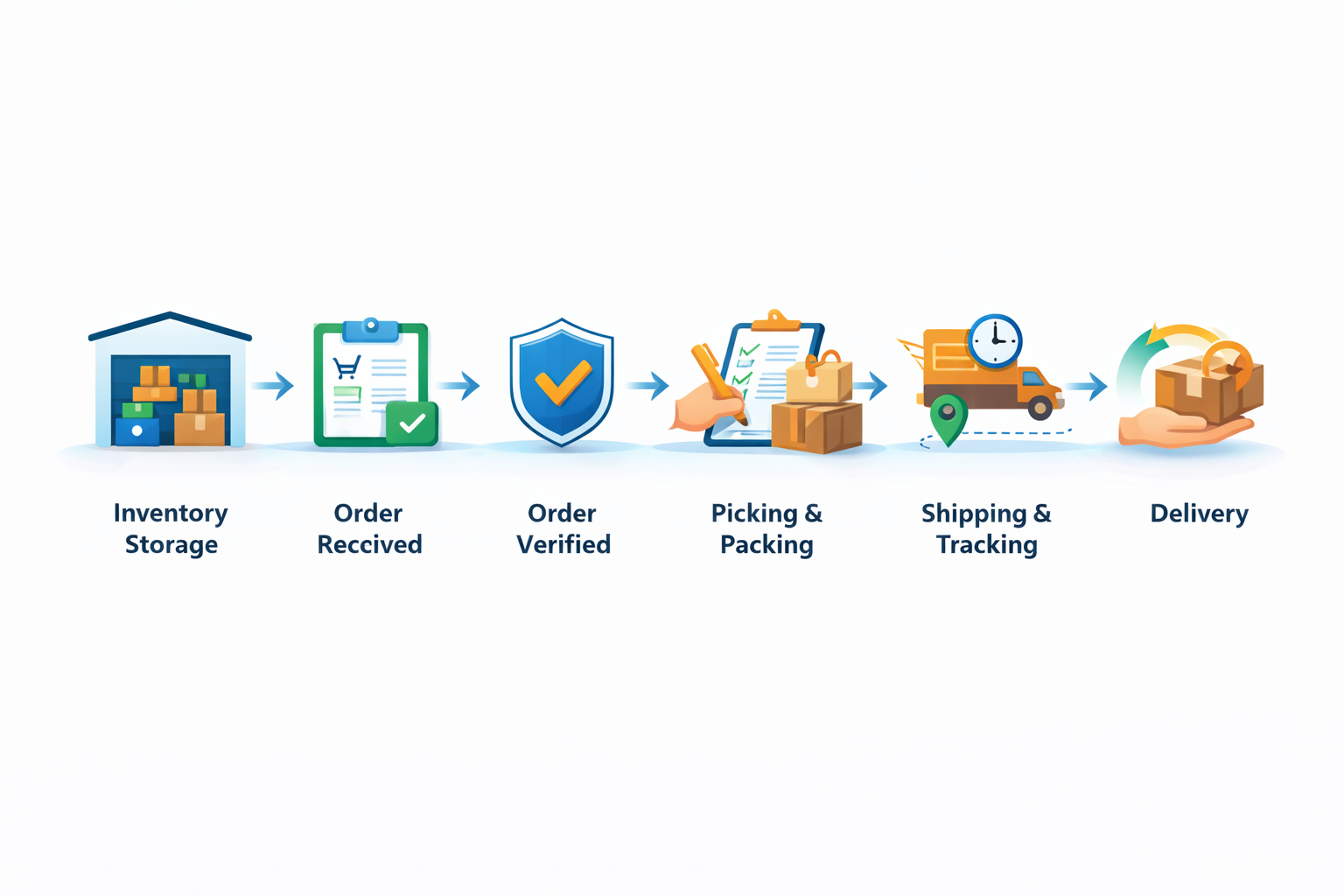
Fulfillment runs in six stages, and seeing each one shows where to find gaps, cut delays, and raise accuracy. Here is how the process works end to end.
Inventory management and storage
Inventory must be received, sorted, and stored correctly before any order can be filled. That means stock-level tracking and product labeling so items are easy to locate in the warehouse. Poor stock management leads to overselling, overbuying, or both. See ecommerce inventory management for the detail.
Receiving orders
When a customer places an order, the system captures product, quantity, shipping details, and payment confirmation. This is the step that connects your store to your fulfillment operation.
Order processing and verification
The order is checked for accuracy and compliance. Payment is approved and stock is confirmed before the order queues for picking. This catches errors before anything ships.
Picking and packing
Warehouse staff (or robots) locate the ordered items and prepare them to ship. Goods are packed to avoid damage and may include an invoice or branding insert.
Shipping and delivery
The package is handed to the carrier. A tracking number is created and shared with the customer, who can then check order status without contacting support.
Returns management
If a customer returns or exchanges an item, the work continues. Clear return handling builds trust and protects satisfaction after the sale.
Common ecommerce fulfillment models
Online stores do not all fulfill orders the same way. The right model depends on your size, order volume, budget, and growth plans. These are the four most common.
In-house fulfillment / self-fulfillment
You handle storage and packing yourself. This keeps full control over operations, branding, and the customer experience.
It gets demanding as order volume rises, and it requires investment in storage, staff, and logistics.
Ideal for: small businesses or startup brands at low to moderate order volume.
Dropshipping
With dropshipping you hold no stock. When an order comes in, the supplier ships the product directly to the buyer. Upfront costs are low and there is no warehousing, but you give up control over quality, shipping speed, and what the customer sees.
Best for: ecommerce businesses testing new products or working with limited capital.
Third-party logistics (3PL)
With a 3PL, you hold inventory at their facility and the partner picks, packs, and ships to your customers. You outsource logistics and focus on growth, marketing, and the customer experience.
3PLs grow with your business and often run more efficient shipping networks. The tradeoff is less direct control and ongoing service costs.
Best for: growing brands scaling without in-house logistics.
Hybrid fulfillment
Hybrid combines models, for example handling some orders yourself and handing others to a 3PL. It gives flexibility on cost, speed, and product type, but it demands tight coordination and clear inventory visibility across systems.
Best for: mid-market companies with complex product lines or order types.
Why fulfillment efficiency drives revenue
Efficient fulfillment is an underrated driver of revenue, loyalty, and growth. Fast, accurate, reliable operations remove friction across the post-purchase journey, from checkout to delivery and beyond.
It improves customer satisfaction and trust
A good customer experience starts with speed, accuracy, and reliability. When orders arrive fast, correct, and safely packaged, customers buy again.
Late, lost, or damaged items lose confidence quickly. Fast processing and proactive tracking updates make customers feel their order is handled. Clear delivery expectations also cut post-purchase anxiety and support tickets.
If you want to increase customer satisfaction, fulfillment performance is one of the strongest levers available.
It reduces operational costs
Efficient fulfillment lowers cost as well as raising satisfaction. Accurate picking, real-time inventory, and tight shipping processes reduce waste by stopping errors before they leave the warehouse.
When fulfillment runs clean, teams spend less time on errors, refunds, and excess inventory. Over time that means healthier margins.
It reduces cart abandonment
Buyers judge fulfillment before the order ships. At checkout they assess delivery speed, shipping reliability, and arrival dates. When those are unclear, hesitation follows.
This is not only about shipping cost. Vague or longer-than-expected delivery times push more shoppers to abandon. Reliable operations let you show accurate delivery estimates, which helps reduce cart abandonment.
It increases repeat purchases
Exceeding expectations drives repeat orders. When customers receive their orders smoothly, your brand reads as reliable.
Smooth fulfillment and easy returns build trust for future sales. Reliable performance turns first-time buyers into regulars.
It improves inventory visibility and control
Strong fulfillment operations give clearer visibility into your whole inventory system. Real-time stock accuracy improves purchasing, forecasting, and promotions.
Better visibility reduces overselling, prevents stockouts, and keeps online availability accurate. Instead of reacting to shortages, you can plan against demand signals and supply volatility.
Common challenges in ecommerce order fulfillment
Fulfillment is hard even for well-run operations. As order volume rises and expectations grow, small inefficiencies turn into operational blockers fast. These are the failures that hurt most.
Inventory inaccuracies and stockouts
Discrepancies happen when system counts do not match physical stock. The result is overselling, backorders, and canceled purchases, all of which frustrate customers.
Stockouts cut trust and send buyers to rivals. The fix is real-time stock levels, timely counts, and integrated sales channels.
Order errors and shipping delays
Wrong products, wrong quantities, or late shipments disappoint customers. Errors trigger refund requests, negative reviews, and extra shipping cost.
They also raise ticket volume and team workload. Prioritize accuracy, automate where possible, and run audits to reduce errors.
Managing returns at scale
Returns rise with order volume. Without an organized system, they overwhelm teams and complicate inventory.
Bad return experiences discourage repeat purchases, and unclear policies frustrate buyers. Protect margins and trust with strong reverse logistics and clear communication around handling ecommerce returns.
External disruptions
Carrier delays, supply chain problems, and unexpected global events disrupt even a well-run process.
You cannot control every external factor, but you can build flexibility into your operation. Multiple carriers, safety stock, and proactive customer communication soften the impact.
Demand spikes
Promotions, launches, and peak seasons spike order volume. Unprepared, those spikes create fulfillment bottlenecks.
Scalable systems, workforce planning, and tested inventory forecasting handle the surge. Flexibility plus capacity planning keeps service levels steady at peak.
How fulfillment drives your support load (and how AI handles it)
Most fulfillment-related support is one question repeated: “where is my order?” WISMO tickets account for 25 to 40% of all ecommerce support volume (LateShipment), and almost every one is an order-status lookup a human agent does not need to do.
An AI agent connected to your store and carrier data answers those questions the moment they arrive. It reads the order, pulls live tracking, and replies with the status, the carrier, and the expected date, on website chat, WhatsApp, Instagram, Messenger, or email, in any language, from one knowledge base.
The economics favor automation. McKinsey estimates an AI resolution costs about $0.62 against roughly $7.40 for a human-handled contact (McKinsey, 2026). Zipchat resolves over 90% of incoming questions automatically, and up to 97% in some stores, which removes the WISMO backlog before it reaches your team. For the dedicated capability, see automate WISMO.
Best practices for ecommerce order fulfillment
A well-run fulfillment operation does not happen by accident. It runs on defined processes, inventory visibility, and consistent execution. These practices lift both the customer experience and operational efficiency.
Set clear delivery expectations
Customers want to know when their order arrives. Clear delivery timelines at checkout reduce doubt and build trust.
Clear expectations also cut support email and frustration. When expectations are met, customers stay satisfied even if delivery takes a few extra days.
Impact: more trust, fewer complaints, less cart abandonment.
Provide order tracking
Real-time tracking and post-purchase updates let customers wait without worry.
Tracking links, status updates, and delivery notifications add transparency and cut “where is my order?” (WISMO) tickets. They also give customers a sense of control over their purchase.
Impact: a better post-purchase experience, fewer support tickets, happier customers.
Build flexibility for demand changes and disruptions
Order volume rises and falls with promotions, seasonality, and unexpected spikes. Shipments can also slip from carrier delays or supply chain problems outside your control.
Flexible systems (extra warehousing, alternative carriers, contingency plans) keep these from spiraling.
Impact: operational reliability, steady on-time performance, fewer delays.
Make returns easy
Returns are part of ecommerce, but a complicated process damages trust.
Clear instructions, simple return policies, and fast processing improve the customer experience and let you recover inventory quickly. A clean return system removes operational friction too.
Impact: better retention, faster restocking, lower friction.
Maintain clear visibility into inventory and orders
Accurate, real-time visibility into inventory and order status is core to fulfilling orders well.
When you can see what is in stock, what is selling, and where orders sit in the pipeline, you make better decisions and avoid costly errors like overselling or delays.
Impact: better decisions, fewer errors, more efficiency.
Modern fulfillment runs on technology that keeps operations connected and ready to grow. These tools maintain visibility, coordinate logistics, and communicate with customers.
- Order and delivery visibility tools. Real-time tracking and status for merchants and customers, adding transparency across the fulfillment journey and cutting post-checkout surprises.
- Shipping and delivery coordination tools. Shipping software integrates with carriers to automate label creation, rate comparison, and dispatch, improving delivery speed and cost while managing multiple carriers.
- Inventory visibility and order management tools. Order and inventory systems keep stock in sync across channels, preventing overselling and supporting smarter planning. Tools like Prediko
use AI-powered demand forecasting, replenishment planning, and purchase order management to help Shopify brands know what to order, when, and how much, keeping inventory ready for fulfillment.
- Customer support tools for order inquiries. Tools like Zipchat handle common questions about orders, delivery status, and returns in real time, cutting support workload while improving response speed and the overall experience.
Conclusion
Order fulfillment is a direct line to the customer experience. Fast, accurate fulfillment builds trust, drives repeat purchases, and supports long-term growth.
As expectations keep rising, brands that invest in efficient fulfillment, backed by the right tools and practices, stand out in a crowded market.
Want to lower support tickets and improve the post-purchase experience? An AI support agent like Zipchat answers order-status and returns questions around the clock, so your order fulfillment strategies scale without overwhelming your team.
FAQ
What is ecommerce order fulfillment?
Ecommerce order fulfillment is the process of receiving, processing, packing, and shipping online orders for customers. It also covers returns and keeping inventory accurate, so customers get the right product when they expect it.
What are the stages of ecommerce fulfillment?
The stages are inventory management and storage, receiving orders, order processing and verification, picking and packing, shipping and delivery, and returns management. Completing each stage well ensures customers get the right product at the right time.
What are the most common fulfillment challenges?
The common challenges are stock inaccuracies and stockouts, order errors and shipping delays, returns at scale, external disruptions, and demand spikes. Left unaddressed, they hurt satisfaction and operational efficiency.
How long does order fulfillment take?
Fulfillment time usually runs from same-day processing to 1 to 3 business days before shipping, depending on the model and infrastructure. Delivery timelines then vary by shipping method, location, and carrier.
How much support load does fulfillment create?
“Where is my order?” (WISMO) questions make up 25 to 40% of ecommerce support tickets (LateShipment). Most are order-status lookups an AI agent can resolve automatically by reading the order and pulling live tracking.
Can an AI agent answer order-status questions?
Yes. An AI agent connected to your store and carrier data reads the order, pulls tracking, and replies with status and expected date across website chat, WhatsApp, Instagram, Messenger, and email. Zipchat resolves over 90% of incoming questions automatically at a fraction of human cost.