





How it works See how Zipchat reads your code and answers technical questions.
Use Cases
See all use casesIndustries
View all industriesCapabilities
See all capabilitiesUse Cases
See all use casesIndustries
View all industriesCapabilities
See all capabilitiesYour AI agent live in under 1 hour
No code. Trained on your catalog. Converts on every channel.
Start free trial Book a demoThis article was written by Megha Meshavaniya of SpeedBoostr and contributed to the Zipchat blog as part of our partnership program. First published: March 27, 2026.
There’s a version of SEO that most Shopify merchants are still optimizing for, and then there’s where search actually is in 2026. The gap between them is getting wider.
Google’s AI Overviews now appear in over 13% of all queries. ChatGPT has a shopping feature. Perplexity recommends products. Gemini summarizes categories. When someone asks an AI assistant what protein powder to buy or which Shopify store has the best candle selection, the answer it gives is not a blue link to your homepage; it’s a synthesized recommendation pulled from sources the AI has indexed, understood, and deemed trustworthy.
Your store either shows up in that ecosystem or it doesn’t. Working with a certified Shopify Partner can help ensure you’re optimizing for both. And the optimization that gets you there is meaningfully different from the keyword stuffing and backlink chasing that passed for SEO a few years ago.
The apps below cover both sides: the technical SEO fundamentals that Google has cared about for years, and the newer AI-specific signals that are now separating stores that get discovered from stores that don’t. Where an app is strong at one but not both, we’ve said so.
The Two Things Worth Optimizing For Right Now
→ Traditional SEO : Google rankings, Core Web Vitals, structured data, meta tags, page speed, backlinks. This still matters. A lot. The stores that ignore it in favor of chasing AI search exclusively are making a mistake. AI search draws heavily from what ranks well in traditional search.
→ Generative Engine Optimization (GEO) : Making your content visible to AI-powered search tools like ChatGPT, Perplexity, and Google AI Overviews. This involves LLMs.txt files, comprehensive structured data, clear product information architecture, and content depth that gives AI systems enough to cite you with confidence.
The best apps on this list do both. A few specialize in one. We’ll tell you which is which.
The Apps
1. Speedboostr – A Shopify Speed & SEO App
Rating: 4.6 / 110+ reviews
Pricing: Free plan available; Startup from $9.99/month
Badge: Built for Shopify
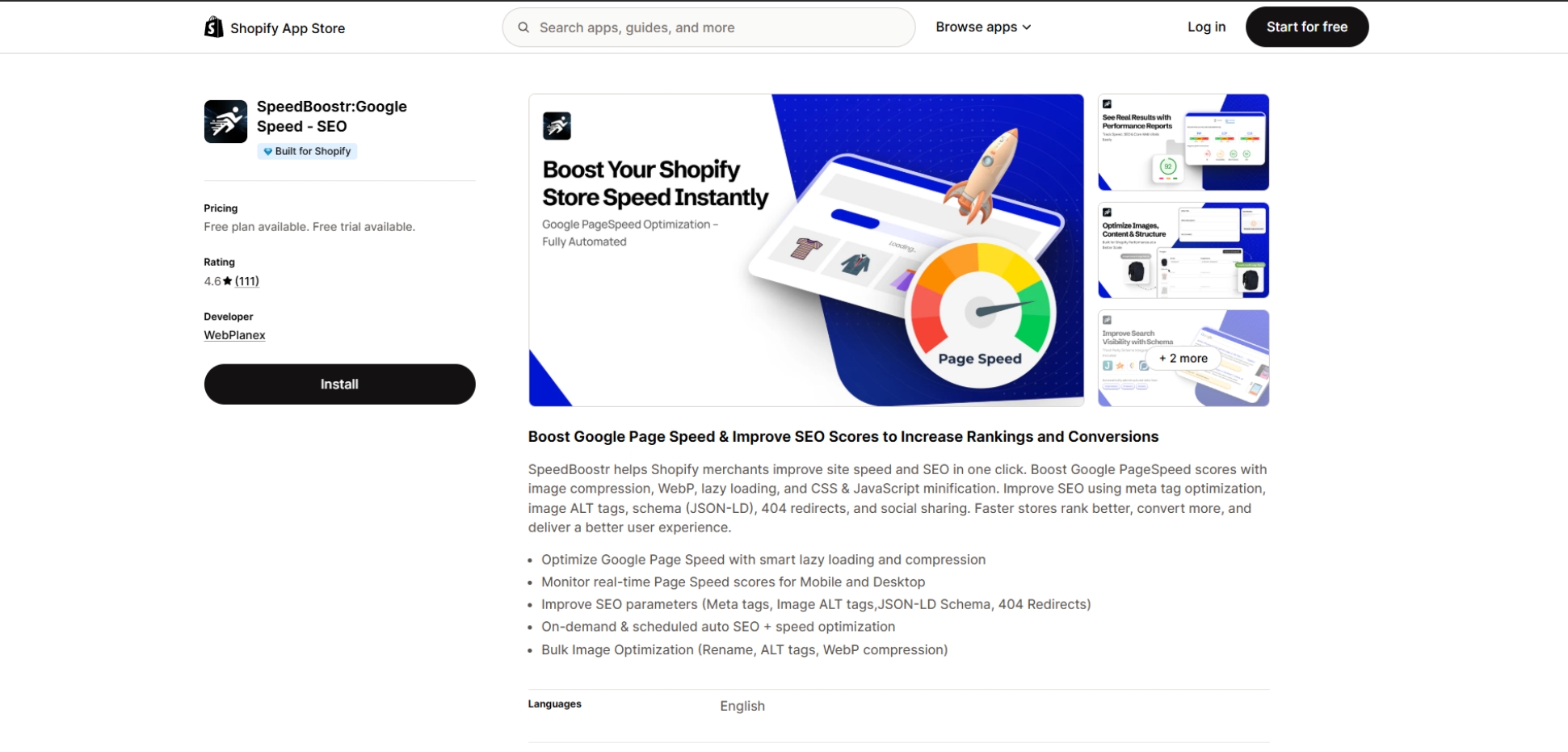
Most speed and SEO apps are separate tools solving separate problems. SpeedBoostr is the rare case where someone built both into one place and actually got both right.
The speed side is genuinely aggressive. CSS and JS compression, third-party app JavaScript lazy loading, image compression with WebP conversion, real-time PageSpeed monitoring across mobile and desktop, and crucially, an automated scheduling feature that runs optimizations on a weekly or monthly cadence without you having to remember to do it manually. That last part matters more than it sounds. Stores that manually ran speed audits three months after launch and then never again are everywhere. Automation is what keeps performance from quietly decaying over time as you add new apps and products.
The SEO side has been expanding fast. Structured data generation in JSON-LD format, automated meta tags and image alt text, 404 redirect management, Search Console integration via OAuth, and, as of March 2026, two new features that directly address AI search visibility: an LLMs.txt Generator and an Advanced Robots.txt Manager.
The LLMs.txt feature is worth explaining. It generates a structured file that maps your store’s products, collections, blog posts, and pages in a format that AI systems, ChatGPT, Gemini, Perplexity, and Claude can parse when deciding what to cite or recommend. It updates dynamically as your catalog changes, and you control which content types get included. It’s the same category of feature that StoreSEO and Tapita offer, except SpeedBoostr pairs it with real performance infrastructure rather than treating it as a standalone SEO checkbox.
The Robots.txt Manager lets you configure crawl rules at the user-agent level, Googlebot, AdsBot, and AhrefsBot, without touching code. For stores that have pages they actively don’t want indexed (staging sections, checkout variants, internal search result pages), having that control in a clean dashboard rather than through developer access is a meaningful operational improvement.
At $9.99/month for the Startup tier, SpeedBoostr sits in the same price bracket as Tapita and Sherpas, but with a broader technical footprint than either. For stores that want page speed, SEO, structured data, AI indexing, and Robots.txt management handled by a single app from a team that actively ships new features, this is the one to look at.
2. Tiny SEO Speed Image Optimizer
Rating: 5.0 / 2,000+ reviews
Pricing: Free plan; paid from $14/month
Badge: Built for Shopify
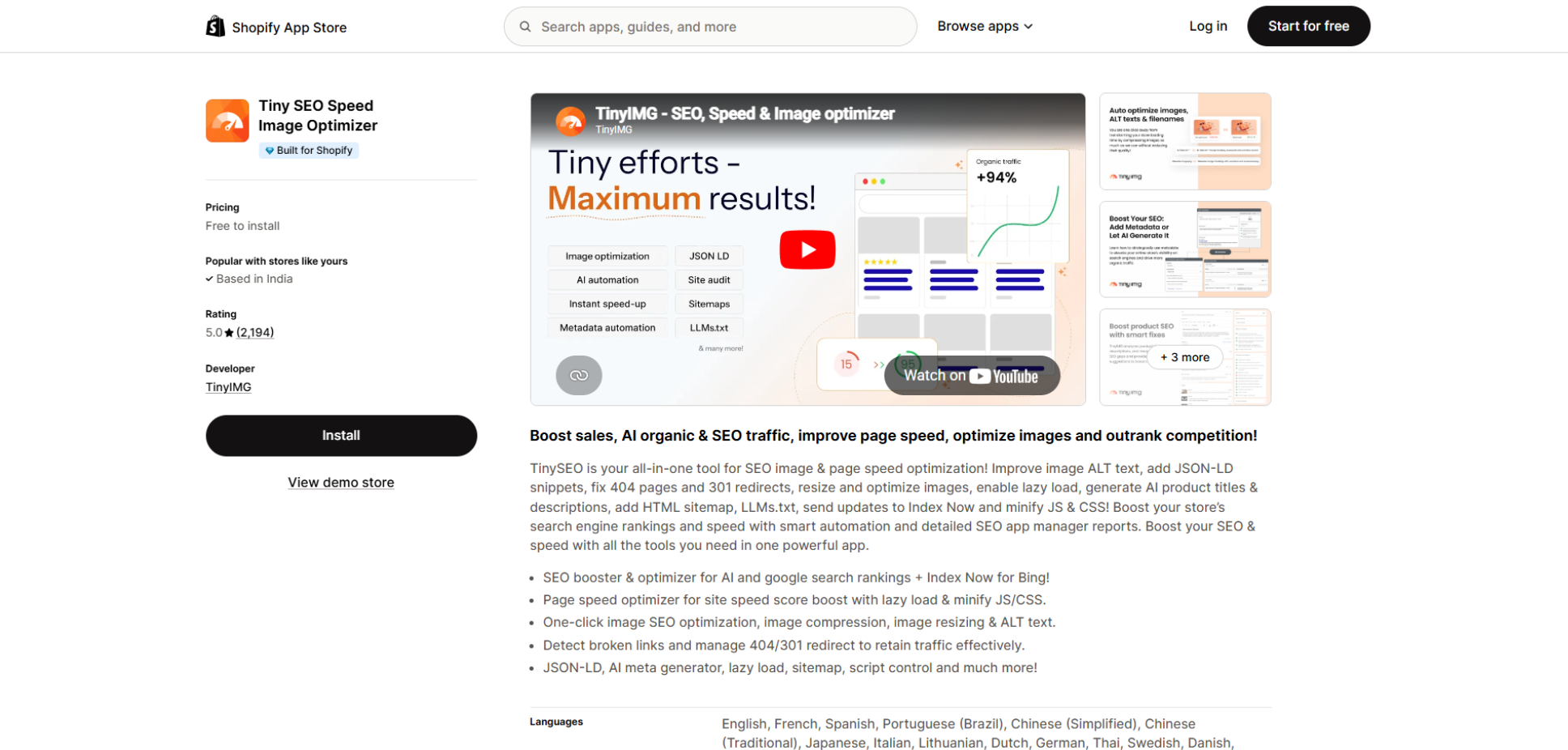
Page speed is, in a lot of ways, the SEO conversation nobody wants to have because the fix isn’t glamorous. Compressing images isn’t exciting. But a store with a 40-point PageSpeed score is a store that Google is already penalizing, and no amount of keyword optimization is going to overcome that drag.
TinyIMG does this more aggressively than most alternatives. In independent testing, it’s been shown to compress PNG files by up to 94% and JPGs by around 54%, without visible quality loss at normal display sizes. It also handles lazy loading, asset preloading, alt text generation, and filename optimization automatically.
The LLMs.txt generation feature was added recently, which gives it double-duty value: image performance plus a baseline of AI search readiness. For stores with large catalogs, hundreds or thousands of product images, the speed impact alone tends to pay for the app within weeks.
3. Booster SEO & Image Optimizer
Rating: 4.8 / 4,000+ reviews
Pricing: Free plan; paid from $39/month
Badge: Built for Shopify
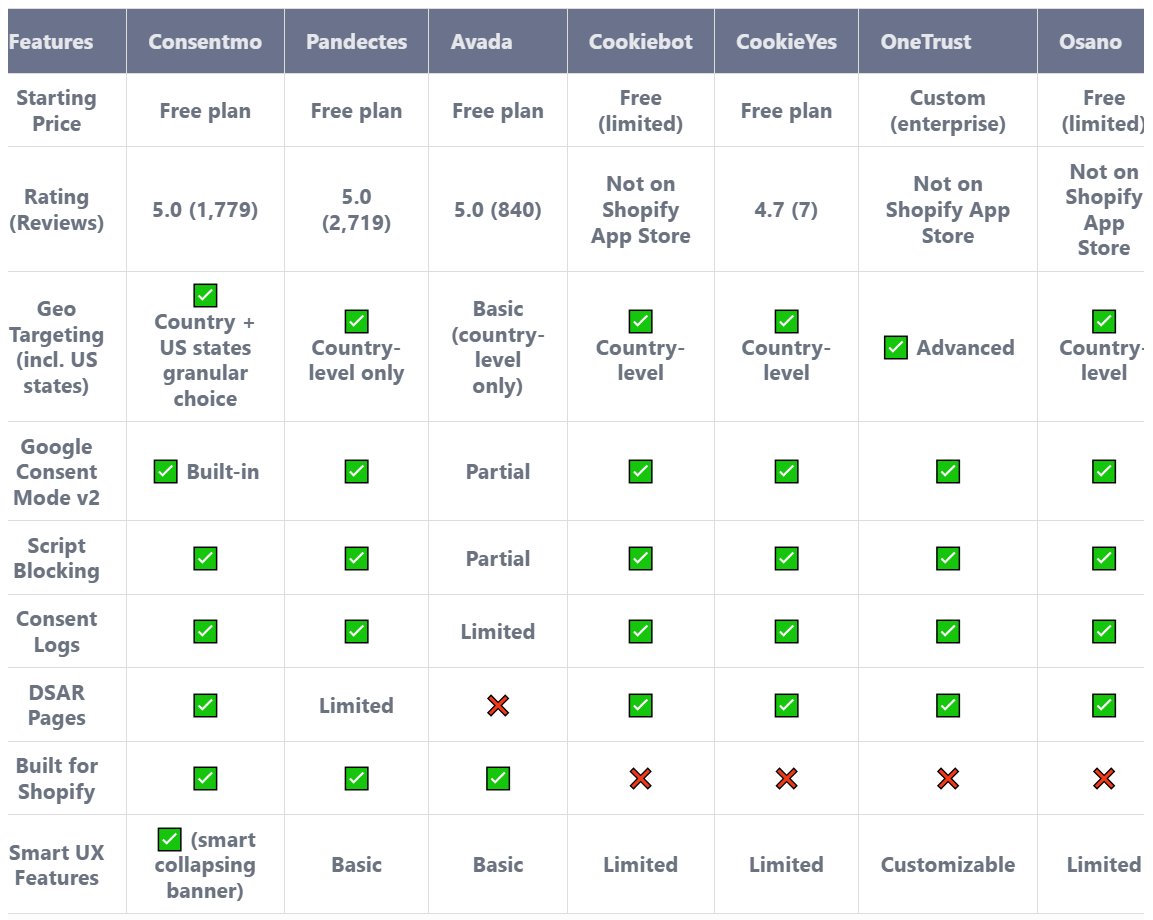
4000 reviews across any app category on Shopify is a lot. Booster SEO earned that volume mostly by being reliable and not requiring constant attention. You set it up, it fixes broken links, compresses images, generates meta tags, and maintains your structured data, without you needing to revisit the dashboard every week.
For store owners who don’t want SEO to be a project, that’s the value proposition. It’s not the most cutting-edge app for AI search specifically, but it handles all the foundational work well enough that most of the technical issues that silently hurt rankings just don’t accumulate over time.
Automated fixes actually do a much better job if you spend a little time upfront auditing things properly instead of just installing them and leaving. Put in 20 minutes at the start, and you’ll barely have to touch it afterward.
4. StoreSEO: AI SEO Blog & Image
Rating: 5.0 / 600+ reviews
Pricing: Free plan available; paid from ~$14.99/month
Badge: Built for Shopify
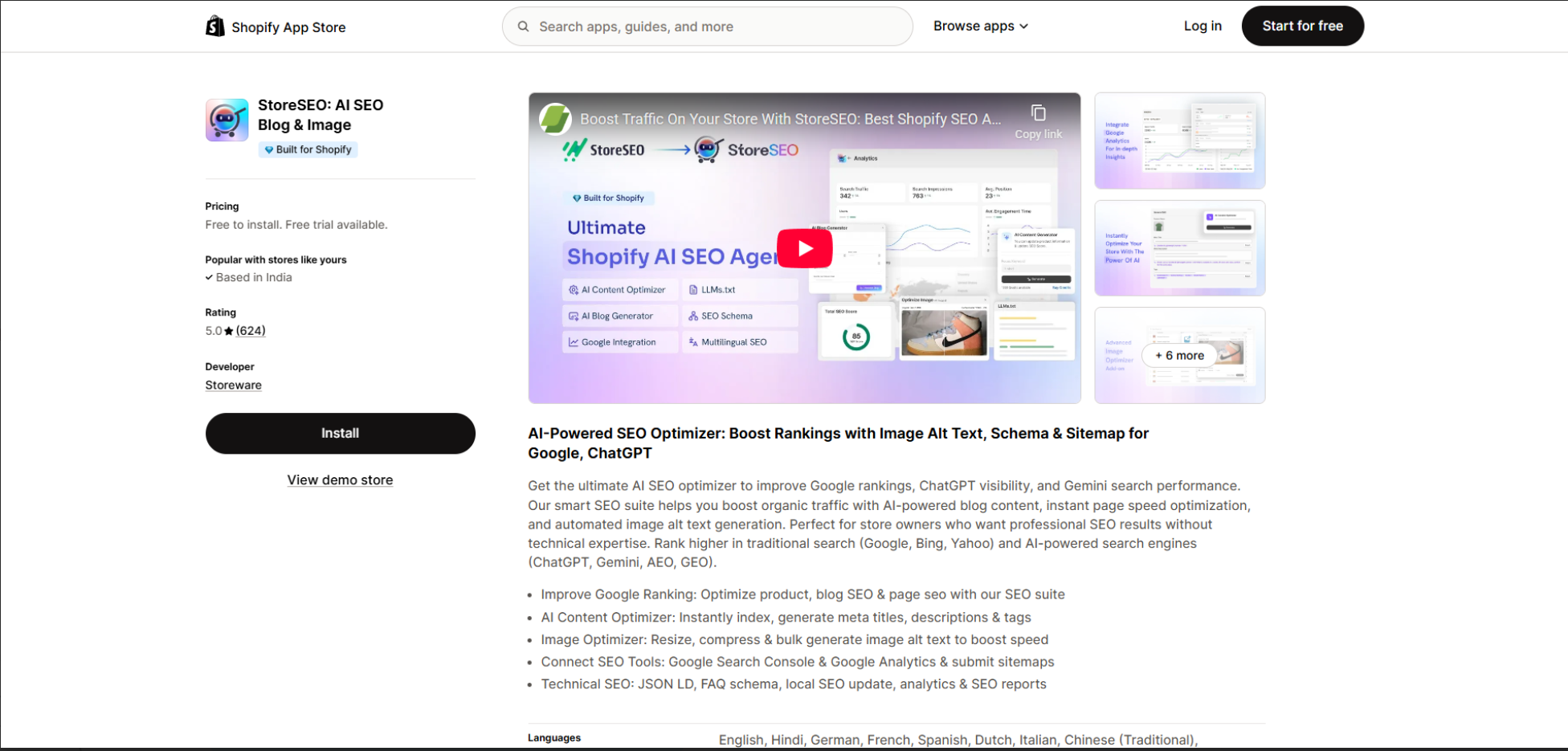
Most Shopify SEO apps are still catching up to where search actually is in 2026. StoreSEO isn’t. What really sets this apart right now is the LLMs.txt generator. It spits out a file that basically explains your store to AI models like ChatGPT, Gemini, Grok, and Claude, so they know what you sell and how to interpret your site.
The rest of the features? They’re solid, no doubt, just not as groundbreaking. You get Google Search Console integration that turns all that raw GSC data into clear, actionable suggestions. There’s structured data setup, sitemap management, and AI-generated meta tags, too. Good stuff, just not the star of the show.
What makes it work together is the dashboard, which actually prioritizes what to fix rather than throwing a wall of red flags at you and leaving you to figure out which ones matter.
If you’re only going to install one SEO app, and your concern is how your store performs in AI-driven search, Google’s AI Overviews, ChatGPT product recommendations, and Perplexity results, this is the one to start with.
5. SearchPie: SEO, Speed & Schema Best for beginners
Rating: 4.9 / 2,000+ reviews
Pricing: Free plan; paid from $39/month
Badge: Built for Shopify
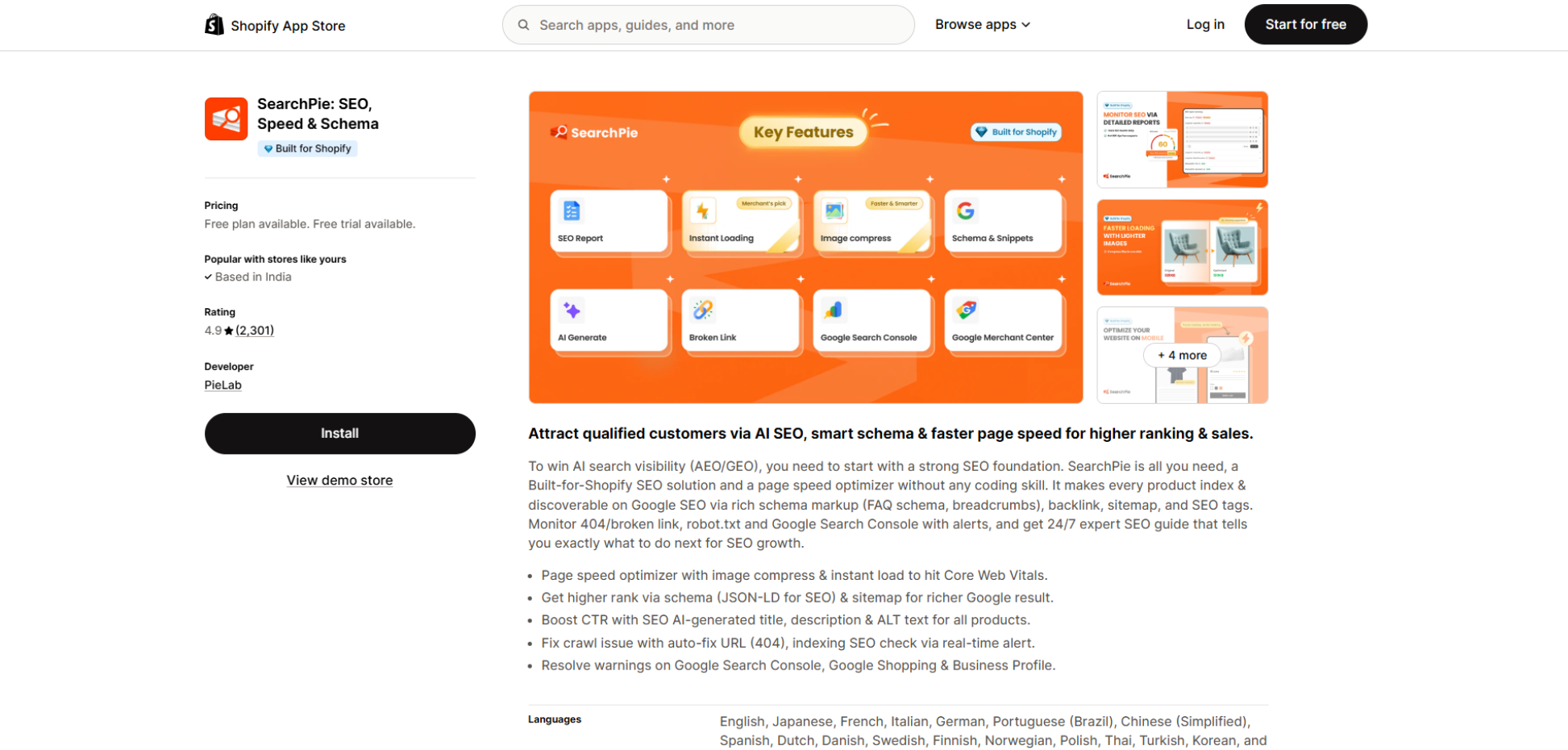
The primary complaint people have about Shopify SEO apps is that they encounter several problems with no guidance on which three to actually fix first. SearchPie is specifically designed to avoid that. It walks you through the process step by step, explains what each optimization does in plain language, and doesn’t assume prior SEO knowledge.
The 24/7 live chat support is mentioned in almost every positive review, and there are a lot of positive reviews. For a store owner who’s never touched SEO and finds the whole category overwhelming, having access to an actual person rather than a help article makes the learning curve significantly shorter.
The schema and speed features are solid, not exceptional. But for a beginner working through SEO systematically for the first time, SearchPie’s biggest value is the guided experience, not the technical depth.
6. Sherpas: Smart SEO
Rating: 4.9 / 900+ reviews
Pricing: Free plan; paid from $14.99/month
Badge: Built for Shopify
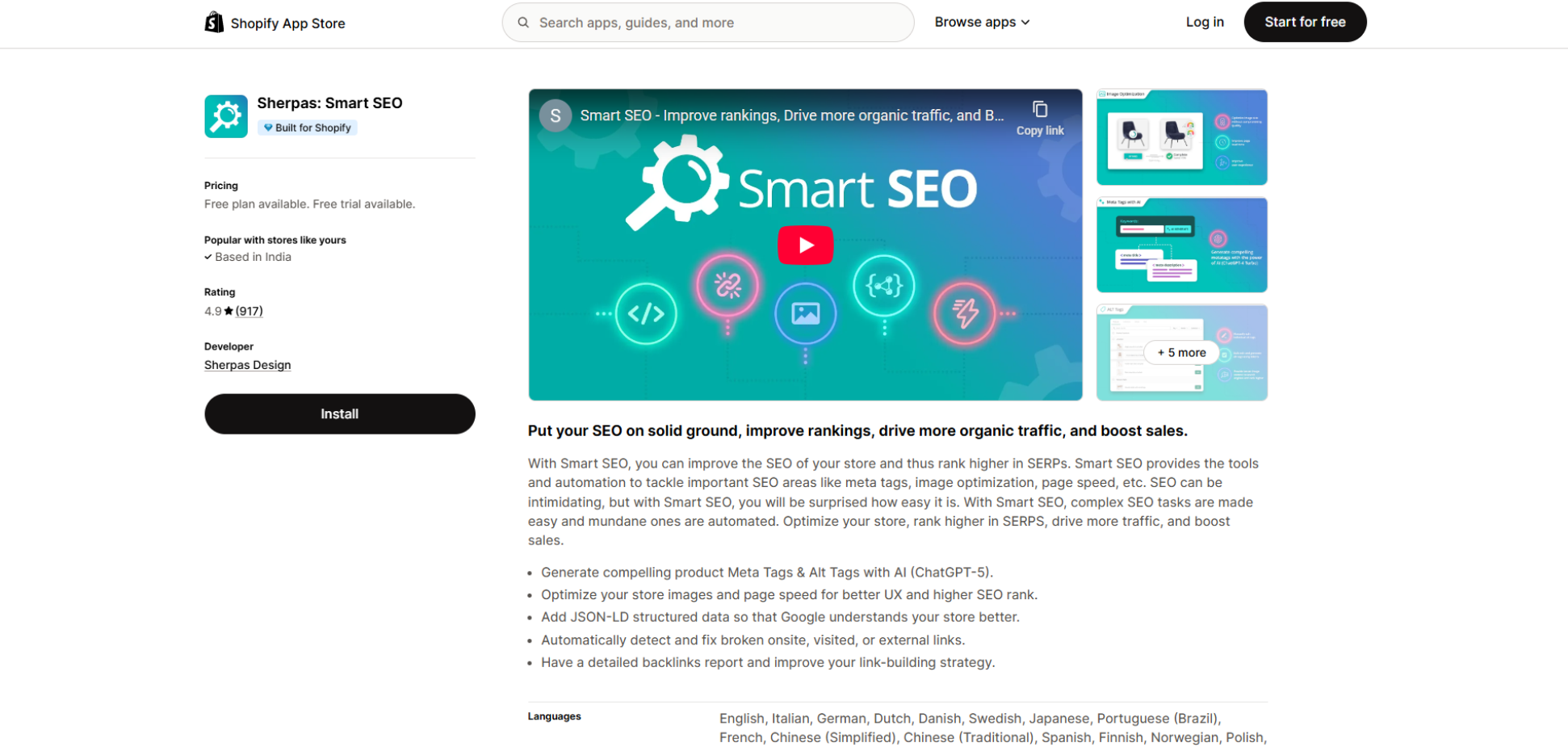
Most SEO apps focus almost entirely on on-page factors. Sherpas is unusual in that it actually monitors backlinks, incoming links from other domains that are a significant ranking signal and one that most Shopify merchants have no visibility into whatsoever.
Beyond backlinks, it handles the things you’d expect: broken link detection and automatic fixes, image compression with predictive loading, and AI-powered metadata generation. The predictive loading feature is worth mentioning separately because it starts loading pages before the user clicks, which produces noticeably better perceived load times in high-traffic situations.
At $9.99 for the entry paid tier, it’s one of the more affordable full-featured options on this list. Stores that have been running for a while and have accumulated a meaningful amount of inbound links are the ones that will get the most from the backlink monitoring, specifically.
7. Tapita: AI SEO Optimizer & Speed
Rating: 5.0 / 2,000+ reviews
Pricing: Free plan; paid from $9.99/month
Badge: Built for Shopify
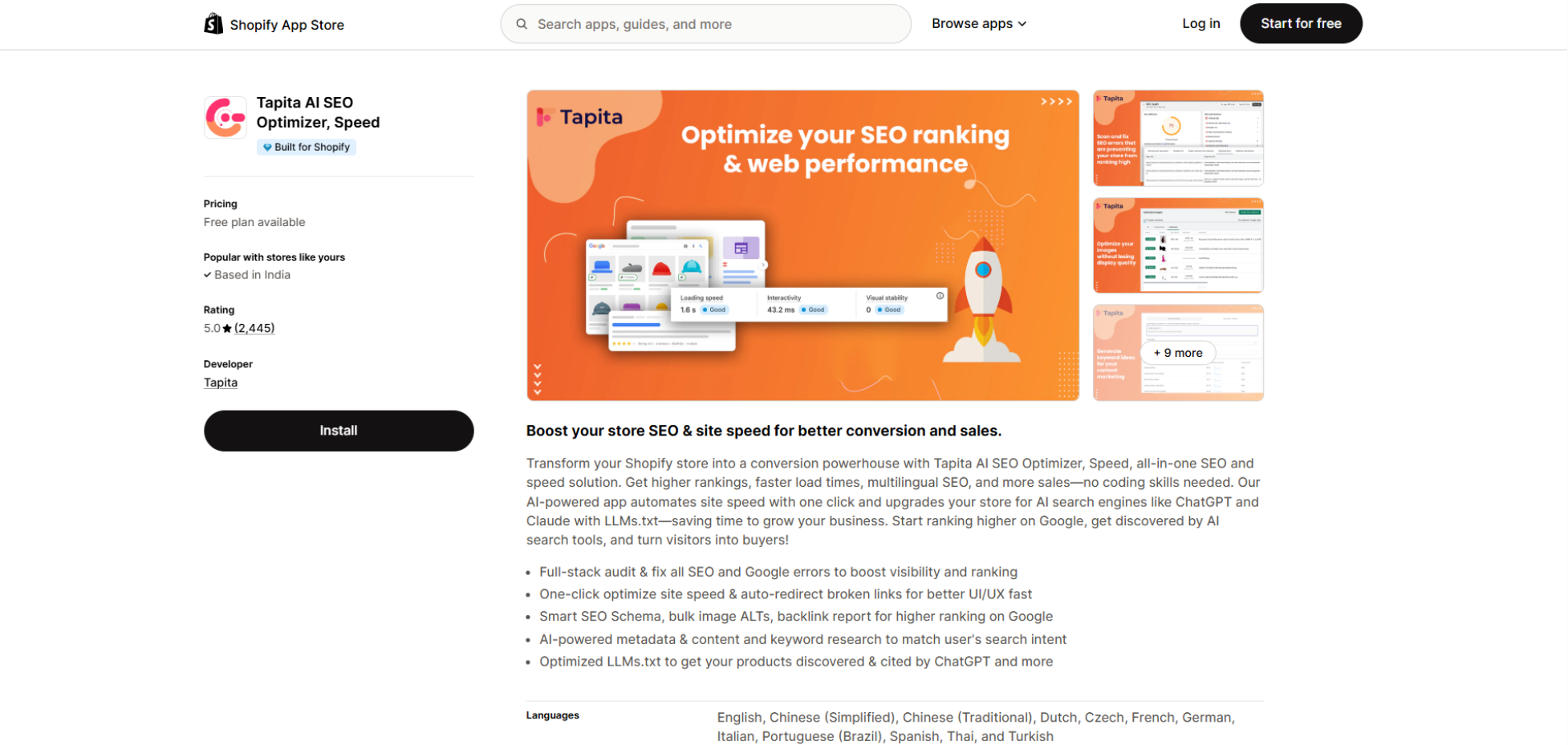
Tapita is frequently cited by Shopify merchants who launched on tight budgets as the app that made the most difference per dollar. The free plan is genuinely functional, not the stripped-down ‘try it for five minutes and hit a paywall’ version that some apps ship. And the paid entry tier at $9.99 unlocks bulk optimization, which is where the real time savings start.
Feature-wise: comprehensive SEO audit, keyword research, structured data setup, Google Search Console integration, speed booster, LLMs.txt generation for AI search, and a content optimization tool that gives page-by-page suggestions based on what you’re actually ranking for. That’s an unusually complete package at this price point.
The one honest caveat: Tapita’s interface is denser than most apps in this category. It doesn’t hold your hand the way SearchPie does. If you’re comfortable with SEO concepts and just need a tool to execute them efficiently, that density is a feature rather than a problem.
8. Yoast SEO
Rating: 4.6 / 100+ reviews
Pricing: $19/month
Badge: Available on Shopify
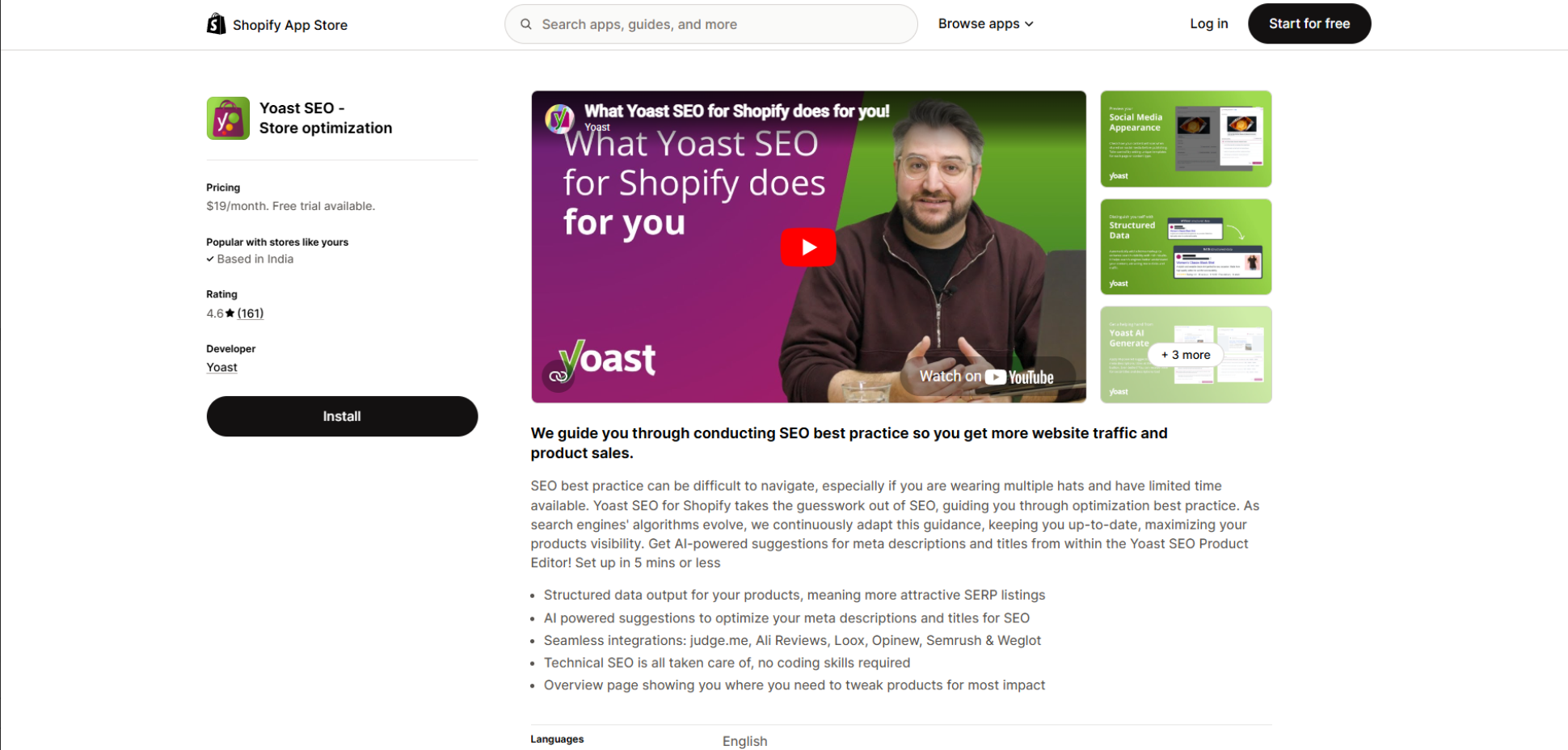
If you’ve built websites on WordPress before, you know Yoast. For more than ten years, it’s been the go-to SEO plugin in its space. But the Shopify version is still pretty new and doesn’t offer everything you’ll find in the WordPress one; that’s something to keep in mind right from the start.
What works great on Shopify? Well, this tool checks how readable your product descriptions and blog posts are, so you’re not just writing for Google, you’re writing for real people too. It helps you manage meta tags and gives you tips for structuring your content. And if you know the WordPress version, you’ll recognize the traffic light system: red, orange, and green signals that instantly show how your content’s doing. It’s still one of the easiest ways to see at a glance if your content hits the mark.
The gap is on the technical side. Yoast for Shopify doesn’t have the same depth of structured data, speed optimization, or AI search features that purpose-built Shopify apps offer. It’s a content SEO tool, not a technical one, which is exactly right for stores that create a lot of editorial content and need help getting it to rank.
9. SEO Instant Indexer
Rating: 4.0 / 15+ reviews
Pricing: Paid from $4.99/month
Badge: Available on Shopify
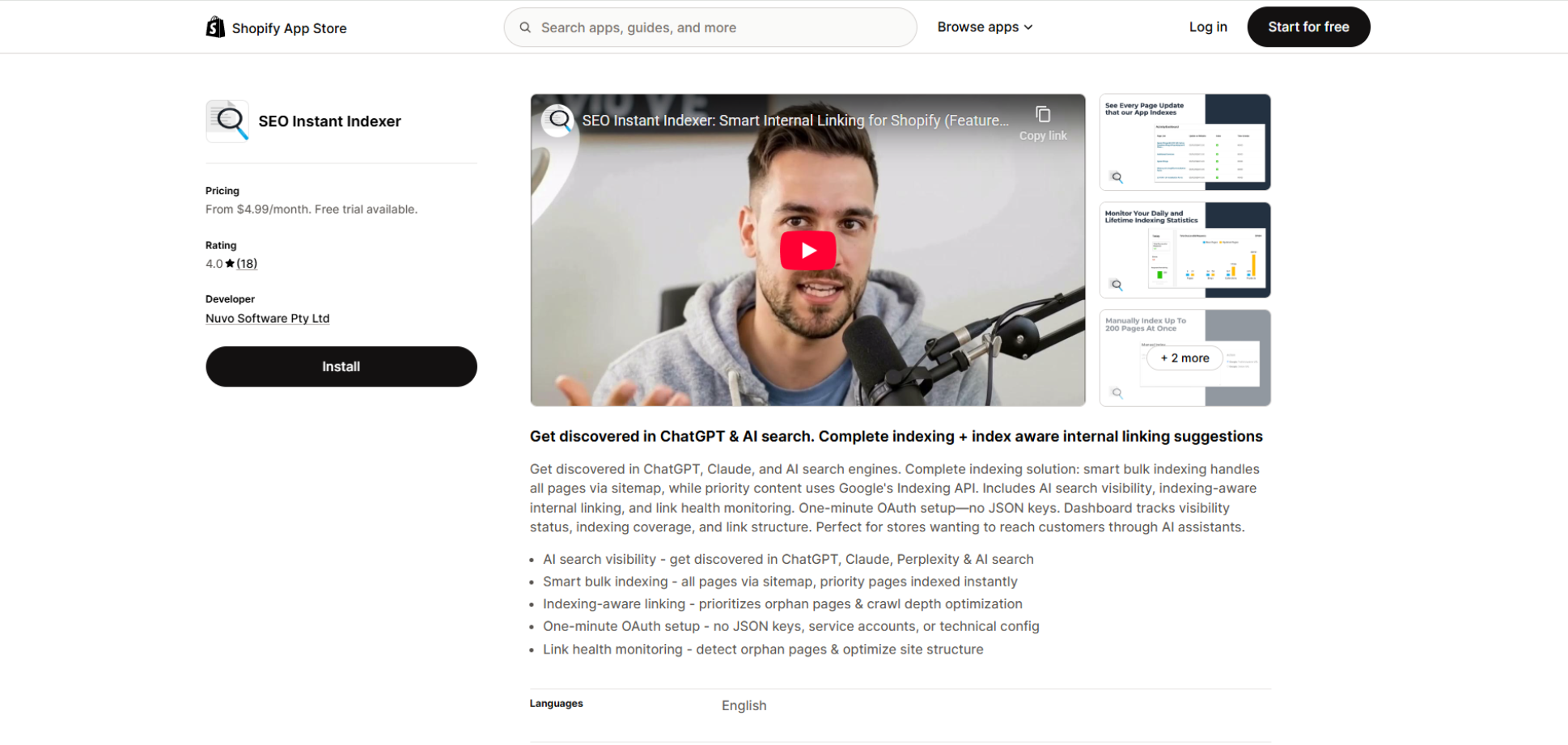
There’s an SEO problem that almost nobody talks about enough: pages that exist on your store but haven’t been indexed by search engines yet. New products, new collections, recently migrated content, Google’s crawl schedule doesn’t care about your launch timeline. Indexly solves this by submitting pages directly via the Google Indexing API, bypassing the wait.
The more recent addition is AI platform indexing, submitting your pages to Bing AI and other AI-powered search tools that have their own indexing pipelines separate from traditional search engine crawlers. You’d typically use it alongside something like StoreSEO or Tapita rather than instead of them. But for stores that launch new products regularly and don’t want to wait two weeks for Google to find them, it fills a gap that other apps don’t address.
10. GP JSON-LD Schema for SEO
Rating: 4.9 / 40+ reviews
Pricing: Free plan; paid from $8.99/month
Badge: Built for Shopify
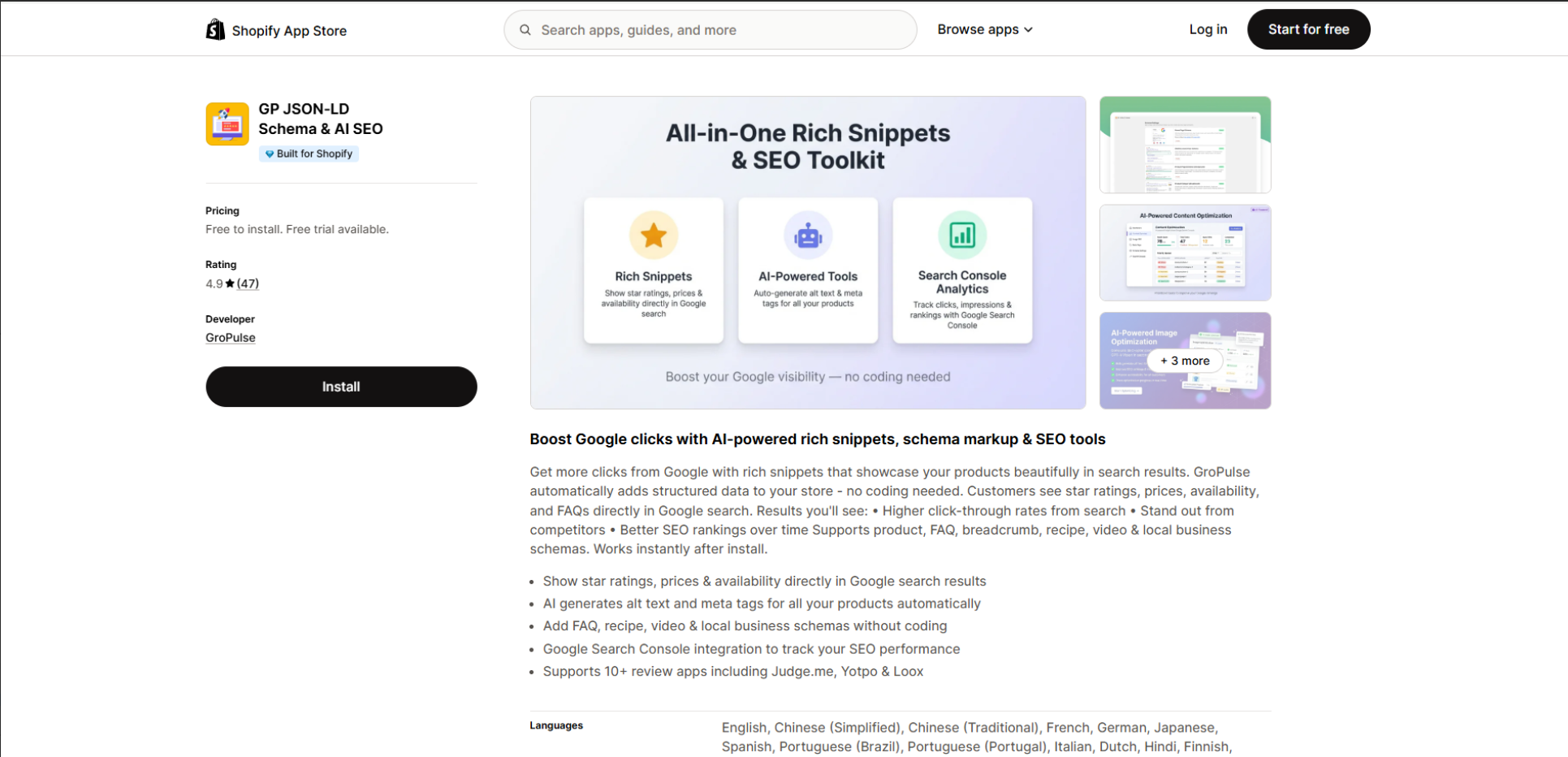
Rich snippets, like star ratings, prices, and availability, that you see next to some search listings appear when you add structured data markup. That’s what lets search engines pick up the info and display it in search results. Most broad SEO apps include a version of this, but GP JSON-LD does it more thoroughly and with more schema types than any all-in-one tool.
Product, review, breadcrumb, organization, FAQ, article, the schema types it supports cover most of what an ecommerce store would realistically need. This matters particularly for AI search: Google’s AI Overviews and other AI-generated answers use structured data to extract product facts, pricing, and reviews when deciding what to surface in a summary.
The setup is code-free. You configure the schema types through the dashboard, and the app handles the implementation. For stores that tried to set up JSON-LD manually and found it confusing, or for developers who want a maintained solution rather than custom code they’ll have to update whenever Shopify changes something, this is worth the install.
How Many Apps Do You Actually Need?
This is worth answering directly because app stacks have a real cost, in money, in page load time, and in the cognitive overhead of maintaining them.
Most stores need two, maybe three SEO apps. One comprehensive app that handles meta tags, structured data, and audit reporting. One image optimizer if your catalog is large or your PageSpeed score is below 70. And optionally a specialist tool, Indexly for rapid indexing, GP JSON-LD for rich snippet depth, or Sherpas if backlink monitoring is important to you.
What you want to avoid: installing five apps that all do image compression and meta tag generation, because they will conflict with each other and you’ll end up worse off than with one good app and nothing else.
The AI search piece, specifically, LLMs.txt generation, comprehensive structured data, content that AI systems can parse and cite, is not something you can bolt on after the fact as easily as image compression. It works better when it’s part of how your store is structured from early on. If you’re reading this and haven’t started on that side of things yet, StoreSEO or Tapita are both reasonable places to start today.
1. What does “AI visibility” mean for a Shopify store?
It’s basically about how easily your store shows up in AI-driven results. That includes search engines using AI, voice assistants, and tools that summarize or recommend products. If your content is clear, structured, and well-optimized, AI systems can understand and surface it more easily.
2. Can Shopify apps really improve SEO performance?
They can help, but they’re not magic. Good apps make it easier to handle things like meta tags, structured data, page speed, and image optimization. The results still depend on how well you use them and whether your content actually adds value.
3. Do I need multiple SEO apps for better results?
Not necessarily. In many cases, using too many apps can slow your site down or create conflicts. It’s usually better to choose one or two solid tools and set them up properly instead of stacking everything you find.
4. Which features should I look for in an SEO or AI-focused Shopify app?
Look for practical features like structured data (schema), automated meta tags, image optimization, and performance improvements. If the app also helps with content organization or internal linking, that’s a bonus.
5. Will these apps help my store rank higher on Google?
They can support your efforts, but they won’t guarantee rankings. Search engines still prioritize relevance, content quality, and user experience. Apps just make the technical side easier to manage.
Author: Megha Meshavaniya
Author’s bio: Megha Meshavaniyais a Content Strategist, Content Writer, and Marketing Lead with 7 years of experience in writing and strategy planning. She helps companies with a clear, AI- smart strategy and content. With experience across SEO, UX writing, and editorial content, she collaborates with cross-functional teams to create scalable content systems and improve digital experiences.
Megha Meshavaniya is a Content Strategist and Marketing Lead with 7 years of experience in SEO, UX writing, and editorial content. She helps companies build scalable content systems and improve digital experiences. She writes on behalf of SpeedBoostr, a Shopify SEO and performance optimization app.
Read more from SpeedBoostr at SpeedBoostr

Learn what Gross Merchandise Value (GMV) means, how to calculate it, and how ecommerce brands use GMV to track growth, revenue, and performance.


Learn how Shopify product spec sheets and AI chatbots reduce support tickets, eliminate buyer friction, and increase ecommerce conversions.

See 10 ecommerce revenue models — pros, cons, and examples. Use the decision matrix to choose the right revenue model and boost your store's profitability.

Agentic commerce explained: what it is, how it differs from conversational commerce, the 4 agent capabilities, 10 use cases, ROI benchmarks, and the 2026 platform shift.