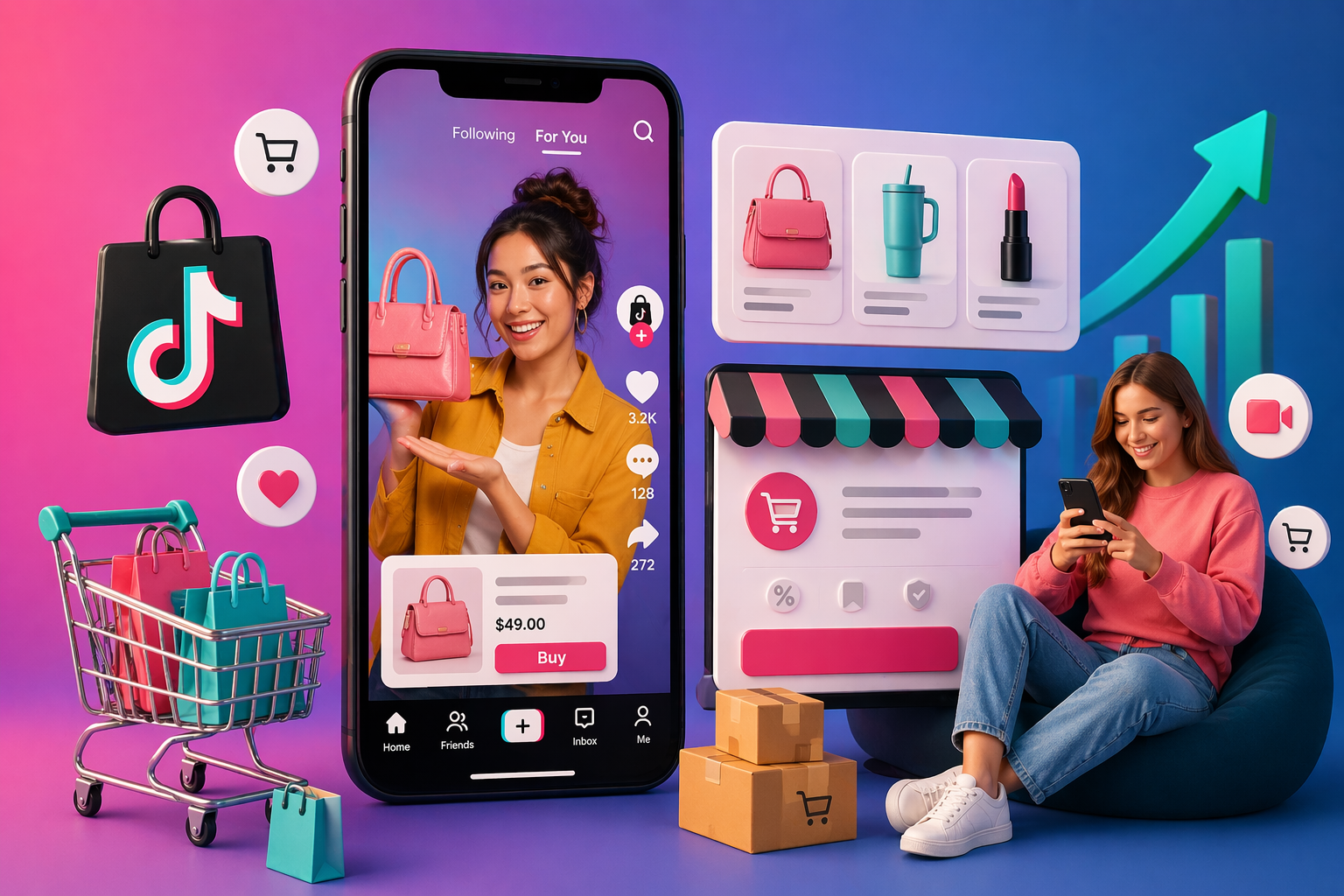
TikTok Shop collapses the entire ecommerce funnel into one platform, turning content into a direct sales channel. It combines discovery, product interaction, and checkout in a single in-app experience.
This guide explains how TikTok Shop works, how it compares to traditional ecommerce, and whether it fits your growth strategy.
What Is TikTok Shop?
TikTok Shop is an in-app commerce system that allows brands, merchants, and creators to sell products directly through TikTok content.
It integrates product listings into videos, LIVE streams, and creator content, allowing users to purchase instantly without leaving the app.
Key insight:
TikTok Shop turns content into a checkout experience, not just a traffic source.
“TikTok is not just an entertainment platform anymore—it’s a discovery engine where products go viral and sell out in hours.” — Gary Vaynerchuk.
How TikTok Shop differs from traditional ecommerce
TikTok Shop changes how users move from discovery to purchase.
-
Native checkout inside TikTok
Users complete purchases without being redirected to an external website.
→ This removes friction and increases impulse buying.
-
Shortened discovery-to-purchase journey
Traditional flow:
Ad → Website → Product page → Checkout
TikTok Shop flow:
Content → Product → Checkout
→ Fewer steps mean higher conversion velocity.
-
Social proof embedded into feed
Likes, comments, shares, and creator endorsements appear alongside products.
→ Trust is built directly within the buying experience.
Key insight:
TikTok merges entertainment and commerce into one continuous flow.
TikTok Shop vs Shopify storefront
There are key strategic differences between TikTok Shop and a Shopify store.
Ownership of customer data
- TikTok Shop: Limited access to customer data.
- Shopify: Full ownership of customer data.
→ This affects retention and long-term marketing.
Margin implications
- TikTok Shop includes platform fees and creator commissions.
- Shopify margins are more controlled.
→ TikTok trades margin for distribution and reach.
Brand control
- TikTok Shop relies heavily on creator-led content.
- Shopify allows full control over branding and UX.
→ TikTok favors speed and authenticity over polish.
Key insight:
TikTok Shop optimizes for conversion speed, while Shopify optimizes for control and long-term value.
How TikTok Shop Works (End-to-End)
TikTok Shop operates through a structured system that connects sellers, creators, and buyers within the app.
Seller onboarding and account setup
To start selling, merchants must complete a setup process inside the TikTok Shop Seller Center.
Required documentation
- Business registration details.
- Identity verification.
- Bank account information.
→ Ensures compliance and payment processing.
Product catalog integration
- Upload products manually or sync via ecommerce platforms.
- Add pricing, inventory, and product details.
→ Creates a live product feed for TikTok.
Payment setup
- Connect payout methods.
- Configure tax and billing details.
→ Enables smooth transaction handling.
Fulfillment models
TikTok Shop offers multiple fulfillment options depending on your setup.
Merchant fulfilled
- You handle storage, packing, and shipping.
→ Full control but higher operational workload.
TikTok fulfilled
- TikTok manages logistics and delivery (in supported regions).
→ Faster shipping and simplified operations.
Creator affiliate model
- Creators promote your products and earn commissions.
→ Scales reach without upfront ad spend.
Key insight:
Fulfillment flexibility allows brands to balance control and scalability.
Commission fees and payout structure
Understanding the economics is critical before launching.
Platform fees
- TikTok charges a commission per sale.
→ Typically, a percentage of each transaction.
Affiliate commission
- Brands set commission rates for creators.
→ Higher commissions attract more creators.
Refund mechanics
- Returns and refunds are handled within TikTok’s system.
→ Impacts margins and cash flow timing.
Key insight:
TikTok Shop operates on a performance-based model where distribution comes at a cost.
How Users Discover and Buy Products on TikTok Shop
TikTok Shop converts attention into purchases through multiple entry points inside the app.
In-feed videos
Products appear directly inside short-form videos.
- Users scroll content.
- See a tagged product.
- Tap to view details.
- Checkout instantly.
→ Discovery and purchase happen in seconds.
Creators and brands sell products during live streams.
- Host demonstrates products in real time.
- Answers questions instantly.
- Shares limited-time offers.
→ Creates urgency and boosts conversion rates.
Product showcase tabs
Brands can display products on their TikTok profiles.
- Dedicated product section.
- Organized catalog view.
- Direct purchase options.
→ Acts like a mini storefront.
Creator affiliate content
Creators promote products using affiliate links.
- Product appears in creator videos.
- Followers trust recommendations.
- Commission incentivizes promotion.
→ Scales reach without paid ads.
Full customer journey
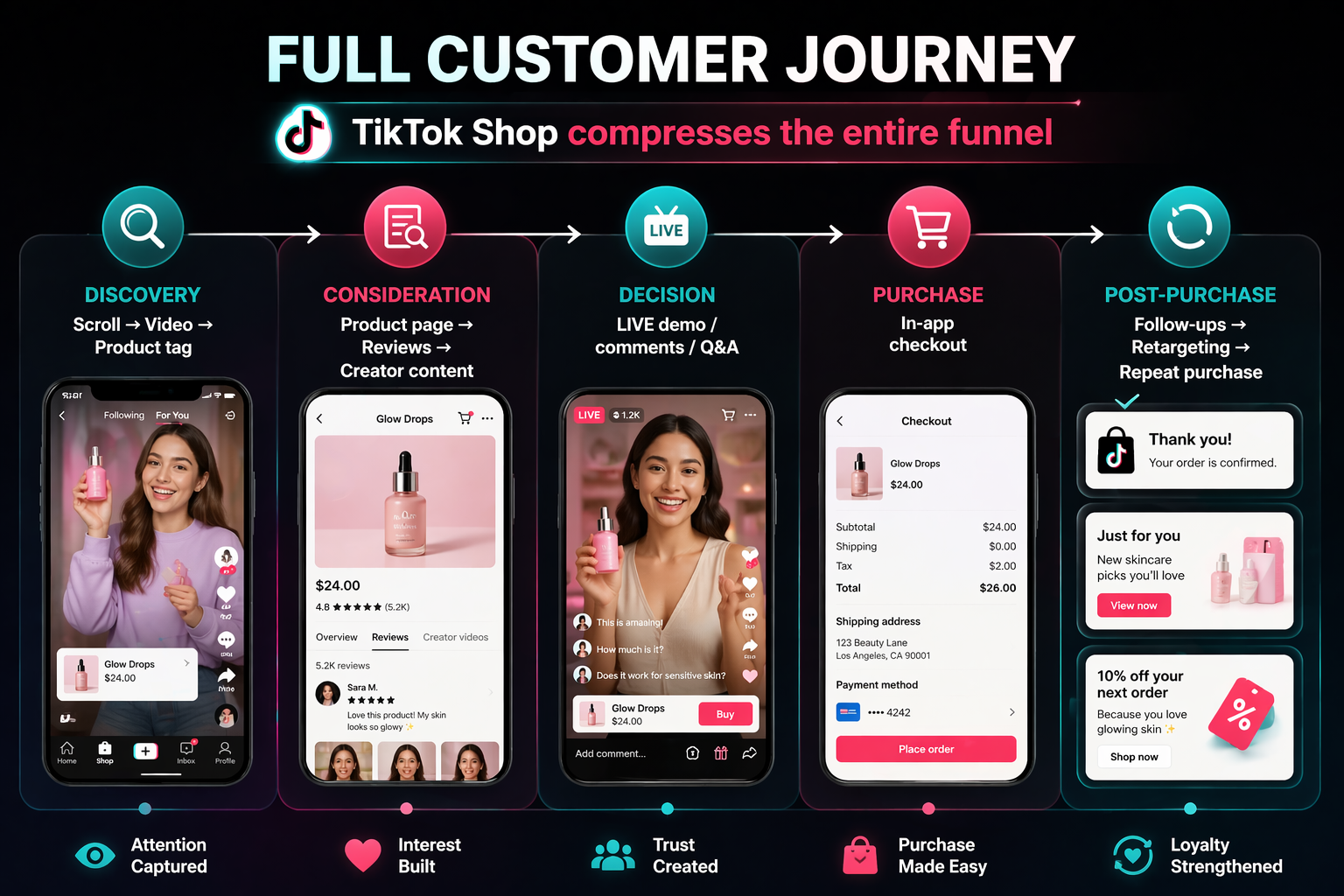
TikTok Shop compresses the entire funnel:
Discovery
Scroll → Video → Product tag
Consideration
Product page → Reviews → Creator content
Decision
LIVE demo / comments / Q&A
Purchase
In-app checkout
Post-purchase
Follow-ups → Retargeting → Repeat purchase
Key insight:
TikTok removes steps, which increases conversion velocity.
TikTok Shop is designed for speed, simplicity, and engagement.
Users move from content to checkout without friction.
- No redirects to external websites.
- Pre-filled user data speeds up checkout.
- Minimal steps to complete the purchase.
→ Faster journeys lead to higher conversion rates.
Key insight:
Fewer clicks = more completed purchases.
Built-in trust and social validation
Every product is surrounded by real user signals.
- Likes, comments, and shares.
- Creator endorsements.
- User-generated content.
→ Trust is created before users even click.
Mobile-first and behavior-driven design
TikTok is optimized for how users actually browse.
- Vertical video format.
- Instant interaction (tap, swipe, buy).
- Algorithm-driven personalization.
→ Products are shown at the right moment of intent.
How TikTok Shop Enables Social Commerce
TikTok Shop is not just ecommerce. It is a social commerce system where content drives transactions.
Content-driven buying behavior
Users don’t search. They discover.
- Products appear naturally in content.
- Entertainment blends with online shopping.
- Buying feels like part of scrolling.
→ Reduces resistance to purchase.
“The future of ecommerce is content-first. The brands that win will be the ones that feel native to the platform, not like advertisers.” — Alex Hormozi.
Creator-led distribution
Creators act as sales channels.
- They introduce products to audiences.
- Demonstrate real use cases.
- Influence purchase decisions.
→ Trust replaces traditional advertising.
Engagement directly impacts sales.
- Comments answer objections.
- Community feedback builds credibility.
- Viral content drives spikes in demand.
→ Conversion is influenced by collective behavior.
Key insight:
Social commerce turns audiences into active participants in the buying process.
TikTok Shop Market Opportunity
TikTok Shop sales are growing fast as social commerce adoption increases globally.
Growth statistics
- TikTok has over 1B+ active users globally (Reuters).
- Social commerce is projected to exceed $1 trillion globally (Accenture).
- TikTok Shop adoption is accelerating across major markets.
High traffic + native checkout = strong conversion potential.
Categories performing well
- Beauty and skincare.
- Fashion and accessories.
- Health and wellness.
- Gadgets and impulse products.
→ Products with visual appeal perform best.
Impulse-driven buying behavior
- Short-form content drives quick decisions.
- Limited-time offers increase urgency.
- Social proof reduces hesitation.
→ Purchases happen faster than traditional ecommerce.
Emerging regions
- Southeast Asia (early strong adoption).
- United States (rapid growth phase).
- United Kingdom (expanding creator economy).
→ Expansion creates new opportunities for brands.
Key insight:
TikTok Shop rewards speed, content quality, and trend alignment.
Pros and Cons of Selling on TikTok Shop
Pros
Native checkout
- Eliminates friction
→ Higher conversion rates
High organic reach
- Algorithm-driven distribution
→ Lower acquisition costs
Creator amplification
- Influencers promote products
→ Scalable growth without ads
Cons
Lower data ownership
- Limited access to customer data
→ Weakens long-term retention
Margin compression
- Platform + creator fees
→ Reduced profit per order
Platform dependency risk
- Reliance on the TikTok ecosystem
→ Less control over growth
Key insight:
TikTok Shop trades control for speed and reach.
TikTok Shop Best Practices for E-commerce Brands
- Hook attention within 3 seconds.
- Focus on product-in-use content.
- Use native, unpolished visuals.
→ Content must match TikTok behavior.
Leverage affiliate creators strategically
- Partner with niche creators.
- Offer competitive commissions.
- Test multiple creators quickly.
→ Scale distribution through performance.
Prioritize velocity over polish
- Launch fast and iterate.
- Test multiple creatives daily.
- Respond to trends quickly.
→ Speed beats perfection on TikTok.
Prepare your post-click experience
- Ensure fast checkout flow.
- Optimize product pages (if external).
- Handle support instantly.
→ Conversion depends on response speed.
If traffic spills to your site, real-time engagement becomes critical.
This is where tools like Zipchat act as a conversion layer, guiding users, answering questions, and reducing drop-offs in real time.
Is TikTok Shop Right for Your Brand?
Use this framework to evaluate fit:
AOV (Average Order Value)
- Lower AOV products perform better
→ Impulse-friendly pricing wins
Margin
- Must absorb platform + creator fees
→ Thin margins may struggle
Logistics readiness
- Fast fulfillment is critical
→ Delays reduce ratings and reach
Creative bandwidth
- Requires constant content production
→ Brands must sustain output
Key insight:
TikTok Shop works best for brands that can move fast, create content consistently, and operate with flexible margins.
Conclusion
TikTok Shop is not just a sales channel. It is a high-velocity conversion engine built on content.
However, traffic alone does not guarantee revenue. When users move beyond TikTok to your store, conversion becomes your responsibility.
This is where Zipchat acts as infrastructure. It turns incoming traffic into guided buying journeys that boost conversions and make revenue more predictable. Zipchat’s seamless integration with social media platforms helps you capture and convert traffic from every channel.
Audit your store’s readiness for TikTok traffic and ensure your conversion systems can handle high-intent visitors effectively.
FAQ
What is TikTok Shop, and how does it work?
TikTok Shop is an in-app ecommerce system that lets users discover, browse, and buy products without leaving TikTok. It connects content, product listings, and checkout into one seamless flow, which increases conversion speed.
How is TikTok Shop different from a Shopify store?
TikTok Shop focuses on in-app conversions and fast purchases, while Shopify focuses on owned customer data and long-term brand control. TikTok drives discovery and impulse buying, while Shopify supports deeper customer relationships.
What fees does TikTok Shop charge sellers?
TikTok Shop charges a percentage per sale as a platform fee. Brands may also pay affiliate commissions to creators. Total costs vary based on pricing, commission rates, and fulfillment setup.
How can I increase conversions from TikTok Shop traffic?
You need fast response systems and optimized experiences. If users land on your site, tools like Zipchat help guide shoppers, answer questions instantly, and reduce drop-offs. This turns traffic into revenue.