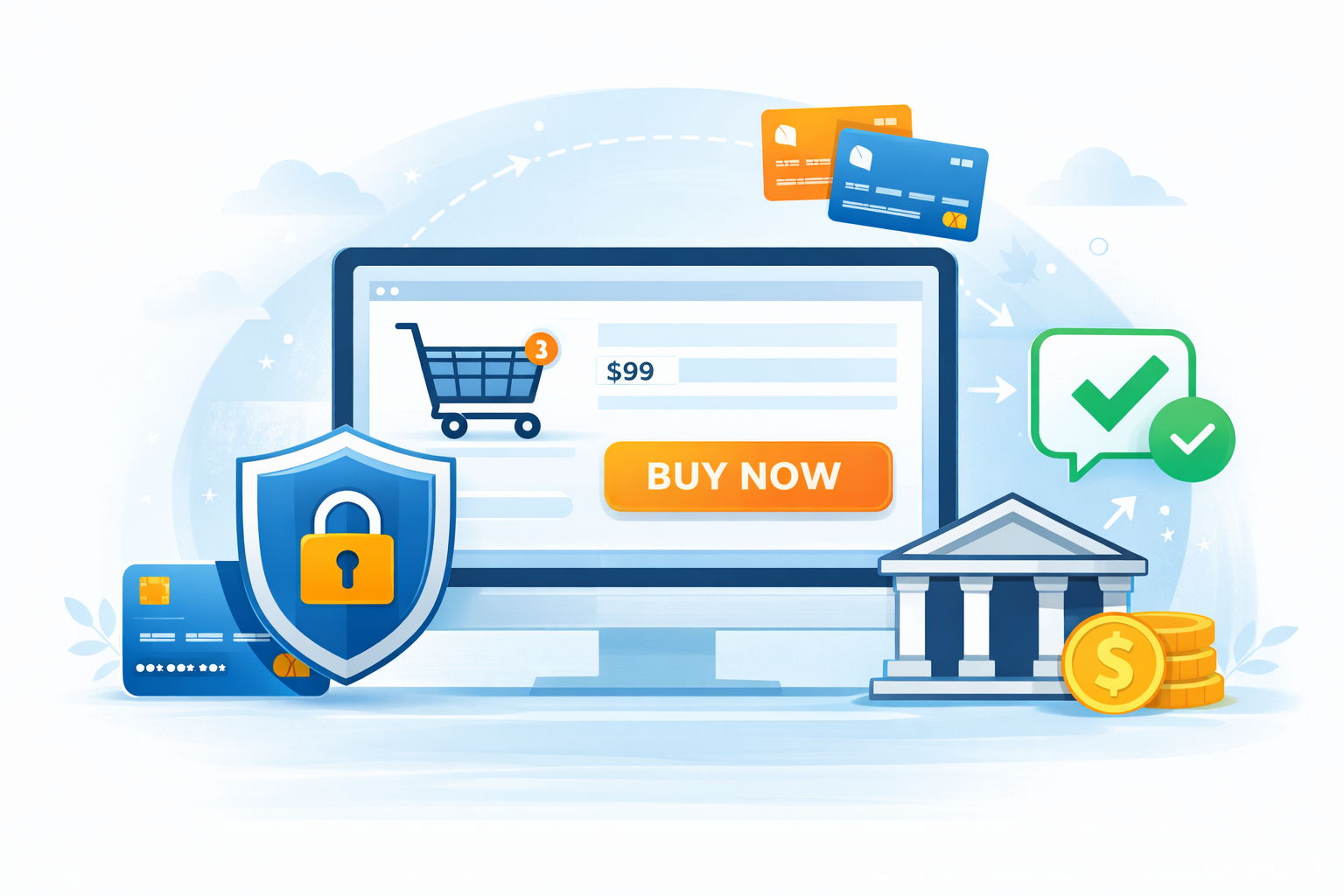
There is a point in every ecommerce transaction when everything is on the line: the checkout. The customer has looked around, compared options, and decided to make a purchase. But in those last seconds, something tiny can go awry. A slow payment page. A failed transaction.
With global retail ecommerce sales projected to reach US$8.1 trillion by 2026 (Statista), and customers preferring payment methods they can trust, ecommerce payment processing has now become the real deal. It now decides whether intention becomes a reward or not.
To complicate the task is how invisible it all seems. Behind-the-scenes payment systems have a significant impact on conversion rates, customer confidence, and growth. A setup that’s clunky or unreliable creates friction.
Customers are turned off by a few payment choices. In reality, payment friction is one of the greatest causes of lost revenue; not because customers don’t want to buy, but because doing so has become harder than it needs to be.
In this guide, you will learn what ecommerce payment processing is, how it’s done, the role of processors and gateways in this process, and how payment performance can improve conversions.
You’ll also learn how to select a solution that fits your ecommerce business and see how tools like Zipchat can subtly support this by providing real-time, tailored help for shoppers, which enables them to finalize checkout orders with peace of mind.
Key Takeaways
Ecommerce payment processing is the secure way that payments for online transactions are made from checkout to settlement.
Payment frustrations can lead to abandoned carts and lower conversion rates.
Payment gateways and processors have separate, yet intertwined transactional roles.
Costs are more than simply transaction fees; there’s fraud, chargebacks, and failed payments to think about as they eat into margins.
The right payment setup depends on your store size, audience, and supported payment methods.
Optimizing payments can reduce friction, build trust, and drive more completed checkouts.
What Is Ecommerce Payment Processing?
Ecommerce payment processing is the process of accepting, authorizing, and delivering payments through an online store. It links up everything that follows when a customer clicks “Pay,” from collecting payment details to authorizing the transaction and sending the money to the business.
At its core, ecommerce payment processing involves two key components:
A payment gateway, which securely collects and transmits customer payment data
A payment processor, which communicates with banks to approve and complete the transaction
Together, they ensure that online transactions happen quickly, safely, and securely.
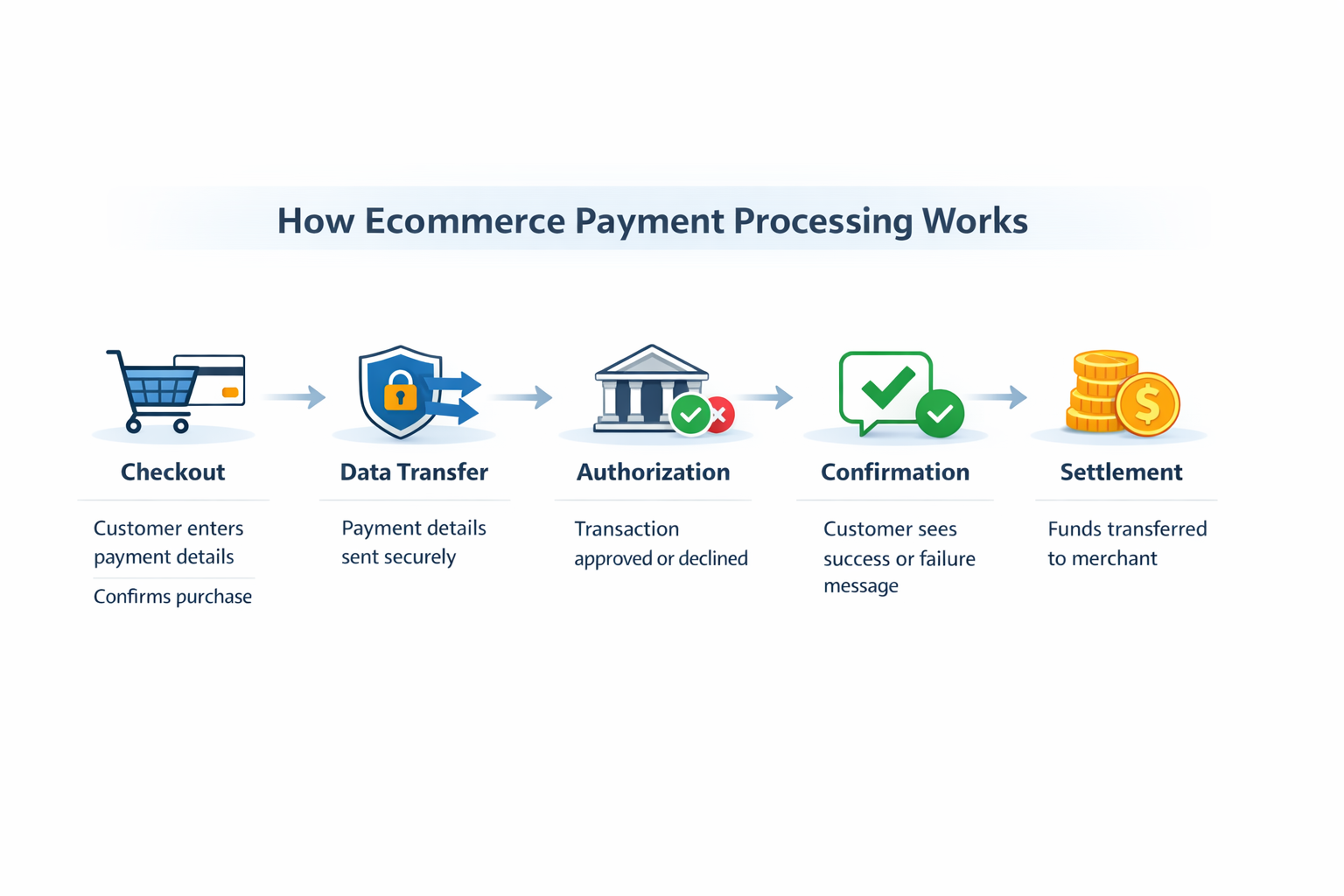
How Ecommerce Payment Processing Works
In order to make it a bit easier for you to understand, let’s break down exactly how ecommerce payments work behind the scenes.
Checkout
The customer fills their payment information (card or wallet) on the checkout page and places an order.
Data Transfer
The transaction is then sent to the payment service providers by the secure payment gateway, which in turn receives and decrypts it before forwarding it to the bank.
Authorization
The payment processor (or acquiring bank) communicates with the customer’s bank (issuing bank) to see if there are enough funds and if it’s an approved transaction.
Confirmation
The bank either approves or rejects the purchase. The response is passed through the processor and gateway to the ecommerce storefront.
Settlement
Once authorized, the funds are debited from the customer's account and transferred to the merchant's account.
The Role of Payment Gateways
A payment gateway is the secure link between your online store and the merchant account. Its primary role is to gather sensitive payment data from customers and securely transmit it for processing.
Then the payment gateway encrypts the valuable information (such as card numbers), helping in the prevention of fraud and abiding by security standards. In a nutshell, the payment gateway enables you to confidently enter payment details at checkout; without it, secure online transactions simply wouldn’t be possible.
The Role of Payment Processors
The back end’s ecommerce payment processor is what takes money from the customer’s bank account and moves it into the merchant's bank account. When a customer makes a purchase, the processor contacts the bank that issued the card to determine whether it is legit and there are sufficient funds in the account to cover the payment. Afterwards, it helps transfer money to the business.
In essence, a gateway handles the data while the payment processor transfers the money, ensuring that each transaction is processed properly and without issue.
How Ecommerce Payment Processing Affects Conversion and Checkout Friction
Ecommerce payment processing is directly related to whether a customer makes the purchase or leaves it in their cart. That layer of effort that even small issues at checkout impose, friction, and friction kills conversions.
Payment processing affects performance as follows:
Reliability
Failed or blocked transactions (even false declines) could directly result in a lost sale. Customers rarely retry multiple times.
Speed
And then the drop somehow gets worse if pages load slowly, or they're just slow to authorize. Swift, slick transactions keep participants rolling.
Trust and security perception
Customers are more likely to hit that purchase button when they see a payment flow that they know and trust. The appearance of poor design or unusual flows can sow doubt.
Available payment methods
Consumers want choices such as credit card payments, digital wallets, and other local methods of payment. Limited options can lower the number of would-be buyers.
Regional payment preferences
Different markets have different payment methods that they prefer. In global ecommerce, failing to support local preferences can lead to a tremendous drop in conversion rates.
Poor-quality page components
This also leads to checkout friction, which in turn has a negative effect on your cart abandonment and conversions.
This is where a platform like Zipchat can have a quiet, but pretty intense impact. Connecting with your ecommerce system gives a real-time personalized assistance, answering payment queries, guiding users through checkout, reducing cart abandonment, and easing uncertainty before it causes drop-off.
Cost Considerations in E-commerce Payment Processing
Understanding Transaction Fees' Structures
Payment processors usually charge a combination of the following fees:
Transaction fees (% of every sale)
Fixed fees per transaction
Monthly platform or service fees
Those costs can change based on the supplier, scope of payment, and location.
Comparing Costs Across Different Processors
Not all payment processors price the same way. Some provide flat-rate pricing, some use interchange-plus, and others employ tiered pricing.
Which one is best for your business will depend on your volume of transactions, average order value, and where your customers are based. When you compare providers, side by side, you’ll see the real cost of processing payments, not just headline rates.
Hidden Fees, and How To Avoid Them
It’s not just the rate, but also where your money is going when you pay for credit card processing. In addition to standard fees, other costs could be lurking in the form of indirect fees, and they can take a big bite out of your margin.
The two most critical pieces of the puzzle are:
Fraud prevention costs
Anti-fraud detection and prevention tools/systems typically include various fees, but can be invaluable to maintaining your bottom line.
Chargebacks
When transactions are challenged by the customer, companies not only lose the sale amount but can also be penalized with chargeback fees. High chargeback rates may, in fact, result in higher processing fees over time.
To avoid these costs:
Monitor transaction data closely.
Use fraud detection tools strategically
All misunderstandings with passengers must be avoided through clear customer communication. Knowing these hidden factors can mean the difference between getting a payment processing setup that safeguards your revenue and long-term profitability.
Choosing the Right Payment Processing Solutions for Your Online Transactions
Selecting the best ecommerce payment processing solution is more than just about fees; it’s also about performance, reliability, and how well it fits in with your operations.
The optimal setup minimizes friction, accommodates your customers’ preferences, and grows with your business. There are some things you should consider before choosing one, and we’re going to list the most important factors.
Features That Speed Up Transactions
Speed is critical at checkout. The longer their transaction closes, the greater the chance of drop off rises. Watch for factors that will minimize the delays and ease the process:
Fast authorization times
Confirms payments in a flash, so checkout is fast.
One-click or accelerated checkout
Cut your purchase down into one easy step.
Auto-fill and saved payment details.
Enables previous customers to make repeat purchases that are as easy and fast as possible
Optimized mobile checkout
A smooth mobile experience is crucial, since a chunk of ecommerce traffic is mobile traffic. These capabilities, in turn, directly influence conversion rates by reducing friction at the most influential phase of the buyer experience.
Compatibility With Ecommerce Platforms
Your point of sale software should work with your current store. Regardless of whether you are a Shopify, WooCommerce, or Magento fan, compatibility means:
Faster implementation
Fewer technical issues
Smoother data flow between systems
Solid integrations mean you can integrate with other tools in your stack. For instance, integrating payment systems with ecommerce platforms such as Zipchat allows for improved synchrony between checkout processes and customer service.
Security Features and PCI Compliance
In ecommerce payments, security is paramount. The payment processor you can trust should comprise:
PCI DSS compliance
Manages the secure processing of sensitive card information
Encryption and tokenization
Protects customer information during transactions
Fraud detection tools
Spot suspicious activity and help keep risk in check
Strong security not only protects your business, but it also builds customer trust, which is a key factor in checkout completion.
Credit and Debit Cards and Other Alternative Payment Methods
The more ways to pay that you provide, the less friction there is for customers to go ahead and make a purchase. The best payment processing service should have the following:
Credit and debit cards
Digital wallets (such as Apple Pay, Google Pay)
Buy Now, Pay Later (BNPL) options.
Local and regional payment methods
Providing the right combination of payment methods allows you to accommodate multiple customer preferences and grow into new markets without introducing friction.
Conclusion
Ecommerce payment processing is not just a backend operation; it’s an integral aspect of the customer experience. Everything from how fast an authorization takes to what payment methods are available impacts checkout friction, conversion rates, and customer confidence.
An under-optimized system may slow, or worst case, sabotage sales, while a well-architected one can make all the difference. Just as important, the proper tools around your payment system can be everything.
Platforms like Zipchat help to cut down on friction by providing quick, personalized service during checkout, addressing questions/needs, and making it easier for your customers to spend their money rather than abandon their shopping cart.
Here are a few things to remember as you compare payment processing:
All costs (including the sort of “secret” fees that come from chargebacks)
Integration with your ecommerce stack
Security and compliance standards
Speed and reliability of transactions
Support for relevant payment methods
Making choices based on these variables will ensure your store is poised for greater conversions and long-term success, not just hype.
Find out how you can maximize your payment stack and support experience.
FAQ
What is ecommerce payment processing?
Ecommerce payment processing refers to the process through which online stores are authorized and able to accept digital payments. It’s the process where a payment gateway and a payment processor collaborate to move the customer’s money to the business.
How do I know if a payment processor is right for my online business?
There are different payment processors for businesses of different sizes, transaction volumes, and customer bases. Among the key drivers are pricing, accepted payment methods, integration capability with your platform, safety of its features, and how consistently it processes transactions.
What is the relationship between ecommerce payment processing and conversions?
How fast and smoothly a customer can check out is directly affected by payment processing. When slow-processing, limited payment options, or a lack of security add friction, people abandon their carts; when the experience is seamless, they convert more.
What are the benefits of adding Zipchat AI to my payments?
By incorporating Zipchat AI, merchants are able to minimize checkout friction with real-time personal shopping help. It can handle payment queries, walk customers through the conversion flow, and troubleshoot in real time, ultimately boosting conversions and decreasing abandonment.