


How it works See how Zipchat reads your code and answers technical questions.
Use Cases
See all use casesIndustries
View all industriesCapabilities
See all capabilitiesUse Cases
See all use casesIndustries
View all industriesCapabilities
See all capabilitiesZipchat AI
Your AI Agent live in under 1 hour
No code. Trained on your catalog. Converts on every channel.
Create free Agent Book a demoLearn Agentic Commerce
Earn certification and merch rewards. No credit card needed.
Start now →An ecommerce revenue model is how your ecommerce store generates revenue, whether through direct sales, subscriptions, memberships, commissions or transaction fees, advertising, affiliate links, usage-based billing, licensing/data, or donations. Choosing the right revenue strategy determines your profit margin, customer lifetime value, and cash-flow stability.
There’s no one-size-fits-all approach to ecommerce revenue streams. A beauty brand enjoying customer loyalty with repeat buyers may not generate income like a digital business generates revenue with metered usage. In this guide, we’ll break down the top 10 ecommerce revenue models, show real-world examples, and give you a simple matrix to help decide which revenue model fits your goals and customer behavior best.
An ecommerce revenue model is how an ecommerce store generates revenue from customers. This type of revenue model turns website traffic and transactions into income. It defines how money flows in, whether through one-time purchases, recurring subscriptions, affiliate commissions, or advertising models.
Ecommerce business model, on the other hand, is the broader strategy behind how a company creates, delivers, and captures value. It includes your audience, marketing, operations, logistics, and pricing strategy, and not just how you make money (Shopify, 2024; BigCommerce, 2024).
Here’s how they differ at a glance:

Understanding this distinction is key when designing or optimizing your ecommerce model. You might keep your business model (say, DTC), but shift your revenue stream from one-time sales to recurring subscriptions for better predictability (Gorgias, 2024; Corporate Finance Institute, 2024).
Choosing the right revenue model varies from business to business. It isn’t just about how you get paid; rather, it is about how fast you recover costs, how stable your income is, and how much margin you keep. The business model you choose for your online business shapes nearly every financial KPI.
Here’s how it impacts your bottom line:
Example: A skincare brand shifting from one-time purchases to a subscription model might see more predictable cash flow, but only if churn stays below ~6% monthly (The Fulfillment Lab, 2024; Altexsoft, 2024).
The best ecommerce revenue model depends on your average order value (AOV), reorder rate, and cash-flow needs. These are ten of the most common models, how they work, and when each makes sense.
Definition: This is a classic sales revenue model where customers pay once per transaction for goods or services.
How it works: You sell a product directly via your online store (DTC or marketplace).
Best for: Most online retailers, fashion, consumer goods brands, and other businesses with high product turnover.
Pros: Immediate cash flow, simple pricing, and scalable.
Cons: Requires constant new customer acquisition; low LTV unless paired with loyalty programs.
Viability thresholds: AOV above $30; healthy conversion rate (CVR) >2.5%.
Examples: Gymshark, Glossier.
KPIs: AOV, CVR, repeat purchase rate.
See how Zipchat helps brands increase conversion rate.
Definition: Customers pay a recurring fee (weekly, monthly, or annually) for continued product access or delivery.
How it works: Charge customers automatically through billing cycles for replenishable or access-based products.
Best for: Consumables, digital services, curated boxes, and software companies.
Pros: Predictable revenue, higher LTV, easier forecasting.
Cons: Sensitive to churn, requires ongoing engagement and retention.
Viability thresholds: Churn <6% monthly; CAC payback within 3 months.
Examples: Dollar Shave Club, Birchbox, Netflix.
KPIs: MRR, churn rate, retention rate.
Learn how Zipchat helps brands reduce churn.
Definition: Customers pay for exclusive access, perks, or communities rather than recurring product deliveries.
How it works: Membership fees grant early access, discounts, or VIP experiences.
Best for: Brands with loyal audiences, lifestyle products, or strong communities.
Pros: Builds loyalty, creates exclusivity, and recurring cash flow across the target market.
Cons: Lower perceived value if benefits aren’t refreshed regularly.
Viability thresholds: Core audience ≥10k; strong engagement rate >5%.
Examples: Costco, Thrive Market, Nike Plus.
KPIs: Renewal rate, engagement frequency, benefit redemption.
Definition: A fixed or percentage fee charged per payment transaction.
How it works: You act as a payment intermediary (e.g., Shopify Payments, Stripe).
Best for: Ecommerce platforms processing high volume or offering checkout infrastructure.
Pros: Scales with transaction volume and is simple to model.
Cons: Thin margins, refund liability, and dependent on partner reliability.
Viability thresholds: High transaction volume; stable GMV growth.
Examples: PayPal, Shopify Payments.
KPIs: Take rate %, transaction count, GMV.
See checkout optimization tips in Resources.
Definition: The platform takes a percentage cut (commission) from every seller transaction.
How it works: You host third-party sellers and collect a commission per sale.
Best for: Marketplaces, aggregators, or platforms connecting buyers and sellers.
Pros: Scales with GMV, low inventory risk.
Cons: Seller acquisition cost, potential leakage (off-platform deals).
Viability thresholds: GMV >$500k/month; take rate 10–25%.
Examples: Etsy, eBay, Amazon Marketplace.
KPIs: GMV, take rate, active sellers.
Learn more about commission models.
Definition: Brands generate revenue by displaying ads or sponsored content on their platforms.
How it works: Revenue depends on impressions (CPM) or clicks (CPC).
Best for: High-traffic ecommerce platforms, media hybrids, content-driven sites.
Pros: Monetizes traffic without product dependency.
Cons: Requires high consistent traffic; may harm UX.
Viability thresholds: >100k monthly sessions; CPM $5–$20.
Examples: Amazon Ads, BuzzFeed Shopping.
KPIs: RPM, CTR, ad yield.
Definition: The affiliate revenue model allows you to earn commissions for referring traffic or sales to partner stores.
How it works: Promote third-party products; earn a % of referred conversions.
Best for: Content sites, influencers, niche comparison platforms.
Pros: Low operational cost, scalable via SEO.
Cons: Affiliate revenue depends on partner reliability and traffic volume.
Viability thresholds: 10k+ monthly visitors; strong content SEO performance.
Examples: Wirecutter, Honey, Skimlinks.
KPIs: RPM, conversion rate, affiliate CTR.
Learn more about affiliate marketing.
Definition: Customers are billed based on actual usage (e.g., per unit, API call, or GB).
How it works: Pricing scales with consumption, ideal for SaaS, digital products, or services with variable demand.
Best for: Digital subscriptions, APIs, logistics, metered billing.
Pros: Aligns price with value; flexible for customers.
Cons: Revenue volatility, forecasting challenges.
Viability thresholds: Reliable usage tracking; gross margin >40%.
Examples: AWS, Twilio, Shippo.
KPIs: ARPU, usage rate, churn.
Definition: Charge third parties to use intellectual property, content, or anonymized data.
How it works: Revenue from licensing product designs, software, or analytics insights.
Best for: Digital creators, data-rich platforms, IP holders.
Pros: Passive, but steady revenue stream of income, scalable.
Cons: Legal complexity, data privacy compliance.
Viability thresholds: Proven IP value; B2B data or tech integration.
Examples: Getty Images, NielsenIQ.
KPIs: License revenue, royalty rate, partner count.
Definition: Customers or backers contribute voluntarily to support a brand, product, or cause.
How it works: Revenue collected through donations or pre-orders before launch.
Best for: Mission-driven brands, product launches, NGOs.
Pros: Builds community trust, no equity dilution.
Cons: Unpredictable; requires emotional buy-in.
Viability thresholds: Strong storytelling; large community (>5k engaged users).
Examples: Patreon, Kickstarter, GoFundMe.
KPIs: Funding success rate, average contribution size.
Summary: Each model has trade-offs between cash immediacy, margin, and customer retention. Most brands blend two or more, like subscription + one-time sales, to balance predictable revenue with flexibility.
Choosing the right ecommerce revenue model isn’t about what’s trending; it’s about what fits your cash flow, customer behavior, and product economics. The table below helps you match your product and market profile to the most viable model before you scale.

Start → What’s your product type?
⬇️
Consumable or recurring need? → Yes → Subscription
⬇️
One-time or durable good? → Yes → Direct Sales
⬇️
High traffic but no inventory? → Affiliate or Advertising
⬇️
Platform hosting sellers? → Commission or Transaction Fees
⬇️
B2B IP or analytics? → Licensing / Data Monetization
⬇️
Cause-based or pre-launch project? → Donations / Crowdfunding
Pro tip: Use the Zipchat Revenue Model Matrix (available as a downloadable Google Sheet) to plug in your AOV, LTV:CAC, and cash-flow cycle — it’ll automatically recommend the top two viable models for your store.
No ecommerce revenue model is “set and forget.” Even the most successful stores fine-tune how they earn as margins shift, customers churn, and channels evolve. Treat your revenue model like a product: test it, track it, and iterate quarterly.
Use controlled experiments before locking in a pricing or monetization structure.
Checklist:
Experiment example: Test a hybrid subscription where first-time buyers purchase à la carte, then receive an opt-in upsell to a recurring plan.
Sources: Shopify Revenue Models Guide, 2025; Gorgias Blog, 2024 – Ecommerce Monetization Frameworks
Once live, focus on a handful of core KPIs that directly reflect model viability.
KPI Checklist:
Use analytics dashboards or Zipchat’s proactive AI notifications to alert your team when key metrics fall outside thresholds.
Sometimes, the best model isn’t singular — it’s layered.
When to hybridize:
Experiments to run this quarter:
Pro tip: Review model performance every quarter. Tie every experiment back to one financial metric — margin, CAC payback, or retention — and log changes in your Revenue Model Tracker (template available in the Resources Hub).
No matter which ecommerce revenue model you choose, one principle stays constant — customer experience drives revenue. Shoppers don’t just buy products; they buy clarity, confidence, and convenience. Zipchat AI enhances each model by automating the right conversations at the right time — from product discovery to retention.
Here’s how proactive messaging and AI assistance support each revenue stream:

Why it matters:
Whether your model depends on conversion, renewal, or engagement, real-time communication builds trust — the foundation of every profitable ecommerce model.
💬 Example: A DTC skincare brand using a subscription model deployed Zipchat’s proactive chat on product pages. By surfacing personalized “Subscribe & Save” offers for returning visitors, it reduced churn by 12% and increased subscriber retention by 18% over one quarter (Zipchat Success Stories).
Next step:
Pro tip: No matter the revenue model, customer conversations are revenue moments. Zipchat helps you capture everyone
An ecommerce revenue model is how an online store earns money — whether through direct product sales, recurring subscriptions, membership access, commissions, ads, or other e-commerce revenue streams. It defines the transaction structure between your brand and your customers (Shopify, 2024).
Dropshipping is a fulfillment method, not a revenue model. You can run a dropshipping business using several different revenue models — for instance, direct sales, subscription boxes, or affiliate commissions. The dropshipping model determines how products reach customers, not how revenue is generated (BigCommerce, 2024).
Low AOV (average order value) stores tend to perform best with subscription or membership models that encourage repeat purchases and predictable recurring income. For small-ticket DTC brands, these models offset thin margins by improving LTV:CAC (lifetime value vs. acquisition cost) ratios (Gorgias, 2024).
A commission model charges a percentage of sales as platform revenue (typical in marketplaces like Etsy or eBay), while transaction fees are fixed or percentage-based costs for payment processing (like Stripe or PayPal). The key difference: commissions monetize other sellers’ revenue, while transaction fees monetize your own sales (Altexsoft, 2024).
A membership model sells access to exclusive benefits or communities (e.g., Costco, Patreon), while a subscription model charges recurring fees for ongoing product or service delivery (e.g., Dollar Shave Club, Birchbox). In short: memberships sell belonging, subscriptions sell continuity (Shopify, 2024).
Yes — many ecommerce brands use hybrid models. For example, a fitness brand might sell equipment (direct sales), offer premium video access (membership), and run affiliate links to partner gear (affiliate model). The key is maintaining clarity in pricing and fulfillment to avoid confusing customers.
To estimate LTV (lifetime value), use:
LTV = Average Order Value × Purchase Frequency × Gross Margin × Retention Period.
For subscription models, replace purchase frequency with average months retained. Use these benchmarks to guide CAC payback goals — ideally, LTV should be at least 3× CAC (Corporate Finance Institute, 2024).
Choosing the right ecommerce revenue model isn’t a one-time decision — it’s a growth framework. Here’s your next move:
Ready to take action?
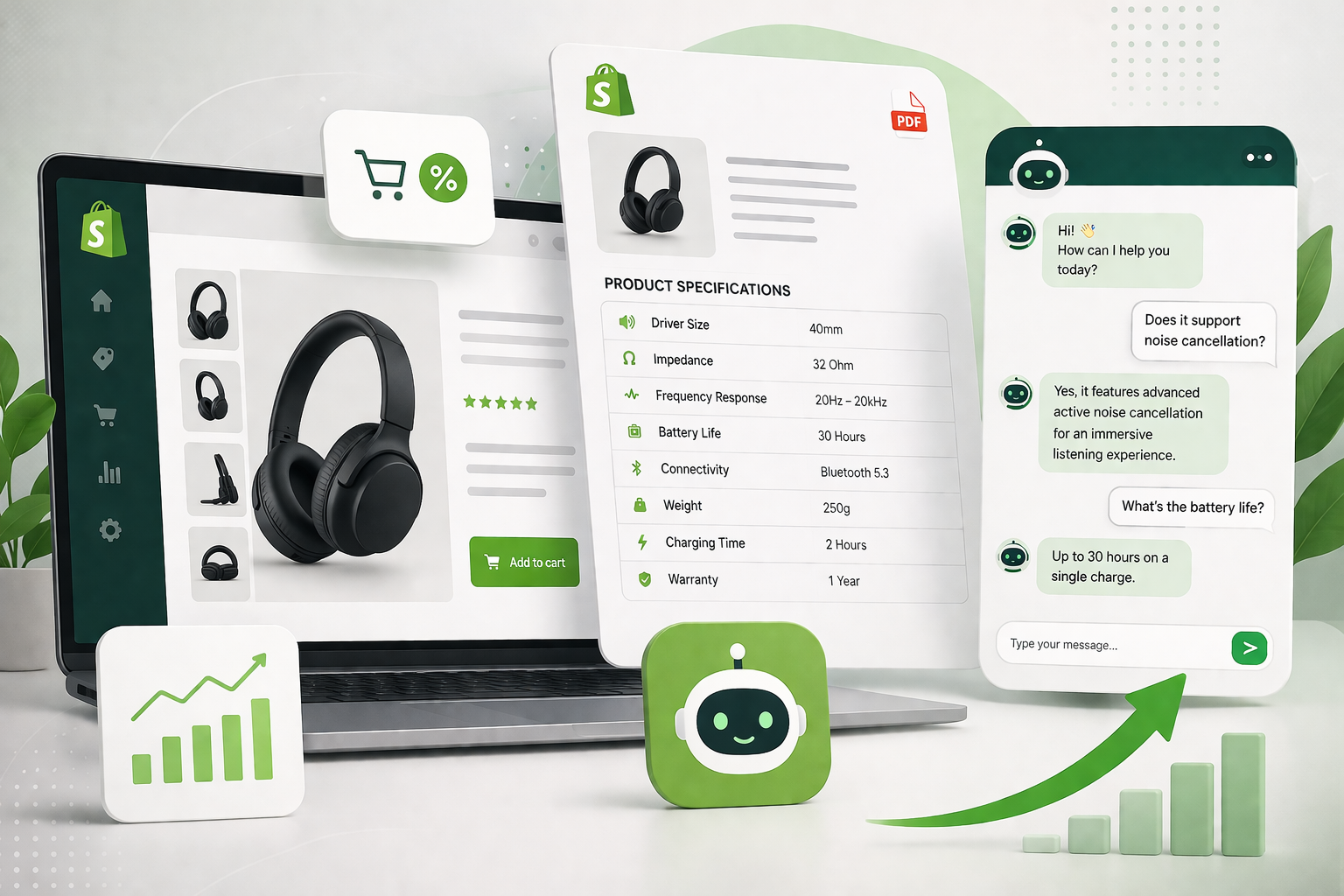
Learn how Shopify product spec sheets and AI chatbots reduce support tickets, eliminate buyer friction, and increase ecommerce conversions.


Agentic commerce explained: what it is, how it differs from conversational commerce, the 4 agent capabilities, 10 use cases, ROI benchmarks, and the 2026 platform shift.
Learn what agentic search is, how it differs from keyword and semantic search, and why it cuts zero-results rate to under 2% for ecommerce stores.
Should you build or buy an AI chatbot for ecommerce? True cost comparison, timeline reality, maintenance burden, and when building makes sense vs. when buying wins.