In 2025, winning in ecommerce sales isn’t about using more channels; it is about aligning every message, campaign, and conversion lever to the right stage of your customer journey. Brands that plan and measure by funnel stage are growing up to 3× faster than those that rely on isolated ecommerce marketing tactics or vanity metrics.
According to Shopify’s Future of Commerce Report 2025, merchants using structured, data-backed marketing frameworks grow up to 30% faster than those running ad hoc marketing campaigns.
This guide breaks down a stage-based ecommerce marketing strategies from awareness to advocacy, with benchmarks, real examples, and a 90-day rollout planner you can copy straight into your workflow to boost website traffic.
You’ll also see exactly whereZipchat fits in, automating pre-purchase conversations, cart recovery, and post-purchase support to drive traffic, all while improving youre-commerce CRO strategies.
What Is an E-Commerce Marketing Strategy?
An ecommerce marketing strategy is a structured plan that connects every stage of your customer journey from awareness to advocacy, clear goals, KPIs, and repeatable actions. An ecommerce marketing plan defines how your brand attracts, converts, and retains customers across channels within a measurable timeframe.
KPIs: Track metrics like CAC, AOV, LTV, and payback period to measure efficiency and growth
90-day rollout: Implement a focused, iterative plan with benchmarks and quick feedback loops
7-Step ECommerce Strategy Plan
Here’s a clear, actionable roadmap to plan, execute, and optimize your ecommerce marketing strategy in seven repeatable steps:
1. Define goals and constraints
Start with measurable business outcomes like revenue targets, repeat purchase rate, or CAC reduction. Align your marketing goals with operational limits (budget, team size, and tech stack). This ensures every channel serves a defined purpose instead of chasing vanity metrics.
2. Identify your ICPs to boost online sales
Map your ideal customer profiles (ICPs), their motivations, objections, and buying triggers. Then outline the journey from discovery to repeat purchase. This becomes your blueprint for personalized content marketing strategies, timing, and offers across each funnel stage.
3. Build your stage framework & Key Performance Indicators (KPIs)
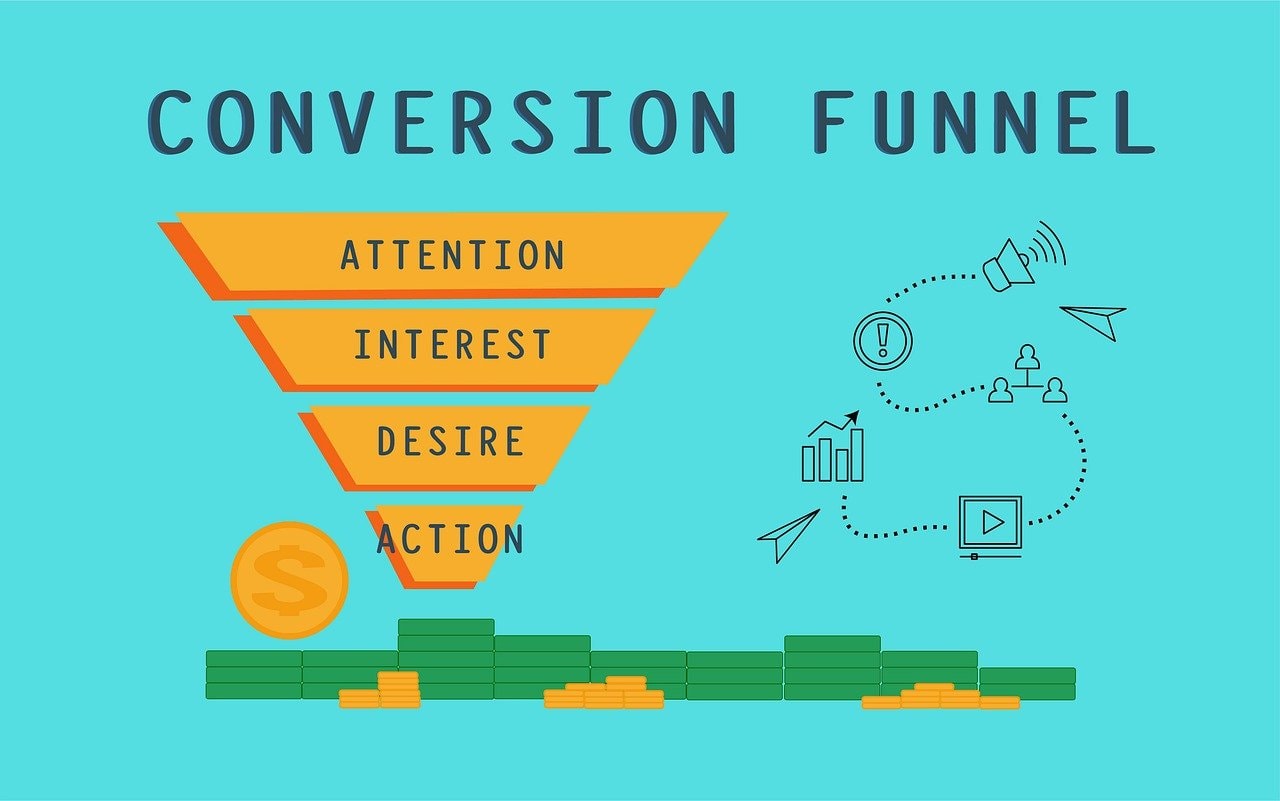
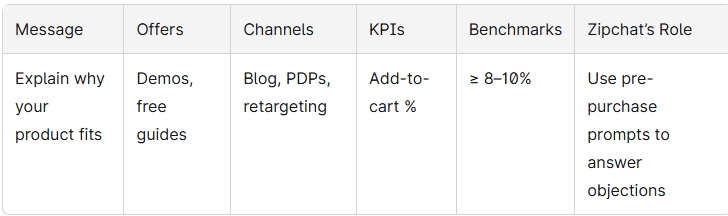
Use a five-stage funnel: Awareness → Consideration → Conversion → Retention → Advocacy, with distinct metrics at each stage. For example, track CTRs and impressions in Awareness, AOV and ROAS in Conversion, and repeat order rate in Retention.
4. Design your channel mix by stage
Assign roles to each channel: Search Engine Optimization and paid social for Awareness, email marketing and retargeting for Consideration, CRO and on-site chat for Conversion, and brand loyalty programs for Retention.
5. Develop offers and creative assets to attract potential customers
Craft irresistible offers that match intent. For the early stage, use educational lead magnets, and for the mid-funnel, try social proof or free shipping. And for late-funnel, add urgency with time-bound discounts. For target audience amplification, testinfluencer marketing strategies that drive authenticity and foster customer loyalty.
6. Build your execution roadmap to boost sales
Turn strategy into a 90-day sprint. Assign timelines, budgets, and owners for each initiative. Integrate marketing automation tools (like Zipchat AI) to handle proactive messaging, cart recovery, and WhatsApp follow-ups.
7. Measure, learn, and iterate
Use dashboards to monitor funnel health weekly, as well as CPCs, AOV, churn, and LTV. Run experiments, not assumptions. Double down on channels with proven ROI and phase out underperformers. Continuous iteration keeps your ecommerce marketing plans responsive and profitable.
The Funnel Framework
Here’s how to structure your ecommerce marketing funnel around five key stages, each with clear goals, KPIs, and actionable plays.
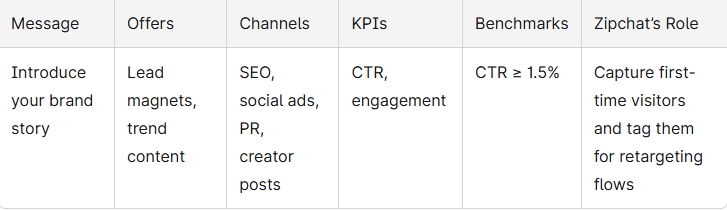
3.1 Awareness
Goal: Drive visibility, interest, and qualified top-funnel traffic. Primary KPIs:
Expand credibility using your top customers as social media influencers.
Unit Economics for E-Commerce to Boost Marketing Efforts
Understanding your unit economics turns guesswork into strategy. It’s how leading brands know which marketing campaigns to scale and which to cut before they quietly burn cash.
At its core, unit economics measure the profitability of a single customer or order, helping you gauge whether your acquisition and retention efforts are sustainable over time.
Why It Matters
Tracking unit economics ensures your marketing funnel isn’t just converting, but compounding. It connects metrics like Average Order Value (AOV) and conversion rate directly to long-term profit velocity, a perspective many brands overlook.
To optimize these metrics, start with using analytics to boost sales and identify which levers (AOV, CAC, repeat rate) most affect your payback period.
Attribution & Measurement in a Cookieless World
By 2025, third-party cookies will be nearly gone and with them the easy answers about which ad actually worked. Modern online businesses building brand awareness must engage customers with new attribution methods that respect privacy while still revealing what drives traffic.
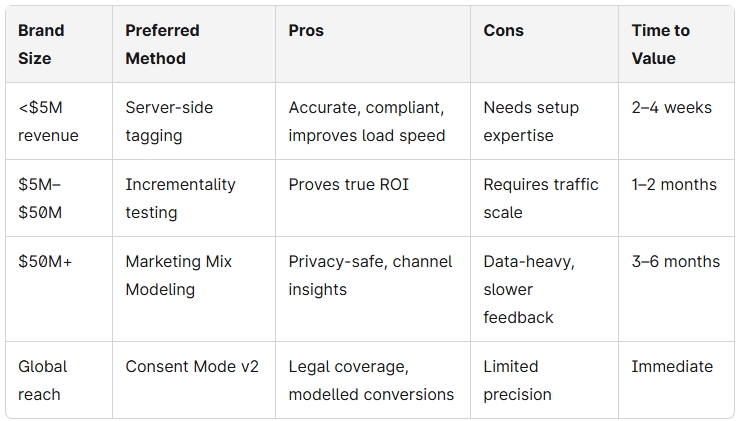
The key is mixing server-side tagging, marketing mix modeling (MMM), and incrementality testing, based on your revenue stage and data maturity.
1. Server-Side Tagging
Server-side tagging shifts tracking from browsers to your server, improving data accuracy and consent compliance. It’s ideal for early to mid-stage brands that rely on ad platforms (Meta, Google, TikTok) but want cleaner, faster data.
2. Marketing Mix Modeling (MMM)
MMM uses statistical regression to evaluate the impact of each channel over time without relying on user-level tracking. It works best once you have stable data and a diverse channel mix.
3. Incrementality Testing
Incrementality testing measures how much lift a campaign truly generates versus a control group. Use it to validate whether that “top-performing” ad is actually bringing new customers.
4. Consent Mode v2
Google’s Consent Mode v2 lets you maintain partial tracking for users who decline cookies, preserving modelled conversions. It’s a must-have for stores expanding into the EU or other privacy-first markets.
Comparison Table
Takeaway: As privacy laws evolve, attribution is less about tracking every click and more about measuring real lift across stages. Start with using analytics to boost ecommerce sales, then layer in MMM or incrementality once your data volume supports it.
AI Search Optimization (2025)
Search Engine Optimization (SEO) has changed. In 2025, visibility isn’t just about keywords, it’s about context. With Google’s AI Overviews, Bing Copilot, and Perplexity answers dominating SERPs, your e-commerce brand needs content that AI can understand, extract, and feature.
That means structuring your strategy for answer engines, not just search engines.
How to Optimize for AI Search for Product Pages
1. Chunk your content (<300 words per section)
AI crawlers extract concise, self-contained passages. Break long-form pages (like your e-commerce strategy framework) into scannable sections with descriptive subheads.
2. Start each section with a direct answer
Write the first 1–2 sentences as if you’re answering a “People Also Ask” question. Example:
“An e-commerce marketing funnel is a stage-based model that maps how shoppers move from discovery to repeat purchase.”
3. Use structured tables and bullets
AI tools prefer extractable data like KPI benchmarks, pricing tiers, or tactic summaries. Include 1 table per major stage (e.g., Awareness → Advocacy).
4. Add micro-FAQs for intent coverage
Each funnel stage should answer mini-questions users actually ask (see below).
AI Optimization Micro-FAQs
Q1: How does AI impact e-commerce SEO in 2025?
AI prioritizes semantically rich content and verified sources over keyword density. Structured answers and linked citations improve inclusion in AI Overviews.
Q2: How can I make my e-commerce site more “AI-readable”?
Use schema markup (FAQ, HowTo, Product), compress media, and label data clearly in tables.
Q3: What’s the best content length for AI snippet inclusion?
200–300 words per topic, with bolded subheads and contextual links.
Q4: Should I cite sources in my blog posts?
Yes. Inline citations (like Gartner, McKinsey, or Shopify reports) help AI rank your content as authoritative.
Q5: How does AI search differ from traditional SEO?
Traditional SEO matches keywords. AI SEO matches meaning. Instead of “best e-commerce platform,” it understands and extracts context from “how to choose an e-commerce platform for omnichannel growth.”
Tools for Tracking Success
In e-commerce, the tools you use to measure behavior matter just as much as the tactics you deploy. The right analytics stack helps you understand why customers convert or don’t, and what to fix next.
Here’s how to build a lean, insight-driven measurement toolkit.
1. Core Analytics (GA4 + Server-Side Events)
Google Analytics 4 remains the foundation. Set up enhanced e-commerce tracking for:
Product impressions, add-to-carts, checkouts, and purchases
Custom events for engagement (video views, scrolls, chat interactions)
Server-side tagging to protect data accuracy in a cookieless world
2. Product & Customer Analytics
Tools like Mixpanel, Amplitude, or Heap help you go deeper, tracking how users move between discovery and checkout. Use them to:
Identify drop-off points between PDPs and the cart
Measure repeat purchase intervals
Spot high-value cohorts based on AOV or frequency
3. Experience & Behavior Tools to Gather Customers feedback
Heatmaps (Hotjar, FullStory) and session replays surface UX friction that is invisible in raw data. Pair this with survey tools (Typeform, Fairing) to collect zero-party insights, such as what users say they want vs. what analytics show.
4. Voice of the Customer (VOC) via Zipchat
Zipchat’s chat transcripts double as a goldmine for qualitative insights: recurring objections, product confusions, or triggers that drive purchases. Export key phrases monthly to refine product pages, FAQs, and email flows.
Conversion Rate Optimization (CRO) & UX
CRO and UX are two sides of the same conversion coin. A fast, frictionless, and trustworthy experience drives every profitable checkout, and small UX gains often outperform big ad spends.
At the Conversion stage, focus on three fundamentals: speed, clarity, and trust.
Speed: The Invisible Conversion Multiplier
Users won’t wait for pages to load.
Target LCP ≤ 2.5s, INP ≤ 200ms, and CLS ≤ 0.1 across key templates.
Compress product images and lazy-load below-the-fold media.
Use a CDN and prefetch common assets to reduce the time needed for interaction..
These technical optimizations directly improve engagement and lower bounce rates, which also boost organic visibility.
Clarity: Guide Without Overwhelming
Every page should answer one question fast—“What do I do next?”
Use strong visual hierarchy: bold CTAs, scannable copy, and short forms.
Replace jargon with plain, benefit-led language.
Keep PDPs focused: one primary CTA, clean pricing, clear variants.
Trust: Remove Doubt at the Moment of Decision
Buyers hesitate when friction or uncertainty creeps in.
Add shipping, return, and payment trust signals above the fold.
Use real UGC or customer photos near CTAs.
Include proactive Zipchat AI prompts like “Need help with fit?” or “Free returns on all shoes.”
These trust nudges mimic the reassurance of an in-store salesperson.
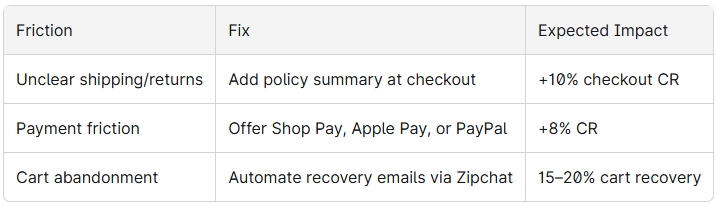
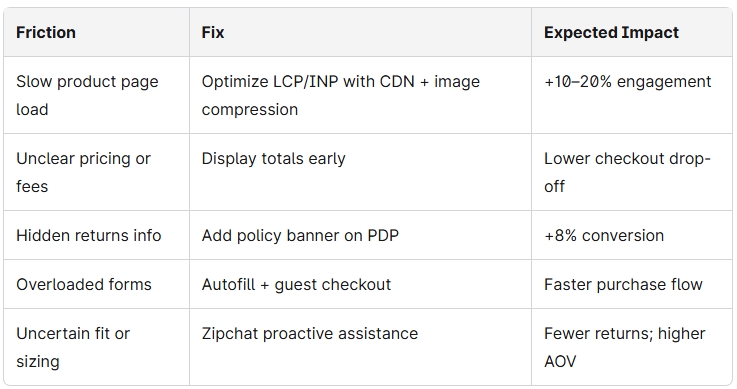
Friction → Fix Table
Channel Deep Dives (Condensed by Stage)
E-commerce channels don’t operate in silos; they power different parts of the customer journey. Below is a condensed, stage-based view showing when and how each major channel earns its keep, complete with mini-examples for context.
1. SEO — Awareness Engine
SEO fuels top-of-funnel discovery by targeting problem-based and intent-driven queries.
Use Zipchat-triggered flows post-purchase for review or cross-sell prompts.
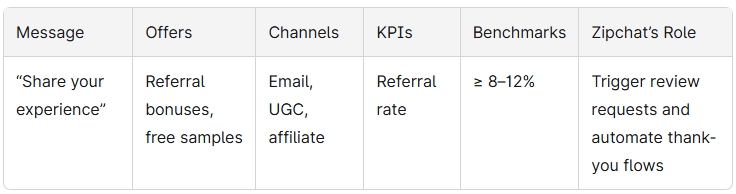
4. Social Media Marketing & Influencer — Awareness + Advocacy
Social media channels are where consumers discover and validate brands. Influencer collabs, UGC, and creator seeding amplify trust and reach.
How-to bullets:
Mix micro-creators for authenticity and macro for reach.
Repurpose top UGC as ad creatives to improve ROAS.
Encourage Zipchat-assisted DMs for faster social conversions.
5. WhatsApp & Messaging — Retention & Service Loop
Conversational commerce drives real-time resolution and repeat sales.
How-to bullets:
Use Zipchat for proactive WISMO deflection (“Your order’s on its way!”).
Automate loyalty check-ins and back-in-stock alerts.
Segment messages by past behavior and purchase frequency.
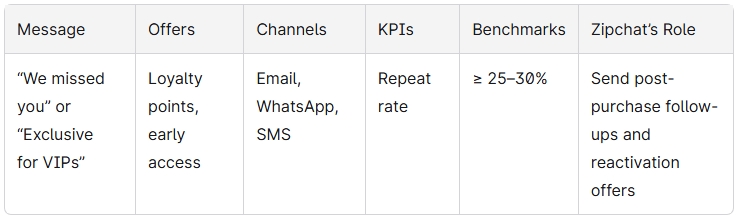
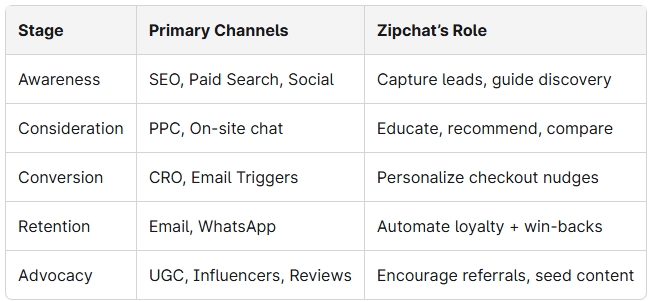
Summary Table: Channels by Funnel Stage
By folding each channel into its natural funnel function, brands avoid redundancy, track impact clearly, and make smarter creative and budget calls across every growth stage.
Trends to Watch (and How to Act on Them)
E-commerce in 2025 is moving fast, and staying ahead means spotting trends before they hit the mainstream. Here are the five that matter most, plus how to turn each one into a competitive edge.
1. AI Personalization Becomes Default
AI will no longer be a “nice-to-have.” Real-time recommendations, predictive offers, and conversational journeys will define brand differentiation.
Do this next: Audit your customer data stack and integrate tools like Zipchat AI to personalize chats, messages, and product suggestions based on behavior in real time.
2. Checkout Modernization Accelerates
One-click payments, wallet integrations, and flexible fulfillment (like “buy online, return in-store”) are setting new standards for conversion UX.
Do this next: Review your checkout flow’s LCP and INP scores and streamline every optional step. Embed chat or Zipchat prompts to resolve last-minute doubts instantly.
3. Retail Media Networks (RMNs) Mature
Retailers like Amazon, Walmart, and Instacart are expanding ad offerings, giving brands precision targeting within buying environments.
Do this next: Allocate 10–15% of ad budget to RMNs and test high-ROI placements around category searches.
4. Localization & i18n Go Mainstream
Global buyers expect content, currency, and checkout experiences tailored to their locale. Do this next: Localize high-performing campaigns first; then adapt your platform choice to support multilingual product feeds and region-based pricing.
5. Compliance Becomes a Brand Advantage
Privacy-first marketing, sustainability disclosures, and accessibility aren’t just legal boxes—they’re trust signals.
Do this next: Run a data consent audit and clearly communicate your ethical standards in emails, PDPs, and chat interactions.
90-Day Rollout Plan: From Strategy to Scale
Now that you’ve got the framework, here’s how to make it real. This 90-day e-commerce rollout plan as outlined in McKinsey’s State of Digital Growth 2024turns your ecommerce marketing strategy into measurable growth, without the chaos of “trying everything at once.” Each phase builds on the last so your funnel evolves logically, with data guiding every move.
Weeks 1–2: Audit & Set Goals
Before diving into tactics, assess where you are and what success looks like.
Audit: Review your current funnel, traffic sources, conversion bottlenecks, and churn drivers.
Define KPIs: Tie revenue goals to funnel stages (Awareness → Advocacy).
Set up analytics: Implement GA4 essential events and use analytics to boost sales.
Quick win: Enable Zipchat AI to start collecting voice-of-customer (VOC) insights from day one.
Outcome: A clear baseline of performance and measurable objectives for the next 90 days.
Weeks 3–6: Build & Launch
This is your foundation stage—build smart, launch lean.
Email setup: Build onboarding, cart recovery, and win-back automations using email automation best practices.
Zipchat integration: Deploy proactive messaging flows to capture high-intent leads and deflect WISMO inquiries.
Outcome: A functioning, data-driven funnel that begins capturing insights from real traffic.
Weeks 7–12: Test & Scale
Now it’s time to iterate, optimize, and scale what works.
A/B test offers, CTAs, and messaging based on engagement and conversion data.
Measure ROI by comparing CAC vs. CLV; adjust ad spend accordingly.
Add personalization: Use Zipchat AI to segment responses and tailor post-purchase experiences.
Expand retention plays: Launch loyalty or referral programs; re-engage dormant customers via email or WhatsApp.
Outcome: A high-performing funnel ready for continuous scaling with reliable data, strong automation, and sharper creative.
Final thought
E-commerce growth doesn’t come from chasing trends; it comes from executing structured plans, testing relentlessly, and using AI tools like Zipchat to turn every interaction into a revenue signal. Book a demo today.
E-Commerce Marketing Strategy: FAQs
1. What is an e-commerce marketing strategy?
An e-commerce marketing strategy is a stage-based plan to attract, convert, and retain online customers using data-driven channels. It connects your awareness, conversion, and retention goals with measurable KPIs and budgets.
2. How do I create one in 2025?
Start with a 90-day rollout:
Audit your funnel and define KPIs.
Map channels to each stage of the customer journey.
Launch, test, and iterate based on performance data.