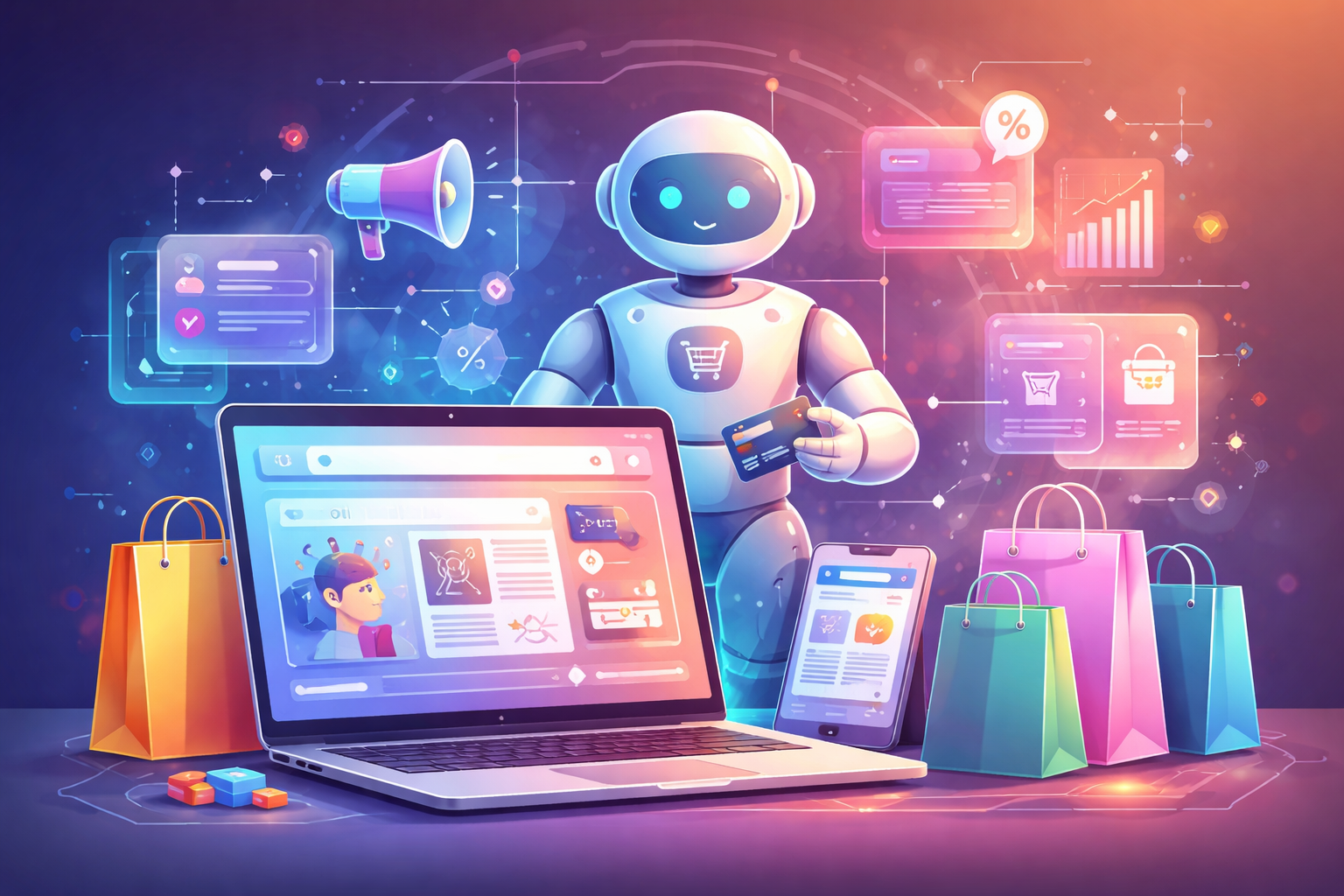
AI trends in ecommerce are transforming how online stores attract, convert, and retain customers.
What used to be manual product recommendations, customer support, pricing, and even search, is now automated and optimized by AI in real time.
This shift is not optional anymore. Stores that adopt AI see higher conversion rates, better retention, and more efficient operations than those that don’t.
According to McKinsey, companies using AI in commerce can increase revenue by 10–15% while reducing costs through automation and better decision-making.
This article breaks down the most important AI trends in ecommerce and explains how each one helps improve conversion, retention, and efficiency.
Key Takeaways
- AI is becoming a core growth driver, improving conversion rates, retention, and operational efficiency.
- Ecommerce brands use AI to automate decisions, personalize experiences, and scale faster.
- Trends like conversational AI and predictive personalization directly impact revenue.
- AI tools reduce friction across the entire customer journey, from discovery to checkout.
- Businesses that adopt AI early gain a competitive advantage in performance and scalability.
Why AI Is Becoming Critical for Ecommerce Growth
AI is no longer a “nice-to-have.” It’s a core system for scaling ecommerce performance.
Here’s why:
- Supports data-driven decision-making
AI analyzes large volumes of customer data instantly. This helps teams make faster and more accurate decisions about pricing, marketing, and inventory.
- Boosts customer satisfaction, retention, and loyalty
AI enables personalized experiences that make customers feel understood and supported. This directly increases customer satisfaction and long-term retention.
- Improves operational efficiency
Automation reduces manual work across support, merchandising, and marketing. This allows teams to scale without increasing costs.
- Improves conversion rates across the buying journey
AI removes friction by guiding users, recommending products, and optimizing checkout. This leads to more completed purchases.
The result: more revenue from the same traffic, with lower operational overhead.
AI Integration in Ecommerce Systems
AI integration is the process of embedding AI tools into your ecommerce stack to automate decisions, improve performance, and connect data across systems.
It’s what turns AI from a standalone tool into a revenue-driving infrastructure.
What AI Integration Looks Like in Practice
AI connects with key systems like:
- Ecommerce platforms (Shopify, Magento).
- CRM and customer data platforms.
- Marketing automation tools.
- Payment and checkout systems.
This creates a unified system where data flows in real time.
Example:
- A customer browses products.
- AI updates recommendations instantly.
- Messaging adapts based on behavior.
- Checkout support activates if friction is detected.
How AI Integration Improves Conversion and Efficiency
When AI is fully integrated, performance improves across the funnel:
- Higher conversion rates
Personalization and guidance happen in real time.
- Better retention
Customer interactions feel consistent across channels.
- Operational efficiency
Automation reduces manual tasks across teams.
- Conversational AI (chatbots, AI agents).
- Recommendation engines.
- Predictive analytics tools.
- Marketing automation platforms.
The key is not the tools themselves, it’s how well they work together.
AI Trends in Ecommerce To Watch
AI in ecommerce is evolving fast, but not all trends matter equally.
The trends below are shaping how online stores increase conversion, retention, and efficiency today.
1. Agentic Commerce and Autonomous AI Agents
Agentic commerce refers to AI systems that can take actions on behalf of users or businesses.
Instead of just assisting, AI agents can:
- Recommend products.
- Complete tasks.
- Automate workflows.
This reduces friction and speeds up decision-making.
For ecommerce:
- Faster buying journeys.
- Less manual intervention.
- Higher conversion rates.
Conversational AI allows stores to interact with customers in real time through chat.
These tools (like chatbots and AI agents) help:
- Answer product questions.
- Guide users through checkout.
- Resolve objections instantly.
This reduces drop-offs and increases conversions.
It also improves retention by providing always-on support without scaling support teams.
3. Personalized Product Recommendations
An AI-powered product recommendation analyzes behavior, preferences, and purchase history. This suggests relevant products to shoppers at the right moment.
This increases:
- Average order value (AOV).
- Conversion rates.
- Customer satisfaction.
Amazon reports that 35% of its revenue comes from recommendations, showing their impact (McKinsey).
4. Predictive Personalization and Messaging
AI predicts what customers are likely to do next — and adapts messaging accordingly.
This includes:
- Personalized offers.
- Dynamic content.
- Behavior-triggered messages.
The result:
- Higher engagement.
- More conversions.
- Stronger retention.
5. AI-Powered E-commerce Search Optimization
Search is one of the highest-intent moments in ecommerce.
AI improves search by:
- Understanding intent (not just keywords).
- Handling typos and natural language.
- Delivering more relevant results.
Better search = faster product discovery = higher conversion rates.
6. AI-Based Fraud Detection and Risk Prevention
AI systems detect suspicious transactions in real time.
They analyze:
- Behavior patterns.
- Transaction anomalies.
- Risk signals.
This reduces fraud while protecting legitimate transactions.
Better fraud systems also:
- Reduce chargebacks.
- Improve approval rates.
- Protect revenue.
7. Predictive Analytics and Demand Forecasting
AI helps businesses predict demand, trends, and customer behavior.
This improves:
- Inventory management.
- Marketing timing.
- Supply chain efficiency.
The result:
- Less overstock.
- Fewer stockouts.
- Better cash flow.
8. Dynamic Pricing
AI adjusts prices based on demand, competition, and customer behavior.
This helps stores:
- Maximize revenue.
- Stay competitive.
- Respond to market changes instantly.
Smart pricing increases margins without hurting conversions.
9. AI-Generated Content
AI tools generate:
- Product descriptions.
- Marketing copy.
- Emails and ads.
This reduces:
- Content production time.
- Operational costs.
At scale, this enables faster growth without increasing team size.
AI combined with AR/VR creates interactive personalized, shopping experiences.
Examples:
- Virtual try-ons.
- 3D product previews.
- Immersive product demos.
These experiences:
- Increase confidence.
- Reduce returns.
- Improve conversion rates.
How These AI Trends Are Shaping Ecommerce Today
These trends reveal a clear shift in ecommerce.
Shopping is becoming:
- More intelligent → AI predicts and adapts.
- More interactive → real-time conversations and guidance.
- More efficient → automation replaces manual work.
AI is no longer limited to one part of the funnel.
It is now embedded across the entire customer journey:
- Discovery (search, recommendations).
- Consideration (personalization, messaging).
- Conversion (checkout optimization, assistance).
- Retention (support, engagement, loyalty).
The result is a system where every interaction is optimized for performance.
Businesses adopting AI are:
- Increasing conversion rates.
- Strengthening retention.
- Scaling operations without increasing costs.
Digital Commerce and AI-Driven Experiences
Digital commerce is evolving from static online stores to interactive, AI-driven experiences.
AI is at the center of this shift, transforming how customers discover, evaluate, and purchase products.
From Static Stores to Intelligent Experiences
Traditional ecommerce:
- Fixed product pages.
- Manual merchandising.
- Limited personalization.
AI-powered commerce:
- Dynamic content and recommendations.
- Real-time personalization.
- Guided shopping experiences.
This shift increases engagement and reduces decision fatigue.
How AI Improves the Digital Commerce Experience
AI enhances every stage of the journey:
- Discovery
Smarter search and recommendations help users find products faster.
- Consideration
Personalized messaging and support build confidence.
- Conversion
Guided checkout reduces friction and drop-offs.
- Retention
Post-purchase engagement improves customer loyalty.
Salesforce reports that 73% of customers expect companies to understand their needs, making personalization essential.
Strategic Impact on Ecommerce Businesses
AI-driven digital commerce is not just about UX; it’s a growth system.
It enables:
- Higher revenue per visitor.
- More efficient scaling.
- Stronger customer relationships.
Stores that adopt AI-driven experiences gain a long-term competitive advantage.
Where Zipchat Fits In
Zipchat acts as a conversational layer within digital commerce.
It helps:
- Provide personalized assistance in real time.
- Guide customers through product discovery and checkout.
- Answer questions instantly.
This directly:
- Increases conversion rates.
- Improves customer satisfaction.
- Reduces friction across the journey.
AI-driven digital commerce is not the future; it’s already the standard.
Conclusion
AI is reshaping ecommerce by turning static stores into intelligent, adaptive systems.
As these AI trends in ecommerce continue to evolve, they’re redefining how brands attract, convert, and retain customers.
The trends covered in this article show how AI is improving:
- Conversion rates through personalization and guidance.
- Retention through better customer experiences.
- Efficiency through automation and predictive insights.
This shift is already happening, and it’s accelerating.
Tools like Zipchat sit at the center of this transformation.
By combining conversational AI with real-time personalization, Zipchat helps stores:
- Recommend products intelligently.
- Guide shoppers through the buying journey.
- Answer questions instantly.
- Reduce friction at checkout.
The result:
- Higher conversions.
- Stronger retention.
- Better customer experience at scale.
Explore the best tools powering this shift.