Try Zipchat in Action!
Enter your store URL to see how Zipchat would behave.


LTV:CAC Ratio: How to Calculate, Benchmark & Improve for Ecommerce

In ecommerce, profitability isn’t just about sales; it’s about efficiency. You can have great revenue and still lose money if you’re overspending to acquire customers who never return. That’s where the LTV:CAC ratio comes in. It is a single metric that shows whether your customer relationships and marketing campaigns are actually paying off.
In plain terms, LTV:CAC compares how much the customer is worth over their lifetime (LTV, or Customer Lifetime Value) to how much it costs to bring them in (CAC, or Customer Acquisition Cost).
A ratio of 3:1, for instance, means you earn $3 in revenue for every $1 spent on acquiring a customer. This is a healthy sign of scalable growth. Too low, and you’re burning cash. A higher ratio, and you might be growing too cautiously.
While this ratio is widely used in the SaaS industry, it’s especially powerful for ecommerce brands, where repeat purchases, retention, and ad costs fluctuate fast. Whether you’re a DTC skincare label or a Shopify apparel brand, knowing your LTV:CAC helps you answer the question every marketer and founder wrestles with:
“Are we spending the right amount to win and keep our customers?”
Next, let’s break down exactly what the LTV:CAC ratio means, how to calculate it, and how to benchmark your results against top ecommerce performers.
What is the LTV:CAC Ratio and How Does It Help in Acquiring Customers?
The LTV:CAC ratio measures how efficiently your ecommerce business turns your sales and marketing spend into long-term customer value. It’s calculated by dividing your Customer Lifetime Value (LTV) by your Customer Acquisition Cost (CAC), showing the revenue generated for every dollar spent acquiring a customer.
Formula:

Let’s unpack the two components:
- Customer Lifetime Value (LTV) represents the total revenue a customer generates throughout their relationship with your brand. It’s influenced by factors like average order value (AOV), purchase frequency, and retention rate.
- Customer Acquisition Cost (CAC) is the average amount you spend to acquire a new customer, including ad spend, marketing and sales expenses, agency fees, and discounts.
When analyzed together, the ratio tells you whether your customer acquisition strategy is sustainable or leaking money. For example, if your LTV:CAC is 3:1, it means for every $1 spent acquiring a customer, you’re earning $3 in return, a healthy balance in most ecommerce scenarios.
For more related performance metrics, check out our guide on KPIs for ecommerce growth.
How to Calculate LTV:CAC
When you follow these three steps, you are ensuring that your growth decisions rest on solid numbers.
1) Customer Lifetime Value (LTV) Calculation
Decide whether you want revenue-based LTV (total sales) or margin-adjusted LTV (revenue × gross margin).
Common formula (revenue basis):
LTV = AOV × Purchase Frequency per year × Average Customer Lifespan (years)
If you want margin-adjusted LTV (recommended for profitability decisions):
LTV_margin = LTV × Gross Margin (%)
Tip: Use the same currency and time windows for all inputs.
2) Customer Acquisition Cost (CAC) Calculation
Add up the total cost incurred on every single customer for a given period (ads, creative, agency, landing page CRO, promotions) and divide by the number of new customers acquired in that period:

3) Divide LTV by CAC

Formula diagram (compact)

Worked example — DTC brand (step-by-step, digit-by-digit)
Inputs:
- Average Order Value (AOV) = $60
- Purchases per year = 2
- Average customer lifespan = 3 years
- Gross margin = 50% (0.50)
- CAC = $45
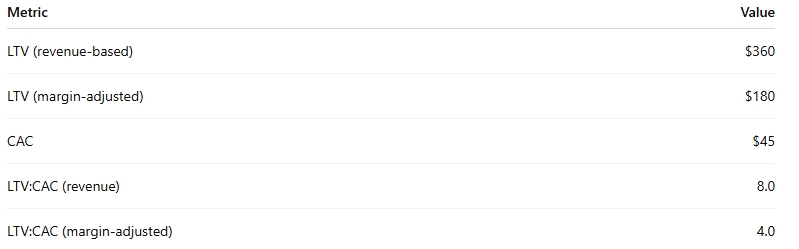
Step 1 — revenue LTV:
- Annual revenue per customer = 60 × 2 = 120.
- Lifetime revenue = 120 × 3 = 360.
Step 2 — margin-adjusted LTV:
- Margin LTV = 360 × 0.50 = 180.
Step 3 — produce ratios:
- Revenue-based LTV:CAC = 360 ÷ 45 = 8.0.
- Margin-adjusted LTV:CAC = 180 ÷ 45 = 4.0.
Clean table
Quick spreadsheet formulas
Paste into Google Sheets where:
- AOV in A2, Frequency in B2, Years in C2, Margin in D2, CAC in E2

What Is a Good LTV:CAC Ratio?
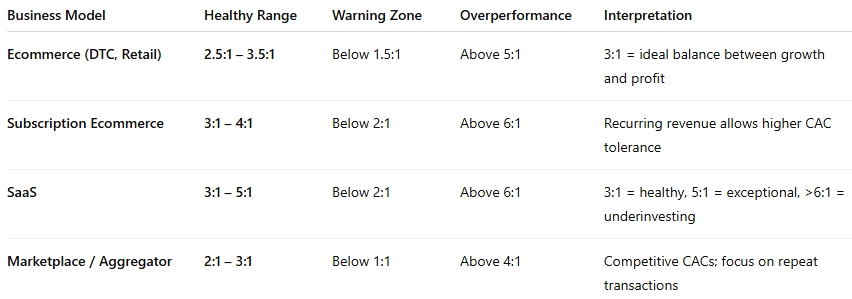
A “good” LTV:CAC ratio shows that your marketing and retention investments are paying off. For most ecommerce brands, a healthy ratio hovers around 3:1. This means that you earn $3 in customer lifetime value for every $1 spent acquiring that customer.
That’s not a hard rule, though. The right ratio depends on your profit margins, retention rate, and payback period.
- If you sell low-margin products (like apparel or CPG), you might be fine closer to 2:1.
- If you have strong retention and recurring revenue, you can sustain a higher CAC because you’ll earn it back over time.
In contrast, if your LTV:CAC drops below 1:1, you’re spending more to acquire customers than they’re worth. This is an unsustainable business model that quickly drains cash flow.
And if your ratio is above 5:1, you may actually be underinvesting in growth. That means there’s likely room to scale your marketing spend while keeping returns profitable.
Related: Learn how your churn rate impacts LTV and long-term profitability.
LTV:CAC Ratio Benchmarks
Why LTV:CAC Matters for Ecommerce
Your LTV:CAC ratio isn’t just a financial metric; it’s the heartbeat of ecommerce profitability. It tells you whether your brand is growing sustainably, overspending on ads, or leaving profit on the table.
Here’s why it matters so much:
- Profitability insights — LTV:CAC instantly reveals whether your customer relationships are profitable over time. A strong ratio means your repeat purchases and retention offset customer acquisition costs.
- Smarter marketing budget allocation — Knowing your ratio helps you decide where to scale or cut spend. You can double down on channels that deliver a high AOV or better payback periods.
- Growth planning — A healthy ratio (around 3:1) gives confidence to scale, whether that means launching new SKUs, expanding to new markets, or investing in conversion rate optimization.
- Investor and board confidence — Investors often use LTV:CAC as a shorthand for efficiency. A strong ratio signals disciplined spending and scalable unit economics.
- Retention feedback loop — Because LTV depends on repeat purchases, your ratio reflects the strength of your post-purchase experience and brand loyalty.
See how Zipchat boosts LTV without raising CAC — Try it free and start converting more site visitors into repeat customers.
How to Improve Your LTV:CAC Ratio for Better Customer Retention
Improving your LTV:CAC ratio comes down to two levers: increasing the average revenue that each customer brings over their lifetime and reducing the cost of acquiring new ones. When both sides move in your favor, your business scales efficiently, not just faster, but smarter.
Increase LTV
Your Customer Lifetime Value (LTV) grows when customers spend more, stay longer, and engage more deeply with your brand. Here are proven ways to make that happen:
- Launch loyalty or VIP programs – Reward existing customers with exclusive perks, early access, or points-based systems that incentivize return purchases.
- Upsell and cross-sell intelligently – Use personalized recommendations based on browsing or purchase history to increase average order value (AOV).
- Automate post-purchase communication – Send replenishment reminders, care guides, or personalized offers via email and WhatsApp flows to re-engage buyers.
- Refine your customer retention playbook – Build stronger relationships through personalization and support — see our guide to customer retention strategies for practical examples.
- Use proactive chat automation – Tools like Zipchat AI can proactively engage high-intent visitors, reduce annual churn rate, and increase LTV without heavy ad spend.
Reduce CAC
Your Customer Acquisition Cost (CAC) drops when you attract new customers more efficiently, spending less to convert more. Here’s how:
- Build a referral engine – Encourage word-of-mouth growth through refer-a-friend campaigns and ambassador programs that turn loyal customers into marketers.
- Invest in SEO and content marketing – Create evergreen educational or lifestyle content that ranks organically and lowers your reliance on paid ads.
- Leverage social proof and UGC – Display customer reviews, testimonials, and authentic user content to improve trust and conversion rates.
- Optimize your funnel – Audit landing pages, checkout flows, and on-site experiences to improve conversion funnel efficiency and reduce drop-offs.
- Segment your paid campaigns – Target audiences based on lifetime value potential, not just acquisition cost, so you don’t overspend on low-value segments.
Book a demo today to improve your ratio — See how Zipchat can help you boost LTV and cut CAC.
FAQ
What is a good LTV:CAC ratio?
A good LTV:CAC ratio for ecommerce typically sits around 3:1. This means that you earn $3 in customer lifetime value for every $1 spent acquiring that customer. Ratios below 1:1 signal unprofitable growth, while ratios above 5:1 may suggest you’re underinvesting in marketing.
How do you calculate LTV : CAC?
To calculate LTV:CAC, divide your average Customer Lifetime Value (LTV) by your Customer Acquisition Cost (CAC):
LTV ÷ CAC = LTV:CAC Ratio.
For example, if your average customer is worth $300 and it costs $100 to acquire them, your LTV:CAC ratio is 3:1, which is a healthy benchmark for ecommerce growth.
Why does LTV:CAC matter for ecommerce?
Your LTV:CAC ratio measures how efficiently your brand turns marketing spend into long-term profit. It helps you identify whether you’re scaling sustainably, managing acquisition costs effectively, and retaining customers long enough to justify the spend, all essential for ecommerce profitability.
Can LTV:CAC be too high?
Yes. While a high LTV:CAC ratio looks great on paper, an excessively high number (above 5:1) often means you’re not spending enough on growth or marketing. It can signal missed opportunities to reach new customers and expand your market share.

Try Zipchat for free