How Shopify Product Spec Sheets + AI Chatbots Increase Conversions in 2026
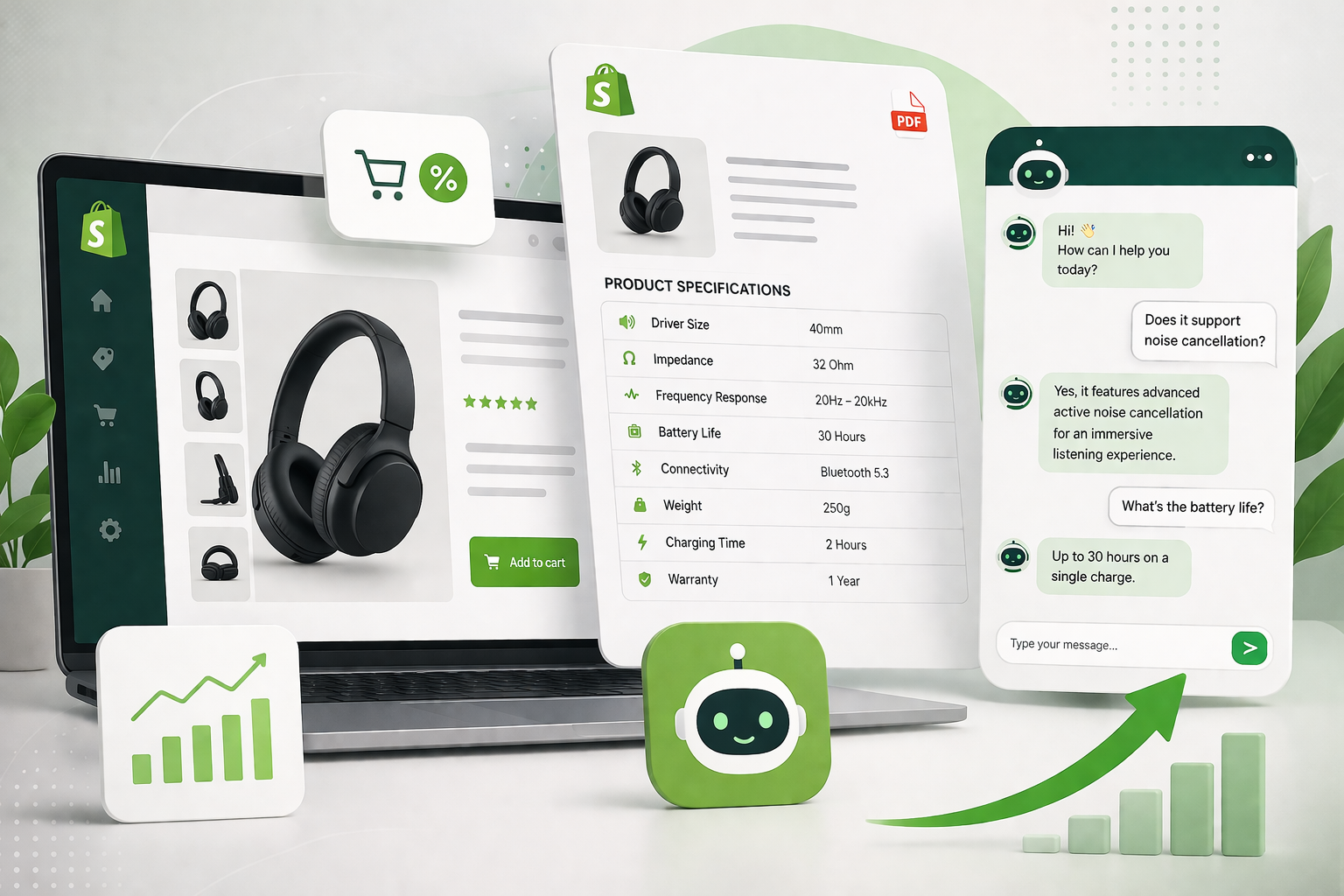
Most Shopify stores lose sales for one simple reason:
Customers are unsure.
Unclear dimensions.
Missing ingredient details.
No downloadable product documentation.
Slow responses to pre-sale questions.
In competitive ecommerce markets, uncertainty reduces conversion rates more than price.
In 2026, high-performing Shopify brands are solving this with two systems:
• Automated Shopify product spec sheets
• AI chatbots for Shopify
When structured product documentation and conversational AI work together, friction drops and conversions rise.
Here’s how.
The Hidden Conversion Problem on Shopify Product Pages
Many Shopify product pages rely on long descriptions, scattered bullet points, and FAQ sections.
But product-heavy brands such as furniture, electronics, and supplements require structured technical information:
• Exact measurements
• Materials and compliance details
• Ingredient breakdowns
• Compatibility specifications
• Variant differences
When this information is not centralized, customers leave or contact support.
That leads to:
• Higher bounce rates
• Increased support tickets
• Cart abandonment
• Operational inefficiency
This is not a traffic issue.
It is a clarity issue.
Real Shopify Case Study: Automating Product Documentation
Lily & Loaf, a growing sports nutrition brand on Shopify, needed a scalable way to distribute ingredient breakdowns and compliance information across hundreds of SKUs.
Before automating Shopify product spec sheets:
• Product PDFs were manually updated
• Teams resent outdated files to distributors
• Version control created confusion
• Customers repeatedly asked for ingredient and usage details
After implementing automated Shopify product PDF generation synced directly to their store:
• Over 300 product spec sheets are downloaded monthly
• Distributors access live product documentation
• Shopify product data remains synchronized automatically
• Support conversations shifted from clarification to purchase intent
Instead of answering “What’s inside this?”
The team began answering “When can this ship?”
That shift indicates stronger buying intent.
Clear documentation improves the quality of customer conversations.
Why Shopify Product Spec Sheets Improve Conversion Rates
Structured product documentation does three things:
1. Reduces Buyer Uncertainty
Downloadable Shopify product PDFs provide clarity in a single file. Customers do not need to search across multiple pages.
2. Signals High Purchase Intent
Spec sheet downloads indicate research behavior. These visitors are often closer to conversion.
3. Reduces Support Volume
When product information is accessible and formatted clearly, repetitive pre-sale questions decrease.
This improves operational efficiency while improving customer experience.
How AI Chatbots for Shopify Close the Remaining Gap
Even with perfect product documentation, some customers still hesitate.
This is where an AI chatbot for Shopify becomes critical.
Zipchat AI enables Shopify stores to:
• Answer product questions instantly
• Engage visitors based on browsing behavior
• Recommend products dynamically
• Recover abandoned carts automatically
When Shopify product spec sheets educate visitors first, AI chat becomes more focused and sales-driven rather than clarification-driven.
This creates higher-quality conversations.
And higher-quality conversations convert better.
The Modern Shopify Automation Stack
High-performing Shopify stores are now combining:
• Automated product documentation
• Conversational AI
• Behavioral engagement triggers
• Data-driven conversion tracking
Example workflow:
- Visitor lands on a Shopify product page
- Downloads a structured product spec sheet
- Continues browsing
- AI chatbot engages with contextual assistance
- Questions are answered instantly
- Checkout completes with reduced hesitation
Instead of relying on manual support, automation handles product education and engagement simultaneously.
This improves:
• Shopify conversion rates
• Customer satisfaction
• Operational scalability
• Revenue per visitor
SEO and Conversion Go Hand in Hand
Optimized product pages with structured documentation also improve:
• On-page engagement time
• Internal linking opportunities
• Reduced bounce rate
• Search engine indexing clarity
Better product information benefits both customers and search engines.
That makes Shopify product documentation not just a support tool, but a growth lever.
Final Thoughts: Remove Friction, Increase Revenue
In 2026, ecommerce growth is not just about acquiring more traffic.
It is about removing uncertainty faster than competitors.
Clear Shopify product spec sheets reduce doubt.
AI chatbots remove hesitation.
When both systems operate together, your store transforms from a product catalog into a decision engine.
And decision engines convert.
If your catalog depends on specs, tear sheets, or downloadable product PDFs, LitPDF is worth a look. It helps merchants present clearer product information, reduce repetitive support questions, and make product documentation easier to manage inside Shopify.