


How it works See how Zipchat reads your code and answers technical questions.
Use Cases
See all use casesIndustries
View all industriesCapabilities
See all capabilitiesUse Cases
See all use casesIndustries
View all industriesCapabilities
See all capabilitiesYour AI agent live in under 1 hour
No code. Trained on your catalog. Converts on every channel.
Start free trial Book a demo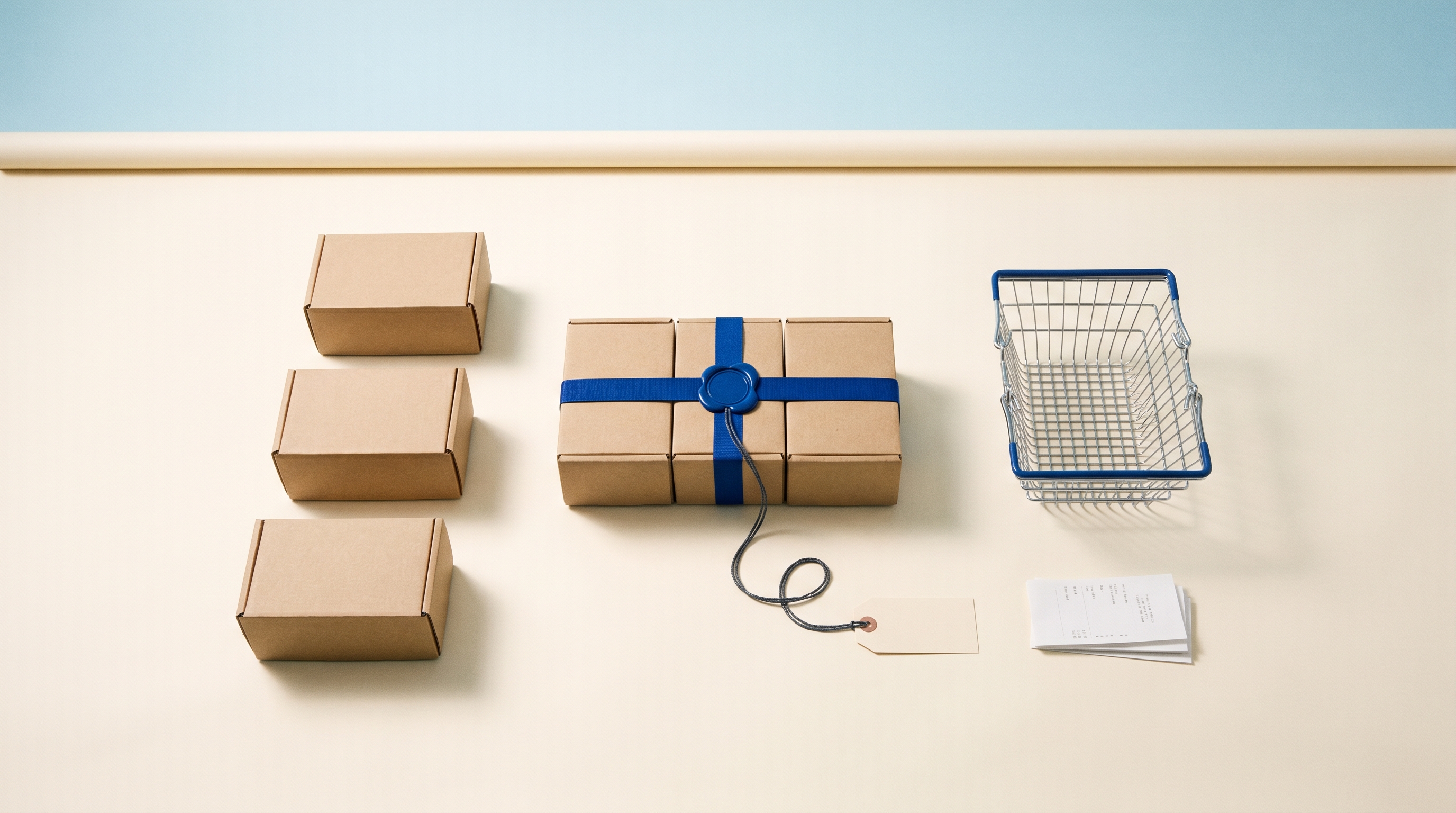
Summary: Product bundling combines two or more SKUs into a single packaged offer that lifts AOV 15% to 25% versus no-bundle baselines. Bundles set basket size before the cart forms, which is the highest-yield moment in the buying journey. This guide covers the five bundle types, 15 vertical examples, the pricing patterns, the metrics, and where bundles fail.
Answer: Product bundling combines multiple SKUs into a single offer at a packaged price. The customer purchases the bundle as one unit, and the store ships the included items together. Unlike cross sell (a second product added to the cart) or upsell (a higher tier of the same product), a bundle is a pre-built combination presented before checkout.
The mechanic raises basket size at the front of the journey. A customer evaluating a $60 product against a $90 bundle at 15% off the sum is anchored to a different reference point than a customer evaluating $60 alone. Anchoring drives 15% to 25% AOV lift across most verticals.
For the broader AOV strategy this fits inside, see the upselling and AOV cluster overview and the AOV pillar guide.
| Type | Definition | Best vertical | Typical lift |
|---|---|---|---|
| Pure bundle | Items sold only as a bundle | Subscription kits, gift sets | 18% to 28% |
| Mixed bundle | Items sold separately and as a bundle | Beauty, supplements, home | 15% to 22% |
| Mix-and-match | Customer picks N items from a curated set | Food, beverage, beauty | 22% to 32% |
| Tiered bundle | Good / better / best (3 sizes) | Subscription, supplements, electronics | 12% to 20% |
| BOGO bundle | Buy one get one (free, half off, etc.) | Apparel, food, supplements | 10% to 18% |
The choice depends on inventory strategy and brand positioning. Pure bundles work best when the items genuinely belong together (a starter kit, a gift set). Mixed bundles preserve customer flexibility but require careful pricing so the bundle is genuinely better than buying separately. Mix-and-match converts highest because customers feel agency in the offer.
These are real patterns that hit 15%+ basket inclusion rates.
1. Beauty: skincare routine bundle. Cleanser plus serum plus moisturizer at 18% off. Sold on PDP as “complete the routine.” Take rate: 22%.
2. Beauty: travel size bundle. Mini versions of 3 bestsellers at a fixed $35 price (regular sum: $48). Take rate: 28% on first-time visitors.
3. Supplements: performance stack. Creatine plus electrolytes plus protein powder at 15% off. Sold on hero PDP as “the stack.” Take rate: 19%.
4. Supplements: starter kit. Multivitamin plus omega-3 plus probiotic at fixed $59 (sum: $78). Take rate: 24% on new customers.
5. Pet: puppy starter bundle. Harness plus leash plus treats plus training pad at 15% off. Sold on collar/harness PDP. Take rate: 25%.
6. Pet: subscription bundle. Food plus toys plus grooming items as a monthly recurring bundle. Take rate at first checkout: 18%.
7. Food: variety pack. 5 best-affinity flavors of a snack at 12% off. Customer mix-and-match select. Take rate: 31%.
8. Coffee: brewing bundle. Beans plus filter plus mug as a fixed-price gift set. Take rate: 14% as a gift; 22% in the holiday window.
9. Electronics: camera kit. Body plus 35mm lens plus SD card plus camera bag at 8% off the sum. Take rate: 11%; AOV lift: 41%.
10. Electronics: home audio bundle. Speaker plus subwoofer plus cables at value-add pricing (hero plus 30%, cables effectively free). Take rate: 9%; AOV lift: 38%.
11. Apparel: outfit bundle. Top plus bottom plus accessory at 15% off. Sold on PDP via “complete the look.” Take rate: 12%.
12. Apparel: 3-pack basics. 3 of the same T-shirt at 20% off the trio. Take rate: 18%.
13. Home: bedroom kit. Sheets plus pillowcase plus duvet cover at fixed $129 (sum: $165). Take rate: 16%.
14. Home: room kit. Coffee table plus 2 end tables plus TV stand at fixed $899 (sum: $1,200). Take rate: 14%; AOV lift: 38%.
15. Subscription: build-your-box. Customer picks 6 of 18 monthly items. Mix-and-match logic. Take rate: 34% on first-month subscribers.
The Pigment hits PMU sales gains via expert product guidance that recommends bundles at the moment of fit-question intent. Home of Wool drove customer service plus product discovery gains in parallel by surfacing bundles in chat. NaVlas.sk delivered haircare expert guidance bundling routine SKUs together based on the chat conversation.
| Pattern | How it works | Best for | AOV lift |
|---|---|---|---|
| Percentage discount | 10% to 20% off the sum of individual prices | All verticals, easy to ship | 15% to 22% |
| Fixed-price packaging | Round number ($99, $199, $499) | Beauty, food, supplements | 18% to 28% |
| Value-add pricing | Hero SKU price plus 30%, others effectively free | Electronics, home, premium | 22% to 35% |
| Tiered bundle | Good/better/best shown side by side | Subscription, supplements | 12% to 20% with tier upsell |
| Volume discount | Buy 2 same SKU save 10%, buy 3 save 20% | Consumables, food, supplements | 10% to 18% |
Value-add pricing converts highest because the customer sees the most expensive item priced normally and the rest as a windfall. Use it when the bundle has a clear hero SKU and complementary items at materially lower price points.
Bundle take rate = Bundle add-to-cart events / Bundle impressions
Bundle attach rate = Orders containing bundle / Total orders
AOV delta = (AOV with bundle program - AOV without) / AOV without
Gross margin per order = (Revenue - COGS - shipping) / Orders
Downstream return rate = Returns / Orders, segmented by bundle vs no-bundle
Example calculation for a beauty store running a skincare routine bundle:
If the AOV lift comes with margin erosion, the bundle is being built around low-margin SKUs. Audit the constituent items and re-rank candidates by margin contribution before scaling.
Failure 1: forced bundles for the wrong audience. A pure bundle of $200 in beauty products to a $40-AOV audience does not convert. The customer cannot afford the entry. Mixed bundles preserve the lower entry price for new customers while offering the bundle for repeat buyers.
Failure 2: irrelevant bundle members. Affinity data is shallow, the bundle pairs items that do not solve the same job. Take rate stays under 4%. Fix with deeper affinity analysis or AI selection.
Failure 3: margin erosion. Bundle take rate hits 25% but gross margin drops 6%. The bundle was sized for take rate, not margin. Set a margin floor in the constraint set.
Failure 4: stockout cascade. Out-of-stock items appear in bundles, cart accepts the bundle, store cannot fulfill. Real-time inventory check at impression time, not only at add-to-cart time.
Failure 5: discount addiction. Customers wait for bundle promotions instead of buying single items at full price. Sales for non-bundled SKUs drop as bundles scale. Solution: limit bundle availability windows or rotate which SKUs are bundle-eligible.
Threshold table:
| Signal | Threshold | Action |
|---|---|---|
| Bundle take rate | < 8% | Audit affinity, rebuild member set |
| AOV delta | < +5% | Adjust pricing pattern |
| Margin per order delta | < +2% | Add margin floor to constraints |
| Single-SKU sales decline | > 10% drop | Limit bundle availability window |
| Return rate uplift | > 15% above baseline | Audit which bundles drive returns |
Bundles become algorithmic, not curated. Static bundles will lose to AI-built bundles that adapt to inventory, margin targets, and individual customer affinity in real time. The first stores to ship algorithmic bundles will widen the AOV gap to manual-bundle stores by 8% to 15% within 12 months. For the implementation playbook, read how to increase AOV with AI bundles.
Mix-and-match becomes the default UX. Customers reject forced bundles increasingly often as they get used to subscription box mix-and-match flows. Stores still running pure bundles in 2027 will see take rate gap of 5 to 10 percentage points versus mix-and-match peers.
Bundles read agent context. When AI agents buy on behalf of users, the bundle has to surface in the agent’s API context, not the visual UI. Structured bundle pricing endpoints become the new SEO. Agentic commerce is the platform shift, not a feature.
Bundle pricing tools mature. Margin-aware bundle pricing engines (set the margin floor, the engine calculates the discount) replace manual percentage-off configuration. Stores using margin-aware tooling will protect contribution margin while running aggressive AOV plays.
Support is a sales channel, not a cost center. Every chat conversation is a moment to recommend a bundle that solves the customer’s job. Three Zipchat capabilities apply:
Plans start at $5. Setup runs in minutes on Shopify, WooCommerce, Wix, and other platforms. Zipchat does not replace dedicated bundle apps for cart-level offers; it complements them by recommending the right bundle in the conversation that produces the cart.
Product bundling is the highest-yield AOV play because it sets basket size before the cart forms. The 15 examples here are starting points, not the final list. Pick a seed SKU, find affinity pairs, choose a pricing pattern, ship to 50% of traffic, and iterate weekly. AI bundle engines accelerate the work once the catalog scales past 200 SKUs.
Ready to recommend the right bundle inside an AI sales conversation? Start a free Zipchat trial or book a demo to see the AI sales assistant suggest bundles from your live catalog.
Discover the best Shopify apps to automate warranty management in 2026. Compare features, pricing, and use cases to pick the right tool for your store.

The 9 best Shopify apps for fashion brands selling internationally in 2026. Compare pricing, ratings, and the right app to add first by problem.

Discover the 10 pre-order questions Shopify customers ask before buying, and how AI chatbots resolve ship-date and deposit tickets 24/7 in 2026.
Learn why AI chat fails without accurate inventory data, how hallucinations kill Shopify conversions, and how live stock feeds ground every reply.