Try Zipchat in Action!
Enter your store URL to see how Zipchat would behave.


Online shopping should take minutes. Yet too often, it turns into a small project; multiple tabs open, unclear product details, slow answers, and a checkout moment that can be frustrating. Shoppers notice this friction, and let’s be frank, they’re done tolerating it. Expectations have changed, attention spans have become shorter, and e-commerce is being pushed into its next phase.
That next phase is agentic commerce. Agentic commerce is not just another tech trend powered by generative AI; it’s a smarter model where autonomous AI agents act more like personal strategists than support tools. They understand what a shopper is trying to achieve, guide them through decisions, and take action across the entire journey, from discovery to checkout to post-purchase support, without constant hand-holding.
When it works well, it feels invisible. The right product surfaces at the right time. Questions get answered before doubt sets in. Tasks move forward without friction. This is the foundation tools like Zipchat are building toward: practical, agentic experiences that actually help shoppers move faster. In this guide, we’ll unpack what agentic commerce is, how agentic AI agents work, how they differ from traditional chatbots, and why ecommerce teams are starting to see them as essential.
Key Takeaways
- Agentic commerce is the next evolution of ecommerce, where autonomous AI agents actively guide shoppers through discovery, decision-making, and purchase instead of waiting for questions.
- Agentic AI agents go beyond chatbots by understanding intent, breaking goals into tasks, and taking actions like recommending products, resolving friction, and completing steps in the journey.
- This model improves the entire customer journey, from pre-purchase research to checkout and post-purchase support, by delivering real-time, personalized assistance.
- Ecommerce teams benefit from higher conversion rates and retention, as agentic commerce reduces hesitation, speeds up decisions, and increases average order value.
- Common use cases include product discovery, cart recovery, and proactive support, especially during high-intent moments.
- Platforms like Zipchat power agentic experiences by combining conversational AI, real-time context, and proactive engagement to turn support into a revenue driver.
What Is Agentic Commerce?
Agentic commerce is a model where autonomous AI agents actively guide shoppers through the buying journey by understanding intent, making decisions, and taking actions on their behalf. Unlike traditional ecommerce, which relies on static pages and reactive support, agentic commerce is proactive, adaptive, and goal-driven.
What Are Agentic AI Agents in Modern AI Platforms?
Agentic AI agents are autonomous software systems designed to understand goals, make decisions, and take actions with minimal human input. In ecommerce, they act as intelligent agents between shoppers and brands, helping customers discover products, answer questions, resolve issues, and complete purchases in real time.
Unlike traditional chatbots that wait for prompts and follow rigid scripts, these AI-powered agents use the agentic commerce protocols to streamline the buying process. They interpret shopper intent, break complex goals into smaller steps, decide the next best action, and execute tasks such as recommending products, checking order details, or triggering follow-ups. Over time, they learn from interactions and outcomes, continuously improving accuracy and relevance.
At their core, agentic AI agents combine autonomy, adaptability, and context awareness. They can access real-time data like browsing behavior, cart contents, and order history, while applying responsible AI practices to ensure decisions remain transparent, fair, and aligned with brand values.
Agentic AI Agents vs. Chatbots
Agentic AI agents and chatbots may look similar on the surface, but they serve fundamentally different purposes in ecommerce. Chatbots are designed to respond, while agentic AI agents are designed to act. This is because these modern agents run on advanced AI platforms that combine reasoning, memory, and access to structured data like product catalogs, inventory, order history, and customer behavior. This allows them to move beyond surface-level conversations and support real outcomes.
This difference shapes how each technology supports shoppers, influences conversions, and scales customer experience. Traditional chatbots operate in a reactive way. They wait for a shopper to ask a question and then reply using predefined rules, scripted flows, or pattern matching. While this works for basic FAQs like shipping times or return policies, chatbots struggle when conversations require judgment, personalization, or multiple steps to resolve.
On the other hand, agentic AI agents proactively engage shoppers based on behavior, intent, and context, and can use the agent payments protocol to securely make purchases on the user's behalf. These agents understand what a customer is trying to achieve, reason through possible next steps, and take action on the shopper’s behalf.
That might mean recommending the right product, resolving checkout friction, initiating a return, or escalating complex cases to a human agent, all without being explicitly instructed at every step. This ability to reason, adapt, and execute is what defines agentic commerce, and it’s explored further in this comparison of AI agents and chatbots.
Agentic AI Agents vs. Chatbots: Key Differences
How do agentic AI agents work in conversational commerce?
Agentic AI agents operate through a continuous decision loop that mirrors how a skilled human assistant thinks, acts, and improves over time. Instead of responding to single questions, they focus on helping shoppers reach a goal, whether that’s finding the right product, completing a purchase, or resolving an issue.
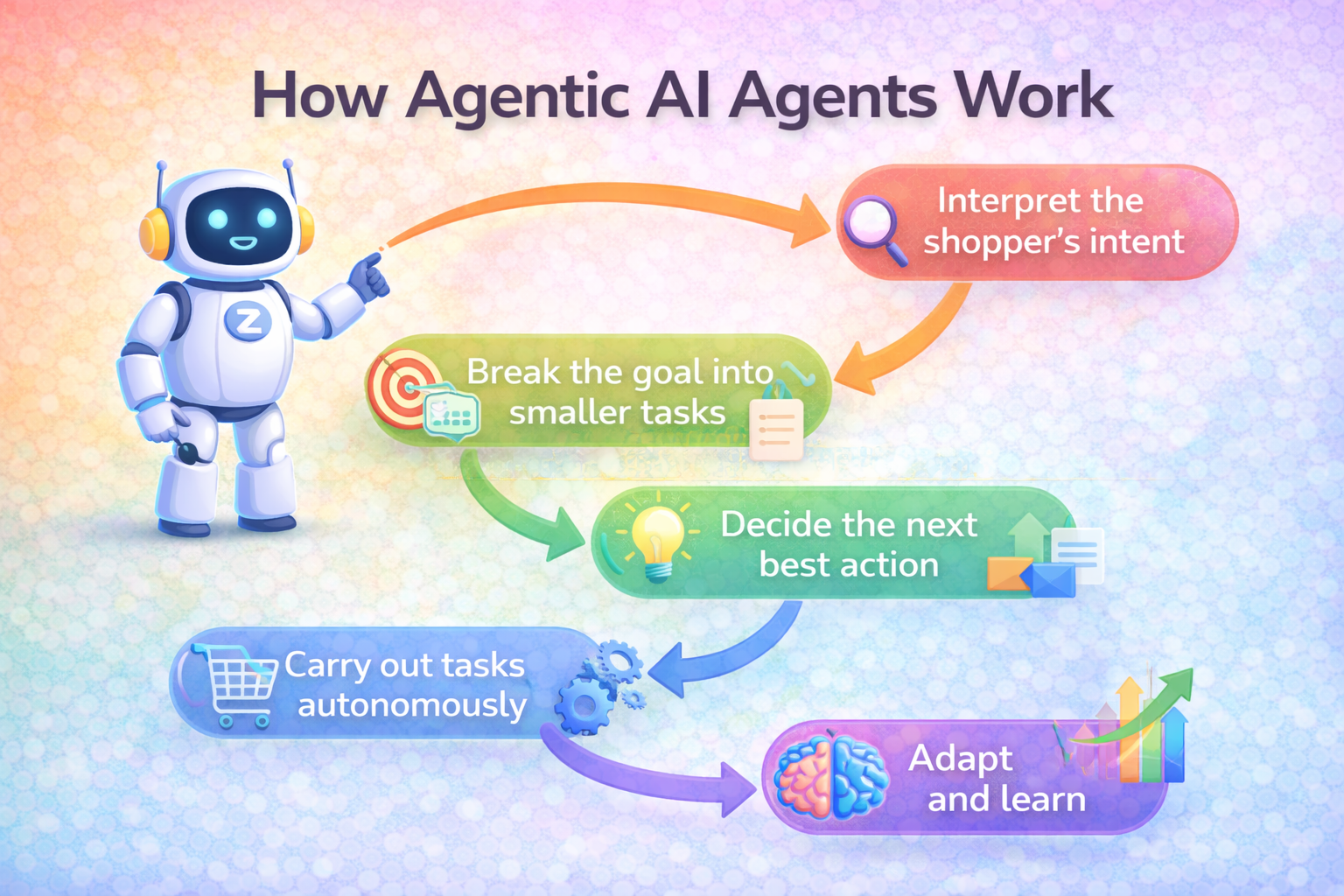
Here’s a simple, high-level breakdown of how the process works:
- Interpret the shopper’s intent
The agent analyzes signals like messages, browsing behavior, cart activity, and past interactions to understand what the shopper is trying to accomplish, not just what they typed. - Break the goal into smaller tasks
Once the intent is clear, the consumer agent decomposes the goal into actionable steps, such as product discovery, comparison, validation, or checkout assistance. - Decide the next best action
Using context and reasoning, the agent evaluates available options and chooses the action most likely to move the shopper forward, such as recommending a product, answering a sizing question, or offering reassurance. - Carry out tasks autonomously
The agent executes autonomous decisions, from responding with personalized recommendations to guiding checkout or triggering follow-ups, without requiring constant human intervention. - Adapt and learn
Over time, the agent learns from outcomes and feedback, refining its decisions to become more accurate and relevant, which ensures consistency with every interaction.
This step-by-step loop is what allows agentic AI agents to deliver proactive, end-to-end shopping assistance instead of isolated responses, making them a core building block of agentic commerce.
How AI-Powered Agentic Commerce Improves the Customer Journey
Agentic commerce transforms the customer journey by removing friction at every stage and replacing reactive support with intelligent, goal-driven assistance. Instead of forcing shoppers to navigate the buying process alone, agentic AI agents stay with them from first interaction to post-purchase support, anticipating needs and taking action in real time.
At the discovery stage, agents guide product exploration by answering questions, clarifying sizing or compatibility, and narrowing options based on consumer intent and behavior. During checkout, they step in to resolve hesitation, explain pricing or shipping details, and recover abandoned carts before shoppers drop off. After purchase, the same agents handle order updates, returns, and common support requests without delays or handoffs. This end-to-end execution is what allows agentic commerce to feel seamless rather than fragmented.
Because agentic AI agents operate independently across channels, web, chat, messaging, and support portals, they deliver consistent, real-time assistance wherever the shopper engages. This approach aligns closely with the principles of proactive customer support, where help appears before frustration sets in. The result is a smoother consumer experience, higher conversion rates, stronger retention, and a customer journey that feels guided instead of interrupted.
Benefits of Agentic Commerce for Ecommerce Brands
Agentic commerce isn’t just a better way to support shoppers; it’s a structural upgrade to how ecommerce brands drive revenue, efficiency, and customer loyalty. By allowing AI agents to act autonomously across the buying journey, brands unlock measurable gains at every stage of growth.
- Reduced cart abandonment
Agentic AI agents intervene at the moment hesitation appears, answering questions about pricing, shipping, or fit before shoppers leave. This real-time intervention helps reduce cart abandonment by resolving uncertainty when intent is highest. - Increased conversion rates and AOV
By guiding product discovery and recommending relevant add-ons or upgrades, agentic agents influence purchasing decisions in context. This leads to higher conversion rates and an increase in average order value without relying on aggressive promotions. - Improved personalization at scale
Agentic commerce adapts in real time based on shopper behavior, cart contents, and purchase history. Instead of generic experiences, every interaction feels tailored without requiring manual segmentation or complex rule-building. - Reduced manual workload for teams
AI agents handle repetitive, high-volume tasks like product questions, order status updates, and basic troubleshooting. This frees human teams to focus on complex issues, strategic initiatives, and high-value customer relationships. - Improved customer satisfaction and trust
Faster responses, consistent answers, and proactive help create smoother experiences. When shoppers get what they need instantly, satisfaction rises, and so does long-term loyalty.
For ecommerce brands, the real advantage of agentic commerce is compound impact: higher revenue, lower operational costs, fraud detection, secure transactions, and better customer experiences, all driven by autonomous, intelligent systems working behind the scenes.
Agentic Commerce Use Cases
Agentic commerce comes to life through practical, everyday actions, which enable agents operate independently across the ecommerce journey. Instead of waiting for instructions, these agents observe intent, decide what to do next, and complete tasks end to end. Below are the most common and impactful agentic commerce use cases in modern ecommerce.
Product discovery
Agentic AI agents actively guide shoppers as they explore a store. When a visitor browses categories, product descriptions, or lingers on specific pages, the agent interprets intent and asks clarifying questions to narrow options.
What the agent does:
It asks about preferences like size, budget, use case, or style, then dynamically adjusts recommendations as the shopper responds.
Real-life example:
A shopper browsing running shoes is asked whether they need shoes for trail or road running. Based on the answer, the agent displays only relevant products instead of forcing the shopper to search manually.
Product recommendations
Beyond discovery, agentic agents continuously refine recommendations based on behavior, cart contents, and past purchases. These suggestions adapt in real time as intent evolves.
What the agent does:
It analyzes context, identifies complementary or higher-fit products, and recommends them at the right moment.
Real-life example:
When a customer adds a camera to their cart, the agent suggests a compatible lens and memory card, adjusting recommendations if the shopper removes or swaps items.
Customer support and issue resolution
Agentic AI agents resolve common support issues without creating tickets or waiting for human agents. They diagnose problems, retrieve relevant data, and complete actions autonomously.
What the agent does:
It answers questions, checks order status, initiates returns, updates shipping details, or escalates issues only when necessary.
Real-life example:
A customer asks, “Where is my order?” The agent pulls tracking information, explains the delivery delay, and updates the expected arrival date without human involvement.
Post-purchase guidance
Agentic commerce doesn’t stop after checkout. AI agents continue assisting customers with onboarding, usage, and follow-up questions.
What the agent does:
It provides setup instructions, usage tips, warranty details, and follow-up recommendations based on the purchased product.
Real-life example:
After buying a smart thermostat, a customer receives step-by-step setup guidance and maintenance tips, along with reminders for software updates or accessories.
These use cases show how agentic commerce shifts ecommerce from reactive interactions to autonomous, task-driven experiences, where AI agents handle work continuously, not just when a shopper asks for help.
The Future of Ecommerce Is Agentic
Agentic commerce represents the next evolution of ecommerce, one where autonomous AI agents don’t just assist shoppers but actively move them forward. By operating across different channels, completing tasks end to end, and adapting in real time, agentic AI reduces friction, raises conversions, and delivers the kind of experiences modern shoppers expect.
As buying journeys grow more complex and expectations keep rising, reactive tools fall short. Agentic commerce fills that gap by combining intelligence, autonomy, and action. Platforms like Zipchat AI are already laying the groundwork for this shift, powering proactive assistance and task-driven interactions that scale without sacrificing experience. Try Zipchat free today.
Want to see the foundation of agentic experiences? Explore what conversational commerce is.
FAQ
What is agentic commerce?
Agentic commerce is an ecommerce model where autonomous AI agents guide, assist, and complete shopping tasks on behalf of customers. These agents interpret intent, make decisions, and act across the entire consumer journey, from discovery to post-purchase, without needing constant human input.
What best describes agentic commerce?
Agentic commerce is proactive, goal-driven, and autonomous. Instead of reacting to questions, AI agents independently decide what actions to take next, handle multi-step tasks, and continuously adapt to shopper behavior to reduce friction and move purchases forward.
How does agentic commerce work?
Agentic commerce works by using AI agents that interpret shopper intent, break goals into tasks, choose the best next action, and execute those actions autonomously. Over time, these agents learn from outcomes, improving recommendations, assistance, and decision-making across channels.



Try Zipchat for free