Try Zipchat in Action!
Enter your store URL to see how Zipchat would behave.


Ecommerce Retention Rate: What It Is, How To Calculate It & Benchmarks
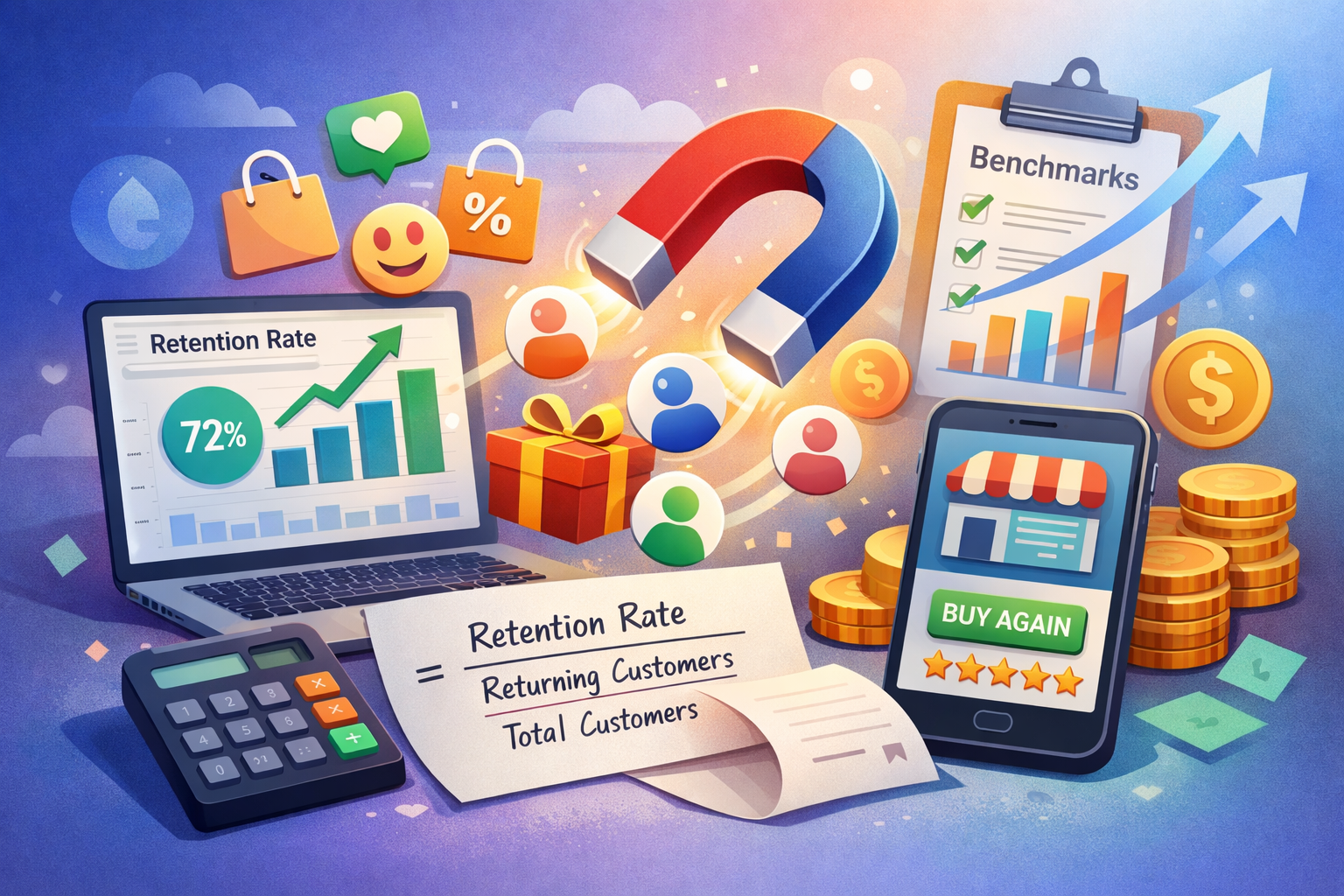
"If your retention is poor, then nothing else matters" - Brian Balfour.
Getting traffic to your store is hard, but getting shoppers to come back is even harder. That’s where real growth happens. Repeat customers tend to spend more over time, cost less to market to, and are far more likely to recommend your brand to others.
In ecommerce, retention isn’t just a nice bonus; it’s a major driver of long-term profitability. This is where ecommerce retention rate comes in. Your retention rate shows how well your store turns first-time buyers into repeat customers over a specific period.
It also helps you understand whether people see enough value in your products, experience, and brand to come back again. A good customer retention rate often signals strong customer trust, while a declining one can point to issues with pricing, product fit, or the post-purchase experience.
In this guide, we’ll break down what the average ecommerce retention rate means, how to calculate it correctly, and what realistic benchmarks look like across industries. You’ll also learn why extremely high retention rates are rare, and how even small improvements in retention can have a big impact on revenue, margins, and long-term growth, especially when paired with tools like Zipchat that help brands understand, support, and re-engage customers at key moments in their journey.
Key Takeaways
- Ecommerce retention rate measures how many customers return to buy again within a set time period
- Strong retention improves revenue stability and reduces reliance on paid acquisition
- Retention rate is calculated using a simple formula based on starting, ending, and new customers
- Benchmarks vary by industry, product type, and purchase frequency
- Extremely high retention rates are uncommon and should always be viewed in context
- Improving retention boosts customer lifetime value and lowers customer acquisition costs over time
What Is Ecommerce Retention Rate?
Ecommerce retention rate is about the number of customers who return to purchase in your store within a specified amount of time. In layman’s terms, it tells you how good your business is at retaining existing customers after they’ve made their first purchase.
The average retention rate is invariably linked to a specified window, typically 30 days, 90 days, or a year. What a “good” retention rate is will vary based on your industry, product type, and price point. In general, most ecommerce brands experience retention rates of between 20% and 40%; anything reliably higher than that is good for the industry.
Why Customer Retention Rate Matters and How It Affects Customer Lifetime value
Retention rate is important because it costs less and is easier to serve an existing customer than find a new one. And once customers come back, you don’t have to keep spending money to reacquire them with ads or promotions. That stability results in predictable revenue and better profit margins over the long term.
Customer lifetime value is also directly affected by retention. Customers who return spend more, trust your brand, and refer it to others. Over time, this creates a flywheel where loyalty is the differentiator between growth in spend versus continuous acquisition spend.
How To Calculate Ecommerce Business Retention Rate
Ecommerce retention rate is calculated by comparing how many customers you keep during a time period against how many you had at the start.
Here’s the standard formula used to calculate customer retention rate:
Ecommerce Retention Rate (%)
(Customers at end of period−New customers acquired)÷Customers at start of period X 100
Example:
If you start the month with 1,000 customers, gain 300 new customers, and end with 900 total customers, your retention rate would be:
(900 − 300) ÷ 1,000 × 100 = 60%
This means 60% of your original customers stayed active during that period.
Ecommerce Retention Rate Benchmarks
Ecommerce customer retention rates vary widely by industry, which is why context matters more than chasing a single “perfect” number.
- Fashion & Apparel: Often ranges from 20% to 30%. Trends change fast, and shoppers like to explore new brands.
- Beauty & Personal Care: Commonly falls between 30% and 40%, driven by repeat needs and replenishment cycles.
- Food & Beverage: Can reach 40% or higher, especially for subscription-based or consumable products.
As a general rule, an average customer retention rate below 20% may signal issues with product fit, pricing, or customer experience. Rates above 40% are strong but uncommon, and usually reflect exceptional customer loyalty, habit-based buying, or subscription-based business models.
Why Extremely High Ecommerce Retention Rates Are Uncommon
Most ecommerce stores struggle to hold onto buyers for long. A big number never returns after one purchase. Choices flood the market, making loyalty tough to build. When prices shift, people notice fast. New deals elsewhere pull attention away easily. Tastes change without warning, which affects repeat visits.
Sticking with one brand feels less common every year. What you sell matters too. Items bought just once tend to stick around less in customers’ minds compared to things people need again and again. Then there is what shoppers expect these days, which keeps climbing. Faster shipping, better support, and smoother experiences are now the baseline, not bonuses.
This is why retention rates should always be viewed in context. A “lower” rate doesn’t always mean poor performance. It needs to be assessed alongside revenue, margins, and growth trends.
Customer Retention Strategies and Retention Metrics
Customer retention strategies work best when the right metrics guide them. Retention rate, repeat purchase rate, and Customer Lifetime Value (CLV) show whether your efforts are actually keeping loyal customers around. Without tracking these numbers, it’s easy to invest in tactics that feel productive but don’t move the needle. Metrics help teams understand what’s working, what’s stalling, and where customers are quietly dropping off.
When strategies and metrics are reviewed together, patterns become clearer. For example, a rising retention rate paired with a higher average order value often signals stronger customer satisfaction. On the other hand, stable sales with falling retention may point to overreliance on new customer acquisition. By linking retention strategies directly to measurable outcomes, ecommerce teams can make smarter decisions and build long-term growth that’s sustainable, not reactive.
The Impact of Improving Customer Retention Rates
Tiny gains in holding onto customers add up fast. Because returning shoppers mean fewer ad dollars spent, which lowers your customer acquisition cost. Repeat buyers also tend to spend more per order, increasing your average order value over time.
Higher retention also boosts customer lifetime value and makes revenue more predictable. Instead of constantly chasing new buyers, you build a stable base that supports healthier margins and long-term growth.
Conclusion
First visits that turn into regular stops, that’s what ecommerce retention measures. Over months, some shoppers return; others vanish. Watching who stays paints a picture of trust built slowly. Money flows more predictably when people come back without being chased.
Performance isn’t just about spikes, but steady returns. Loyalty hides in those numbers, quiet but clear. Keeping an eye on how many customers return helps online stores spend less, earn more over time, because better experiences keep people coming back.
Progress matters more than hitting ideal targets since small, smart choices add up through consistent effort. Want to improve retention? Explore proven customer retention strategies for ecommerce growth here.
FAQ
1. What is ecommerce retention rate?
Ecommerce retention rate measures the percentage of customers who return to make another purchase within a specific time period. It shows how well an online store keeps customers engaged after their first order and is a key indicator of loyalty and long-term growth.
2. What is a good retention rate for eCommerce?
A good ecommerce customer retention rate depends on the industry and product type. Most stores fall between 20% and 40%. Rates above 40% are strong but uncommon, while rates below 20% may signal issues with product value or customer experience.
3. How do you calculate ecommerce retention rate?
To calculate ecommerce retention rate, subtract new customers from the total customers at the end of a period, divide by the number of customers at the start, and multiply by 100. This shows the percentage of existing customers who stayed active.