Running a Shopify store has never been more expensive or unforgiving. Ad costs keep rising, margins keep tightening, and wasted traffic hits hard. Yet many brands still pour budget into acquisition and expect the site to convert on autopilot. Too often, it does not.
Conversion rate optimization (CRO) fixes this by reducing friction, building trust, and guiding shoppers to confident decisions. Targeted improvements can lift conversion meaningfully from the same traffic, without raising ad spend.
This article breaks down 7 proven conversion rate optimization use cases that every Shopify brand should use to turn more visitors into buyers.
This is a guest contribution from the OptiMonk team, with two AI-chat use cases added by Zipchat. OptiMonk and Zipchat are partners, not the same product.
The short version
Conversion rate optimization is the practice of turning more existing visitors into buyers by removing friction at decision points. It matters because ad costs are rising and every visitor is now more expensive. This guide covers 7 use cases: multi-step popups, free shipping thresholds, no-discount cart recovery, proactive recommendations, sales-page product pages, AI chat, and AI product questions.
What is conversion rate optimization for Shopify brands?
Conversion rate optimization is the structured practice of increasing the share of visitors who complete a purchase. It works by reducing uncertainty at the moments where buying decisions break down, instead of buying more traffic to compensate for a leaky funnel.
For Shopify brands, the math is simple. You already pay for the traffic. CRO captures more revenue from that same spend by closing the gap between intent and action.
Why CRO matters more than ever for Shopify brands
Running a Shopify store has become more expensive and far less forgiving. Advertising costs are rising. Margins are tighter. Wasted traffic is no longer sustainable.
Yet most Shopify brands still prioritize acquisition over conversion. Budgets and teams are built around driving traffic, while the on-site experience is expected to work by default. In reality, many stores look fine on the surface but fail to support real buying decisions.
High-intent visitors often arrive on product pages that do not clearly communicate value, differentiation, or reassurance. When conversion drops, traffic quality gets the blame, even though the real issue lies in what happens after the click.
Modern ad platforms like Google, Meta, and TikTok amplify this. They deliver intent rather than volume. Visitors arrive with expectations already formed. When everyone sees the same generic experience, most are forced to figure things out alone and leave.
CRO exists to close this gap. It reduces uncertainty at key moments in the buying journey, without increasing ad spend. In an environment defined by rising costs and shrinking margins, it has become one of the most reliable growth levers available.
How much can CRO actually lift conversion?
Realistic gains depend on the tactic, and most published figures come from vendors, so treat them as directional ranges rather than guarantees. Across commonly cited CRO data, exit-intent and popup tactics tend to lift around 5 to 10% on affected sessions, social proof around 3 to 5%, and personalization around 5 to 15%, with results varying widely by store and audience [NEEDS VERIFICATION].
Two framing points keep expectations honest. First, most A/B tests do not win: typical win rates land around 10 to 30%, and reliable results need hundreds of conversions per variant [NEEDS VERIFICATION]. Second, gains compound. Several modest wins stacked across the funnel usually beat the hunt for one big jump.
The takeaway is to run many small, well-targeted tests and keep the ones that move the metric. That is how the 7 use cases below are meant to be used.
The 7 best CRO use cases for Shopify brands
As traffic costs rise, these seven CRO use cases address the exact points where Shopify buying decisions break down.
List building remains one of the highest-leverage growth activities for Shopify brands. Turning first-time visitors into email or SMS subscribers creates a second chance to convert traffic that does not buy on the first session.
Popups are still one of the most effective tools for this, but the classic one-step “10% off” popup has lost much of its impact. Most visitors have seen the same offer dozens of times and learned to ignore it or close it automatically.
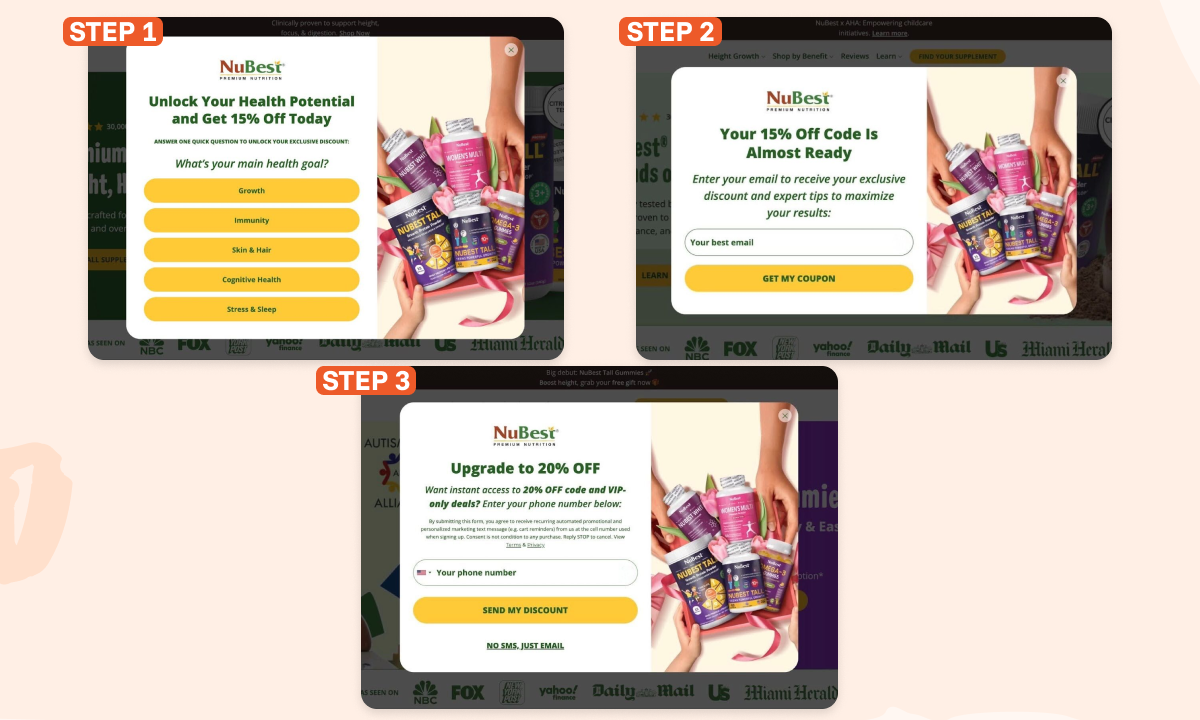
Multi-step popups perform better because they reverse the usual order of commitment. Instead of asking for an email address immediately, they start with a low-effort interaction, such as a simple question or a value-based hook. Once the visitor engages, the incentive is revealed and the subscription feels like a continuation rather than a decision.
This structure lowers initial resistance and makes the offer feel more relevant by the time it appears. When the email or phone number is requested, the visitor is already engaged, which consistently leads to higher signup rates compared to single-step discount popups.
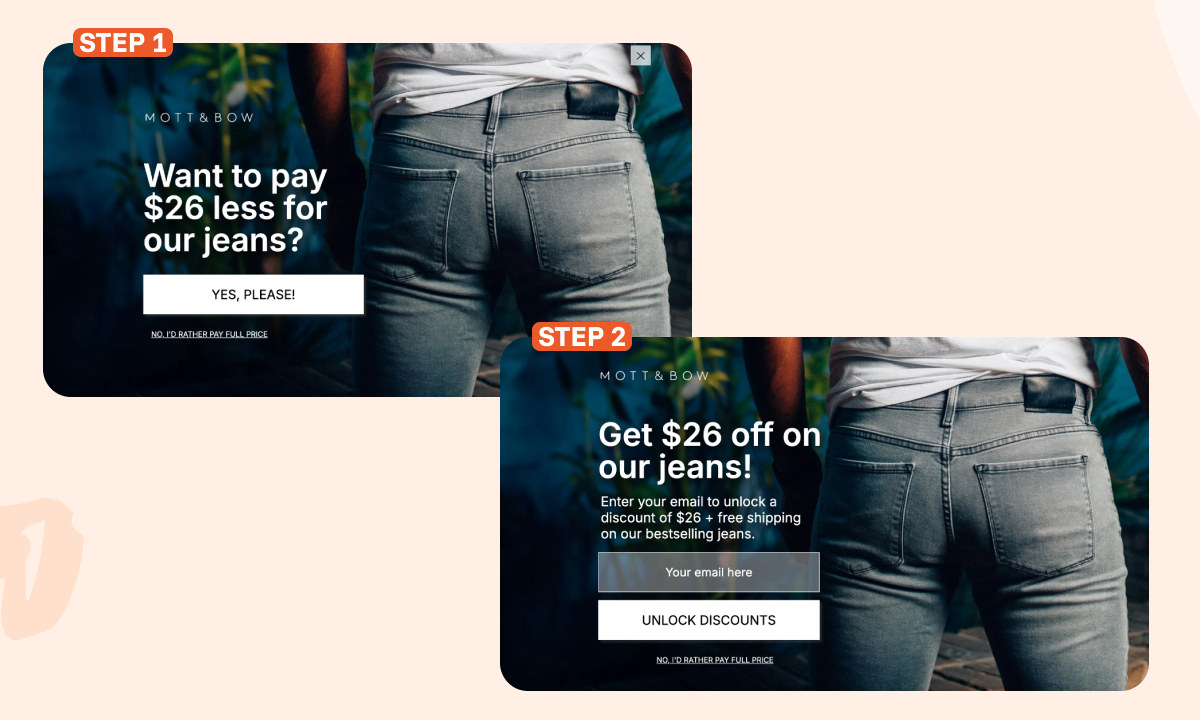
At the same time, the early interaction creates momentum through a series of small “yes” moments instead of forcing an instant discount decision.
If that first step also includes a segmentation question, it adds long-term value by making future email or SMS campaigns more relevant and better targeted.
Unexpected shipping costs remain one of the most common reasons for cart abandonment. When shoppers reach checkout and discover additional fees, many leave, even if they were already close to completing the purchase.
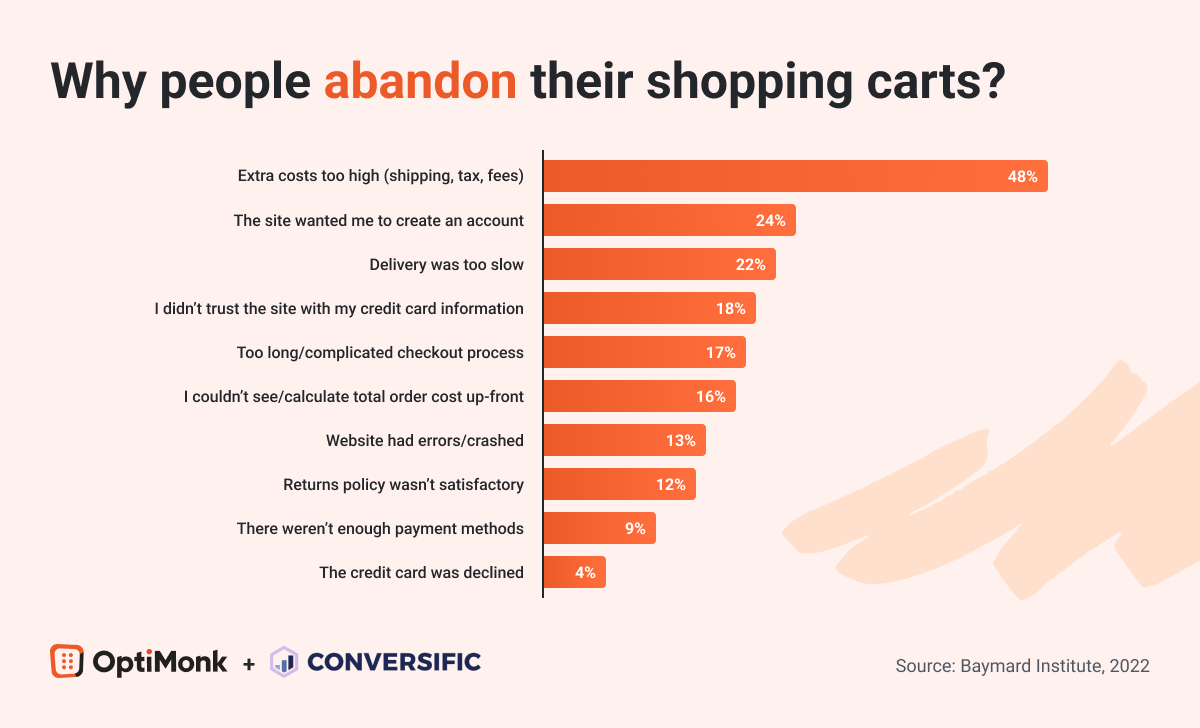
A free shipping threshold reduces this friction by setting a clear expectation early in the journey. Instead of surprising customers at checkout, it gives them a concrete target to work toward while browsing.
Dynamic free shipping bars are particularly effective because they respond to cart behavior in real time. As items are added, the message updates to show how close the shopper is to free shipping. This creates a sense of progress and urgency without relying on discounts.
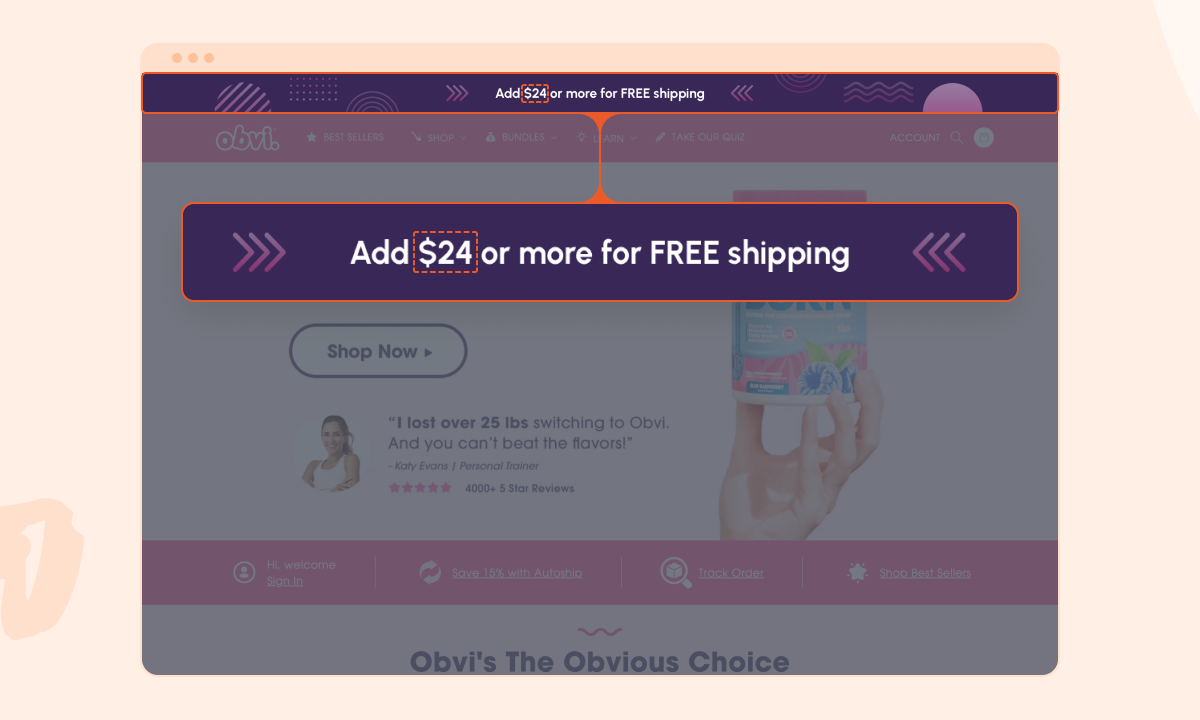
By encouraging shoppers to add one more item to qualify for free shipping, brands can reduce abandonment and increase average order value naturally, without eroding margins. The incentive is tied to progress in the cart rather than discounting products, which feels more natural to shoppers.
3. Recover cart abandoners without discounting
Most cart recovery tactics rely on discounts. While this can bring shoppers back in the short term, it consistently erodes margins and teaches customers to abandon their carts to get a better deal.
Over time, this conditioning becomes expensive. Shoppers learn that hesitation is rewarded, and full-price purchases become harder to sustain. What starts as a recovery tactic slowly turns into a pricing problem.
There is a more effective approach that recovers revenue without training customers to wait for coupons. Instead of offering an incentive, the goal is to remove the reason the shopper hesitated in the first place.
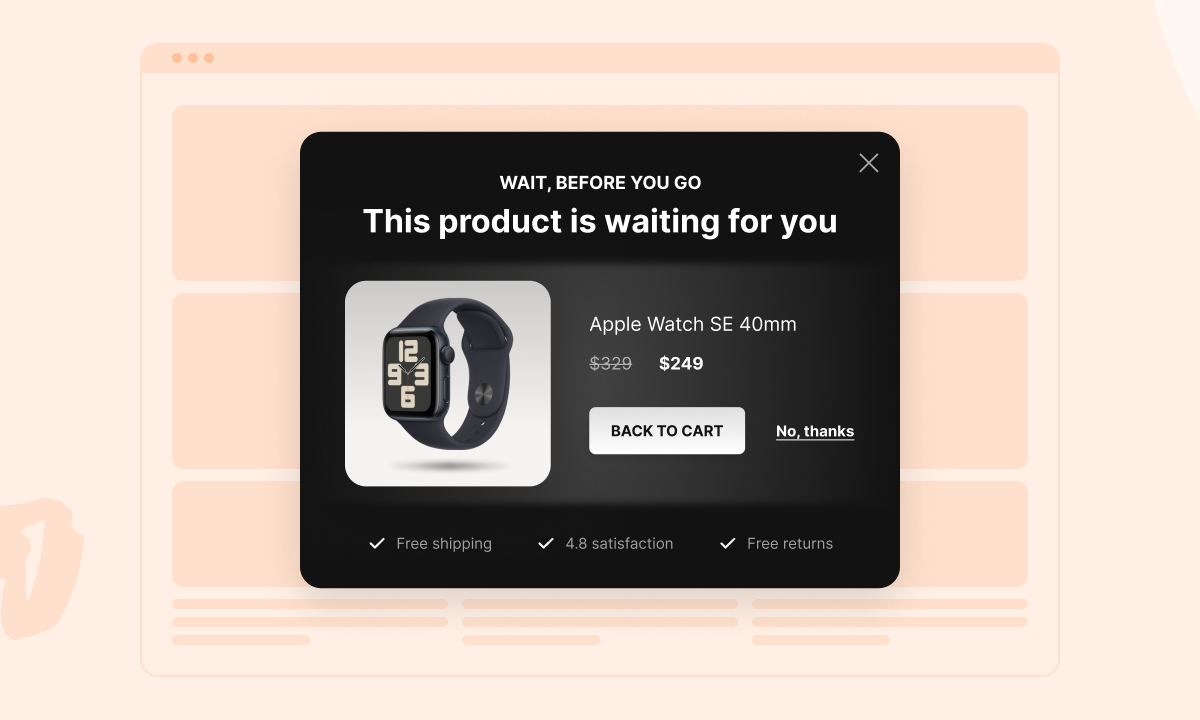
Exit-intent reminders work best when they focus on reassurance rather than discounts, at the exact moment hesitation appears. By reminding shoppers of the items they are about to leave behind and addressing common points of hesitation (delivery costs, return policies, or trust signals), brands can reduce abandonment at the moment doubt surfaces.
This approach preserves margin, supports confident decision-making, and converts hesitant shoppers without undermining long-term pricing discipline.
4. Increase AOV with proactive, relevant product recommendations
Many shoppers leave product pages because the item is not a perfect fit. This does not mean they are uninterested. It often means they have not been shown a better alternative quickly enough.
Traditional “related products” sections are largely passive. They sit below the fold, compete with page content, and are easy to ignore. As a result, they rarely intercept the moment when a shopper starts reconsidering their choice.
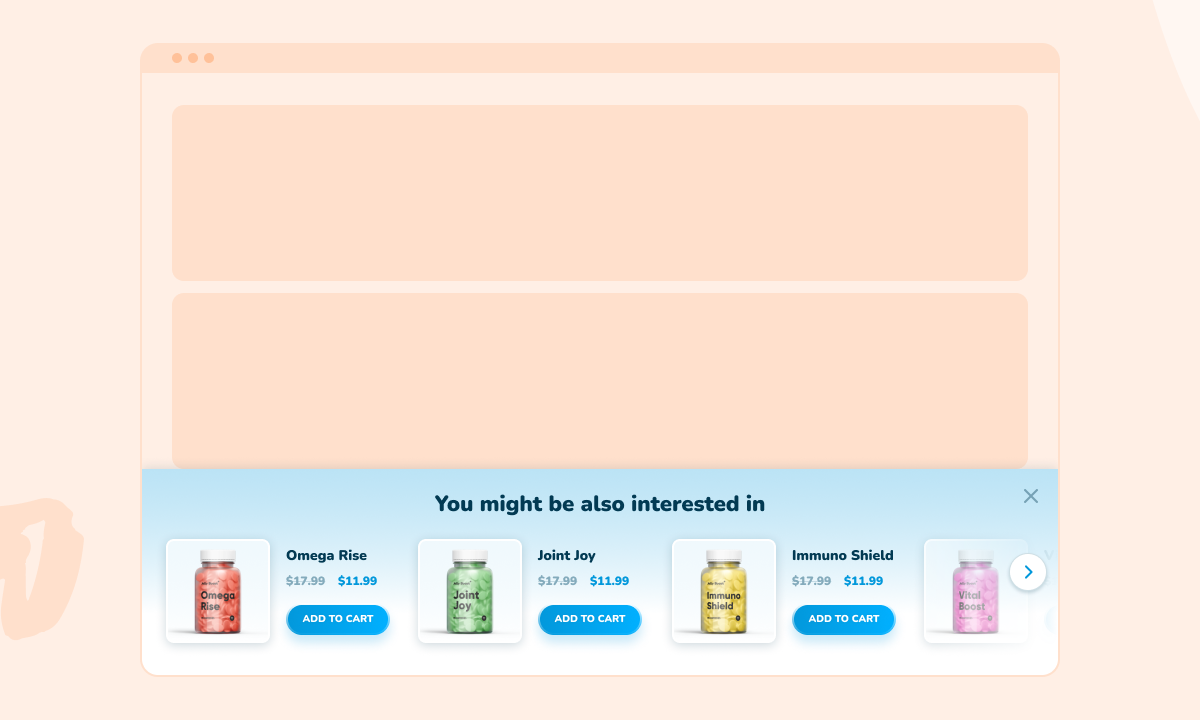
A proactive recommendation sticky bar solves this by keeping relevant alternatives visible as the shopper scrolls. Instead of waiting for users to look for options, it gently surfaces products they are more likely to want based on the current context.
Because these recommendations appear as guidance rather than promotion, they feel helpful rather than pushy. Shoppers stay engaged, discover better-fitting products, and are more likely to add items to their cart.
This increases average order value naturally, without forcing bundles or relying on discounts, by helping shoppers make better decisions instead of pressuring them into larger purchases.
5. Turn product pages into high-converting sales pages
In the era of Google Performance Max and dynamic ads, shoppers often land directly on product pages. For many visitors, the product page is the first and only impression of the brand.
Yet most Shopify product pages are still built around templates that prioritize features and specifications over benefits. They explain what the product is, but not clearly enough why it matters or who it is for. High-intent traffic arrives and leaves without enough context to make a confident decision.
High-converting product pages behave more like sales pages:
- They lead with a clear, benefit-driven headline.
- They follow with a short, compelling description that frames the product in terms of outcomes rather than features.
- Key benefits are easy to scan.
- Visual proof supports the claims, and high-quality images help shoppers imagine using the product.
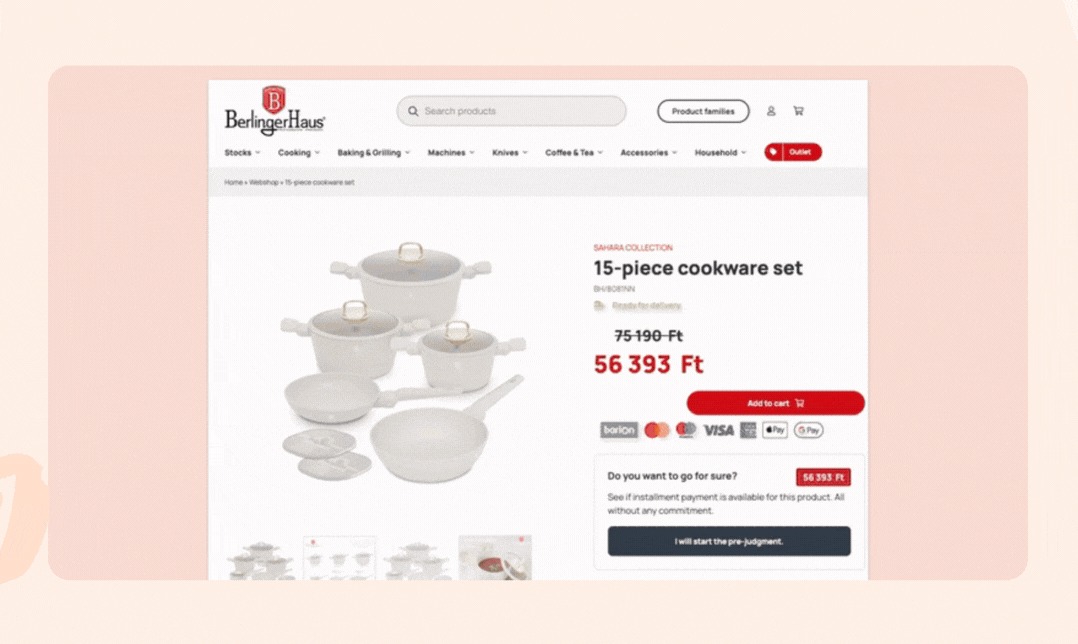
Manually optimizing hundreds of product pages is a time-consuming and complex task. With OptiMonk’s AI Product Page Optimization, you can improve your product pages by automatically generating high-converting visuals and copy, tailored to each product.
AI can create engaging headlines, highlight product benefits, and visualize products in relevant scenarios, helping shoppers picture the product and increasing visual relevance.
6. Use AI chat to answer objections before they cause an exit
AI chat is a CRO lever because it resolves the hesitation that static pages cannot, in real time, on the session that would otherwise bounce. When a shopper has a question about fit, shipping, materials, or use case, a fast accurate answer keeps the decision moving instead of sending them to a search tab.
Most on-site chat still relies on canned flows or slow human queues. Neither matches the moment a high-intent visitor stalls. A conversational AI agent that knows the catalog can answer instantly, in the shopper’s language, at any hour.
This is where Zipchat fits alongside the OptiMonk tactics above. Zipchat’s AI agent runs across website chat, WhatsApp, Instagram, Messenger, and email, supports any language, and can act through Agentic Skills rather than only reply. It engages proactively when behavior signals hesitation, the same principle behind exit-intent reminders, applied to live conversation.
Zipchat reports a 16.3% chat-to-conversion rate and a +37.8% conversion lift for merchants using its agent (Zipchat first-party data, 2026). Because Zipchat has its own pixel, it attributes the chat-to-checkout path and the downstream revenue, so the lift is measurable rather than assumed. Plans start from $64/month, billed annually, with a 7-day trial and a 30-day money-back guarantee, and there is no free plan.
Treat AI chat the way you treat any other CRO use case here: run it, measure the lift against a holdout, and keep it if it moves the metric.
7. Answer product questions on the page with AI
AI product questions resolve the specific doubts that stop a purchase, directly on the product page, before the shopper has to leave to find an answer. Sizing, compatibility, ingredients, delivery windows: these are the questions that quietly kill conversion when a page leaves them unanswered.
This pairs naturally with use case 5. A sales-page product page sets up the decision. AI product questions on that same page close the remaining gap by handling the long tail of specific concerns no static template can predict.
Zipchat’s AI product questions (AI PDP questions) sit on the product page and answer in context, drawing on the live catalog so responses match real availability and product detail. Agentic AI Search lets shoppers find the right product by describing what they want, and proactive engagement surfaces help at the moment a shopper stalls. Human escalation stays under 3%, so most questions resolve without a support handoff (Zipchat first-party data, 2026).
The CRO logic mirrors the proactive recommendation bar in use case 4: meet the shopper where the decision happens, with relevant help, instead of waiting for them to hunt for it.
CRO use cases compared
Each use case targets a different friction point. Use this to match a tactic to the problem you actually have.
| Use case | Friction it removes | Funnel stage | Discount required |
|---|
| Multi-step popups | Low list capture from first visit | Top of funnel | No |
| Free shipping threshold | Surprise shipping costs at checkout | Cart | No |
| No-discount cart recovery | Hesitation and abandonment | Cart / exit | No |
| Proactive recommendations | Poor product fit | Product page | No |
| Sales-page product pages | Weak value communication | Product page | No |
| AI chat | Unanswered objections mid-session | All stages | No |
| AI product questions | Specific product doubts | Product page | No |
When CRO tactics fail
CRO does not work when the underlying offer, product, or traffic is broken. No popup or chat agent fixes a product the market does not want, or paid traffic that targets the wrong intent. Fix the offer and targeting first.
These tactics also fail on low traffic. Reliable A/B testing needs hundreds of conversions per variant, so very small stores should ship sensible defaults rather than chase statistical significance they cannot reach [NEEDS VERIFICATION].
Overuse backfires too. Stacking aggressive popups, bars, and prompts on every page creates friction instead of removing it. Each intervention should earn its place by clearing a specific, observed obstacle, then prove itself against a holdout.
Where CRO is heading in 2026 and beyond
CRO is shifting from static, scheduled interventions toward real-time, AI-driven assistance. Popups and bars still work, but they fire on rules. Conversational AI responds to the actual question a shopper has, in the moment they have it.
Measurement is changing alongside it. With browser and platform tracking restrictions tightening, first-party attribution matters more. Tools with their own pixel can attribute outcomes the ad platforms now miss, which makes incremental lift, measured against holdouts, the credible standard rather than vendor headline numbers.
The brands that win will treat acquisition and on-site conversion as one system, and let AI handle the high-volume, repetitive decision support that humans cannot scale.
Wrapping up
As traffic becomes more expensive and less forgiving, Shopify growth is no longer about adding more tools or driving more visitors. It is about making better use of the traffic already arriving.
The most effective CRO strategies remove friction at key decision points, support confident choices, and align the on-site experience with the intent created before the click. Whether it is list building, cart recovery, recommendations, product page optimization, or AI-led conversation, small, well-timed interventions consistently outperform broad, discount-driven tactics.
This is also where AI becomes most useful, not as a replacement for strategy, but as a way to execute proven CRO patterns faster and more consistently.
Most of the CRO use cases above can be implemented with OptiMonk. To explore them in practice, get started with OptiMonk’s AI Wizard, which generates conversion-focused, on-brand CRO campaigns based on your goals and context. For the AI-chat use cases, Zipchat adds the conversational layer that answers objections and product questions in real time.
Frequently asked questions
What is a good conversion rate for a Shopify store?
Most Shopify stores convert somewhere in the low single digits, and a healthy benchmark sits around 2 to 4% depending on category, price point, and traffic source [NEEDS VERIFICATION]. Rather than chase a universal number, compare your rate against your own baseline and lift it with targeted CRO tests on your highest-traffic pages.
Does CRO require offering discounts?
No. Discount-free tactics often outperform coupons over time. Free shipping thresholds, exit-intent reassurance, proactive recommendations, and AI chat all lift conversion by removing friction and answering objections, not by cutting price. Discounts can recover a sale short term but train shoppers to wait, eroding margin and full-price demand.
How does AI chat improve conversion rate?
AI chat improves conversion by resolving shopper objections in real time, on the session that would otherwise bounce. It answers questions about fit, shipping, and use case instantly, engages proactively when behavior signals hesitation, and works across channels. Zipchat reports a 16.3% chat-to-conversion rate and attributes the revenue through its own pixel (Zipchat first-party data, 2026).
How many CRO tests should I run at once?
Run as many small, isolated tests as your traffic supports, since reliable results need hundreds of conversions per variant. Most tests do not win, with typical win rates around 10 to 30%, so volume and iteration matter more than any single big bet [NEEDS VERIFICATION]. Keep the changes that move your metric and retire the rest.
Can OptiMonk and Zipchat be used together?
Yes. They solve different parts of the same funnel. OptiMonk handles popups, free shipping bars, recommendation widgets, and AI product page optimization. Zipchat adds the conversational layer: AI chat and AI product questions that answer objections in real time. Used together, they cover both scheduled interventions and live decision support.